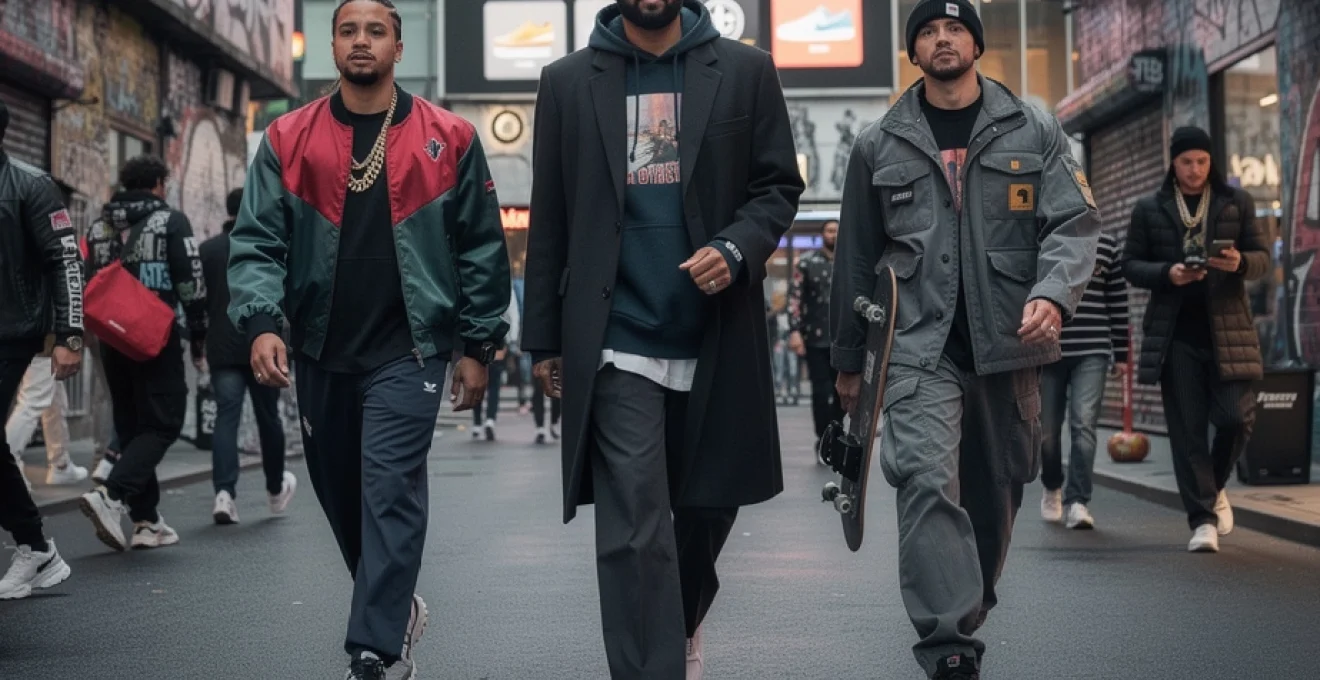
The intersection of street culture and contemporary menswear represents one of the most significant fashion revolutions of the past five decades. What began as underground expressions of urban creativity has fundamentally transformed how modern men dress, challenging traditional boundaries between high fashion and everyday attire. Street culture’s influence permeates every aspect of today’s masculine fashion landscape, from the oversized silhouettes gracing luxury runways to the technical fabrics engineered for urban functionality.
This cultural shift extends far beyond mere aesthetic choices, encompassing a complete reimagining of fashion’s social hierarchy. Street culture has democratised fashion, creating new pathways for creative expression that bypass traditional gatekeepers. The result is a dynamic ecosystem where underground movements can influence global brands overnight, whilst luxury houses actively seek inspiration from the very communities they once overlooked.
Historical evolution of streetwear aesthetics in contemporary menswear
The transformation of streetwear from subcultural uniform to mainstream fashion staple represents a fascinating study in cultural evolution. Beginning in the late 1970s, various urban movements began developing distinct visual languages that would eventually reshape the entire fashion industry. These early adopters weren’t simply following trends; they were creating entirely new forms of sartorial communication that spoke to experiences largely ignored by traditional fashion establishments.
Hip-hop culture’s sartorial legacy: from Run-DMC to Off-White collaborations
Hip-hop culture’s impact on contemporary menswear cannot be overstated, having fundamentally altered how masculinity is expressed through clothing. The movement’s early pioneers understood fashion as a form of cultural resistance, using oversized silhouettes and bold branding to challenge conservative dress codes. Run-DMC’s iconic partnership with Adidas in the 1980s established the template for music-fashion collaborations that continues to influence brand strategies today.
The evolution from those early partnerships to today’s high-fashion collaborations reveals how thoroughly hip-hop aesthetics have permeated luxury fashion. Contemporary designers regularly reference hip-hop’s visual vocabulary, from the deconstructed tailoring popularised by early rap videos to the logo-heavy designs that dominated the 1990s scene. This influence extends beyond surface-level appropriation, fundamentally changing how luxury brands approach masculinity and urban authenticity.
Skateboarding subculture integration: vans, supreme, and technical fabrication
Skateboarding’s contribution to modern menswear lies primarily in its emphasis on functionality and durability. The subculture’s practical needs drove innovations in fabric technology and garment construction that have since become standard across the fashion industry. Brands like Vans pioneered the integration of technical performance features with everyday aesthetics, creating footwear that functions equally well on the street and in the skate park.
Supreme’s rise from niche skateboarding retailer to global fashion powerhouse illustrates how subcultural authenticity can translate into mainstream commercial success. The brand’s limited-release strategy, borrowed from skateboarding’s culture of exclusivity, has been adopted by countless luxury brands seeking to recreate that sense of scarcity and desire. Technical fabrication originally developed for skateboarding now appears in everything from luxury streetwear to traditional suiting.
Graffiti art translation into graphic tee design language
The visual language of graffiti has profoundly influenced contemporary graphic design in menswear, introducing bold typography and layered imagery to mainstream fashion. Graffiti artists’ understanding of space, colour, and composition translated naturally to textile design, creating a new aesthetic vocabulary that challenged traditional notions of refinement. This influence appears not only in obvious graphic tees but also in the subtle details of luxury garments.
Modern designers regularly employ graffiti-inspired techniques such as layering, distressing, and colour blocking to create visual interest in their collections. The movement’s emphasis on individual expression through visual art has encouraged brands to develop more personalised approaches to design, moving away from homogeneous seasonal collections toward pieces that allow for individual interpretation and styling.
Urban workwear appropriation: dickies and carhartt mainstreaming
The appropriation of workwear brands like Dickies and Carhartt into street fashion represents a fascinating example of
how garments designed for manual labour became symbols of authenticity and resistance to fashion elitism. Originally valued for their durability and affordability, these pieces were adopted by skaters, graffiti artists, and hip-hop communities who needed clothing that could withstand daily wear in urban environments. Over time, the clean lines, neutral colour palettes, and boxy silhouettes of workwear translated seamlessly into contemporary menswear, offering a pragmatic alternative to more polished tailoring.
As streetwear gained visibility, designers began to recontextualise these utilitarian garments, elevating them through premium fabrics, refined fits, and subtle branding. Carhartt WIP (Work In Progress) exemplifies this shift, bridging the gap between blue-collar heritage and global street style. Today, chore jackets, double-knee trousers, and heavyweight canvas shirts sit comfortably alongside designer sneakers and luxury outerwear, illustrating how street culture has redefined what constitutes aspirational menswear.
Luxury fashion houses adopting street-level design methodologies
The growing influence of street culture on menswear has forced luxury fashion houses to rethink their design processes from the ground up. Rather than dictating trends from a distance, many brands now observe and respond to street-level style in real time. Capsule drops, limited releases, and collaborative collections mirror the tactics of independent streetwear labels, reflecting a more agile, community-focused approach to design.
This shift is not just aesthetic; it represents a structural change in how collections are conceived, marketed, and distributed. Luxury menswear increasingly borrows the « drop » model from sneaker culture, building anticipation through scarcity and social media storytelling. The result is a feedback loop where the street both inspires and validates luxury, and where the distinction between a runway piece and a « street » piece is often more about context than construction.
Virgil abloh’s deconstructionist approach at louis vuitton men’s
Virgil Abloh’s tenure at Louis Vuitton Men’s marked a turning point in how luxury fashion engages with street culture. Trained as an architect and shaped by Chicago’s DJ and skate scenes, Abloh approached tailoring as something to be deconstructed, remixed, and recontextualised. Classic menswear codes—suits, trench coats, and leather goods—were filtered through a streetwear lens, incorporating bold colour, industrial detailing, and graphic symbols drawn from youth culture.
Abloh’s philosophy of « 3% alteration »—the idea that a small change can completely transform a garment—helped bridge the gap between traditional luxury and everyday wear. His collections often referenced hip-hop, rave culture, and global street scenes, making Louis Vuitton relevant to younger, digitally native consumers. In doing so, he demonstrated that luxury menswear could be both aspirational and grounded in the realities of street style, without resorting to superficial appropriation.
Balenciaga’s oversized silhouette revolution under demna gvasalia
Under Demna Gvasalia, Balenciaga became synonymous with the oversized silhouettes and normcore aesthetics that now define much of contemporary menswear. Drawing inspiration from Eastern European street style, corporate uniforms, and vintage sportswear, Gvasalia exaggerated proportions to blur the line between comfort and couture. Hoodies, parkas, and logo tees—once seen as purely casual—were transformed into statement pieces through scale, fabrication, and styling.
This « anti-fit » approach resonated with a generation seeking clothes that reflect both comfort and cultural commentary. By elevating everyday garments to the runway, Balenciaga challenged the long-held equation of slim tailoring with sophistication. The success of these oversized looks across both high fashion and mass-market retailers shows how strongly street culture has reshaped ideas of masculine silhouette and presence.
Fear of god’s jerry lorenzo: elevated streetwear construction techniques
Jerry Lorenzo’s Fear of God sits at the intersection of streetwear and luxury tailoring, offering a blueprint for elevated casualwear in men’s fashion. Lorenzo borrows from basketball culture, grunge, and 1990s hip-hop, then refines those references through meticulous pattern cutting and high-end fabric selection. Elongated hemlines, dropped shoulders, and layered styling are executed with the precision more commonly associated with Italian suiting than with hoodies and sweatpants.
What sets Fear of God apart is its emphasis on construction as a marker of value rather than loud branding alone. Double-stitched seams, custom hardware, and carefully washed fabrics signal quality to an audience that has grown increasingly discerning. In a market saturated with graphic tees, Lorenzo’s work suggests that the future of men’s streetwear will be defined by craftsmanship as much as by cultural relevance.
Stone island’s technical innovation in urban performance wear
Stone Island occupies a unique space in men’s fashion, fusing street credibility with cutting-edge textile research. Originally rooted in Italian sportswear, the brand built its reputation on garment-dyeing techniques and experimental fabrics capable of withstanding harsh conditions. These innovations—reflective textiles, heat-sensitive dyes, and weather-resistant membranes—found a natural home in urban environments, where functionality and style must coexist.
As street culture embraced Stone Island, particularly through football casuals and UK grime scenes, the brand demonstrated how performance wear could shape mainstream menswear. Today, technical outerwear, detachable layers, and utility-focused detailing have become standard in both high fashion and high-street collections. This focus on engineered fabrics reflects a broader shift: modern menswear is increasingly expected to perform in real life, not just photograph well.
Sneaker culture’s dominance in contemporary masculine fashion
Sneaker culture has arguably done more than any other movement to redefine masculine style norms in the 21st century. Where formal leather shoes once symbolised status, limited-edition sneakers now occupy that role, often commanding higher resale prices than traditional luxury footwear. According to recent market analyses, the global sneaker market is projected to surpass $100 billion in value within the next few years, driven largely by collectors and fashion-conscious consumers.
For many men, sneakers act as both a foundation and a focal point for their outfits. A pair of high-heat collaborations—whether Nike x Off-White, Adidas Yeezy, or New Balance x Aimé Leon Dore—can instantly communicate knowledge of street culture and design. This shift has also relaxed dress codes in workplaces and social settings, making « smart sneakers » paired with tailoring an accepted, even expected, style choice. In effect, sneaker culture has turned footwear into a personal brand statement, as central to identity as a watch or fragrance.
Digital streetwear communities and influencer-driven trend propagation
The rise of digital platforms has radically accelerated the influence of street culture on menswear. Instead of waiting for seasonal runway reports or magazine editorials, style-conscious men now discover trends in real time via social media, resale sites, and online forums. This decentralised ecosystem empowers both micro-influencers and everyday users to shape what becomes desirable, often within days or even hours.
In this environment, trends spread less like carefully planned campaigns and more like viral memes. A single TikTok video or Instagram post can push a niche Japanese label or an under-the-radar sneaker into global visibility overnight. For designers and brands, this means streetwear trends must now be anticipated, monitored, and responded to continuously, rather than just twice a year.
Instagram’s role in hypebeast culture amplification
Instagram has been instrumental in amplifying Hypebeast culture and turning menswear into a highly visual, shareable experience. Curated grids, fit-pics, and brand lookbooks create a daily stream of inspiration that blurs the line between marketing and self-expression. For many users, « If it’s not on the feed, did the outfit even happen? » has become an unspoken rule, reinforcing fashion as a form of social currency.
Brands leverage this by designing products with instant visual impact—oversized logos, striking colourways, and recognisable silhouettes that read clearly on small screens. Influencers, in turn, act as cultural translators, showing audiences how to style complex pieces or integrate high-end streetwear into everyday wardrobes. This cycle of posting, tagging, and reposting keeps street-influenced menswear constantly in motion, ensuring that even classic items are continually reinterpreted.
Tiktok’s algorithm-driven fashion cycle acceleration
TikTok has taken this dynamic a step further by using algorithm-driven feeds to accelerate fashion cycles. Unlike Instagram’s more curated environment, TikTok’s « For You Page » surfaces content based on engagement patterns, allowing unknown creators to spark global trends overnight. Outfit transitions, styling hacks, and micro-trend breakdowns make menswear approachable while compressing the time between emergence and saturation.
This speed has both benefits and drawbacks. On one hand, it allows smaller streetwear brands to gain visibility without massive marketing budgets. On the other, it can cause styles to burn out quickly, turning once-coveted pieces into last month’s news. For men building a wardrobe, the challenge is clear: how do you differentiate between fleeting TikTok trends and streetwear staples that will still feel relevant in a few seasons?
Stockx and GOAT: resale market economics shaping design decisions
Platforms like StockX and GOAT have transformed sneakers and streetwear into a transparent, data-driven marketplace. By publicly tracking resale prices and transaction volumes, these platforms reveal which products hold value and which designs fail to resonate over time. For contemporary menswear, this has introduced a new layer of financial consideration into what might once have been purely aesthetic choices.
Designers and brands are acutely aware that certain silhouettes, colourways, and collaborations are more likely to perform on the secondary market. As a result, we see strategic scarcity, storytelling-heavy releases, and an emphasis on « collectability » baked into product launches. For consumers, these platforms function both as price guides and as barometers of cultural relevance, subtly shaping what feels worth buying and wearing.
Discord and reddit communities: underground brand discovery mechanisms
Beyond mainstream social media, platforms like Discord and Reddit host highly engaged communities dedicated to niche menswear and underground streetwear labels. These spaces function like modern-day speakeasies of style, where users trade information about upcoming drops, share on-foot photos, and review quality with a level of honesty rarely found in official marketing. Subreddits focused on sneakers, techwear, and archival fashion frequently surface brands long before they hit the wider market.
For designers operating outside the traditional fashion system, these communities can act as both test markets and focus groups. Genuine feedback about fit, fabric, and durability travels fast, rewarding brands that prioritise authenticity and penalising those that overpromise. For men looking to develop a distinctive style, these forums offer something invaluable: access to perspectives beyond the algorithm, and the chance to discover pieces before they become ubiquitous.
Technical fabrication innovations stemming from street functionality
One of the most tangible ways street culture has influenced menswear is through technical fabrication and garment engineering. Urban environments demand clothing that can handle fluctuating weather, long commutes, and constant movement. In response, brands have adopted performance fabrics once reserved for outdoor gear or military applications—think ripstop nylon, breathable membranes, moisture-wicking knits, and abrasion-resistant blends.
Today, it is common to see cargo trousers with water-repellent coatings, hoodies lined with thermal fleece, and lightweight shell jackets that pack into their own pockets. This fusion of function and style mirrors the evolution of smartphones: just as we expect our devices to do more than make calls, we now expect our clothes to do more than look good. For the modern man navigating city life, technical streetwear offers a toolkit of garments designed to work as hard as he does.
Brands specialising in techwear have pushed this approach to its logical extreme, treating garments almost like modular architecture. Hidden pockets, adjustable hems, and articulated knees allow for customisation and movement, while monochrome palettes keep looks versatile. Even if you prefer a more understated wardrobe, incorporating a few technically advanced pieces—such as a breathable shell or stretch wool trousers—can dramatically increase comfort without sacrificing style.
Cultural appropriation versus authentic collaboration in street-influenced luxury
As street culture has become central to contemporary menswear, questions of cultural appropriation and authenticity have moved to the forefront. When luxury brands borrow from hip-hop, skateboarding, or marginalised communities, the line between appreciation and exploitation can be thin. The key difference often lies in who benefits, who is credited, and whether the original communities are meaningfully involved in the creative and financial process.
Authentic collaboration tends to be grounded in long-term relationships, transparent storytelling, and shared values. When a luxury house works closely with a streetwear label, artist, or cultural figure—inviting them into the design studio, sharing profits, and acknowledging their influence—the result can be genuinely innovative menswear that respects its roots. Conversely, surface-level borrowing of slang, symbols, or aesthetics without context can feel hollow, and today’s consumers are quick to call it out.
For men navigating this landscape, an awareness of brand histories and partnerships can inform more responsible purchasing decisions. Asking simple questions—Who designed this? Whose culture is being referenced? Are they part of the conversation?—helps distinguish meaningful collaborations from opportunistic trend-chasing. As street-influenced luxury continues to evolve, the most enduring menswear will likely come from those intersections where creativity, respect, and representation align.