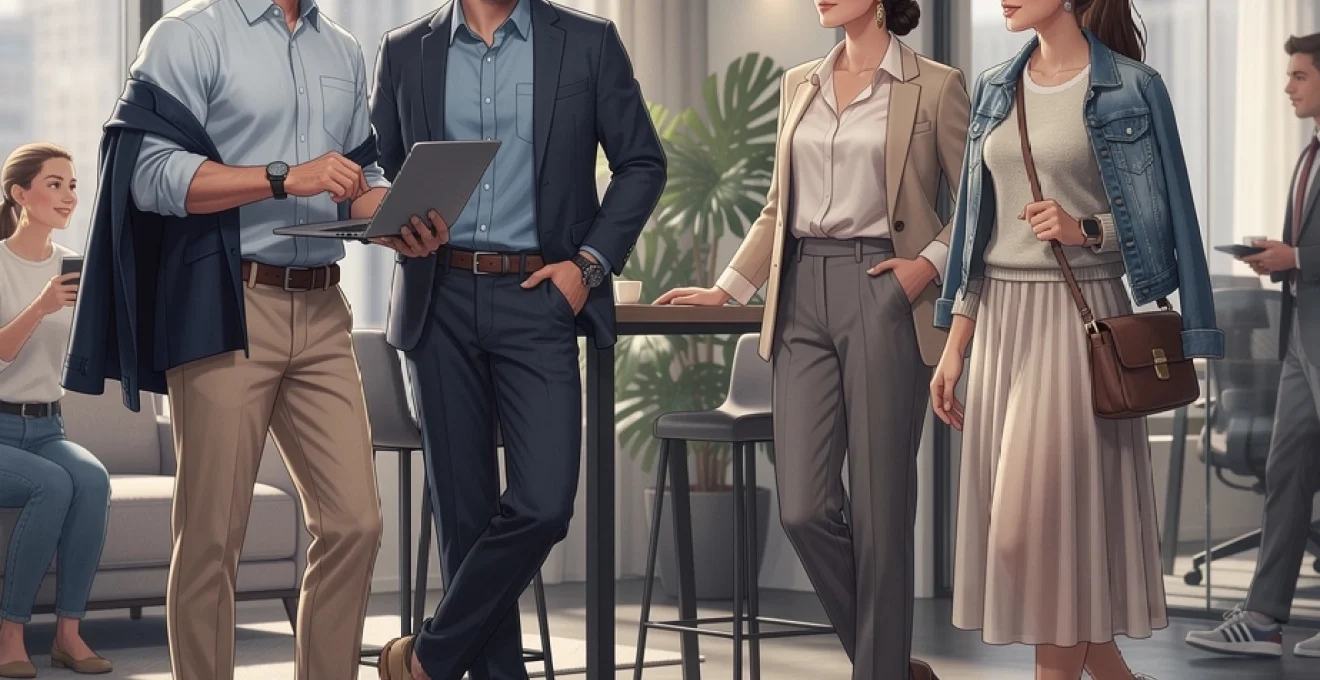
# Smart-Casual Dressing Decoded for Modern Lifestyles
Few dress codes spark as much confusion as smart-casual. This sartorial sweet spot sits somewhere between boardroom formality and weekend leisure, yet its precise boundaries remain frustratingly vague. For professionals navigating contemporary workplaces, social engagements, and hybrid environments, understanding smart-casual attire has become essential rather than optional. The challenge lies not in lack of clothing options but in identifying which combinations strike the correct balance between polished professionalism and relaxed authenticity.
Modern work culture has fundamentally transformed dress expectations. Remote work, flexible schedules, and cross-industry networking events have created situations where traditional business formal feels excessive whilst pure casualwear appears disrespectful. Smart-casual emerged to fill this void, offering a versatile middle ground that respects professional contexts whilst acknowledging contemporary lifestyle realities. Mastering this dress code unlocks confidence in diverse settings, from client lunches to evening receptions, without the anxiety of appearing underdressed or uncomfortably overdressed.
Defining Smart-Casual dress code parameters in contemporary fashion
Smart-casual exists on a spectrum rather than as a fixed rulebook. At its core, this dress code combines refined garments with comfortable, everyday pieces to create outfits that feel intentional without appearing overly formal. The key principle involves elevating casual staples through better fabric quality, improved fit, and strategic layering. Think of smart-casual as dressing one level above your natural comfort zone whilst remaining two levels below traditional business attire.
The confusion surrounding smart-casual stems from its context-dependent nature. What qualifies as smart-casual for a tech startup differs significantly from smart-casual at a law firm’s summer party. Environmental factors matter tremendously: a rooftop bar in August demands different considerations than a November gallery opening. Temperature, venue formality, industry norms, and time of day all influence appropriate smart-casual interpretation. Rather than memorising rigid rules, developing an understanding of these contextual variables enables more accurate outfit decisions.
Several reliable indicators distinguish smart-casual from adjacent dress codes. Fabric refinement provides perhaps the clearest signal—smart-casual prioritises natural fibres like cotton, wool, and linen over synthetic athletic materials. Garment structure matters equally: pieces should have defined shapes rather than the relaxed drape of loungewear. Footwear serves as another crucial differentiator, with leather shoes, refined loafers, or quality trainers replacing athletic footwear or casual sandals. Finally, overall presentation conveys intention—smart-casual outfits look deliberately assembled rather than hastily thrown together from whatever was clean.
The smartest approach to smart-casual involves building a flexible wardrobe foundation where individual pieces work across multiple formality levels, allowing you to adjust outfit refinement based on specific circumstances.
Three refinement levels help conceptualise where smart-casual fits within broader dress code hierarchies. Level one encompasses formal business attire, evening wear, and special occasion dressing—highly structured garments requiring dry cleaning and careful maintenance. Level three includes outdoor leisure wear, athletic clothing, and relaxed weekend pieces prioritising comfort and practicality over polish. Smart-casual occupies level two, the substantial middle ground where most contemporary professional and social life actually occurs. Understanding this positioning helps you calibrate outfit choices with greater precision.
Wardrobe foundation: essential Smart-Casual garments for men
Building an effective smart-casual wardrobe begins with versatile foundation pieces that pair seamlessly across different combinations. Rather than purchasing complete outfits, invest in individual garments that work together multiplicatively. A core wardrobe of eight to twelve carefully selected pieces generates dozens of smart-casual outfit permutations, providing variety without overcrowding your closet. Prioritise quality over quantity—better fabric and construction ensure longevity whilst maintaining the refined appearance smart-casual demands.
Oxford cloth Button-Down shirts and chambray alternatives
The Oxford cloth button-down shirt represents perhaps the most versatile smart-casual staple for men. Its structured collar and button placket provide formality, whilst the soft cotton fabric and casual button-down collar prevent stuffiness. Classic white and light blue versions form essential foundations, but don’t overlook subtle
ticking patterns, university stripes, and soft pastels that introduce personality while remaining workplace appropriate. For more relaxed environments, chambray shirts offer a smart alternative: they carry the ease of denim but with a lighter handle and neater appearance. When selecting Oxford and chambray shirts for smart-casual dressing, prioritise a trim but not tight silhouette, sleeves that break at the wrist bone, and collars that sit cleanly under knitwear or jackets. Aim for a small rotation of three to five shirts you can rely on throughout the week, rather than an overflowing rail of pieces you rarely wear.
Fit and fabric weight make a significant difference to how these shirts read in different contexts. Heavier Oxford cloth works well in cooler seasons and under blazers, whereas lighter weaves and chambray options feel more comfortable in warmer climates or air-conditioned offices. You can roll sleeves neatly for after-hours events or Friday schedules without compromising the smart-casual dress code. Subtle details—like a single chest pocket, mother-of-pearl buttons, or contrast stitching—add interest whilst maintaining a professional edge. Think of these shirts as the anchor of your smart-casual wardrobe, capable of dressing up dark denim or softening the formality of tailored trousers.
Chinos, tailored trousers, and dark denim selection criteria
Your choice of trousers often determines whether an outfit lands firmly in smart-casual territory or slips into weekend wear. Chinos occupy the central position in this category: they are more relaxed than suit trousers yet sharper than jeans. For a truly versatile smart-casual wardrobe, focus on mid-weight cotton chinos in neutral tones such as navy, stone, charcoal, and olive. A slight taper through the leg with minimal break at the ankle produces a modern, streamlined silhouette that pairs equally well with trainers or loafers.
Tailored trousers become essential when your work environment leans closer to business casual or when you attend client-facing meetings. Look for wool or wool-blend fabrics with a touch of stretch for comfort, flat fronts rather than heavy pleats, and clean lines that create a sophisticated impression without the rigidity of a full suit. Dark denim, meanwhile, is the most debated element of men’s smart-casual style. To ensure jeans read as smart rather than sloppy, choose a deep indigo or black wash, minimal fading, no rips, and a slim-straight cut. If you could reasonably imagine the jeans worn with a blazer at a dinner, they likely meet smart-casual standards.
How do you decide which option to wear on any given day? Use context as your guide. For a tech-sector office or a relaxed networking event, dark denim and a crisp Oxford shirt often suffice. For presentations, industry conferences, or cross-department meetings, chinos or tailored trousers signal greater intent. Pay attention to fabric performance as well—many modern brands now offer crease-resistant or temperature-regulating fabrics that support all-day comfort, making it easier to maintain a polished appearance from morning commute to evening drinks.
Blazers, sport coats, and unstructured jackets for versatility
No single garment elevates an outfit to smart-casual status more efficiently than a well-chosen blazer or sport coat. The difference between a shirt and jeans combination that feels like weekend wear and one that feels meeting-ready is often a lightweight jacket. For contemporary workplaces, unstructured blazers—those with minimal padding and softer construction—hit the right note. They retain the sharp lines of tailoring without the stiffness of traditional suiting, making them ideal for long days at the office or travel-heavy schedules.
When building your smart-casual jacket rotation, prioritise versatility first. A navy cotton or wool-blend blazer anchors countless outfits, pairing with chinos, grey trousers, or dark denim. A textured sport coat in hopsack, tweed, or linen blend introduces visual interest and reads slightly more relaxed, perfect for creative industries or evening events. Unstructured jackets in jersey or technical fabrics bridge the gap between tailoring and outerwear, particularly valuable in climates where a full suit jacket feels unnecessary. Ask yourself: could this jacket dress up a T-shirt but also complement an open-collar shirt? If the answer is yes, it likely fits the smart-casual brief.
Length, lapel width, and pocket style also influence how formal or casual a jacket appears. Slightly shorter lengths and patch pockets skew more relaxed, while structured shoulders and peak lapels feel more formal. For smart-casual dressing decoded in a modern context, favour notch lapels, half-lined or unlined constructions, and breathable fabrics you can comfortably wear indoors. Treat these jackets as your “armour of ease”—you gain the authority associated with tailoring while retaining the comfort and movement of casualwear.
Loafers, desert boots, and minimalist trainers as footwear options
Footwear is often the quickest visual cue others use to assess how smart or casual you are. In smart-casual environments, choosing the right shoes can rescue an otherwise borderline outfit or undermine a carefully curated look. Loafers—penny, tassel, or bit styles—remain the classic choice for modern professionals. In leather, they pair effortlessly with chinos and tailored trousers; in suede, they relax dark denim without looking sloppy. Brown tones are particularly adaptable, bridging navy, grey, and earth-tone wardrobes.
Desert boots and chukka styles offer a slightly more rugged take on smart-casual dressing whilst still reading refined enough for many offices. Their ankle height and clean lines work well with tapered trousers and jeans alike, especially in neutral suede or waxed leather. Minimalist trainers, meanwhile, have become widely accepted in contemporary workplaces, especially in tech, media, and design. The key is restraint: opt for low-profile, logo-light sneakers in white, black, or muted tones with premium leather or high-quality canvas construction. Running shoes, bulky athletic trainers, and heavily branded sneakers still sit firmly outside smart-casual territory in most professional settings.
When assessing whether footwear aligns with a smart-casual dress code, evaluate three aspects: material, silhouette, and condition. Leather or suede typically reads smarter than synthetic mesh; sleek, low-profile shapes look more polished than chunky soles; and well-maintained shoes always outshine scuffed, worn-out pairs, no matter how expensive they were initially. Consider building a rotation of three core pairs—one loafer, one desert boot or chukka, and one minimalist trainer—giving you flexibility to adapt to different environments without overcomplicating your choices.
Women’s Smart-Casual capsule wardrobe construction
For women, smart-casual dressing decoded revolves around constructing a capsule wardrobe that balances professionalism, comfort, and self-expression. Rather than chasing every micro-trend, the aim is to collect a concise range of pieces that mix and match seamlessly across office days, client meetings, and after-work events. A well-curated smart-casual capsule reduces morning decision fatigue and supports a more sustainable approach to fashion, as you rely on a smaller number of high-quality garments worn in multiple ways.
The most effective women’s smart-casual wardrobes include a blend of structured and relaxed silhouettes: tailored trousers with soft knit tops, polished blazers over fluid dresses, and premium denim grounded by refined footwear. Fabrics, again, play a central role—natural fibres such as cotton, silk, wool, and linen help outfits look elevated even when the designs themselves feel simple. As you consider which items to prioritise, think in terms of roles: which tops can dress up jeans and also sit under a blazer? Which skirts and trousers shift easily from desk to dinner?
Silk blouses, knitted tops, and structured t-shirts
Silk blouses are arguably the cornerstone of a women’s smart-casual wardrobe. Their fluid drape and subtle sheen immediately lift an outfit beyond everyday casual without feeling as rigid as a traditional dress shirt. Neutral shades like ivory, navy, and blush offer maximum versatility, while understated prints can introduce personality in more creative environments. When choosing silk or satin styles, pay attention to opacity, neckline depth, and sleeve length to ensure they remain appropriate across varied professional settings.
Knitted tops and fine-gauge sweaters bridge the gap between comfort and polish, especially in climates where air conditioning or seasonal changes demand light layering. A high-quality knit in merino wool, cotton, or cashmere blends works beautifully with tailored trousers, midi skirts, or premium denim. Structured T-shirts—designed with heavier cotton, clean necklines, and slightly boxy fits—provide a modern alternative to blouses on more relaxed days. These elevated tees pair well with blazers and statement jewellery, proving that smart-casual does not require sacrificing comfort.
How many tops do you need to sustain a smart-casual capsule wardrobe? For many professionals, a rotation of two silk or satin blouses, three to four mix-and-match knit tops, and a couple of structured T-shirts offers ample flexibility. This limited palette allows you to invest in superior fabric and construction quality, meaning your tops will resist pilling, maintain their shape, and continue to look refined after repeated wears. As with men’s shirts, fit is crucial—tops should skim the body rather than cling, with hemlines that work both tucked and untucked depending on the outfit.
Midi skirts, tailored trousers, and premium denim integration
On the bottom half, smart-casual dressing for women leans heavily on midi skirts, tailored trousers, and premium denim. Midi skirts, in particular, strike an ideal balance: the longer length feels office-appropriate, while movement and silhouette introduce a contemporary feminine edge. A-line or column styles in fabrics like crepe, lightweight wool, or structured cotton pair effortlessly with both blouses and knitwear. Solid colours—black, navy, camel, or soft neutrals—offer maximum versatility, while subtle prints can be introduced once the basics are in place.
Tailored trousers provide the backbone of many women’s professional outfits. For smart-casual environments, look for high-waisted, straight or slightly tapered cuts that elongate the leg and work with flats, ankle boots, or heels. Fabrics with a hint of stretch support all-day comfort, especially for hybrid office days involving commuting and long meetings. Premium denim can also play a key role when chosen carefully. Dark washes, clean finishes, and streamlined silhouettes (such as straight-leg or gentle flare) ensure jeans feel polished rather than purely casual. Distressing, raw hems, and light washes are best reserved for non-work contexts.
Integrating these pieces into a cohesive capsule involves considering proportion and balance. A fitted knit with wide-leg trousers, for instance, maintains visual harmony, as does a more relaxed blouse tucked into a straight midi skirt. Asking simple questions—“Would I feel confident meeting a client in this?” or “Could this outfit transition to an after-work dinner without changes?”—helps you decide whether a combination truly meets smart-casual standards. Over time, you will identify a handful of silhouettes that consistently work for your body type and schedule, making outfit planning far easier.
Blazers, cardigans, and lightweight knit jackets
Layering pieces are what transform a simple jeans-and-top combination into a clearly smart-casual look. For women, blazers remain the most powerful tool in this category. Modern cuts with slightly relaxed shoulders, longer lengths, and breathable linings provide structure without rigidity. A black or navy blazer is the obvious starting point, but lighter neutrals like taupe, sand, or grey offer softer alternatives that pair beautifully with both dark and light bases. Single-breasted designs with minimal hardware tend to feel the most adaptable across industries.
Cardigans have evolved from purely cosy layers to polished smart-casual staples. The key is to choose refined versions: think fine-gauge knits, clean buttons, and hip-length or slightly cropped designs that complement dresses and high-waisted trousers. Worn buttoned-up, a cardigan can mimic the look of a soft blazer; worn open, it relaxes a more structured outfit. Lightweight knit jackets and coatigans (coat-cardigan hybrids) also deserve consideration, particularly for open-plan offices where temperatures fluctuate. They offer the third-piece effect—instantly making an outfit look more considered—without the formal connotations of tailoring.
From a practical perspective, investing in two to three layering pieces that coordinate with most of your wardrobe is usually more effective than owning many one-outfit-only jackets. Choose colours that align with your preferred base tones and consider fabric weight relative to your climate. Just as with men’s unstructured blazers, these layers act as your adjustable dial on the smart-casual spectrum: you can add or remove them to suit the formality of different spaces throughout your day.
Ankle boots, ballet flats, and designer trainers selection
Footwear often dictates whether a women’s outfit reads as smart, casual, or the ideal smart-casual midpoint. Ankle boots are among the most adaptable options, working with trousers, midi skirts, and dresses across multiple seasons. Block heels in the 3–6 cm range provide height without sacrificing comfort, while sleek leather or suede finishes ensure a polished effect. Pointed or almond toes generally appear more refined than round toes and help elongate the leg line, especially when worn with cropped trousers.
Ballet flats have experienced a strong resurgence in recent fashion cycles and align perfectly with the smart-casual dress code when chosen thoughtfully. Styles with structured soles, quality leather, and minimal embellishment feel more professional than ultra-soft, slipper-like versions. Neutral tones or classic black remain the most versatile, though a single pair in a statement colour can enliven a predominantly neutral wardrobe. Designer trainers—or more accurately, minimalist fashion sneakers—also occupy a place in modern women’s offices, particularly in tech, media, and creative industries. As with men’s trainers, keep the silhouette clean, the branding subtle, and the colour palette restrained.
If you are building a smart-casual wardrobe from scratch, a simple footwear strategy can be helpful. Start with one pair of black or tan ankle boots suitable for most seasons, add a pair of structured ballet flats or loafers for days when comfort is paramount, and round out the set with low-profile trainers for more relaxed environments or commute-heavy schedules. Rotating between these ensures even wear and gives you the flexibility to dial outfits up or down depending on the occasion without needing an extensive shoe collection.
Fabric selection and textile quality standards for Smart-Casual attire
Smart-casual dressing decoded properly always returns to fabric selection and textile quality. Two people can wear almost identical outfits in terms of cut, yet the one in higher-quality fabrics will appear markedly more polished. Natural fibres such as cotton, wool, linen, and silk typically drape better, breathe more effectively, and age more gracefully than low-grade synthetics. That said, modern blends—such as wool with a small percentage of elastane or recycled polyester—can improve durability and crease resistance without sacrificing refinement.
When assessing textiles for smart-casual clothing, consider three dimensions: hand-feel, weight, and performance. Does the fabric feel substantial rather than flimsy, soft rather than scratchy? Is it appropriate for your climate and layering needs? Will it wrinkle excessively during a typical workday? For instance, a mid-weight cotton Oxford or poplin shirt will generally look fresher at 5 p.m. than a very lightweight fabric that shows every crease. Similarly, high-twist wool trousers resist bagging at the knees and maintain a sharp line, even after hours of sitting.
You might wonder whether investing in better fabric genuinely makes a difference in a world saturated with fast fashion. Yet numerous wardrobe studies show that higher-quality garments are worn far more frequently and retained for longer, reducing both cost-per-wear and environmental impact. A thoughtfully chosen wool blazer may serve you for a decade of smart-casual events, whereas a cheaper counterpart might lose its shape within a season. Treat fabric labels as a quick diagnostic tool: aim for predominantly natural fibres with only small additions of synthetics for stretch or durability, and be cautious of pieces relying entirely on low-cost polyester for their structure.
Texture also plays a subtle but powerful role in signalling formality. Smooth, crisp fabrics—like worsted wool, fine cotton, and silk—tend to look more formal, while slubby linens, brushed cottons, and chunkier knits skew more casual. By combining textures thoughtfully, you can fine-tune the smart-casual balance. For example, pairing a sleek silk blouse with soft, matte trousers prevents the outfit from feeling too dressy, while wearing a textured knit under a smooth blazer softens the authority of the jacket. Think of texture as a volume dial you can turn up or down depending on the setting.
Navigating workplace Smart-Casual policies across industries
Although “smart-casual” appears frequently in employee handbooks and event invitations, its practical interpretation varies dramatically between industries. A smart-casual dress code in a fintech startup looks quite different from smart-casual in a regional law firm, even when both share similar client profiles. Understanding these nuances allows you to show respect for the culture you operate in while still expressing personal style. It also reduces the mental load of decoding vague dress expectations before every meeting or networking event.
One helpful approach is to view industry norms as different points on the same smart-casual spectrum. Tech and creative fields often sit at the more casual end, incorporating premium denim and trainers as standard. Corporate environments, particularly finance and consulting, lean toward the smarter side, favouring tailored trousers, dresses, and leather footwear. As hybrid work continues to reshape office life—recent surveys show over 60% of knowledge workers operate in some form of hybrid model—companies are revisiting dress codes, moving away from strict business formal yet still expecting presentable, client-ready appearances.
Tech sector dress codes: silicon valley to shoreditch standards
In the tech sector, smart-casual dressing decoded often starts from a baseline of casualwear and adds refinement. Engineers, product teams, and startup founders frequently prioritise comfort and practicality, but investor meetings, partner visits, and conferences still demand a degree of polish. In hubs like Silicon Valley or Shoreditch, “smart” usually translates into upgraded fabrics and cleaner silhouettes rather than traditional suits. Dark jeans or chinos, quality knitwear, and minimalist trainers have become de facto uniforms in many offices.
For men and women alike, the key smart-casual strategy in tech involves owning a small set of elevated pieces that can easily layer over everyday basics. A well-fitting blazer or chore jacket, premium leather sneakers, and one or two pairs of dark, non-distressed jeans allow you to move from coding session to stakeholder presentation with minimal outfit changes. Graphic T-shirts may be acceptable in some startup cultures, but substituting them with plain or subtly textured tees instantly raises the tone without feeling out of place. Ask yourself: would this outfit look appropriate if a major client or investor walked into the office unannounced?
Remote and hybrid work have also influenced tech-sector style. Video calls place greater emphasis on what appears within the frame—tops, jackets, and grooming—while allowing more flexibility below the desk. Many professionals now keep a “Zoom-ready” blazer or blouse on their chair, ready to slip on over a T-shirt when a spontaneous meeting arises. Even in relaxed cultures, maintaining a consistent smart-casual standard communicates reliability and respect for colleagues and partners across time zones.
Creative industries: advertising, media, and design studio expectations
Creative fields such as advertising, media, and design studios often encourage more individuality in dress, yet smart-casual still forms the baseline expectation, especially in client-facing roles. Here, personal style becomes part of your professional identity: outfits that blend polish with creativity can enhance credibility when presenting concepts or leading workshops. You are more likely to see bold colours, statement accessories, and experimental silhouettes, but they are usually grounded by smart-casual fundamentals like quality footwear and considered layering.
For many creative professionals, the smart-casual sweet spot lies in mixing classic pieces with trend-led items. Think tailored trousers paired with a contemporary knit, or a simple black dress elevated by sculptural jewellery and distinctive shoes. Denim is widely accepted, provided it is clean, well-fitting, and styled deliberately—perhaps with a sharp blazer or refined blouse. The “too casual” line is usually crossed when outfits resemble gymwear or loungewear rather than intentional ensembles. If you could comfortably wear the same outfit to a Sunday sofa day, it probably falls short of smart-casual standards in these sectors.
Client meetings, pitches, and industry events may call for a slightly smarter interpretation. In those scenarios, adding structure—a blazer, tailored coat, or heeled boot—signals respect without stifling your creative edge. Because creative workplaces often lack formal written dress codes, observing colleagues and leaders you respect can offer valuable guidance. Notice which elements they repeat across different contexts: particular jacket styles, preferred footwear, or signature accessories that always feel appropriate yet distinctly personal.
Corporate smart-casual: financial services and consultancy adaptations
In traditionally formal environments like financial services, legal practice, and management consulting, “smart-casual” has historically translated to “business casual with slightly more freedom.” Even as these sectors modernise—many large firms have relaxed strict suit policies in recent years—the expectation of polish remains higher than in tech or creative industries. Smart-casual here often excludes trainers, distressed denim, and overtly fashion-forward pieces, leaning instead toward understated tailoring and classic footwear.
For men, this typically means button-down shirts, merino or cashmere knits, tailored trousers or high-quality chinos, and leather loafers or brogues. Ties may be optional day-to-day but still appear for key client meetings or formal presentations. For women, sheath dresses, midi skirts with blouses, and tailored trousers with knit tops or blazers form the core of corporate smart-casual. Heeled pumps, loafers, and refined ankle boots are preferred, with trainers generally reserved for commuting unless explicitly accepted in your firm’s culture.
How can you decode your specific corporate environment? Start by dressing one notch more formal than you think necessary during your first weeks, then calibrate based on what senior colleagues wear in comparable roles. Remember that client-facing days often warrant a shift up the refinement spectrum, even if internal office culture is relatively relaxed. When in doubt, err toward smarter choices: it is almost always easier to remove a blazer or swap heels for flats than to compensate for an outfit that feels underdressed in a high-stakes meeting.
Seasonal Smart-Casual adaptations and layering techniques
Seasonality adds another dimension to smart-casual dressing, particularly in regions with marked temperature shifts or in cities where commuting involves changing climates throughout the day. The goal is to maintain a consistent level of polish while adapting fabrics, colours, and layering strategies to remain comfortable. Think of your wardrobe as a modular system: core pieces stay constant, while outer layers and accessories rotate with the seasons.
In warmer months, lightweight natural fibres become non-negotiable. Linen shirts, cotton-linen blends, unlined blazers, and breathable knitwear allow air circulation while preserving structure. For men, polos and open-collar shirts in high-quality cotton pique or linen can replace heavier Oxfords on the hottest days. Women might opt for sleeveless blouses with higher necklines, breezy midi dresses, or wide-leg trousers in fluid fabrics. The key to summer smart-casual is ensuring that relaxed silhouettes are counterbalanced by polished elements—structured sandals, leather belts, or a sharp blazer for air-conditioned interiors.
Colder seasons invite richer textures and layering opportunities. Wool-blend trousers, heavier chinos, and dark denim provide warmth while maintaining a refined appearance. For both genders, fine-gauge roll-necks or mock necks worn under blazers offer a sleek alternative to shirts and ties, particularly in creative or tech settings. Layering a thin base layer under shirts or dresses can increase warmth without adding visible bulk, preserving clean lines. Outerwear such as tailored overcoats, trench coats, or smart parkas completes the ensemble, allowing you to arrive at offices or events looking composed rather than bundled.
Effective layering for smart-casual dressing hinges on proportion and colour coordination. A simple rule of thumb is to keep the innermost layers lighter in colour and weight, building toward darker or heavier outer layers. This not only flatters most body types but also allows for straightforward adjustments as you move between environments. Consider adopting a limited seasonal palette—warmer neutrals and soft tones in spring and summer; deeper, richer hues in autumn and winter—to create cohesion across your outfits. By planning your smart-casual wardrobe with seasonality in mind, you reduce last-minute outfit panic when the weather shifts.
Accessorising Smart-Casual outfits: watches, belts, and leather goods
Accessories are the finishing layer that can subtly transform an outfit from basic to considered. In smart-casual contexts, the most effective accessories are often the least ostentatious: well-chosen watches, belts, bags, and small leather goods that support both function and style. Think of them as punctuation marks in your outfit—they should clarify your message, not distract from it. A simple, clean watch face, for instance, communicates reliability and attention to detail without saying a word.
For men, a leather belt matched reasonably closely to shoe colour remains a reliable starting point. Even in more relaxed offices, a quality belt prevents an outfit from feeling unfinished. Watches in steel or leather with minimal complications pair easily with both shirts and knitwear, while fabric or rubber straps tend to skew more casual. Slim leather wallets, cardholders, or crossbody bags also contribute to a cohesive look, especially in hybrid work situations where you frequently move between locations and need to carry laptops or documents.
Women often have a wider range of accessory options, but the same smart-casual principles apply. Structured leather totes, crossbody bags, or satchels elevate even simple outfits and accommodate work essentials without sacrificing aesthetics. Jewellery can express personality—think delicate layered necklaces, understated hoops, or a single statement ring—but should not overwhelm the overall ensemble, particularly in conservative industries. Scarves in silk or fine wool offer both warmth and visual interest, easily transforming a minimalist outfit into something more distinctive.
Across all genders, the condition of accessories matters as much as their design. Scuffed shoes, cracked belts, or overstuffed bags undermine the polished impression you aim for with smart-casual dressing. Regular maintenance—cleaning leather, rotating bags to prevent wear, and storing jewellery properly—extends the life of your pieces and preserves their visual impact. As you refine your smart-casual wardrobe, consider curating a small, high-quality set of everyday accessories you genuinely enjoy using. These will become your quiet style signatures, reinforcing your professional presence in every setting you enter.