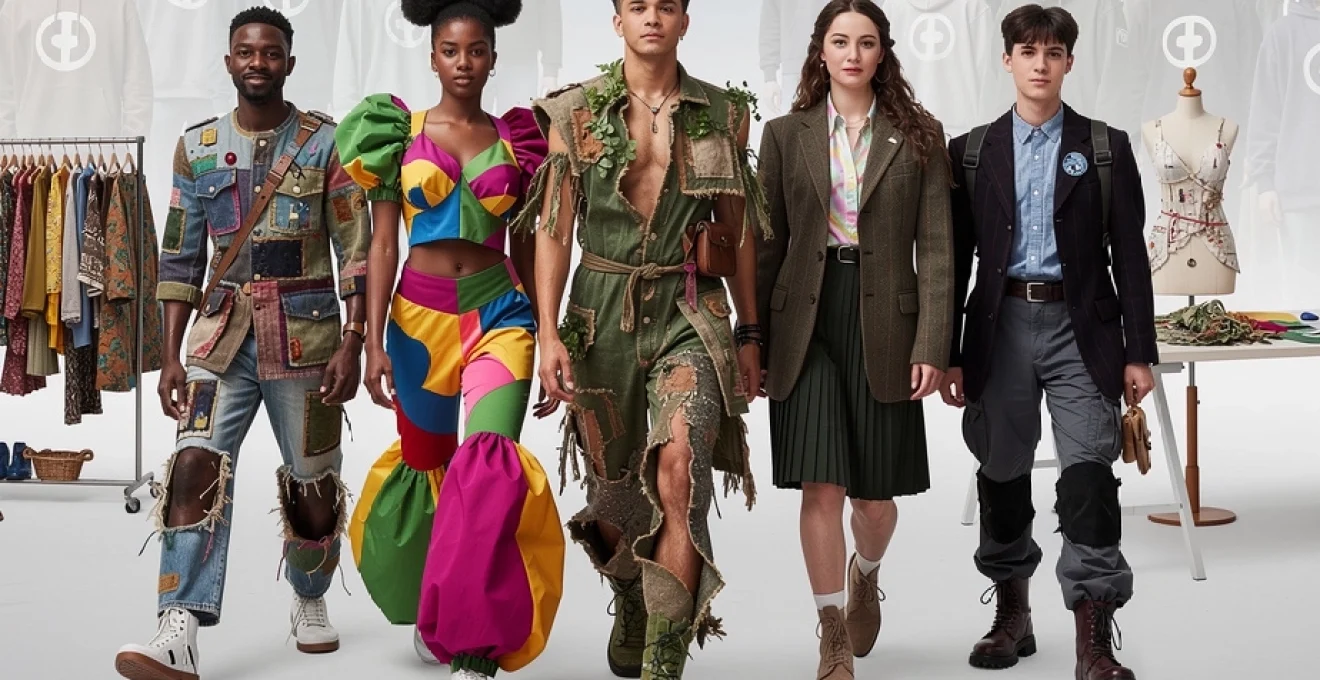
Fashion has entered a new era where personal authenticity trumps industry-dictated trends. For decades, consumers followed seasonal directives from design houses and fashion magazines, purchasing items because they were deemed « in style » rather than because they resonated personally. However, a fundamental shift is reshaping how individuals approach their wardrobes. The algorithmic homogenization that characterized the late 2010s and early 2020s—with its rapid-fire succession of « cores » and viral aesthetics—has sparked a counter-movement. Today’s fashion-conscious consumer increasingly prioritizes individual expression over collective conformity, viewing clothing as a canvas for personal narrative rather than a uniform for trend participation. This transformation reflects broader cultural shifts toward authenticity, sustainability, and psychological well-being, fundamentally challenging the traditional fashion industry’s power structures.
The decline of Logo-Centric fashion and Mass-Market uniformity
The once-dominant paradigm of logo-centric fashion is experiencing a significant decline. For decades, conspicuous branding served as social currency, with luxury houses leveraging monogrammed patterns and prominent logos to signal status and taste. However, contemporary consumers increasingly view overt branding as antithetical to genuine style individuality. Research from 2024 indicates that 67% of consumers aged 18-35 actively avoid clothing with visible logos, perceiving them as markers of conformity rather than distinction. This rejection stems partly from market saturation—when everyone carries the same branded bag or wears the same logo-emblazoned hoodie, the item loses its capacity to communicate uniqueness.
Mass-market uniformity has similarly fallen from favour. The fast fashion model that dominated the early 21st century created a landscape where individuals in different cities, countries, and continents wore virtually identical outfits sourced from the same global retailers. This homogenization reached its peak during the « Zara effect » period, when runway-inspired designs could appear in high-street stores within weeks, creating a visual monotony across urban centers worldwide. The psychological impact proved profound: when personal style becomes indistinguishable from mass-produced templates, clothing loses its communicative power. Today’s fashion ecosystem reflects a rebellion against this uniformity, with consumers actively seeking differentiation mechanisms that allow them to stand apart from algorithmic sameness.
The decline of trend cycles as authoritative directives represents another dimension of this shift. Where fashion seasons once operated on predictable six-month cycles, the social media era compressed trend lifespans to mere weeks or even days. This acceleration created trend fatigue, leaving consumers exhausted by the constant pressure to update their wardrobes. Industry analysts note that trend-chasing behaviour has decreased by approximately 43% since 2020, with individuals instead investing in pieces that reflect enduring personal aesthetic values rather than fleeting viral moments. This transformation fundamentally challenges the traditional fashion industry’s business model, which relied on planned obsolescence and seasonal reinvention to drive consumption.
Psychological drivers behind Self-Expression through wardrobe curation
Understanding why individuality has become paramount requires examining the psychological mechanisms that connect clothing choices to identity formation. Fashion operates as a sophisticated system of non-verbal communication, allowing individuals to broadcast complex information about themselves before uttering a word. This communicative function becomes increasingly important in digitally mediated societies where first impressions often occur through visual platforms like Instagram, LinkedIn, or dating applications. The psychological investment in wardrobe curation reflects deeper human needs for self-actualization and authentic self-presentation.
Identity construction theory and clothing as personal narrative
Identity construction theory posits that individuals actively construct their sense of self through external signifiers, with clothing serving as one of the most visible and controllable elements. Unlike physical features that are largely fixed, clothing offers near-infinite possibilities for self-definition and redefinition. Contemporary fashion consumers increasingly approach their wardrobes as evolving autobiographies, with each garment representing a chapter, experience, or aspect of their multifaceted identities. This narrative approach to dressing explains why individuals might retain certain items despite their worn condition—these pieces carry emotional and biographical significance that transcends aesthetic considerations.
The psychological literature distinguishes between « assigned identity » (how others perceive us) and « avowed identity » (how we perceive ourselves), with clothing serving as a
deliberate tool for aligning the two. By consciously selecting garments that reflect their internal self-concept, individuals attempt to narrow the gap between how they feel and how they are read by others in social and professional contexts. Wardrobe curation thus becomes a form of ongoing identity editing—adding, removing, and recontextualising pieces as one’s beliefs, affiliations, and aspirations evolve. In this sense, individuality in fashion is less about owning rare items and more about composing a coherent, personally meaningful visual story from the available cultural wardrobe.
The hawthorne effect and social media’s role in authenticity pursuit
The Hawthorne Effect—the phenomenon where individuals alter their behaviour when they know they are being observed—has been radically amplified by social media. Platforms like Instagram and TikTok create a state of perpetual visibility, where everyday outfits can be broadcast to hundreds or thousands of viewers. Initially, this drove hyper-curated, approval-seeking looks that mimicked influencers and celebrities. Over time, however, many users have experienced performance burnout, leading to a renewed desire for authenticity rather than constant optimisation for likes.
This tension has given rise to what some researchers call « performed authenticity »: users intentionally showcasing imperfect, eclectic, or vintage pieces to signal that they are not simply chasing the latest micro-trend. Ironically, even this authenticity can become aestheticised and copied, blurring the line between genuine self-expression and yet another template. Still, the overall direction is clear—audiences increasingly reward individuality, repeat-wear, and creative styling over algorithm-friendly sameness. You can see this shift in the popularity of « outfit repeating » challenges and « get ready with me » videos that foreground personality and narrative over flawless presentation.
Maslow’s Self-Actualisation hierarchy applied to fashion choices
Applying Maslow’s hierarchy of needs to fashion reveals why individuality has grown in importance. At the base level, clothing fulfils physiological and safety needs—protection from the elements, compliance with dress codes, and basic functionality. As individuals move up the hierarchy, fashion begins to address belongingness and esteem, signalling group membership, subcultural affiliation, or professional competence. Historically, many consumers stopped there, using clothes primarily to fit in and gain approval.
Today, an increasing share of fashion-conscious consumers are operating near Maslow’s self-actualisation tier, where the priority shifts from external validation to internal congruence. Here, clothing choices are guided by questions like, « Does this feel like me? » rather than « Is this in style? » Self-actualised dressing might involve mixing high and low pieces, wearing archival items alongside emerging designers, or defying conventional norms around gender, age, or occasion. The wardrobe becomes a toolkit for living in alignment with one’s values—sustainability, creativity, comfort, or cultural pride—rather than a scoreboard for trend compliance.
Consumer rejection of aspirational marketing and celebrity endorsements
One of the clearest indicators of this psychological shift is the waning effectiveness of traditional aspirational marketing. Celebrity endorsements once functioned as powerful cues of desirability; owning the bag seen on a red carpet or the sneakers worn by a pop star promised symbolic access to their lifestyle. Yet surveys conducted between 2022 and 2025 show a consistent decline in trust toward celebrity-driven campaigns, especially among Gen Z, who often view them as inauthentic and overly commercial.
Instead, consumers now gravitate toward « horizontal » influence—peers, micro-creators, and niche communities whose style feels attainable and sincere. When you see someone with a modest following creatively restyling the same trousers five different ways, the message is not « be like me » but « here is what you can do with what you already have. » This shift undermines the old top-down model in which brands dictated taste from above, replacing it with a participatory ecosystem where individual expression and peer validation carry more weight than glossy, celebrity-fronted campaigns.
Digital platforms enabling bespoke fashion ecosystems
The rise of digital platforms has provided the infrastructure for this new individuality-focused fashion landscape. Rather than relying on a few global retailers for wardrobe updates, consumers now navigate a fragmented but fertile ecosystem of resale apps, customisation services, small-batch designers, and digital-native brands. These platforms expand access to unique garments and enable users to curate wardrobes that feel genuinely one-of-a-kind, even when budgets are limited.
Depop and vinted’s circular economy models for unique garment sourcing
Resale marketplaces like Depop and Vinted have become central to how younger consumers source distinctive pieces. Operating on circular economy principles, these platforms allow garments to circulate across multiple owners, accumulating stories and patina instead of ending up prematurely in landfills. For style-focused users, the appeal is twofold: they can discover discontinued collections, niche subcultural pieces, and vintage items that are no longer available through traditional retail, while also aligning with their sustainability values.
The social features embedded in these apps—follower feeds, seller profiles, curated drops—transform second-hand shopping into a community-driven discovery process. Instead of walking into a chain store where everyone starts from the same rack, you effectively enter thousands of mini-boutiques shaped by individual taste. This fragmentation increases the probability that your chosen garment will not be replicated across your social circle, strengthening your capacity to build a visually distinctive, ethically grounded wardrobe.
Customisation technologies: Print-on-Demand and AI-Driven pattern generation
Alongside resale platforms, customisation technologies have lowered the barrier to personalising garments at scale. Print-on-demand services enable users to upload graphics, text, or photography and have them rendered on T-shirts, jackets, or accessories without the upfront costs of traditional manufacturing. For many, this transforms fashion from passive consumption into an accessible form of creative production, blurring the line between consumer and designer.
Emerging AI-driven pattern generation tools push this even further. By inputting preferences such as silhouette, colour palette, or reference images, users can generate unique prints or garment concepts that reflect their personal aesthetic. While these systems are still developing, they foreshadow a fashion future where your wardrobe may be as personalised as your social media feed. The analogy with music streaming is apt: just as algorithms assemble custom playlists from a shared library of tracks, AI-powered fashion tools can help you orchestrate a wardrobe from a global archive of fabrics, cuts, and cultural references—without sacrificing individuality.
Instagram and TikTok’s democratisation of Micro-Trend creation
Social platforms like Instagram and TikTok have also democratised who gets to initiate fashion conversations. Micro-trends—often rooted in niche aesthetics like « dark academic streetwear » or « soft gorpcore »—frequently emerge from ordinary users experimenting with their closets rather than from runway shows. These styles can gain momentum through organic sharing, duets, and stitching, evolving as different communities adapt them to their own contexts.
This bottom-up dynamic allows for a much wider range of identities, body types, and cultural references to shape what counts as aspirational style. A schoolteacher in Lisbon, a student in Lagos, and a skateboarder in Seoul can all become reference points for new ways of dressing, independent of traditional gatekeepers. For you as a consumer, this means there is no single « correct » way to interpret a look; micro-trends become open frameworks to be remixed with your existing wardrobe, encouraging experimentation rather than strict adherence.
Blockchain authentication for Limited-Edition and One-Off pieces
At the more technical end of the bespoke ecosystem, blockchain technology is being explored as a way to authenticate limited-edition or one-off garments. By creating tamper-proof digital certificates of ownership and provenance, brands and independent designers can verify that a piece is genuinely rare, not a mass-produced copy. For collectors and fashion enthusiasts, this verifiable scarcity adds emotional and financial value, reinforcing the sense of owning something truly individual.
While the integration of blockchain into everyday fashion is still nascent, pilot projects—particularly in luxury streetwear and sneaker culture—demonstrate its potential. Imagine being able to trace a jacket’s entire lifecycle, from fabric source to pattern cutter to previous owners, via a digital ledger accessible on your phone. This kind of authenticated storytelling not only combats counterfeiting but also deepens the personal connection between wearer and garment, turning clothes into traceable, unique artefacts rather than anonymous commodities.
Independent designers disrupting fast fashion’s homogenised aesthetic
Independent designers have been instrumental in challenging fast fashion’s visual uniformity and linear production models. Operating outside the constraints of mass-market sales targets, many of these creatives use their collections to explore nuanced narratives—about identity, climate anxiety, or community—that resonate with consumers seeking more than surface-level aesthetics. Their work demonstrates that individuality in fashion can be both conceptual and wearable, merging artistic experimentation with everyday functionality.
Marine serre’s upcycled couture and Zero-Waste pattern making
Marine Serre has become a leading figure in this movement through her commitment to upcycling and zero-waste techniques. Her collections frequently incorporate deadstock fabrics, repurposed household textiles, and post-consumer garments, transformed into futuristic silhouettes that feel both dystopian and optimistic. By making visible the seams, patchworks, and material histories of her pieces, Serre positions individuality not as pristine newness but as layered, reconstructed narrative.
This approach directly counters fast fashion’s emphasis on disposable sameness. When you wear a Marine Serre garment, you are not only adopting a distinctive visual language—crescent moons, hybrid sportswear-tailoring—but also participating in a critique of overproduction and waste. Each piece is slightly different due to the variability of source materials, reinforcing the idea that ecology and individuality can coexist within a single design philosophy.
Christopher john rogers’ maximalist colour theory and silhouette innovation
Christopher John Rogers disrupts homogenisation from another angle: radical colour and volume. In a decade dominated by beige minimalism and safe neutrals, his kaleidoscopic palettes and sculptural silhouettes feel like a joyous refusal to shrink into the background. Drawing on art history, queer culture, and Southern American iconography, Rogers uses bold stripes, saturated brights, and exaggerated tailoring to create looks that demand to be noticed.
For wearers, this maximalism is more than a visual statement; it is a psychological tool for occupying space unapologetically. Choosing a Rogers-inspired aesthetic—whether through his pieces or through similar styling moves—signals a commitment to visibility and self-celebration. In a world where many individuals have been socialised to minimise themselves, especially along gendered or racial lines, such fashion choices can be deeply empowering acts of individuality.
Collina strada’s Sustainability-Driven narrative and community Co-Creation
Collina Strada, led by Hillary Taymour, exemplifies how independent labels can weave sustainability, community, and playfulness into a cohesive aesthetic. The brand’s collections often incorporate deadstock materials, hand-dye techniques, and whimsical prints featuring animals, fruits, or surreal motifs. Runway presentations double as performances and community gatherings, with casting that embraces different ages, body types, and abilities, challenging narrow industry norms.
Crucially, Collina Strada invites its audience into a collaborative relationship. From open-source patterns to social media prompts encouraging fans to style pieces in unexpected ways, the brand treats individuality as a shared project rather than a top-down directive. When you engage with such labels, you are not just buying clothes; you are joining a network of people experimenting with how fashion can be kinder, stranger, and more personal—without sacrificing environmental responsibility.
Subcultural resurgence and niche aesthetic movements
While mainstream fashion becomes more fragmented, subcultures and niche aesthetics have re-emerged as powerful engines of individuality. Instead of a few dominant styles defining an era, we now see parallel micro-worlds—each with its own codes, references, and communities—coexisting and sometimes overlapping. These movements give people ready-made but flexible frameworks for exploring who they want to be, much like choosing a genre when curating a playlist.
Gorpcore’s technical fabrication and outdoor heritage reimagining
Gorpcore, named after the hiking snack « good old raisins and peanuts, » celebrates functional outdoor gear as everyday fashion. Technical fabrics, taped seams, ripstop nylon, and modular pockets migrate from backcountry trails to city streets, repurposed as symbols of preparedness and quiet rebellion against purely decorative clothing. Brands with deep outdoor heritage—Arc’teryx, Patagonia, Salomon—are recontextualised as style statements rather than niche sporting labels.
For many adopters, Gorpcore represents a lifestyle aspiration rather than a literal hiking schedule. Wearing a waterproof shell with office trousers or pairing trail shoes with a tailored coat signals an affinity for resilience, environmental awareness, and understated individuality. In contrast to logo-heavy streetwear, the « flex » here lies in fabric technology and archival colourways, inviting you to express personal values—comfort, durability, ecological concern—through meticulously chosen utilitarian pieces.
Dark academia’s literary symbolism and vintage tailoring revival
Dark Academia channels a romanticised vision of scholarly life, drawing on imagery from old universities, libraries, and classic literature. Tweed blazers, pleated skirts, loafers, and turtlenecks are styled in muted, autumnal palettes, often sourced from vintage shops or inherited wardrobes. Accessories like fountain pens, leather satchels, and signet rings function as symbolic props, reinforcing a narrative of intellectual curiosity and introspection.
This aesthetic resonates strongly in an era of digital overload, offering an analogue fantasy where time slows down and knowledge is tactile. When you adopt Dark Academia elements—perhaps a checked blazer over a band tee or a worn trench coat with modern denim—you participate in a visual conversation about nostalgia, learning, and resistance to hyper-speed trend cycles. The style encourages individuality not through shock value but through depth of reference, rewarding those who imbue their outfits with personal literary and cultural touchpoints.
Normcore’s Anti-Fashion philosophy and intentional mundanity
Normcore, often misunderstood as mere blandness, is better described as intentional mundanity. Its staples—straight-leg jeans, plain sweatshirts, unfussy sneakers, anonymous baseball caps—foreground comfort and functionality while deliberately sidestepping overt trend signalling. The individuality here lies not in standing out visually but in rejecting the constant demand to perform uniqueness.
In practice, Normcore offers a kind of sartorial quiet quitting: you opt out of the pressure to constantly optimise your appearance and instead invest your identity energy elsewhere—creative work, relationships, activism. For many, this is its own radical statement in a culture that commodifies every aspect of selfhood. By dressing « normally » on purpose, you reclaim agency over when and how you choose to be visually exceptional, rather than allowing algorithms or marketing campaigns to dictate those moments.
Y2K nostalgia’s archival reappropriation and Gender-Fluid styling
The resurgence of Y2K fashion—low-rise jeans, baby tees, sparkly accessories, and playful colour schemes—illustrates how younger generations rework recent history to craft their own identities. Rather than replicating early-2000s looks wholesale, many Gen Z consumers remix archival pieces with contemporary sensibilities around fit, comfort, and gender expression. A once hyper-feminised item like the mini skirt might now be styled with chunky boots and oversized knits, worn by people of any gender as an expression of fluidity and fun.
This reappropriation highlights an important point: individuality does not require inventing an entirely new aesthetic from scratch. Much like sampling in music, style innovation often involves taking familiar elements and arranging them in unexpected ways. By sourcing original 2000s garments from thrift stores, combining them with modern tailoring, or subverting their original cultural connotations, today’s Y2K enthusiasts transform nostalgia into a forward-looking, inclusive fashion language.
Data-driven personalisation and AI-Powered style profiling
Behind the scenes, data analytics and AI are reshaping how brands and platforms understand and serve individual style preferences. Recommendation engines once focused narrowly on size and basic category; now they incorporate browsing patterns, social engagement, and even regional weather data to suggest outfits that feel uncannily aligned with your tastes. This level of personalisation helps reduce choice overload, guiding you toward pieces that fit your existing wardrobe and aesthetic rather than pushing generic bestsellers.
More advanced systems experiment with style profiling, clustering users into nuanced archetypes based on colour choices, silhouette preferences, and risk tolerance in fashion. Instead of labelling you simply as « edgy » or « classic, » AI might recognise that you favour structured outerwear, sustainable materials, and a muted palette with occasional statement accessories. Used ethically, these insights can empower you to refine your individuality—highlighting patterns you weren’t consciously aware of and suggesting subtle expansions. The challenge, of course, is ensuring that algorithms support exploration rather than boxing users into ever-narrower style bubbles, a tension that both consumers and brands will need to navigate thoughtfully.
Generational shifts in fashion consumption patterns and value systems
Individuality’s rise as the new fashion statement is also driven by generational changes in how people approach clothing, spending, and values. While it is risky to over-generalise, clear patterns have emerged in how Gen Z and Millennials differ from previous cohorts in their relationship to fashion. These shifts influence everything from store formats to marketing language, and they collectively push the industry toward more diverse, sustainable, and self-expressive models.
Gen z’s preference for thrifting and Second-Hand market dynamics
Gen Z has embraced thrifting and second-hand fashion not just as a cost-saving measure but as a core element of style identity. Surveys from 2023–2025 show that a majority of Gen Z shoppers in Europe and North America purchase pre-loved clothing at least once per quarter, with many citing « finding unique pieces » and « reducing environmental impact » as key motivations. For them, walking out of a vintage store with a one-of-a-kind jacket carries far more social capital than buying the latest high-street drop.
This behaviour has reshaped market dynamics. Traditional retailers now compete with resellers, peer-to-peer marketplaces, and curated vintage shops for attention and spend. At the same time, Gen Z’s enthusiasm for upcycling, DIY alterations, and outfit repeating challenges the stigma once associated with visible re-wear. When you proudly credit a thrifted skirt or reworked shirt in a social post, you model a fashion narrative in which creativity, resourcefulness, and individuality eclipse sheer newness.
Millennial capsule wardrobe philosophy and investment dressing
Many Millennials, shaped by economic instability and sustainability concerns, have gravitated toward capsule wardrobes and investment dressing. Rather than chasing every micro-trend, they prioritise versatile, high-quality pieces that can be styled in multiple ways and worn across years. The goal is not minimalism for its own sake, but coherence: a tightly edited closet where most items work together and genuinely reflect the wearer’s lifestyle and aesthetic.
This approach reframes individuality around intentional selection instead of sheer variety. A well-chosen blazer, pair of boots, or statement dress becomes a personal signature, recurring across seasons rather than disappearing after a single Instagram appearance. For those adopting this philosophy, questions like « Will I still wear this in three years? » and « Does this align with my values? » overshadow « Is this trending right now? » The result is a more stable, confident sense of style that evolves gradually rather than lurching from fad to fad.
Ethical transparency demands and supply chain traceability standards
Across generations, but especially among younger consumers, there is a growing expectation that fashion brands disclose how and where their products are made. Reports of labour exploitation, environmental damage, and greenwashing have fuelled a demand for traceability—from fibre sourcing to factory conditions and end-of-life options. Shoppers increasingly research brands’ certifications, read impact reports, and favour labels that offer concrete data over vague sustainability slogans.
This push for transparency intertwines with the quest for individuality. Dressing in line with your ethics—choosing fair-trade denim, regenerative cotton, or low-impact dyes—is itself a form of self-expression. It signals that your personal style statement extends beyond surface aesthetics to encompass the invisible narratives woven into your clothes. As supply chain tracking tools, QR-coded labels, and third-party verification become more common, you gain greater power to ensure that your wardrobe reflects not only who you are, but also the kind of world you want to help create.