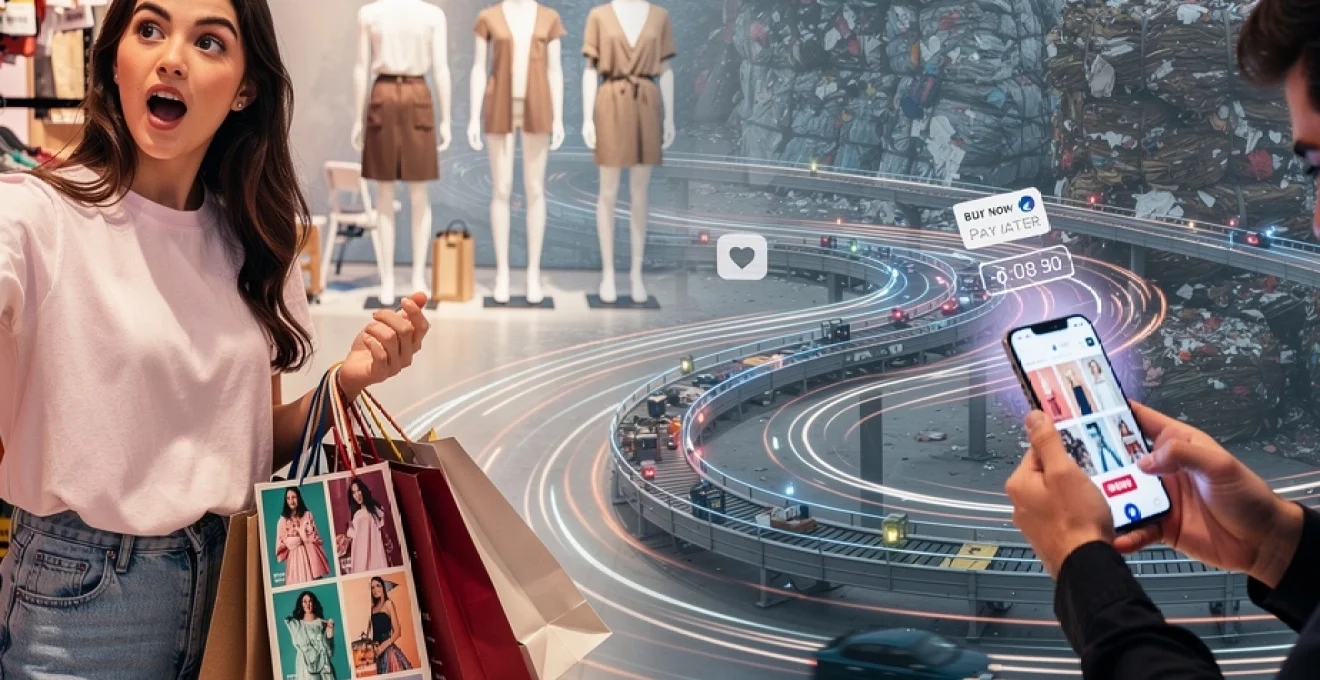
The fashion industry has undergone a seismic transformation over the past two decades, fundamentally altering how consumers interact with clothing. What was once a considered purchase involving careful deliberation has morphed into a rapid-fire transaction driven by algorithms, social validation, and neurochemical rewards. Fast fashion brands have mastered the art of converting fleeting desires into immediate purchases, creating a consumption pattern that generates over 40 million tons of textile waste annually while simultaneously reshaping the psychological relationship between people and their wardrobes. This shift represents more than a mere change in shopping habits—it signifies a profound restructuring of consumer identity, economic priorities, and environmental consciousness that warrants careful examination.
Psychological triggers behind Micro-Seasonal shopping cycles
The traditional fashion calendar once operated on a straightforward seasonal basis: spring/summer and autumn/winter collections provided consumers with predictable buying opportunities twice yearly. Fast fashion has demolished this framework, replacing it with what industry analysts term « micro-seasons »—relentless cycles of new inventory that arrive weekly or even daily. This acceleration exploits fundamental aspects of human psychology, creating shopping behaviours that previous generations would find bewildering. The constant novelty activates reward centres in the brain with remarkable efficiency, establishing purchasing patterns that mirror addictive behaviours more closely than rational consumer decision-making.
Research conducted at Stanford University in 2007 revealed that when subjects encountered desirable clothing items during brain imaging studies, their pleasure centres activated proportionally to their desire for the product. The crucial finding was that obtaining these items at perceived bargain prices amplified the neurochemical reward significantly. Fast fashion brands have weaponised this insight, creating pricing structures and marketing messages that consistently trigger these dopamine responses. The result is a consumer base conditioned to associate shopping with immediate gratification rather than long-term satisfaction.
Dopamine-driven purchase patterns in zara and H&M store layouts
Walk into any Zara or H&M location and you’ll encounter a carefully orchestrated environment designed to maximise purchase frequency. Store layouts position new arrivals prominently near entrances, ensuring that the novelty effect—that initial burst of excitement from encountering something fresh—hits you immediately upon entering. Merchandise arrangements change frequently, sometimes twice weekly, training regular customers to visit often lest they miss something desirable. This creates what behavioural economists call a « variable reward schedule, » the same mechanism that makes slot machines so compelling.
The average Zara customer visits the store seventeen times per year, compared to just four visits annually for typical clothing retailers. This isn’t coincidental. Strategic scarcity plays a crucial role—items are intentionally produced in limited quantities, creating authentic supply constraints that intensify the urgency to purchase immediately. The knowledge that a desirable item might vanish within days transforms browsing into a high-stakes treasure hunt, with dopamine surges accompanying both the discovery and acquisition phases.
FOMO marketing tactics through instagram and TikTok influencer collaborations
Social media has become the primary engine driving fast fashion consumption among younger demographics. Instagram launched its integrated shopping feature in 2020, effectively transforming the platform from a photo-sharing application into a sprawling digital marketplace. TikTok followed suit, recognising that the boundary between content consumption and product consumption had dissolved entirely. Influencers occupy the crucial space in this ecosystem, serving as both aspirational figures and trusted recommenders whose endorsements carry substantial weight with their followers.
Studies demonstrate a direct correlation between the number of fashion influencers someone follows and their clothing purchase frequency. When an influencer posts an outfit with tagged brands, their audience experiences a powerful combination of social proof (others are buying this), aspiration (I could look like that), and accessibility (I can purchase this right now). The fear of missing out—FOMO—compounds these pressures. A 2017 survey found that 41% of women aged 18-25 felt pressured never to wear the same outfit twice in social situations, a statistic that would have seemed absurd to previous generations but now drives constant wardrobe turnover.
Fashion « haul » videos exemplify this phenomenon perfectly. Content creators showcase massive quantities of inexpensive clothing, often exceeding hundreds of pounds in value, generating millions of views. These videos normalise excessive consumption while providing affiliate revenue streams for creators through tracked discount codes
for the brands. For viewers, each haul acts like a live catalogue combined with social validation: if this much clothing can be bought, unboxed, and discarded with such ease, then constant purchasing starts to feel not just acceptable, but aspirational.
The scarcity principle in shein’s limited-time collection drops
If Zara and H&M train shoppers through physical layout and rotation, Shein perfects psychological manipulation through digital scarcity. The brand releases thousands of styles daily, but highlights certain items as limited-time drops or “flash sale” pieces, complete with countdown timers and stock meters. These features tap directly into scarcity bias—the well‑documented tendency for people to assign higher value to items that appear rare or fleeting.
When a top is labelled as “only 6 left” or discounted for “the next 30 minutes,” the brain interprets inaction as a potential loss rather than a neutral choice. This loss aversion is far more motivating than the promise of gain. The shopper thinks less about whether they truly need the item and more about the imagined regret of missing out. In practice, Shein can quietly restock similar pieces later, but by then, the micro‑season has moved on and the cycle restarts with another manufactured scarcity event.
Hedonic adaptation and the decreasing satisfaction curve
At the heart of fast fashion consumption lies a powerful psychological phenomenon: hedonic adaptation. This describes how we quickly return to a baseline level of happiness after positive events, no matter how exciting they feel in the moment. The first time you buy a new dress for a special occasion, the thrill is intense. By the tenth impulse purchase in a month, that same novelty barely registers, prompting you to seek yet another hit.
Fast fashion micro‑seasons accelerate this adaptation. Because newness is always available, items lose emotional value almost as soon as they arrive. Clothes bought “just in case” or “because they were on sale” often end up unworn, buried in overstuffed wardrobes, or discarded after a single outfit photo. Over time, consumers can find themselves buying more but enjoying their clothing less, stuck in a decreasing satisfaction curve where increased volume fails to deliver increased happiness.
Economic restructuring of wardrobe investment behaviours
The psychological rewiring created by fast fashion is mirrored by a quiet but profound economic shift in how people structure their wardrobes. Where previous generations prioritised durability and repair, many modern consumers treat clothing as a low‑commitment, high‑turnover expense. This doesn’t just alter shopping habits; it reshapes budgets, savings plans, and even perceptions of value. Understanding these changes is key if we want to move from disposable fashion to intentional wardrobe investment.
Cost-per-wear calculations in primark versus sustainable brand purchasing
On the surface, a £6 Primark top looks like a clear win over a £60 blouse from a sustainable brand. Yet when we factor in cost per wear—the price of an item divided by the number of times we actually use it—the maths can flip dramatically. If the cheaper top distorts after three washes and gets binned, its cost per wear might be £2. The more expensive blouse, worn twice a week for two years, comes in at only a few pence per wear.
Fast fashion teaches us to focus on the price tag at checkout, not the long‑term value of the garment. Many consumers report feeling “broke” despite owning overflowing wardrobes, precisely because they keep buying low‑quality pieces that fail quickly. Shifting to a cost‑per‑wear mindset helps reframe sustainable or higher‑quality fashion not as a luxury, but as a rational economic decision—especially when combined with repairing, reselling, or sharing items to extend their lifespan.
Credit facilitation through klarna and afterpay instalment models
Buy-now-pay-later services like Klarna and Afterpay have intensified fast fashion’s grip on consumer habits by decoupling the act of buying from the immediate financial consequence. At checkout, a £120 basket at ASOS or Boohoo can be reframed as “just £30 today” or “four easy payments,” softening the psychological barrier that would normally prompt reflection. The result is a smoother, more impulsive pathway from desire to acquisition.
These instalment models often market themselves as tools for financial flexibility, but they can normalise living one step ahead of one’s means. For younger shoppers, who may already face rising living costs and stagnant wages, spreading payments can feel like the only way to participate in trend cycles. Yet missed instalments, interest, and fees can quickly turn a cheap haul into an expensive liability. In this way, fast fashion doesn’t just clutter wardrobes; it can also quietly erode financial stability.
The decline of capsule wardrobe mentality among gen Z consumers
The capsule wardrobe—a small, versatile collection of high‑quality pieces designed to mix and match—once represented the pinnacle of smart dressing. Among many Gen Z consumers, however, the concept has lost cultural traction. Social media platforms favour constant visual novelty over repeat appearances, rewarding those who show up in new outfits rather than styling the same pieces in creative ways. The idea of being photographed multiple times in the same dress is, for some, a social risk rather than a neutral choice.
Fast fashion brands capitalise on this mindset by positioning variety as a form of self‑expression: why have ten dependable pieces when you could have fifty “fun” ones? The economic impact is subtle but significant. Instead of allocating budget towards fewer, better garments, many young shoppers spread their spending thinly across a high volume of low‑cost items, reducing the perceived value of any single piece. Re‑popularising capsule thinking—without shaming those with limited means—could help reorient style around creativity, not quantity.
Disposable income allocation shifts in UK millennial demographics
Data from UK household spending surveys indicates that millennials allocate a larger share of their discretionary income to clothing and footwear than older generations did at the same age. Some of this reflects rising social and workplace expectations around appearance, but fast fashion pricing models also play a role. Because individual items seem cheap, it’s easy to underestimate how much is being spent across a month or a year on clothes that quickly fall out of rotation.
For many millennial consumers facing high housing costs and economic uncertainty, fast fashion offers a relatively accessible way to experience “luxury” or change. A new outfit becomes a small, manageable treat in a financial landscape where bigger goals—home ownership, savings, retirement—feel distant. The trade‑off is that frequent low‑value purchases can crowd out more meaningful long‑term investments. Recognising this shift isn’t about blaming individuals, but about understanding how the industry has positioned clothing as an emotional outlet in an economically precarious era.
Supply chain velocity and on-demand production models
Behind the psychological hooks and flexible payment options lies an industrial machine operating at unprecedented speed. Fast fashion’s defining feature is not just low pricing, but its ability to translate online trends into physical garments in a matter of days or weeks. This supply chain velocity fundamentally changes what consumers expect from brands: near‑instant gratification, endless choice, and continuous novelty. Yet the same mechanisms that make this possible are also those that strain workers and ecosystems the hardest.
Boohoo’s 2-week design-to-retail pipeline architecture
Boohoo is often cited as a prime example of ultra‑fast fashion, with some styles going from concept to live on the website in as little as two weeks. This compressed pipeline relies on close‑to‑market production, often in the UK or nearby regions, combined with flexible subcontracting arrangements. Designers monitor social media, celebrity outfits, and search data daily, sketching or digitising new styles that can be sampled and approved in a matter of hours.
Once approved, small initial batches are produced to “test and react” rather than committing to large inventories upfront. If an item sells out quickly, production ramps up; if it flops, it disappears quietly, replaced by the next attempt. From a business perspective, this architecture minimises risk and maximises responsiveness. For consumers, it normalises the expectation that any viral look can be replicated and delivered almost immediately—a cycle that leaves little room for questioning who pays the hidden price for such speed.
Just-in-time manufacturing at fashion nova distribution centres
Fashion Nova, another ultra‑fast fashion player, uses a form of just‑in‑time manufacturing paired with highly responsive distribution centres. Rather than holding vast quantities of finished garments in warehouses, the company coordinates tightly with a network of suppliers that can produce small runs at short notice. Inventory data flows back in near real time, informing which styles should be replenished and which should be abandoned.
This system mirrors the logistics of tech hardware or automotive industries, but with far less publicly visible oversight. Workers in supplier factories absorb the pressure of short lead times and fluctuating orders, while distribution centres are optimised to move products from packing line to customer doorstep within days. For shoppers, the experience feels seamless: a quick click and a parcel appears. Yet this frictionless convenience depends on an underlying infrastructure that treats garments as ephemeral commodities, not durable goods.
Algorithmic trend forecasting through google trends and pinterest data mining
To keep their supply chains running at full speed, fast fashion brands increasingly rely on algorithmic trend forecasting. Instead of waiting for runway shows or annual reports, data teams mine platforms like Google Trends, Pinterest, TikTok, and Instagram to identify emerging colours, silhouettes, and search phrases. A spike in searches for “cottagecore dress” or “90s cargo pants” becomes a signal to design and produce corresponding items within weeks.
In effect, consumers’ online behaviour becomes a live blueprint for the next wave of products. The more we click, save, and search, the more accurately brands can predict what will sell—and the faster they can flood the market with cheap versions. This creates a feedback loop where trends burn out quicker, because they reach saturation much sooner. It’s like turning up the playback speed on the fashion timeline: exciting at first, but exhausting and environmentally costly in the long run.
Environmental consciousness versus purchase frequency paradox
An intriguing tension has emerged in recent years: surveys consistently show that consumers, especially younger ones, care deeply about climate change and ethical production. Yet fast fashion sales continue to rise, and average garment usage continues to fall. This paradox—knowing more but changing less—reveals how powerful marketing, habit, and convenience can be, even in the face of genuine environmental concern. Understanding this gap is crucial if we want awareness to translate into action.
Greenwashing strategies in ASOS conscious collections
Many major retailers, including ASOS, have launched “conscious,” “eco,” or “sustainable” collections that promise reduced impact without requiring consumers to change their underlying shopping habits. On the surface, this looks like progress: recycled fibres, organic cotton, or “responsibly sourced” labels can seem like easy wins. But when only a tiny fraction of a brand’s overall output meets these criteria, and when transparency is limited, these initiatives can drift into greenwashing.
By offering a dedicated conscious line, brands sometimes imply that the rest of their range is business as usual—and that buying more is fine as long as you choose the “right” label. The psychological effect is soothing: consumers can feel they are making an ethical choice while maintaining high purchase frequency. In reality, the most sustainable garment is often the one we don’t buy, or the one we already own. Eco‑collections that ignore overproduction risk acting more as marketing shields than meaningful solutions.
Textile waste generation rates among fast fashion consumers
Globally, it’s estimated that a truckload of textiles is landfilled or incinerated every second. Fast fashion consumers contribute disproportionately to this waste, not only because they buy more items, but because those items tend to have shorter lifespans. Studies have found that some fast fashion garments are worn as few as seven to ten times before being discarded, often due to poor fit, rapid trend turnover, or quality issues like pilling and seam failure.
Many consumers donate unwanted clothing to charity shops in the hope it will be reused, but resale markets are saturated. A significant portion of donated garments still ends up as waste, either domestically or in importing countries that receive bales of low‑quality textiles. The psychological distance between clicking “add to cart” and watching clothes pile up in local landfills is vast, which makes it easier to underestimate individual impact. Yet each unworn dress or impulse‑buy top is a tangible part of that global waste stream.
Carbon footprint awareness gap in mango and uniqlo shoppers
Brands like Mango and Uniqlo occupy a space that many consumers perceive as more “respectable” than ultra‑cheap labels, thanks to slightly higher price points and more minimalist branding. However, carbon accounting data suggests that mid‑market high‑street brands can have footprints comparable to, or even exceeding, budget competitors when you factor in scale and production volume. The challenge is that most shoppers have little concrete information about the emissions behind each purchase.
Without clear, standardised labels or accessible impact data, it’s easy to assume that a cleaner store aesthetic equals a cleaner supply chain. Surveys reveal that while a majority of shoppers say they care about fashion’s carbon footprint, far fewer can estimate it or identify which fibres and processes are most intensive. This awareness gap allows frequent purchasing to feel harmless, especially when paired with occasional “sustainable” messaging. Bridging it will require not only education but also systemic transparency from brands and regulators.
Digital commerce architectures enabling impulse buying
Beyond in‑store layouts, the digital architecture of fast fashion websites and apps is meticulously engineered to encourage impulse buying. Infinite scroll product feeds, personalised recommendations, and one‑click checkouts all reduce the friction between seeing and owning. We might tell ourselves we’re “just browsing,” but the design of these platforms quietly nudges us towards action at every step.
Techniques borrowed from gaming and social media—such as push notifications about abandoned carts, countdown timers on sales, and loyalty points for frequent purchases—turn shopping into a form of interactive entertainment. Add in saved payment details and pre‑filled shipping information, and the process of buying a dress becomes almost as quick as liking a photo. To regain control, some consumers find it useful to insert their own friction back into the system: deleting stored cards, unsubscribing from promotional emails, or enforcing a 24‑hour cooling‑off period before completing a purchase.
Social identity construction through trend cycle participation
Ultimately, the impact of fast fashion on consumer habits extends far beyond wardrobes and wallets; it reaches into the way we construct and communicate who we are. Clothing has always been a language of identity, but the speed of trend cycles has changed the grammar. Instead of building a coherent personal style over time, many of us feel pressure to continually update our “aesthetic” to align with whatever is currently viral—Y2K this month, quiet luxury the next, coquette or blokecore after that.
Participating in these cycles can deliver a real sense of belonging: wearing the right jeans or sneakers signals membership in a particular online or offline tribe. Yet when identity is tethered too tightly to rapidly shifting trends, it can become fragile. We may feel out of date or “left behind” the moment an algorithm moves on. Reframing fashion as a tool for self‑expression rather than self‑validation can be quietly radical. By curating a wardrobe that reflects our values as well as our tastes—favouring longevity, comfort, and creativity over constant novelty—we begin to step outside the fast fashion script and write a more sustainable story for ourselves.