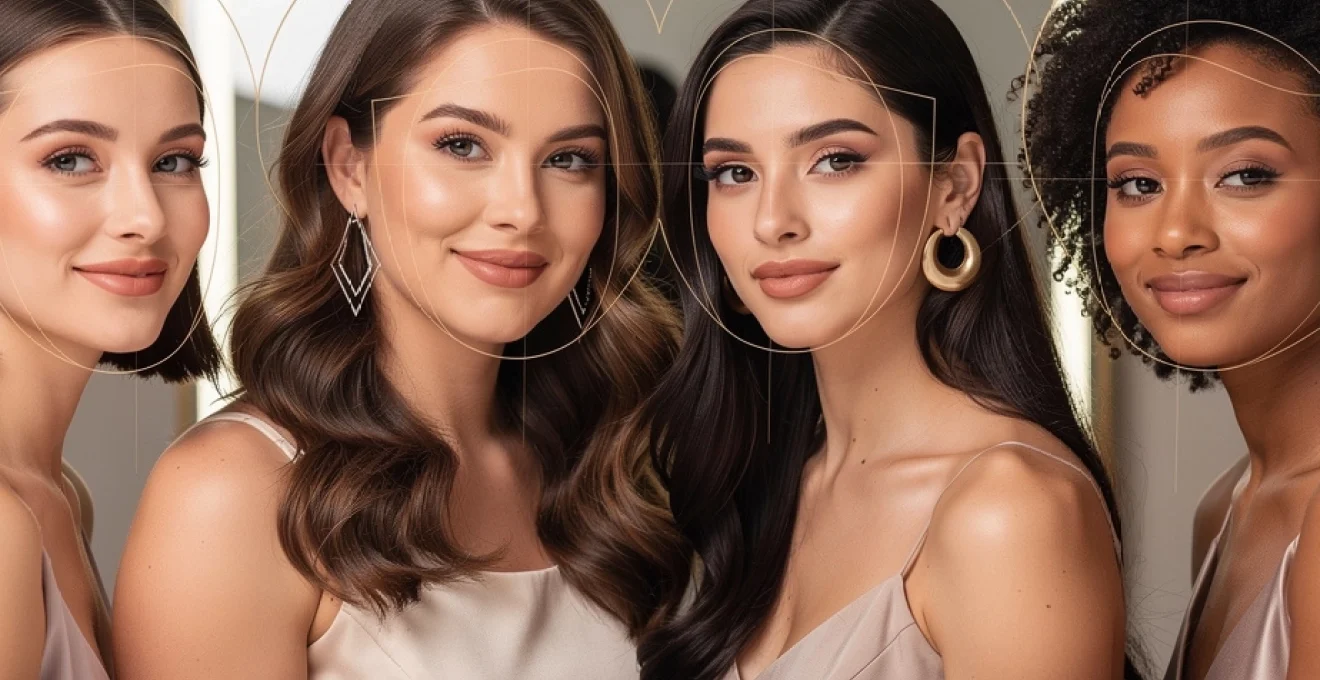
The artistry of earring selection extends far beyond simple aesthetic preference, transforming into a sophisticated science that harmonises facial proportions with jewellery design principles. Understanding how specific earring styles interact with your natural bone structure can dramatically enhance your overall appearance, creating visual balance and highlighting your most attractive features. This transformative approach to accessory selection has gained considerable momentum in recent fashion circles, with stylists and jewellery designers increasingly emphasising the importance of personalised earring curation based on individual facial geometry.
The relationship between facial architecture and earring selection operates on fundamental design principles that have guided aesthetic choices for centuries. Much like how skilled photographers use lighting and angles to create flattering portraits, the strategic selection of earrings can reshape perceptions of facial proportions. Contemporary research in fashion psychology indicates that well-chosen accessories can increase confidence levels by up to 23%, whilst simultaneously improving how others perceive your overall style sophistication.
Face shape analysis and classification systems for earring selection
Professional face shape analysis requires a systematic approach that moves beyond casual mirror observations to embrace precise measurement techniques and geometric principles. The fashion industry has refined these classification systems over decades, developing standardised methods that consistently identify the six primary facial configurations: oval, round, square, heart-shaped, diamond, and elongated rectangular. Each classification carries distinct characteristics that influence how light reflects off facial planes and how accessories interact with natural bone structure.
Modern styling professionals employ sophisticated measurement ratios to determine facial classifications, moving beyond subjective visual assessments. This scientific approach ensures more accurate earring recommendations and eliminates the guesswork traditionally associated with accessory selection. The precision of these methods has revolutionised personal styling services, enabling consultants to provide mathematically-backed recommendations that consistently deliver flattering results.
Geometric face mapping techniques using golden ratio principles
The golden ratio, mathematically expressed as 1:1.618, provides the foundation for understanding ideal facial proportions and subsequently selecting complementary earring styles. Professional stylists utilise this ancient mathematical principle to assess how earring dimensions should relate to specific facial measurements. When facial features align closely with golden ratio proportions, certain earring styles can enhance this natural harmony, whilst faces that deviate from these ratios benefit from strategic earring choices that create visual balance.
Advanced face mapping techniques involve plotting key facial landmarks and calculating dimensional relationships between features. The distance between temples, cheekbone prominence, jawline width, and facial length all contribute to determining the most flattering earring styles. This methodical approach ensures that earring selection enhances rather than competes with your natural features, creating a sophisticated harmony that appears effortless.
Oval face structure characteristics and proportion measurements
Oval faces represent the aesthetic ideal in classical beauty standards, characterised by balanced proportions where facial length measures approximately 1.5 times the width at the cheekbones. The forehead width typically aligns with the cheekbone measurement, whilst the jawline tapers gently without sharp angular transitions. These harmonious proportions provide exceptional versatility in earring selection, as the balanced foundation rarely requires significant visual correction or enhancement.
Individuals with oval facial structures can successfully wear virtually any earring style, from delicate studs to dramatic chandelier designs. However, the most flattering choices avoid extreme proportions that might disrupt the natural balance. Medium-sized hoops, elegant drop earrings, and classic stud styles consistently enhance oval faces without overwhelming their inherent symmetry. The key lies in selecting pieces that complement rather than dominate the facial landscape.
Round face angular deficit analysis and compensation methods
Round facial structures present unique styling opportunities through strategic angular compensation techniques. These faces typically measure nearly equal in width and length, with soft curves dominating the jawline and cheekbone areas. The absence of sharp geometric lines creates a youthful, approachable appearance that benefits significantly from earring styles that introduce vertical elements and geometric definition.
Effective compensation methods for round faces focus on creating the illusion of length and adding structural elements that enhance facial definition. Long drop earrings, geometric designs with sharp angles, and vertically-oriented styles consistently deliver flattering results. The strategic introduction of angular elements through earring selection can transform the perception of facial proportions, creating a more sculpted and defined appearance
To avoid reinforcing the natural width of a round face, it is advisable to minimise very wide hoops, circular studs or button-style earrings that echo the facial outline. Instead, think of your earrings as architectural tools: by introducing slender vertical lines and subtle asymmetry, you create a more elongated visual path for the eye to follow. This deliberate contrast between soft facial curves and structured earring silhouettes is what ultimately delivers a more refined and sculpted impression.
Square face jawline prominence and softening requirements
Square faces are defined by a broad forehead, strong jawline, and relatively minimal taper from cheekbones to chin, creating an impression of visual strength and angular precision. From a geometric perspective, the width of the jaw and forehead are often very close, while the length of the face may be only marginally greater than its width. This facial architecture naturally draws attention to the lower third of the face, meaning that earring selection should prioritise softening and diffusion rather than further definition.
To balance jawline prominence, stylists typically favour earrings with curved profiles, fluid silhouettes, and gentle movement. Rounded hoops, soft teardrops, organic shapes and designs with subtle undulation introduce visual softness that counteracts the right angles of the jaw. When viewed front-on, these pieces create the impression of more gradual transitions between facial planes, effectively blurring the sharp corners that can otherwise appear dominant in photographs and direct lighting.
Earrings that are excessively angular, square, or rectangular tend to mirror the underlying bone structure and intensify perceived rigidity. Similarly, very short, wide studs that sit flush against the lobe may concentrate focus at jaw level, where the face is already broadest. Instead, medium-length drops that sit just below the jawline and earrings that incorporate circular or oval components help to guide the eye along a more graceful curve, resulting in a more harmonious and flattering frame for the face.
Heart-shaped face forehead-to-chin ratio assessment
Heart-shaped faces (sometimes classified as inverted triangles) are characterised by a noticeable width at the forehead that tapers towards a narrower, often pointed chin. From a measurement standpoint, the forehead width typically exceeds the jawline by a clear margin, and cheekbones are usually pronounced, creating a dynamic upper-third dominance. This forehead-to-chin ratio informs earring strategy: the styling objective is to visually widen the lower part of the face while subtly de-emphasising the upper regions.
Professional stylists often use earrings to redistribute visual weight downward, counterbalancing the broad upper third. Designs that are narrower at the top and wider at the bottom—such as pear drops, triangular silhouettes that flare toward the end, and chandeliers with a soft, spreading profile—work particularly well. These shapes echo the inverse of the face’s outline, filling out the jawline area and creating a sense of equilibrium between forehead and chin.
Compact studs or very top-heavy designs, by contrast, tend to concentrate attention around the widest part of a heart-shaped face, exaggerating the forehead-to-chin disparity. When you select earrings that introduce volume and movement closer to the jaw, you effectively “anchor” the look, allowing your eyes and lips to become the focal points rather than the hairline. This approach is especially powerful in updo hairstyles or when wearing high necklines, where the lower face benefits from additional visual support.
Earring geometry and proportional design principles
Once facial classification is established, the next step is understanding how earring geometry interacts with your individual proportions. In the same way that architects balance height, width, and structural lines to achieve pleasing skylines, jewellery designers balance drop length, diameter, and silhouette to complement the human face. Applying proportional design principles to earring selection ensures that each piece works with your features, not against them, enhancing facial symmetry and perceived harmony.
Three geometric dimensions dominate this conversation: vertical drop (how far earrings extend below the lobe), horizontal spread (such as hoop diameter or cluster width), and contour line (whether the silhouette is angular, curved, or a hybrid of both). By calibrating these dimensions to your face length, width, and jaw structure, you can fine-tune your accessory choices for maximum impact. Rather than guessing, you begin to treat your reflection almost like a blueprint, adjusting the “lines” you add—your earrings—until the whole composition feels visually balanced.
Drop length calculations for facial balance enhancement
Drop length is one of the most powerful yet overlooked variables in choosing earrings that flatter your face shape. As a functional guideline, stylists often compare earring length to total face length (from hairline to chin), aiming to keep the drop within 30–50% of this measurement for everyday wear. For instance, if your face length measures 18 cm, a versatile drop length will typically sit between 5.5 and 9 cm, depending on whether you prefer subtle refinement or more dramatic elongation.
For round faces, drops that sit closer to the 40–50% range of face length help to create the illusion of vertical extension, particularly when the design remains slim and streamlined. In contrast, individuals with long or elongated rectangular faces usually benefit from shorter drops—around 20–35% of face length—to avoid visually stretching the face further. Here, the aim is to introduce width and presence near the midface, so medium-length drops with horizontal or cluster elements can be especially effective.
Square and heart-shaped faces occupy an intermediate zone where drop length should both soften and balance. Square faces are flattered by medium drops that end between the midpoint of the jaw and just below it, softening corners without overemphasising chin length. Heart-shaped faces often appear most harmonious when the drop extends to or slightly below the jawline, transferring visual weight to the narrower lower third. As with all ratio-based guidelines, the ultimate test is dynamic: noticing how the earrings look when you smile, speak, and move under different lighting conditions.
Hoop diameter specifications and face width correlations
Hoop earrings act like geometric frames around the face, making their diameter and thickness especially important. A practical way to calibrate hoop size is to compare hoop diameter to the widest horizontal measurement of your face (typically cheekbone width). For everyday balance, stylists often recommend hoop diameters in the range of 25–40% of this width. So if your cheekbones span 14 cm, hoops between 3.5 and 5.5 cm usually offer a flattering yet wearable proportion.
Round faces generally benefit from medium to large hoops that are slender rather than bulky, particularly elongated or oval hoops that introduce subtle verticality. These proportions counteract facial fullness without adding extra width. Square faces, on the other hand, respond well to wider circular hoops with softer edges, as the rounded contour offsets jawline sharpness. Very thick or heavy hoops, however, can drag the visual centre of gravity downward and may feel overpowering on smaller or more delicate faces.
Heart-shaped and oval faces enjoy a broad tolerance for hoop sizes, but the focus should be on where the lowest point of the hoop sits relative to the jaw. For heart-shaped faces, hoops that align with or sit slightly below the jawline help widen the lower third. For long faces, compact huggies or small-to-medium hoops that sit close to the lobe add width without adding length, acting almost like a horizontal “punctuation mark” that breaks up vertical space. When in doubt, opt for slim, mid-sized hoops as a baseline and adjust up or down in diameter depending on the visual effect you prefer.
Stud size scaling based on earlobe proportions
Although studs are often viewed as a universal default, their size in relation to the earlobe can significantly impact overall facial harmony. A useful proportional benchmark is to ensure that the visible diameter of a round stud does not exceed 60–70% of your earlobe height. For example, if your earlobe measures approximately 10 mm from piercing to lower edge, studs between 4 and 7 mm will typically appear balanced, whereas larger designs may start to dominate the area and feel visually heavy.
On more delicate or narrow faces—particularly heart-shaped or diamond configurations—oversized studs can concentrate too much attention at the upper half of the face, particularly when worn with pulled-back hairstyles. In these instances, smaller solitaire studs, understated pearls, or minimalist geometric designs provide sparkle without overwhelming the facial canvas. Round faces can handle slightly larger studs, but should still avoid very wide, flat discs that echo facial roundness; faceted or irregular shapes help to introduce subtle definition.
For square and oval faces, stud size can be more experimental, especially for evening wear. Square faces pair well with softly rounded or cushion-cut studs that contrast with jawline angles, while oval faces can wear everything from micro-studs to bold statement pieces. To maintain comfort and prevent lobe stretching, it is advisable to consider not just front-on size but also the depth and weight of the stud; designs that appear moderate from the front may still feel heavy if constructed in dense materials.
Angular vs curved earring silhouettes for feature harmonisation
The contour of an earring—whether primarily angular or curved—plays a critical role in harmonising with or counterbalancing your facial structure. Think of these contours as visual “rhymes” or “counterpoints” to the lines of your face. Angular silhouettes (triangles, rectangles, sharp geometric motifs) add structure and emphasise edges, making them ideal for soft or rounded features that benefit from definition. Curved silhouettes (circles, ovals, waves, teardrops) diffuse sharpness and introduce fluidity, ideal for faces with prominent angles.
Round faces gain particular benefit from earrings with vertical angles and clean lines, such as slim bars, geometric drops, or faceted shapes; these pieces create visual “edges” where the face has none, sharpening the overall impression. Conversely, square and diamond-shaped faces typically look more balanced in rounded hoops, oval drops, or organic, nature-inspired motifs that soften strong cheekbones and jawlines. In this way, earring silhouette functions much like contouring in makeup: angular for lift and structure, curved for softness and diffusion.
Oval and heart-shaped faces sit in a flexible middle ground, able to accommodate both angular and curved designs depending on the desired effect. Heart-shaped faces often benefit from a hybrid approach: subtle angularity at the bottom of earrings to add width near the chin, combined with softer curves near the top to prevent hardening the eye area. Ultimately, your choice of angular versus curved silhouettes allows you to fine-tune how assertive or gentle your features appear, offering a powerful styling lever for both everyday and formal looks.
Material selection and visual weight distribution
Beyond geometry, the materials you choose—metals, gemstones, pearls, and alternative finishes—directly influence visual weight, which is how heavy or dominant an earring appears on the face. Highly reflective metals, saturated gemstones, and dense shapes naturally draw more attention than matte finishes or translucent stones, even when their physical weight is similar. Understanding this distinction allows you to tailor your earrings not only to your face shape, but also to your comfort level and styling goals.
For smaller or more delicate facial structures, lightweight materials such as fine-gauge precious metals, resin accents, or petite pearls often provide enough visual impact without overwhelming features. In particular, individuals with heart-shaped or diamond faces may prefer to keep the upper portions of their earrings lighter in tone and mass, concentrating bolder materials toward the lower half to balance a narrower chin. This strategic distribution of visual weight supports the overall face shape while maintaining comfort throughout the day.
Those with square, round, or elongated rectangular faces can generally accommodate slightly more substantial earrings, especially when the design helps correct or balance proportions. For example, a long rectangular face might benefit from medium-sized, low-sheen hoops in brushed metal that add width rather than height, whereas a round face may look best in polished metal linear drops that catch the light and vertically elongate the silhouette. In professional contexts, mid-sheen finishes (like satin or brushed metals) are often preferred, as they provide sophisticated reflection without the distraction of intense sparkle.
Material choice also intersects with lifestyle and sensitivity considerations. Hypoallergenic metals such as surgical steel, titanium, or high-karat gold can be essential for those with reactive skin, ensuring that design aspirations never compromise comfort. For extended wear, selecting earrings that feel almost weightless while still delivering the correct visual emphasis is key—particularly for statement looks. Designing your personal collection with a mix of “lightweight impact” pieces and more substantial, occasional styles ensures you always have suitable options that enhance your natural face shape and align with your daily demands.
Professional styling techniques for celebrity-inspired earring combinations
Celebrity stylists rarely rely on a single pair of earrings to do all the work; instead, they curate combinations that respond to face shape, outfit lines, and camera angles. By examining red carpet looks, you’ll notice a consistent principle at play: earrings are chosen to either reinforce or counteract the silhouette of the hairstyle, neckline, and facial structure. This intentional layering approach can easily be adapted to your own wardrobe, even if your day-to-day life is more boardroom than premiere.
For oval and heart-shaped faces, stylists often experiment with asymmetrical combinations—such as a statement drop on one side paired with a delicate stud or huggie on the other—to add visual intrigue without disturbing the underlying balance. This technique works particularly well when hair is tucked behind one ear or styled in a side part, allowing one earring to act as the primary focal point. The key is maintaining coherence in metal tone or motif so the look feels deliberate rather than mismatched.
Round and square faces frequently benefit from layered piercings that transition from angular or elongated shapes at the main lobe piercing to smaller, softer pieces higher up the ear. For instance, a slim bar or geometric drop in the primary piercing, paired with tiny curved huggies or micro hoops in secondary piercings, introduces structure at the lower half of the ear while softening the overall outline near the temple. This gradient of size and shape subtly sculpts the face when viewed from multiple angles—a technique stylists rely on for close-up photography.
For elongated and diamond-shaped faces, celebrity-inspired styling often centres on building horizontal interest. Multiple small hoops stacked along the ear, clustered studs, or ear climbers that travel upward rather than downward can all help create the impression of width. When you combine this with strategic hair placement—such as soft waves that frame the cheekbones—you achieve a look that feels luxurious but remains proportionally balanced. Ask yourself: from three metres away, which features do you want to draw attention to? Then let your earring combinations act like subtle spotlights, directing the viewer’s eye accordingly.
Colour theory applications in earring selection for skin undertones
Colour theory plays a crucial role in ensuring that your earrings do more than just flatter your face shape; they should also enliven your complexion. At a foundational level, professionals consider three main skin undertone categories—warm, cool, and neutral—when recommending metals and gemstones. Warm undertones (often associated with golden, peach, or olive hints) tend to glow in yellow gold, rose gold, and warm-toned gemstones like citrine, garnet, and champagne diamonds. Cool undertones (with pink, red, or blue hints) are generally complemented by silver, white gold, and stones such as sapphire, amethyst, and icy diamonds.
Neutral undertones, which sit comfortably between warm and cool, enjoy broad flexibility and can move between metals depending on outfit and makeup. However, even within each undertone category, the interaction between colour and face shape still matters. For example, if you have a round face with warm undertones, choosing elongated drop earrings in warm metals with vertical lines of colour can both lengthen the face and enhance your natural glow. Similarly, a square-faced individual with cool undertones may find that rounded silver hoops with soft, cool stones effectively soften angularity while harmonising with their skin.
From a colour-blocking perspective, stylists often use earring colour to create contrast or continuity with hair and eye colour. Dark hair paired with deep-toned earrings can create a sophisticated, unified column that elongates the profile, particularly effective for round and heart-shaped faces. In contrast, high-contrast pairings (such as dark hair with bright, cool-toned earrings) can break up vertical lines and add interest around the midface—helpful for long or rectangular face shapes that benefit from visual segmentation.
Think of your earrings as small but powerful colour accents in the composition of your look. Are you aiming to create warmth and approachability, or crisp modernity and definition? Warm metallics and earthy stones typically soften and humanise, while cool metals and high-contrast gems sharpen and dramatise. By aligning your earring palette with your skin undertone and your desired mood, you ensure that the colour of your jewellery enhances your natural radiance rather than competing with it.
Hair length and texture considerations in earring visibility optimisation
Even the most carefully selected earrings must contend with one final variable: your hair. Hair length, volume, and texture can dramatically alter how visible your earrings are and how they interact with your face shape. Long, dense, or curly hair can partially obscure smaller styles, effectively reducing their visual footprint, while short, fine, or tightly styled hair leaves earrings fully exposed and more dominant in the overall look. Accounting for this factor allows you to choose designs that maintain presence, even when partially veiled by your hairstyle.
For individuals with long or voluminous hair, especially in wavy or curly textures, medium to long earrings with defined outlines and a touch of movement tend to remain visible. Think elongated drops, sculptural hoops, or angular designs that can peek through layers of hair as you move. If your face is round or square, this is an opportunity to double down on elongating or softening shapes, respectively, knowing that the hair will naturally diffuse some of the earring’s intensity. In essence, hair acts as a semi-transparent frame, so the earring design must be strong enough to read through it.
Short styles, pixie cuts, and sleek updos expose the entire ear and jawline, magnifying the impact of your earrings. For heart-shaped or diamond faces, this means that any top-heavy or overly large stud will dominate the upper half of the face, so you may wish to prioritise balanced drops or medium hoops that bring focus closer to the chin. Those with long or rectangular faces can use small-to-medium studs, clustered designs, or horizontal ear cuffs to introduce width around the midface, taking full advantage of the clean backdrop a short hairstyle provides.
Hair parting and styling details also matter. A deep side part that reveals one ear more than the other invites asymmetrical earring styling, while centre parts and evenly distributed hair call for symmetrical designs to maintain balance. If you regularly transition between wearing your hair up and down in a single day, consider versatile pieces—such as structured medium hoops or convertible drop-and-stud sets—that remain flattering under both conditions. By viewing your hair and earrings as a coordinated system rather than separate elements, you ensure that each supports your natural face shape and elevates your overall appearance.