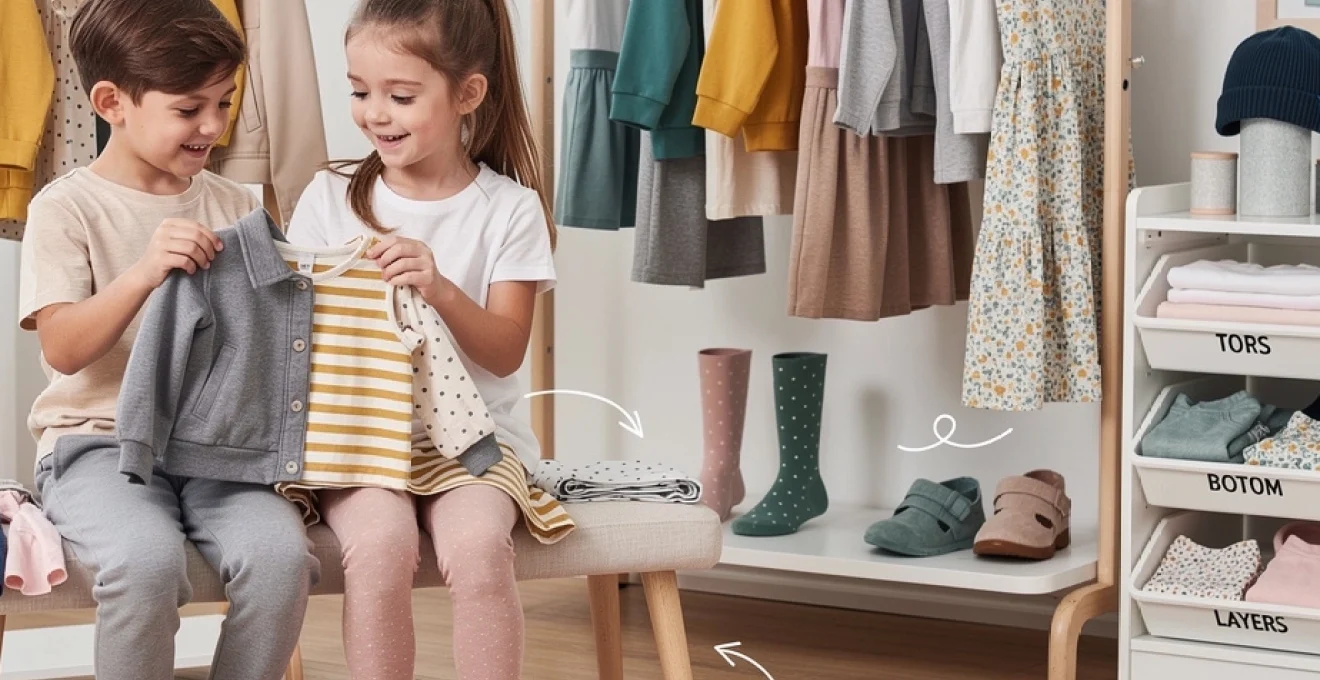
The chaotic morning routine of dressing children can transform from daily battlefield to smooth operation with one strategic approach: building a capsule wardrobe designed for effortless mixing and matching. Rather than filling wardrobes with countless garments that rarely coordinate, parents can create exponentially more outfit combinations with significantly fewer, carefully selected pieces. This approach not only saves money and reduces clutter but also empowers children to dress independently whilst looking put-together every single day.
The mathematics behind capsule wardrobing is remarkably compelling. With just twelve thoughtfully chosen items, you can create over forty distinct outfit combinations. This isn’t merely theoretical—it’s a practical reality that countless families have successfully implemented. The secret lies in understanding colour coordination, fabric compatibility, and strategic garment selection that prioritises versatility without sacrificing style or comfort.
Capsule wardrobe architecture: building a core foundation with 10-15 essential pieces
Constructing an effective children’s capsule wardrobe begins with recognising that foundation pieces serve as the backbone of countless combinations. Unlike adult wardrobes that might prioritise fashion trends, children’s capsules must balance durability with growth accommodation whilst maintaining sufficient visual appeal to encourage independent dressing. The ideal capsule contains approximately 10-15 items that coordinate seamlessly, allowing your child to select virtually any combination with confidence that the result will be both appropriate and attractive.
Selecting neutral base colours for maximum versatility in children’s clothing
The cornerstone of any successful mix-and-match wardrobe rests upon a carefully curated palette of neutral base colours. Rather than defaulting exclusively to black, white, and grey—which can appear overly mature for children—consider expanding your neutral foundation to include navy, olive green, camel, and soft grey. These colours provide sophisticated coordination opportunities whilst maintaining an age-appropriate aesthetic that children genuinely enjoy wearing.
Navy proves particularly valuable as it pairs beautifully with virtually every accent colour whilst being far more forgiving of stains and wear than stark white. Similarly, soft grey serves as an excellent alternative to black, offering comparable versatility without the severity. When selecting neutral pieces, aim for approximately 60-70% of your capsule wardrobe to consist of these foundational colours, with the remaining percentage allocated to accent colours and patterns that reflect your child’s personality and preferences.
The 5-piece bottom strategy: trousers, leggings, and skirts that multiply outfit options
The bottom half of outfits typically receives less visual attention than tops, making this category ideal for strategic minimalism. A well-planned selection of five versatile bottoms can pair with virtually every top in the wardrobe, instantly multiplying your outfit possibilities. Consider this strategic combination: one pair of dark denim jeans, one pair of navy or grey joggers, one pair of stretchy leggings in a neutral tone, one versatile skirt or shorts in a complementary neutral, and one additional bottom in either a coordinating colour or simple pattern.
This five-piece approach ensures you have appropriate bottoms for every activity and weather condition without overwhelming storage space or decision-making processes. The key lies in selecting pieces with compatible colour tones that harmonise with your chosen neutral palette. Dark denim, for instance, pairs effortlessly with virtually every top colour, whilst navy joggers provide comfortable versatility that transitions seamlessly from playground to family gatherings.
Layering fundamentals: vests, cardigans, and lightweight jumpers as multipliers
Layering pieces function as wardrobe multipliers, transforming basic outfits into varied looks whilst providing practical temperature regulation for unpredictable children who fluctuate between too hot and too cold throughout the day. A strategic selection of three to four layering pieces can dramatically expand your outfit combinations whilst teaching children valuable lessons about adapting their clothing to changing conditions.
Consider incorporating a lightweight cardigan in a neutral tone, a zip-up hoodie in a complementary colour, and perhaps a denim jacket or gilet that adds textural interest. These pieces should coordinate with both your neutral foundation and accent colours, ensuring they enhance rather than complicate the mixing process. The beauty of quality layering pieces lies in their ability to make a
same t-shirt and jeans feel new again simply by changing what sits over the top. Over a week, those three or four layers can turn a small rotation of basics into what feels like an endlessly fresh set of mix-and-match outfits for kids.
Investment pieces versus fast fashion: durability testing for high-rotation garments
When you rely on a minimal wardrobe, each item works harder, so durability becomes non-negotiable. While fast-fashion bargains can be tempting, repeatedly replacing worn-out leggings or stretched collars quickly becomes more expensive than investing in a few higher-quality pieces. Look for reinforced stitching at stress points, dense yet soft fabrics that bounce back after washing, and waistbands that retain elasticity rather than twisting or rolling after a few wears.
One simple test when shopping for mix-and-match kids’ clothes is the “scrunch and stretch” method: lightly scrunch the fabric in your hand for a few seconds, then release. If it remains badly creased or feels thin and papery, it is unlikely to survive weekly wear. You can also check inside seams for loose threads and feel whether knees and elbows have adequate reinforcement for playground activity. Investment pieces do not need to be designer; many mid-range brands offer hard-wearing cotton jerseys, French terry, and denim designed for multiple children to wear in succession.
Another consideration is colourfastness, especially if you are building a capsule wardrobe around a tight colour palette. High-rotation garments that fade unevenly can quickly disrupt the cohesion of your interchangeable wardrobe. Opt for garments labelled colourfast where possible and wash new pieces inside out on cooler cycles. When a single navy jogger can anchor half your weekly outfits, spending a little more upfront to avoid thinning fabric and washed-out colour is often the most economical and sustainable choice.
Colour theory and pattern coordination for effortless mix-and-match combinations
Colour theory might sound technical, but in practice it is one of the easiest tools for creating mix-and-match outfits for kids that always look intentional. When every item in the wardrobe sits within a cohesive palette, your child can reach for almost anything and still emerge looking coordinated. Rather than relying on guesswork each morning, you are building a simple visual system that does the heavy lifting for you.
Children are naturally drawn to bright, expressive colours and playful patterns, so our goal is not to suppress that joy but to frame it. By anchoring colourful pieces with thoughtfully chosen neutrals and using clear rules about how many colours to combine, we can keep outfits fun without drifting into chaos. The result is a wardrobe that feels creative and expressive for your child, yet remains easy to manage and pair for you.
The rule of three: creating cohesive colour palettes for interchangeable wardrobes
One of the most effective tools for building a small, interchangeable wardrobe is the Rule of Three. Instead of buying clothes in every shade your child likes, choose three main colours for a season: one or two neutrals and one accent. For example, you might choose navy, soft grey, and mustard for autumn, or cream, denim blue, and coral for spring. Everything you purchase for that period should sit comfortably within this trio.
Within each outfit, the Rule of Three also suggests limiting visible colours to three at a time. This does not include very small details, such as a multicoloured graphic or tiny trim, but it does apply to the main blocks of colour in tops, bottoms, and layers. Why does this work so well for mix-and-match kids’ clothes? Because it creates instant cohesion: any cardigan, t-shirt, and pair of trousers that share a palette will almost always work together, even যখন you are dressing in a hurry.
If your child is especially drawn to bright colours, you can rotate accent colours by season while keeping neutrals consistent. For instance, navy and grey can stay constant all year, while accents shift from yellow in spring to rust in autumn. This approach means that new purchases automatically integrate with older pieces, further multiplying outfit options without requiring a complete wardrobe overhaul.
Strategic pattern mixing: stripes, polka dots, and florals in complementary scales
Patterns are often where parents feel least confident, yet they are also where children have the most fun. The key to successful pattern mixing in a small wardrobe is to treat patterns as you would treat spices in cooking: a little goes a long way, and balance is everything. Start by choosing two or three pattern types that repeat across the wardrobe—such as stripes, polka dots, and a simple floral—rather than introducing every motif on the shop rail.
To keep patterned outfits harmonious, focus on scale and shared colours. Pair a large-scale floral skirt with a fine striped top, or bold polka dot leggings with a tiny heart-print t-shirt that shares at least one common colour. One pattern should always play the “lead role” while the other takes a supporting position, much like a main character and a side character in a story. This stops two strong prints from visually competing and making the outfit feel overwhelming.
Another helpful guideline is to treat certain subtle patterns as near-neutrals within your mix-and-match outfits for kids. Very fine stripes in navy and white, micro-dots on soft grey, or textured knit patterns in a single colour can pair with almost anything. When you view these pieces as flexible bases rather than statement items, you open up many more combination possibilities without visually overloading the outfit.
Monochromatic layering techniques for foolproof daily dressing
On the busiest mornings, monochromatic dressing can be your best ally. Monochromatic outfits use variations of a single colour family—such as different blues or soft earth tones—to create a polished, intentional look with minimal effort. For children, this approach is particularly effective because it allows them to choose freely within a drawer or section of the wardrobe, knowing that everything there already belongs to the same colour story.
To build monochromatic mix-and-match outfits for kids, start with one dominant colour like blue, green, or pink, and introduce lighter and darker versions of that hue. A pale blue t-shirt, mid-blue joggers, and a navy hoodie, for example, create depth without clashing. Textures also play an important role: mixing denim, jersey, and knitwear within the same colour family stops the outfit from feeling flat or uniform.
Monochromatic dressing can also be used as a calming counterbalance for particularly bold or patterned items. If your child has a favourite vibrant jumper or printed jacket, pair it with bottoms and layers that sit within the same colour family but are less intense. This way, your child still enjoys their statement piece, but you maintain a cohesive, easy-to-wear wardrobe that works hard across multiple seasons.
Fabric selection and seasonal transitions for year-round outfit flexibility
Careful fabric selection is essential when you are relying on a small number of garments to cover changing weather and high activity levels. The right fabrics allow pieces to transition between seasons with just a few strategic layers, greatly increasing the number of mix-and-match outfits your child can create. Instead of buying entirely separate wardrobes for summer and winter, you are building a continuum where most items serve multiple roles throughout the year.
When evaluating fabrics, consider three key criteria: breathability, stretch, and resilience. Children run hotter and move more than adults, so materials that trap heat or restrict movement quickly become unworn clutter. At the same time, fabrics must be robust enough to withstand regular washing, grass stains, and the occasional craft-session mishap without losing shape. By prioritising a small group of well-chosen textiles, you can create a comfortable, low-maintenance wardrobe that truly earns its space.
Cotton jersey and french terry: all-season foundation fabrics for active children
Cotton jersey and French terry are the unsung heroes of all-season kids’ capsule wardrobes. Cotton jersey—the fabric used for most quality t-shirts—is soft, breathable, and has enough natural stretch to accommodate climbing, jumping, and floor-sitting without feeling restrictive. In summer, a single jersey layer keeps children cool; in cooler months, these same tops become base layers under jumpers or cardigans.
French terry, recognised by its smooth exterior and tiny loops on the inside, is ideal for joggers, sweatshirts, and casual dresses. It is warmer than plain jersey yet lighter and more flexible than traditional fleece, making it a superb layering fabric. With one or two French terry jumpers and a pair of joggers in your neutral colour palette, you can bridge the gap between seasons and adapt quickly to fluctuating temperatures.
These fabrics also perform exceptionally well in the laundry, which is crucial when your child’s entire selection of mix-and-match outfits relies heavily on a few core pieces. They dry relatively quickly, resist pilling when made from quality yarns, and are less prone to shrinking if washed according to care instructions. As you audit or build your child’s wardrobe, prioritising cotton jersey and French terry for high-rotation items will give you the best return on both comfort and durability.
Transitional layering: converting summer pieces into autumn outfits with strategic additions
One of the most powerful advantages of a thoughtfully built capsule wardrobe is the ability to carry favourite pieces from one season into the next. Rather than packing away all summer dresses and shorts in September, you can extend their life with clever layering. This approach not only stretches your budget but also ensures your child gets more wear out of garments they love.
Think of summer clothes as the base layer in your mix-and-match system. A sleeveless dress can be worn over a long-sleeve cotton tee and paired with ribbed tights and ankle boots for autumn. Lightweight shorts can transition into cooler weather when combined with thick leggings, cosy socks, and a French terry sweatshirt. Even airy cotton skirts can work year-round with the right thermal base layer and a snug cardigan.
To make transitional layering effortless, it helps to keep a small set of season-spanning accessories within the same colour palette as your main wardrobe. Beanies, scarves, and thicker socks in your chosen neutrals or accent colours act like “connectors,” visually tying together summer prints with autumn textures. In practice, this means your child can continue to enjoy familiar favourites while you maintain a lean, efficient collection of clothes.
Breathable synthetic blends versus natural fibres in high-activity garments
When dressing highly active children, the debate between natural fibres and synthetics often centres on comfort versus performance. Natural fibres like cotton and bamboo are breathable, gentle on sensitive skin, and excellent for everyday wear. However, they can sometimes struggle with moisture management in very active situations, such as sports or outdoor clubs, where sweat-wicking and rapid drying become more important.
Breathable synthetic blends—such as polyester or nylon mixed with elastane—offer advantages for specific high-activity garments within a mix-and-match kids’ wardrobe. These fabrics can wick moisture away from the skin, dry quickly after a downpour or an impromptu water fight, and often resist abrasion better than pure cotton. Used sparingly for items like sports leggings, base layers, or outer shells, they can complement your natural-fibre foundations without dominating the wardrobe.
For most families, a hybrid approach works best. Reserve predominantly synthetic fabrics for performance pieces worn a few times a week, and keep everyday tops, leggings, and pyjamas in soft natural fibres for maximum comfort. Always check for breathable weaves or mesh panels in synthetic items and avoid heavy, plasticky fabrics that trap heat. By striking the right balance, you ensure your child’s mix-and-match outfits remain both practical and pleasant to wear, whatever their day holds.
Mathematical outfit combinations: calculating maximum wardrobe output from minimal investment
One of the most persuasive arguments for creating mix-and-match outfits for kids with minimal pieces is the raw mathematics behind it. When every top can pair with every bottom, and each can be layered with two or three outer pieces, the number of possible outfits multiplies rapidly. Rather than guessing, we can use simple combinatorics to understand exactly how much value we are getting from a well-designed capsule wardrobe.
Imagine a small wardrobe consisting of six tops, five bottoms, and three layering pieces that all coordinate. At its simplest, the number of basic outfits (top + bottom) is 6 × 5 = 30. If each of those 30 outfits can be worn with any of the three layers, you suddenly have up to 90 visually distinct combinations. Even if, in reality, your child favours certain pairings, you still gain an enormous amount of variety from just 14 items.
Of course, not every theoretical combination will be practical or loved, but even using a conservative estimate can be eye-opening. If your child regularly wears just half of those 90 combinations, that still offers more than one unique outfit for every school day across an entire term. When you compare this with an overflowing wardrobe where many pieces clash and go unworn, the benefit of a carefully planned, mathematically efficient capsule becomes clear.
Practical organisation systems: visual wardrobe planning for independent dressing
Even the most perfectly curated capsule wardrobe will underperform if it is difficult to see and access. Organisation is where theory becomes everyday reality, particularly if your goal is to help your child dress independently. By arranging clothes in a way that visually supports mix-and-match dressing, you turn a chest of drawers or wardrobe rail into a simple, intuitive system your child can understand at a glance.
The aim is to reduce decision fatigue by limiting visible options without restricting creativity. Instead of stacking all trousers in one deep pile or cramming tops onto a single hangar, we group compatible pieces and make categories clear. This way, your child knows exactly where to look for neutral leggings, favourite graphic tees, or warm layers, and can experiment within safe boundaries that still result in coordinated outfits.
The hanger method: grouping compatible pieces for child-led outfit selection
For children who respond well to visual prompts, the hanger method is a simple but powerful tool. Rather than hanging each garment in isolation, you group compatible tops, bottoms, and layers together on a small cluster of hangers. Think of it as creating “mini capsules” within the wardrobe: one rail section for school-appropriate outfits, another for weekends, and perhaps a small section for smart-casual events.
You might, for instance, hang a navy cardigan beside two or three tops and two bottoms that all coordinate with it. Your child can then choose any combination from that cluster and know it will work. Over time, as they become more confident in mixing and matching kids’ clothes, you can loosen these groupings and encourage them to combine pieces from different sections, still anchored by your overall colour palette.
This method is particularly effective for younger children or those who find too many choices overwhelming. By editing what is visible while still offering variety, you maintain the benefits of a capsule wardrobe without sacrificing autonomy. As a result, morning routines become smoother, and your child gains a sense of ownership over their style and daily dressing decisions.
Drawer dividers and categorisation techniques for easy morning routines
Not every household has the space for extensive hanging storage, which is where drawer dividers and clear categorisation become invaluable. Instead of one large drawer packed with a jumble of items, use simple dividers or small boxes to create dedicated zones: one for neutral leggings and joggers, one for everyday tops, one for “fun” statement pieces, and one for underwear and socks. When your child opens the drawer, they instantly see building blocks for mix-and-match outfits grouped in a logical way.
Folding clothes using a vertical method—so that items stand upright rather than stacked—further supports independent dressing. Each piece becomes a “card” in a visual deck, easy to flip through without dismantling the entire pile. You might, for example, keep all neutral tops in one divider at the front and brighter, patterned tops at the back, subtly guiding your child to create balanced outfits.
Consistency is crucial. Once you decide on a categorisation system, try to maintain it across seasons, simply swapping out heavier items for lighter ones within the same sections. Labelling drawers with simple words or icons can also help pre-readers identify where each type of clothing belongs. Over time, this clear structure transforms busy mornings from a frantic search into a quick, almost automatic routine.
Weekly outfit planning charts: teaching children mix-and-match principles
If your mornings are particularly rushed—or your child enjoys planning ahead—a weekly outfit chart can be a game-changing addition. This might be as simple as a magnetic board, a whiteboard, or a printed sheet with spaces for each day of the week. Together, you and your child can choose outfits for school, activities, and weekend plans in one relaxed planning session, perhaps on a Sunday evening.
As you fill in the chart, talk through your mix-and-match logic: “We chose the navy joggers because they go with three of your favourite tops,” or “This cardigan works with both Monday’s dress and Thursday’s jeans.” In doing so, you are not only reducing weekday stress but also explicitly teaching your child the principles behind a capsule wardrobe. Over time, they begin to internalise concepts like neutral bases, accent colours, and layering.
Once your child understands the system, you can gradually hand over responsibility. Ask them to propose outfits for the chart while you simply check for weather appropriateness or school requirements. This collaborative approach nurtures independence and problem-solving, turning dressing from a point of friction into a small, daily exercise in creativity and planning.
Sustainable fashion practices: extending garment lifespan through strategic purchasing
Building mix-and-match outfits for kids with minimal pieces naturally aligns with sustainable fashion principles. When every item is chosen carefully, worn frequently, and maintained well, we reduce waste, lower our environmental footprint, and model thoughtful consumption for our children. A capsule wardrobe encourages us to ask, “Will this piece work with at least three others?” before purchasing, rather than buying on impulse.
Strategic purchasing begins with checking fibre content, construction quality, and care instructions. Opting for robust, easy-care fabrics and classic shapes makes it easier to pass garments down to siblings or friends, further extending their useful life. Choosing slightly adjustable features—such as elasticated waists, turn-up cuffs, or dresses that can be worn as tunics as your child grows—also maximises longevity without sacrificing comfort.
Repair and care habits play an equally important role. Learning to mend small holes, replace buttons, or reinforce thinning knees can add months or even years to a garment’s lifespan. Washing at lower temperatures, air-drying when possible, and turning printed pieces inside out all help preserve colour and fabric strength. When an item truly reaches the end of its wearable life, consider repurposing it into cleaning cloths, hair accessories, or craft materials, rather than sending it straight to landfill.
By framing these choices as part of your family’s values, you give your child a powerful early lesson in responsibility and respect—for their belongings, for the people who made their clothes, and for the planet. In this way, a small, well-planned wardrobe does more than save time and money; it becomes a quiet, everyday expression of mindful living.