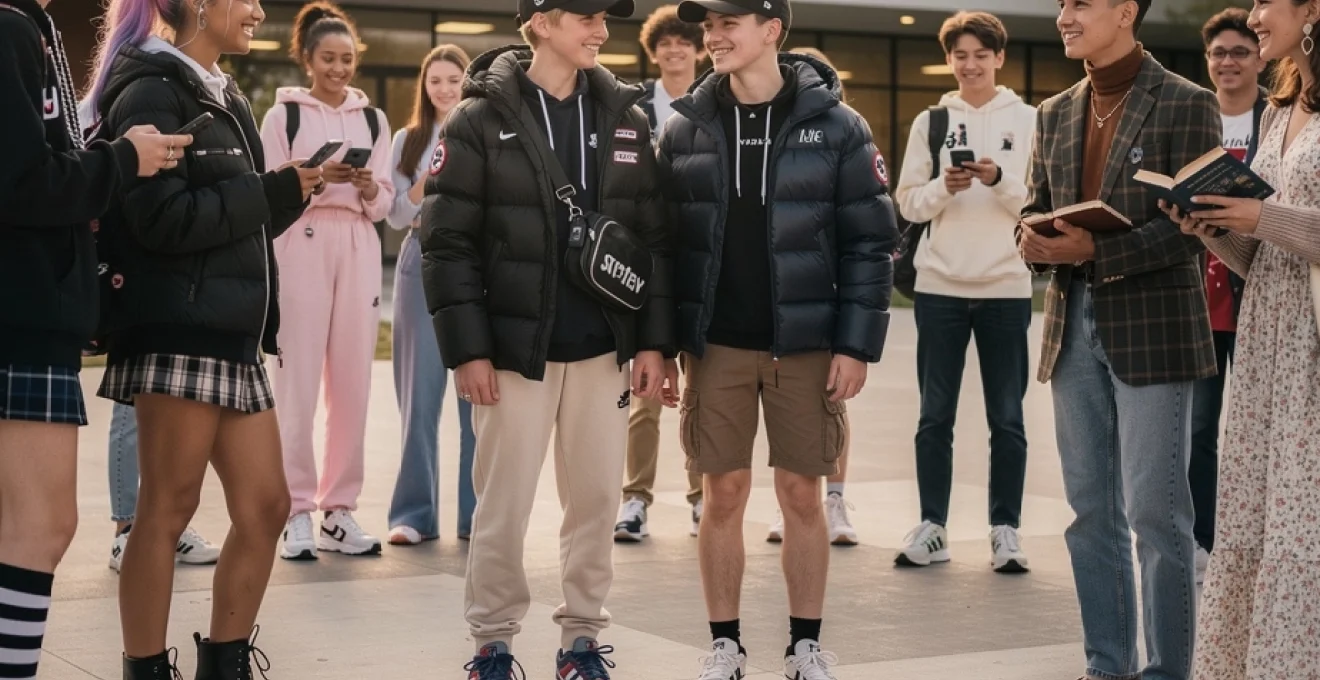
The clothes teenagers wear serve as far more than practical necessities—they function as complex social signifiers, identity markers, and belonging badges in the intricate ecosystem of adolescent life. During these formative years, fashion choices become deeply intertwined with peer relationships, creating a dynamic where acceptance, status, and self-expression collide. Research consistently demonstrates that 87% of Gen Z respondents admit their friends significantly influence their clothing choices, revealing the profound power of peer networks in shaping consumer behaviour. This influence manifests through subtle social cues, digital interactions, and the fundamental human need for tribal belonging that intensifies during the teenage years.
Understanding how peer influence operates within teenage fashion ecosystems requires examining the psychological mechanisms, digital platforms, subcultural movements, and socioeconomic factors that collectively shape what young people choose to wear. The modern adolescent navigates a landscape vastly different from previous generations, where physical school corridors intersect with digital social spaces, creating amplified opportunities for both connection and comparison. This multidimensional influence network has transformed fashion from a personal preference into a sophisticated social language with its own rules, hierarchies, and constantly evolving vocabulary.
Psychological mechanisms behind adolescent conformity and social acceptance through fashion
The teenage brain undergoes remarkable development, particularly in regions governing social cognition and reward processing. This neurological transformation creates a heightened sensitivity to peer approval that manifests powerfully in fashion decisions. Adolescents experience intensified activation in the ventral striatum—the brain’s reward centre—when receiving positive feedback from peers, making acceptance through appropriate clothing choices neurologically rewarding in ways adults may struggle to comprehend fully.
Social identity theory and In-Group fashion homogeneity among teenagers
Social Identity Theory, developed by Henri Tajfel, explains how individuals derive self-concept from perceived membership in social groups. For teenagers, clothing becomes a visible manifestation of group belonging, offering immediate visual confirmation of shared values and tribal affiliation. When a peer group collectively adopts specific brands, styles, or aesthetics, individual members face considerable psychological pressure to conform, as deviation threatens their position within the valued in-group. This homogeneity serves protective functions—reducing uncertainty about social standing whilst simultaneously broadcasting group membership to outsiders.
Research examining secondary school environments reveals distinct fashion clusters corresponding to social groupings, with remarkable consistency in brand preferences, silhouettes, and colour palettes within each group. Students unconsciously calibrate their wardrobes to mirror their desired social circle, creating fashion echo chambers where individual expression becomes subordinated to collective identity. This phenomenon transcends conscious decision-making, operating at subconscious levels where the brain continuously scans for alignment cues.
Fear of ostracism as a catalyst for trend adoption in secondary school environments
The fear of social exclusion represents one of humanity’s most primal anxieties, rooted in evolutionary history when ostracism genuinely threatened survival. Teenage brains exhibit heightened sensitivity to exclusion cues, processing social rejection in the same neural regions that register physical pain. This neurological reality transforms seemingly trivial fashion choices into high-stakes decisions with perceived social survival implications.
Within secondary school contexts, wearing the « wrong » trainers or outdated styles can trigger genuine anxiety about social positioning. Students report stress around outfit repetition, brand visibility, and aesthetic alignment with peer expectations. The unspoken uniform of acceptability shifts with remarkable speed, requiring constant vigilance and adaptation. Those unable to maintain pace—whether through financial constraints, parental restrictions, or personal preference—frequently experience marginalisation, confirming their fears and perpetuating conformity pressure throughout peer networks.
The halo effect and perceived status through brand alignment with popular peers
The Halo Effect describes how positive impressions in one area influence opinions in unrelated domains. When popular or high-status peers wear specific brands or styles, those items acquire transferred prestige through association. A previously unremarkable hoodie becomes desirable when adopted by admired classmates, demonstrating how peer influence operates beyond rational assessment of garment quality or personal aesthetic preference.
This mechanism explains the remarkable market power of peer-endorsed brands within teenage demographics. When influential students wear Nike Tech
Fleece, Trapstar, or a specific sneaker silhouette, their endorsement functions as an informal seal of approval. Other teenagers, keen to absorb some of that social capital, align their fashion choices accordingly, often prioritising brand alignment over genuine preference. Over time, these patterns can reshape individual taste, as repeated exposure and social rewards make once-neutral brands feel intrinsically more appealing and « right » for everyday wear.
The halo effect also contributes to entrenched status hierarchies within schools. Students who cannot access these high-status brands may be unfairly perceived as less fashionable, less confident, or even less competent, despite no objective difference in their abilities or personality. In this way, peer-influenced brand alignment reinforces broader inequalities, turning teenage fashion choices into a visible scoreboard of perceived worth that extends far beyond clothes themselves.
Cognitive dissonance reduction through fashion mirroring behaviours
Cognitive dissonance occurs when a person holds two conflicting beliefs or behaves in ways that contradict their self-image, creating psychological discomfort. In adolescent fashion, this often appears when teenagers privately dislike a trend but feel compelled to participate because their friends embrace it. To reduce internal tension, they may gradually convince themselves that they genuinely enjoy the style, retroactively aligning their preferences with their behaviour.
This process of dissonance reduction explains why some teens report « warming up » to a look they initially found unappealing once it becomes dominant in their peer group. Fashion mirroring—subtly copying the outfits, brands, and styling choices of close friends—serves as a shortcut to resolving the clash between wanting individuality and fearing exclusion. Over time, personal style can become a negotiated compromise between authentic taste and socially rewarded conformity, with the brain smoothing over contradictions to protect a coherent sense of self.
For parents, educators, and marketers, recognising cognitive dissonance in teenage fashion choices is crucial. When a young person insists they « love » a style that clearly causes them discomfort or financial strain, it may reflect internal pressure rather than genuine preference. Encouraging open conversations—asking, « Do you like this, or do you feel you should like it? »—can help teens disentangle external expectations from their own emerging fashion identity.
Digital platforms amplifying peer-to-peer fashion influence: TikTok, instagram, and VSCO culture
While school corridors once served as the primary runways of teenage fashion, digital platforms now operate as 24/7 style stages where outfits are curated, documented, and evaluated in real time. TikTok, Instagram, Snapchat, and photo-first apps like VSCO have dramatically amplified peer-to-peer influence by transforming everyday clothing into shareable content. Instead of seeing a few classmates’ outfits each day, teenagers now engage with hundreds of peer looks, micro-trends, and styling hacks before breakfast.
This constant visual exposure compresses trend cycles and intensifies comparison. A look can move from niche to ubiquitous within days, with algorithmic feeds pushing similar aesthetics to entire friend groups simultaneously. In this environment, teenage fashion choices become deeply entangled with performance, visibility, and social metrics—likes, comments, saves, and shares—turning peer influence into a quantifiable, public force.
Instagram aesthetic curation and the homogenisation of teen fashion vocabularies
Instagram encourages users to present a coherent visual identity, often referred to as an « aesthetic. » For teenagers, this can mean choosing clothes not just because they feel good in person, but because they « fit the grid »—the colour palette, mood, and vibe of their profile. As friend groups cross-pollinate ideas, we see increasing homogenisation of fashion vocabularies: similar poses, mirror selfies, outfit formulas, and go-to brands repeating across multiple accounts.
Popular teen aesthetics like « clean girl, » « streetwear minimalism, » or « soft girl » come with implicit dress codes: specific silhouettes, textures, and accessories that signal insider knowledge. When peers collectively embrace one of these codes, individual experimentation can feel risky—will an unusual print or second-hand jacket disrupt the carefully curated feed? Over time, Instagram can nudge teenagers toward safe, trend-led choices, narrowing the range of what feels socially acceptable to post and wear.
However, Instagram can also be a tool for conscious differentiation. Teens who follow diverse creators—thrifters, slow fashion advocates, or alternative style influencers—gain exposure to wider fashion ecosystems, which can support more authentic self-expression. Curating a feed that reflects varied body types, cultures, and price points helps counter the pressure to conform to a single dominant look.
Tiktok’s #OOTD challenges and viral trend acceleration among gen Z cohorts
TikTok has become a primary engine for viral fashion trends among Gen Z. Short-form videos featuring #OOTD (outfit of the day), « get ready with me » clips, and haul content enable teens to see complete looks in motion, often narrated with personal commentary. The platform’s algorithm rapidly amplifies successful content, meaning a specific hoodie, jean cut, or trainer style can jump from one user to millions of viewers overnight.
For teenagers, participating in these trends offers both creative fun and social validation. Recreating a viral outfit, using the same audio track, or stitching a popular creator’s video can serve as an informal badge of membership in a wider digital tribe. Yet this same mechanism fuels intense pressure to keep up with rapidly shifting micro-trends, especially when peers are tagging each other, sharing links, or comparing who managed to buy the latest drop first.
This acceleration has real-world consequences for teenage fashion consumption. Fast fashion retailers and direct-to-consumer brands monitor TikTok closely, rushing similar styles to market within weeks. As a result, the gap between seeing a trend and being able to purchase it has narrowed dramatically, further tightening the loop between peer endorsement, online visibility, and offline wardrobe decisions.
Bereal’s authenticity paradox and its impact on everyday teen fashion choices
BeReal, designed as an antidote to overly curated social media, prompts users to share unfiltered snapshots at random times each day. In theory, this reduces pressure to stage outfits and settings. In practice, many teenagers report an « authenticity paradox »: knowing they could be prompted at any moment, they still feel compelled to look casually presentable most of the time, just in case.
This subtle shift influences everyday fashion choices. Rather than dressing purely for comfort at home or during low-stakes activities, some teens opt for « camera-ready basics »—neat loungewear, coordinated athleisure, or branded hoodies that photograph well without seeming try-hard. The possibility of an unexpected peer audience reshapes their baseline outfits, blurring the boundary between public and private fashion.
Interestingly, BeReal can also normalise more realistic teenage wardrobes. When peers post in school uniforms, messy buns, or repeat outfits, it chips away at the illusion—common on Instagram—that everyone is constantly in new, on-trend clothes. For some, this shared vulnerability reduces pressure and encourages a more sustainable, less perfectionist approach to daily dressing.
Snapchat streaks and real-time peer fashion validation loops
Snapchat’s core features—ephemeral snaps and streaks—create continuous, low-effort visual check-ins between friends. Teens exchange quick mirror selfies, locker-room snaps, or pre-lesson outfit shots, inviting instant feedback in the form of emojis, comments, or screenshot « saves. » These micro-interactions form real-time validation loops where clothing choices are informally reviewed multiple times a day.
Because snaps disappear, experimentation can feel safer: a teen might test a bold jacket or new hairstyle in a private snap before wearing it to school. Positive reactions from trusted peers can boost confidence and encourage more adventurous fashion choices. On the other hand, lacklustre responses—or subtle teasing—can lead to rapid self-censorship, with teens abandoning looks that do not receive immediate digital approval.
Over time, this constant feedback cycle teaches teenagers which outfits earn the most praise within their peer network. Just as a musician refines a song based on audience reactions, teens refine their personal style according to Snapchat-mediated peer responses, reinforcing certain brands, colours, or silhouettes while quietly dropping others from rotation.
Subcultural fashion movements and micro-trend differentiation in teen communities
Not all teenage fashion is about blending in; many adolescents use clothing to signal alignment with specific subcultures and micro-communities. Online platforms have made it easier than ever to discover and join these style tribes, from E-girl aesthetics to Dark Academia. Within schools and digital spaces, these micro-trends function like miniature fashion dialects, offering both belonging and differentiation from mainstream norms.
These subcultural styles often operate as counter-narratives to dominant aesthetics. When a school environment is saturated with athleisure and streetwear, adopting a niche look becomes a way to stake out identity territory— »I am not like everyone else. » Yet even these alternative choices are shaped by peer influence, as teenagers look to like-minded friends and influencers for guidance on what constitutes authenticity within their chosen tribe.
E-girl and e-boy aesthetics: stratification within digital native peer groups
The E-girl and E-boy aesthetics, born largely on TikTok and Twitch, blend elements of emo, anime, grunge, and K-pop styling. Think dyed hair streaks, layered chains, heavy eyeliner, striped sleeves, oversized band tees, and platform shoes. Among digital-native teens, adopting this look signals membership in an online-first subculture that values gaming, alternative music, and internet humour.
Within peer groups, E-girl/E-boy fashion can create a distinct social stratum: those « in the know » versus those aligned with more conventional styles. Teens who embrace this aesthetic often report feeling simultaneously more visible and more niche; they may attract admiration from some classmates while facing misunderstanding or judgement from others. Peer influence operates strongly within the subculture itself, where specific brands, hairstyles, and makeup techniques become informal requirements for full belonging.
Because E-girl/E-boy aesthetics circulate heavily through outfit tutorials and transformation videos, younger teens may feel pressure to intensify their look over time—more dramatic hair colours, bolder makeup, or pricier accessories—to maintain credibility. Yet for many, this style also offers a powerful outlet for creativity and a community that validates emotional expression and vulnerability, aspects sometimes missing in mainstream fashion cultures.
Skater culture revival through brands like vans, thrasher, and supreme
Skater culture has experienced a notable revival among teenagers, even among those who do not skate. Brands like Vans, Thrasher, and Supreme function as shorthand for a laid-back, rebellious, and « effortlessly cool » identity. For male and female teens alike, incorporating these labels into outfits—checkerboard slip-ons, logo hoodies, beanies—signals alignment with a relaxed, anti-authoritarian ethos, whether or not it reflects their actual lifestyle.
Peer groups often coalesce around skate-inspired style, with friend circles developing shared uniforms of baggy jeans, graphic tees, and oversized flannels. In some schools, the skate look marks out a specific social niche distinct from athleisure or preppy aesthetics. Because many of these items are relatively unisex and durable, skater fashion also supports a more inclusive, gender-fluid approach to dressing that resonates with a broad spectrum of Gen Z identities.
However, the commodification of skate culture can generate tensions. Original skaters may feel that peers are wearing Thrasher or Supreme without understanding or respecting the community roots. This dynamic illustrates how fashion as social currency can dilute subcultural meanings when trends spread rapidly through peer networks and online platforms.
Dark academia and cottagecore: literary-inspired fashion tribes on pinterest
Dark Academia and Cottagecore represent two literary-inspired aesthetics that gained momentum through Pinterest, Tumblr, and later TikTok. Dark Academia romanticises libraries, classical studies, and gloomy campuses, translating into tweed blazers, turtlenecks, loafers, and muted tones. Cottagecore idealises rural simplicity and nature, favouring floral dresses, cardigans, and soft, earthy palettes. For many teens, these styles offer a fantasy escape from high-pressure academic and digital realities.
Peer influence in these communities often revolves around mood boards and shared inspiration boards. Friends swap pins, share second-hand finds, and stage themed photoshoots in parks, bookshops, or vintage cafés. Participating in these aesthetics allows teenagers to express intellectual interests, environmental values, or introverted tendencies through clothing, building micro-communities that extend beyond traditional school cliques.
At the same time, maintaining a fully curated Dark Academia or Cottagecore wardrobe can be resource-intensive. Teens without access to thrift shops, safe outdoor spaces, or specific garments may feel excluded from fully « embodying » the aesthetic. This highlights a broader tension: even supposedly gentle, alternative styles can create new forms of fashion gatekeeping when circulated through idealised, highly curated online imagery.
Hypebeast culture and limited-edition sneaker economies among male teenagers
Hypebeast culture, centred on limited-edition streetwear and sneakers, has a particularly strong presence among male teenagers. Brands like Supreme, Palace, Off-White, and collaborations between Nike, Adidas, and high-fashion designers release products in scarce quantities, creating artificial scarcity and intense demand. Within peer groups, owning a coveted pair of trainers or a rare hoodie functions as a status symbol and conversation starter, immediately elevating social standing among those who understand the market.
Teenagers navigate complex release calendars, raffles, and resale platforms to secure these items, often engaging in what amounts to a parallel economy. Some buy and resell sneakers for profit, leveraging knowledge of drops and market value to gain both financial and social capital. Others feel locked out due to high prices or lack of access, which can heighten feelings of exclusion when peers proudly display their latest acquisitions at school.
This ecosystem intensifies peer pressure around fashion spending. When classmates casually wear shoes reselling for hundreds of pounds, it can distort perceptions of what is « normal » or reasonable for teenage clothing budgets. For parents and educators, understanding hypebeast culture is key to contextualising why certain items carry outsized emotional weight and how peer dynamics in this space can influence risk-taking, financial decisions, and self-esteem.
Socioeconomic stratification and branded fashion as social currency in adolescent hierarchies
Teenage fashion does not exist in a vacuum; it reflects and reinforces broader socioeconomic divides. Logos, cuts, and even fabric quality can operate as visual shorthand for family income and social class. In many schools, branded clothing functions as social currency, with certain labels acting as tickets to higher-status peer groups and others marking perceived marginality.
These dynamics put particular pressure on teens from lower-income households, who may feel compelled to stretch budgets, work part-time jobs, or engage in risky behaviours to obtain the « right » brands. Conversely, teens with easier access to high-status labels can underestimate how much unearned advantage this confers in social interactions. Recognising branded fashion as a form of stratification helps explain why seemingly simple outfit choices can carry such emotional and relational weight in adolescent environments.
Nike tech fleece and trapstar as status signifiers in UK secondary schools
In many UK secondary schools, Nike Tech Fleece tracksuits and streetwear brands like Trapstar have become potent status signifiers. These items are associated with urban cool, athletic prowess, and social confidence, making them especially desirable among teenage boys but increasingly popular across genders. Wearing a full Nike Tech set, often in specific colourways, can instantly communicate that a teen is aligned with dominant peer trends and, by implication, socially savvy.
Because these garments are relatively expensive for most families, their visibility in school corridors can sharpen awareness of economic differences. Some students report feeling « less than » when their joggers or hoodies lack visible swooshes or brand logos, while others feel judged for wearing budget alternatives. In certain contexts, not owning Nike Tech or Trapstar can even become a basis for teasing, underscoring how fashion hierarchies map onto class-based insecurities.
Addressing these dynamics requires both cultural and practical responses. Schools that enforce uniform policies may reduce overt brand competition, but they do not eliminate the underlying desire for status expression. Open dialogue about consumer pressure, along with celebrating non-branded, creative, or second-hand style, can help weaken the automatic association between specific labels and social worth.
Fast fashion accessibility through shein and PrettyLittleThing for budget-conscious teens
Fast fashion retailers like Shein and PrettyLittleThing have become go-to destinations for budget-conscious teenagers seeking on-trend pieces. These platforms offer hundreds of new styles each week at very low prices, making it easier for teens to keep pace with rapidly evolving peer trends without the upfront cost of premium brands. For some, this accessibility can level the playing field, allowing participation in key looks even when household budgets are tight.
However, this model also introduces new pressures and ethical dilemmas. The sheer volume of cheap options can foster a mindset of disposability—wearing an outfit once for social media or a party, then moving on. Peer norms around frequent outfit changes, fuelled by online haul culture, can push teens into overconsumption patterns that strain finances and contribute to environmental harm. Additionally, growing awareness of labour issues in ultra-fast fashion creates cognitive dissonance for socially conscious teens who still crave trend alignment.
Parents and educators can support healthier patterns by highlighting alternatives that remain budget-friendly: swapping clothes with friends, upcycling older pieces, or exploring charity shops and vintage markets. When peer groups collectively value creativity over constant novelty—praising how someone styles the same item in multiple ways, for instance—they can reduce the perceived need for continuous low-cost purchasing.
Luxury brand gatekeeping: canada goose, moncler, and peer group exclusivity
At the opposite end of the spectrum, luxury outerwear brands like Canada Goose and Moncler have become powerful markers of exclusivity in some adolescent circles, particularly in colder climates. These jackets, often costing several hundred pounds or more, function as mobile status billboards, instantly distinguishing wearers as belonging to a financially privileged tier. Within certain schools, especially fee-paying or selective institutions, such brands can become part of an unofficial uniform among elite peer groups.
This creates a form of fashion gatekeeping: teens without access to these brands may find certain friend groups harder to penetrate, regardless of shared interests or personality fit. The symbolic temperature of a Canada Goose coat extends beyond warmth; it signals social insulation and perceived superiority. For the wearer, the garment can provide a psychological shield against insecurity, while simultaneously reinforcing distance from peers who cannot or choose not to participate in luxury consumption.
Some schools have responded by restricting overt luxury branding on campus to reduce visible inequality. Nevertheless, teenagers often find other, subtler ways to signal status through accessories, trainers, or tech devices. Encouraging peer cultures that celebrate skills, humour, kindness, and creativity over visible wealth is essential to counterbalance the exclusionary potential of branded fashion hierarchies.
Gender-specific peer pressure dynamics in teenage fashion consumption patterns
Peer influence on fashion is not experienced uniformly across genders. While all teenagers navigate social expectations, the specific pressures, vulnerabilities, and reward structures surrounding clothing differ for girls, boys, and gender-diverse youth. These distinctions are shaped by long-standing cultural norms about masculinity, femininity, and body presentation, which peer groups often reinforce—consciously or unconsciously—through comments, compliments, and subtle cues.
Among teenage girls, fashion-related peer pressure frequently intersects with beauty ideals and body image. Friends may bond over shared aesthetics, but they may also police each other’s choices through backhanded remarks about « trying too hard, » « showing too much, » or not being « on trend » enough. Social media intensifies this by spotlighting curated images that appear effortlessly perfect. As a result, girls often juggle multiple, sometimes conflicting demands: to look attractive but not « attention-seeking, » stylish but not overdressed, unique but still aligned with the group.
For boys, pressure often centres more on brand loyalty, functionality, and perceived toughness or coolness. Wearing the « wrong » trainers, too-tight jeans, or colours deemed insufficiently masculine can invite teasing or social exclusion. In some contexts, overt interest in fashion is still stigmatised among male peers, leading style-conscious boys to downplay their enthusiasm or frame it in acceptable terms (e.g., sneaker collecting as a form of sports culture). Within hypebeast and streetwear communities, however, deep fashion knowledge can earn respect and elevate status.
Gender-diverse and LGBTQ+ teens face additional complexity. Clothing becomes a crucial tool for affirming identity, yet peer responses can range from supportive curiosity to hostility, depending on the school climate and friendship networks. Positive peer groups can offer safe spaces for experimentation, sharing tips on androgynous styling, binder-safe outfits, or makeup across genders. Negative environments, by contrast, may force young people to maintain separate wardrobes: one for safety and one for self-expression, intensifying internal conflict and anxiety.
Across all genders, empowering teens to articulate their own comfort thresholds—and to challenge harmful comments within friend groups—can reduce the sting of peer-driven fashion norms. When teenagers hear peers say, « Wear what makes you feel good, » and see that attitude backed up with consistent acceptance, it begins to loosen the grip of rigid, gendered dress codes and opens more room for authentic style exploration.
Neurobiological development and heightened peer susceptibility during adolescence
The intensity of peer influence on teenage fashion is not simply a cultural phenomenon; it is underpinned by neurobiology. During adolescence, the brain undergoes significant restructuring, particularly in regions linked to reward, emotion, and social cognition. The limbic system, which processes rewards and social signals, matures earlier than the prefrontal cortex, which governs impulse control and long-term planning. This developmental mismatch makes teenagers especially responsive to immediate social rewards—like compliments on an outfit—while less attuned to distant consequences such as debt or overconsumption.
Functional MRI studies show that adolescents exhibit stronger activation in reward centres than adults when receiving positive feedback from peers. In fashion terms, this means that a casual « That jacket is sick » from a popular classmate can carry disproportionate emotional weight, reinforcing the behaviour that led to the compliment. Over time, the brain learns to associate specific clothing choices, brands, or aesthetics with social approval, strengthening neural pathways that favour conformity to peer norms.
At the same time, the prefrontal cortex is gradually developing capacities for self-reflection, future planning, and value-based decision-making. This is why older teenagers often begin questioning trends they once followed blindly, asking themselves, « Do I actually like this, or am I just copying my friends? » Supporting this maturation process—through conversations that encourage critical thinking about marketing, body image, and consumerism—can help teens build more autonomous fashion identities as their brains become better equipped to balance short-term peer approval against long-term wellbeing.
Understanding the neurobiological roots of peer susceptibility also invites compassion from adults. When a young person seems distraught over a jacket, trainers, or not having the latest trend, their reaction is not trivial; it reflects a brain wired at this life stage to treat social belonging as a top priority. By acknowledging this reality and offering tools—not shaming—to navigate it, we can help teenagers use fashion as a creative outlet rather than a source of chronic stress, gradually shifting from externally driven choices to styles that genuinely reflect who they are becoming.