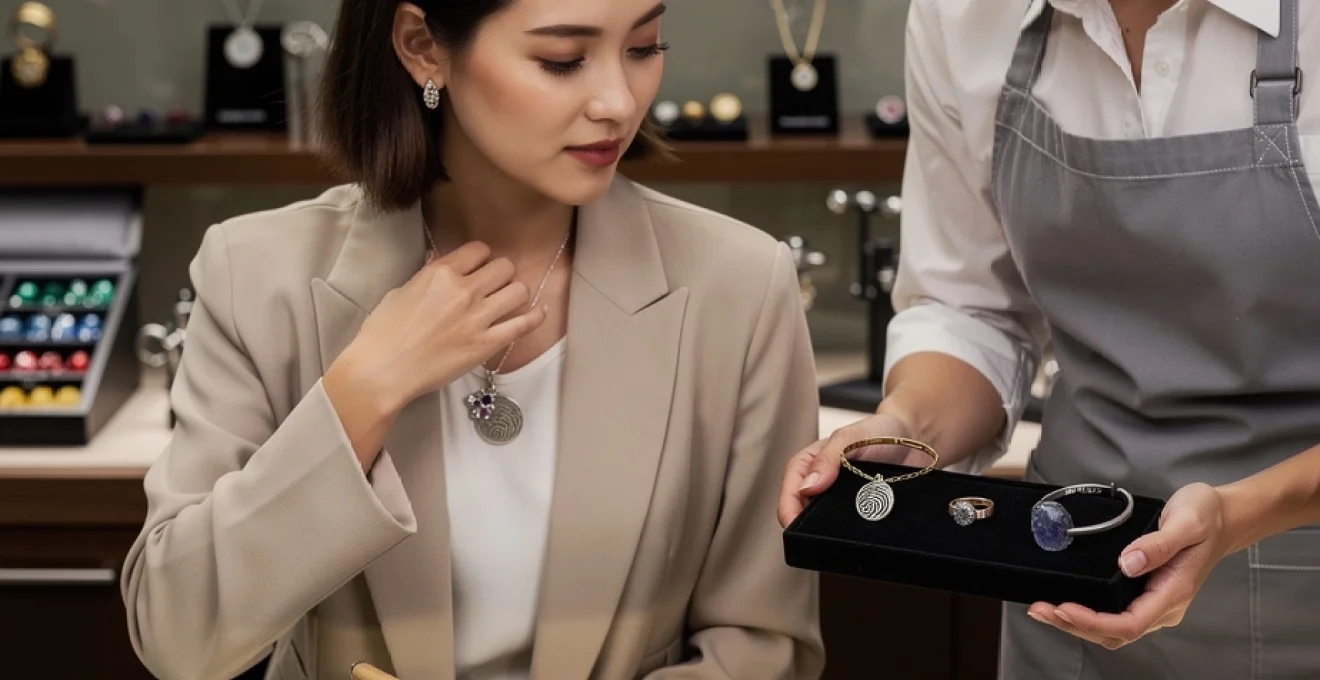
In an era where mass-produced accessories dominate retail spaces, personalised jewellery emerges as a powerful antidote to uniformity, offering individuals the opportunity to wear pieces that truly reflect their identity and values. The growing desire for authentic self-expression through fashion has transformed personalised jewellery from a niche luxury into a mainstream phenomenon that bridges craftsmanship, technology, and emotional significance. Modern consumers increasingly seek pieces that tell their unique stories, whether through engraved initials, integrated birthstones, or custom designs that capture precious memories.
The personalised jewellery market has experienced remarkable growth, with industry reports indicating a compound annual growth rate of 8.7% between 2020 and 2025. This surge reflects not only changing consumer preferences but also technological advances that have made customisation more accessible and affordable. From laser engraving systems that achieve microscopic precision to 3D printing technologies that enable complex geometric designs, the tools available to contemporary jewellers have revolutionised what’s possible in personalised accessories.
Today’s personalised jewellery encompasses far more than traditional name plates or simple engravings. Modern techniques allow for intricate fingerprint impressions, DNA preservation within gemstone settings, and even cremation ash integration that transforms memorial pieces into wearable art. These innovations represent a fundamental shift in how individuals relate to their accessories, moving beyond mere adornment towards pieces that serve as tangible connections to loved ones, significant moments, and personal achievements.
Engraving techniques and customisation methods for bespoke jewellery
The foundation of personalised jewellery lies in the diverse array of engraving and customisation techniques available to contemporary artisans. Each method offers distinct advantages in terms of precision, durability, and aesthetic appeal, allowing craftspeople to select the most appropriate approach based on the specific requirements of each piece. Understanding these techniques helps appreciate the complexity and artistry involved in creating truly personalised accessories.
Laser engraving precision on sterling silver and gold alloys
Laser engraving represents the pinnacle of precision in modern jewellery personalisation, utilising focused light beams to create detailed patterns, text, and images on metal surfaces. This technology operates with tolerances as tight as 0.001 inches, enabling the reproduction of intricate designs that would be impossible to achieve through traditional hand engraving methods. Contemporary laser systems can work with various precious metals, including sterling silver, 14k and 18k gold alloys, and platinum, each requiring specific power settings and pulse frequencies to achieve optimal results.
The process begins with digital design creation, where artwork is converted into vector format and optimised for laser processing. Modern systems can engrave text as small as 0.5mm in height while maintaining perfect legibility, making them ideal for creating detailed family trees, coordinate locations, or meaningful quotes on compact surfaces like wedding bands or pendant reverses. The heat-affected zone created by laser engraving typically extends only 0.02-0.05mm below the surface, ensuring structural integrity while achieving lasting visual impact.
Hand engraving artistry using gravers and burin tools
Hand engraving remains the gold standard for luxury personalised jewellery, combining traditional craftsmanship with artistic expression that no machine can replicate. Master engravers utilise specialised tools including gravers, burins, and push tools to carve directly into metal surfaces, creating textures and patterns that reflect the unique touch of human artistry. This technique requires extensive training, with skilled engravers typically completing seven to ten years of apprenticeship before achieving mastery.
The hand engraving process allows for extraordinary customisation, enabling artisans to adjust depth, angle, and texture in real-time based on the metal’s response and the desired aesthetic outcome. Bright cutting, a specialised hand engraving technique, creates faceted surfaces that catch and reflect light similarly to diamonds, adding brilliance to monograms and decorative borders. Contemporary hand engravers often combine traditional techniques with modern magnification systems and pneumatic tools, achieving detail levels that rival historical masters while improving efficiency.
Diamond drag engraving for intricate text and symbol work
Diamond drag engraving utilises an industrial diamond stylus to create precise lines and patterns on metal surfaces
by physically scratching rather than removing material. The diamond tip is drawn across the surface under controlled pressure, displacing metal to form crisp, fine lines. This method is particularly effective on harder metals such as stainless steel, titanium, and certain white gold alloys where traditional cutting tools may struggle or wear quickly.
Because diamond drag engraving is a relatively shallow process, it is best suited to delicate text, coordinates, icons, and line-art symbols that do not require deep relief. It is often used for personalised jewellery such as ID bracelets, medical alert tags, and inside-ring inscriptions where legibility and durability are paramount but heavy material removal is not desirable. The characteristic, slightly faceted line quality produced by the diamond stylus can catch the light subtly, adding a refined sparkle to even the most understated personalised pieces.
Chemical etching processes for deep relief personalisation
Chemical etching offers a different approach to personalisation, relying on controlled corrosion rather than mechanical force. In this technique, a resist material is applied to protect selected areas of the metal, leaving the desired design exposed. The piece is then immersed in an etching solution that gradually dissolves the unprotected metal, creating recessed patterns, text, or imagery with measurable depth. The result is a relief effect that can be felt as well as seen, adding tactile interest to personalised jewellery.
This process is particularly effective for larger flat surfaces such as cufflinks, dog tags, locket exteriors, and bracelet plates where you want bold, high-contrast motifs. Because the etch depth can be adjusted by timing and solution strength, artisans can create anything from subtle shading to deep channels suitable for subsequent enamelling or ink filling. Chemical etching does require careful handling of chemicals and strict safety protocols, but when executed correctly it produces highly durable personalisation resistant to wear and polishing over time.
CNC machining applications in contemporary custom jewellery
CNC (Computer Numerical Control) machining brings industrial-grade precision to bespoke jewellery, especially when creating custom shapes, relief carvings, and three-dimensional text. In this method, a computer-controlled milling machine or lathe cuts the design directly into metal blocks or castings using rotating tools. Complex curves, recessed initials, and sculpted motifs can be executed repeatedly with micron-level accuracy, making CNC invaluable for personalised luxury items that require both consistency and detail.
The workflow usually begins in CAD (Computer-Aided Design) software, where the jeweller or designer builds a 3D model of the piece, including any personalised names, dates, or symbols. The file is then translated into machine code that guides the cutting tools along precise paths. CNC machining is particularly powerful for thick signet rings, raised-letter name pendants, and custom lockets where the personalisation is integrated structurally rather than merely applied to the surface. When combined with hand finishing and setting work, CNC allows you to enjoy the best of both worlds: high-tech precision and artisanal refinement.
Personalised birthstone integration and gemological considerations
Birthstone personalisation adds a rich layer of symbolism to customised jewellery, allowing wearers to connect their pieces to specific people, milestones, or life events. Whether you are building a multi-stone family necklace, a stackable ring set, or a personalised charm bracelet, understanding how different gemstones behave is crucial for creating pieces that are both meaningful and durable. The choice of stone, its setting style, and its placement all affect not only the design but also how well the personalised jewellery will withstand everyday wear.
Traditional birthstone assignments and modern alternatives
Traditional birthstone charts assign a specific gem to each month, a practice that goes back centuries and varies slightly across cultures. For example, January is typically associated with garnet, April with diamond, and September with sapphire. Modern jewellery brands often expand these options with alternative stones that offer different price points, colours, or ethical sourcing profiles. This flexibility lets you personalise jewellery in a way that fits both your budget and values without sacrificing meaning.
In recent years, consumers have embraced laboratory-grown gemstones and unconventional options such as moonstone, morganite, and spinel as contemporary birthstone alternatives. These choices can bring new colour palettes and enhanced durability to personalised birthstone designs. Some clients also prefer to tie stones to zodiac signs or personal colour preferences rather than strict month-based assignments. By discussing both traditional and modern birthstone choices with a jeweller, you can co-create a piece that feels authentic to your story rather than constrained by a single prescriptive chart.
Prong setting techniques for multiple birthstone arrangements
Prong settings remain one of the most popular ways to integrate multiple birthstones into personalised jewellery because they allow maximum light to enter the stones. In multi-stone family rings or mother’s necklaces, shared-prong and cluster arrangements can keep pieces compact while still showcasing each individual gem. The number, shape, and orientation of prongs are carefully chosen to balance security with visual delicacy, especially when combining stones of different sizes or cuts.
When designing a multi-birthstone layout, it is important to consider both symmetry and the visual hierarchy of colours. Some families prefer chronological arrangements, while others may group stones by tone for a more harmonious look. Jewellers may recommend protective setting variations—such as low-profile basket prongs or double claws—for softer gems like opal or turquoise. This attention to detail ensures that your personalised birthstone jewellery can be worn every day without compromising either aesthetics or safety.
Bezel setting applications in family tree jewellery designs
Bezel settings, which encircle the stone with a continuous rim of metal, offer exceptional protection and a sleek modern look. In family tree jewellery designs—such as personalised pendants or bracelets that represent each family member—bezels are often the preferred choice because they hold stones securely while allowing for dense yet readable layouts. They also minimise snagging on clothing, making them ideal for people with active lifestyles or young children.
From a design perspective, bezels create clean outlines that help visually separate stones with similar colours, clarifying the “map” of relationships in a family tree piece. Different bezel shapes (round, oval, hexagonal, or custom profiles) can also encode subtle meanings, such as distinguishing generations or marking special milestones. When combined with engraved names or dates, bezel-set birthstones transform personalised jewellery into a compact, wearable archive of family history that can be passed down as an heirloom.
Gemstone compatibility and mohs hardness scale considerations
Not all gemstones are equally suited to daily-wear personalised jewellery, and this is where the Mohs hardness scale becomes a practical design tool. The scale ranks minerals from 1 (talc) to 10 (diamond) based on their resistance to scratching. Stones ranked 7 and above, such as quartz, topaz, sapphire, and diamond, are generally better equipped to handle the friction and knocks of everyday life. Softer stones can still be used but may require more protective settings and mindful wear.
When combining birthstones with very different hardness levels in a single piece, jewellers often position the more delicate gems away from exposed edges or raised surfaces. For instance, an opal or pearl might be recessed in a bezel, while harder stones like sapphire or garnet take the outer, more vulnerable positions. This is similar to placing stronger books at either end of a shelf to support the others. Understanding these gemological considerations helps ensure that your personalised jewellery remains beautiful and intact for years, rather than becoming a piece you are afraid to wear.
Name jewellery trends and typography in precious metal design
Name jewellery has evolved far beyond the classic cursive nameplate necklace, embracing new typographic styles, precious metal finishes, and custom layout options. Today, you can choose from minimalist block-letter bar necklaces, architectural signet rings carved with initials, and stacked bangles featuring children’s names in contrasting fonts. The typography you select effectively becomes part of your personal branding, broadcasting elements of your personality every time you wear the piece.
Current trends in personalised name jewellery include mixing uppercase and lowercase letters, combining matte and high-polish finishes within a single word, and incorporating tiny symbols—such as stars, hearts, or zodiac icons—into the lettering itself. Advances in CAD design and micro-casting make it possible to produce even delicate serif fonts and script styles with excellent structural integrity. When choosing a font, it can help to think of it the same way you would choose a typeface for a logo: legibility, mood, and long-term appeal matter more than passing trends. By aligning typography, metal colour, and scale, you ensure that your custom name piece feels intentional rather than generic.
Fingerprint and biometric impression jewellery manufacturing
Fingerprint and biometric impression jewellery takes personalisation to an intimate level, transforming unique biological markers into wearable art. A fingerprint pendant, for example, captures the whorls and ridges of a loved one’s touch, while heartbeat waveforms or soundwave engravings can visualise a baby’s first cry or a meaningful phrase. These pieces resonate on a deep emotional level because they encode something that is literally unique to one individual, turning the abstract idea of connection into a tangible form.
The manufacturing process usually begins with capturing a high-resolution scan or ink impression of the biometric data, which is then digitised and cleaned in graphic software. For fingerprints, the resulting image can be translated into a raised or recessed pattern and applied using laser engraving, CNC machining, or casting from a 3D-printed master. The key challenge is achieving sufficient contrast and clarity at jewellery scale without compromising structural strength. Done well, the result is personalised jewellery that feels as intimate as holding someone’s hand, yet robust enough to wear every day as a subtle, elegant fashion statement.
Memorial and commemorative jewellery craftsmanship techniques
Memorial and commemorative pieces sit at the intersection of jewellery design and emotional care, allowing people to carry memories and loved ones with them in a discreet, comforting way. Unlike purely decorative accessories, these items are often commissioned during moments of transition—bereavement, anniversaries, or life milestones—and must balance technical excellence with sensitivity. Skilled jewellers work closely with clients to choose materials, settings, and personalisation methods that align with both the story being told and the wearer’s lifestyle.
Cremation ash integration in resin and glass settings
One of the most distinctive forms of memorial jewellery involves integrating cremation ashes into resin or glass settings. In resin-based designs, a small amount of ash is carefully mixed into a clear or coloured resin and then cast into cabochons, beads, or inlay segments that are later set into precious metal. Glass memorials use a similar principle: the ash is encapsulated within molten glass, often forming delicate swirls or nebula-like patterns as the material cools. The result is a subtle, abstract appearance that only those “in the know” will recognise as containing cremation material.
Because ashes are irreplaceable, jewellers follow strict chain-of-custody protocols and work with redundancy—dividing the material, documenting each stage, and sometimes producing test pieces first. Clients are typically briefed on the visual outcomes, as ash can vary in colour and texture. When combined with engraving, birthstones, or fingerprints, cremation-ash inlay transforms personalised jewellery into a portable memorial that is both deeply private and visually sophisticated.
Photo etching on lockets and pendant surfaces
Photographic personalisation allows cherished images to be translated directly onto metal or glass, giving traditional lockets and pendants a new level of detail. Modern photo etching and laser marking systems can reproduce tonal gradations by varying dot density or engraving depth, similar to how a newspaper halftone image works. This means faces, landscapes, or handwritten notes can be miniaturised and permanently fixed to the surface of gold, silver, or stainless steel.
In practice, the original photograph is scanned at high resolution, adjusted for contrast, and converted into a pattern that the laser or etching equipment can interpret. The result may be a subtle monochrome portrait on a locket’s interior or a high-contrast emblem on a dog tag-style pendant. As with all personalised jewellery, design decisions around image size, framing borders, and protective finishes (such as clear enamel or rhodium plating) affect both appearance and longevity. When you open a locket and see a loved one’s image perfectly preserved, the technology behind it fades into the background, leaving only the emotional impact.
DNA preservation methods in contemporary memorial pieces
Beyond fingerprints and ashes, some memorial jewellery incorporates DNA material such as hair, encapsulated cells, or synthesised DNA strands that encode meaningful data. Certain specialist studios now offer gemstones grown from carbon extracted from hair or cremation remains, creating lab-grown diamonds or sapphires that carry a direct physical link to the deceased. Others embed preserved hair, fabric, or petals in resin or glass, similar to traditional Victorian mourning jewellery but using modern stabilisation methods.
DNA-based personalisation raises both scientific and ethical considerations, so reputable providers are transparent about their processes and limitations. For example, a diamond grown “from” hair may contain carbon from multiple sources to ensure crystal stability, while still preserving symbolic continuity. These emerging techniques illustrate how far personalised jewellery has come: from simple monograms to pieces that literally incorporate the building blocks of life. For many wearers, that knowledge transforms a beautiful accessory into a profound object of remembrance.
Handwriting reproduction using vector conversion technology
Reproducing a loved one’s handwriting on metal is one of the most emotionally resonant forms of personalisation, capturing the unique rhythm and quirks of their pen stroke. The process typically starts with a scan or clear photograph of a handwritten note—perhaps a signature from an old letter or a short phrase like “love you always.” Designers then convert this image into a vector file, smoothing imperfections only where necessary to maintain legibility while preserving the character of the original script.
Once vectorised, the handwriting can be scaled, curved around a ring, or positioned on a pendant before being engraved or cut out in metal. Laser engraving allows for incredibly fine line work, while CNC milling can create raised, sculptural lettering that you can trace with your fingertip like a tactile memory. The result feels more like carrying a piece of that person’s presence than simply wearing text in a standard font. It is this ability to bridge time and distance that makes handwriting-based personalised jewellery such a powerful commemorative medium.
Market positioning and consumer psychology of personalised luxury items
The rapid growth of the personalised jewellery sector is driven not just by technology but by deep psychological needs: the desire for individuality, emotional connection, and perceived control over one’s identity. In a landscape flooded with mass-market fashion, customised pieces signal that you have made a deliberate choice rather than simply bought what was available. This sense of agency is a major reason why consumers are willing to pay a premium for personalised luxury items, even when the base materials might be similar to non-custom alternatives.
From a market positioning perspective, brands that excel in personalised jewellery often highlight narrative, craftsmanship, and transparency over flashy branding. They invite clients into the design process, using digital configurators or in-person consultations to co-create pieces. This collaborative experience becomes part of the value proposition: you are not just purchasing jewellery, you are commissioning a story in metal and stone. Studies in consumer behaviour show that such co-creation increases attachment and reduces buyer’s remorse, because the customer feels like a stakeholder in the outcome.
At the same time, personalised jewellery taps into the psychology of gifting and memory-making. A bespoke birthstone ring or engraved pendant does more than decorate; it functions as a physical anchor for shared moments, which is especially compelling in an increasingly digital world. Savvy brands leverage this by positioning personalised pieces as “future heirlooms” rather than seasonal trends, thereby justifying higher price points and encouraging repeat purchases for new life events. As we continue to seek authenticity and connection in what we wear, personalised jewellery is likely to remain at the forefront of meaningful, unique fashion statements.