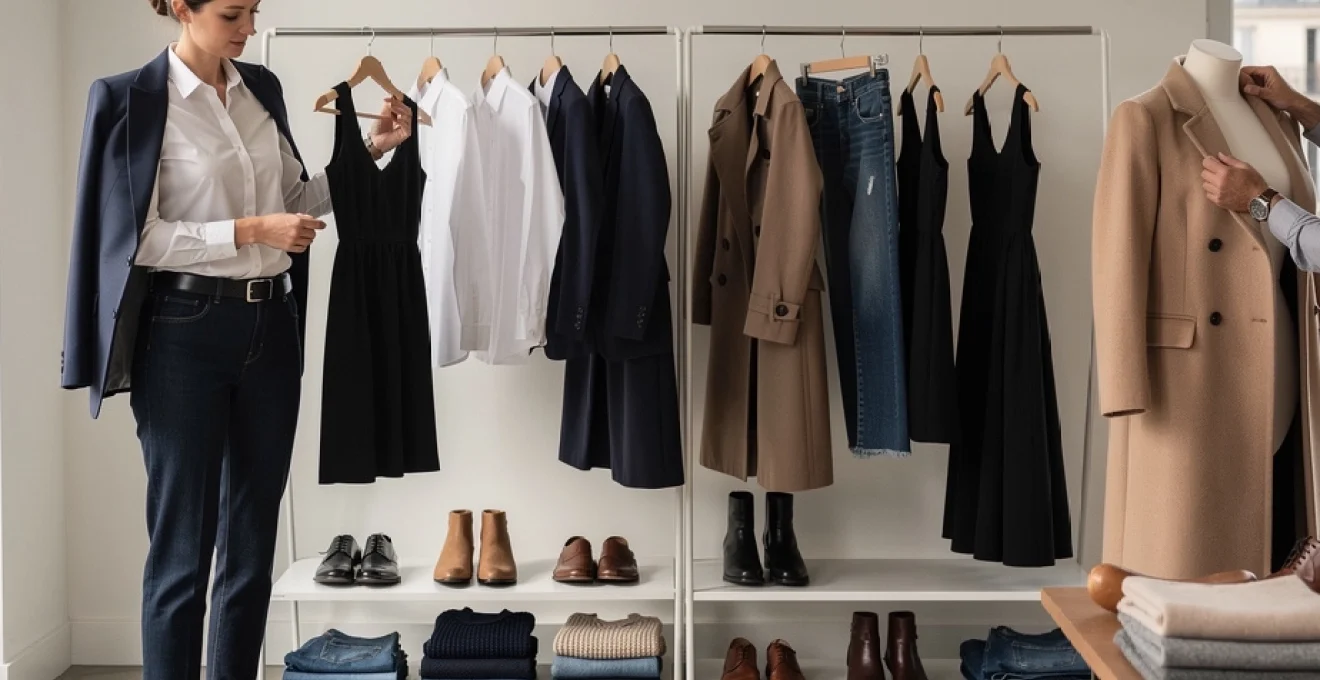
Building a wardrobe that transcends fleeting trends requires understanding the fundamental principles of timeless design and exceptional craftsmanship. The concept of capsule wardrobes has evolved from simple minimalism to sophisticated curation, where each piece serves multiple purposes whilst maintaining impeccable quality standards. Investment dressing has become increasingly relevant as consumers recognise the value of purchasing fewer, better-made garments that withstand both physical wear and stylistic obsolescence.
The modern approach to wardrobe essentials combines traditional tailoring expertise with contemporary lifestyle demands. Fashion industry data reveals that individuals typically wear only 20% of their wardrobe 80% of the time, highlighting the importance of selecting core pieces that deliver consistent performance. Understanding fabric technology, construction methods, and styling versatility enables you to build a collection that serves your professional and personal needs across multiple seasons and occasions.
Quality garments represent more than mere clothing; they embody craftsmanship heritage and engineering precision. The distinction between temporary fashion purchases and permanent wardrobe investments lies in construction details, fabric selection, and timeless design principles that remain relevant regardless of current trends. This comprehensive approach to wardrobe building ensures that your investment yields dividends through extended wear periods and consistent stylistic relevance.
Essential tailoring fundamentals: investment pieces for longevity
The foundation of exceptional wardrobes begins with understanding traditional tailoring principles that have guided garment construction for centuries. Modern investment pieces incorporate these time-tested methods whilst adapting to contemporary lifestyle requirements and fabric innovations. Quality tailoring involves precise measurements, careful pattern matching, and meticulous attention to construction details that ensure garments maintain their shape and appearance through extensive wear cycles.
Professional tailoring standards emphasise structural integrity through canvas interfacing, hand-finished seams, and reinforced stress points. These construction methods significantly impact garment longevity, with properly tailored pieces often outlasting their ready-to-wear counterparts by decades. The initial investment in quality construction translates to superior cost-per-wear calculations, making expensive pieces more economical over extended periods. Structural reinforcement techniques include French seams, bound buttonholes, and canvas chest pieces that maintain garment shape through repeated cleaning and wearing cycles.
Savile row construction standards in contemporary wardrobe planning
Savile Row tailoring represents the pinnacle of construction excellence, establishing benchmarks that influence contemporary garment manufacturing. Traditional techniques include floating canvas construction, where multiple layers of horsehair canvas provide structure without compromising drape or comfort. Modern adaptations of these methods incorporate lightweight interfacing materials that maintain structural integrity whilst reducing garment weight and improving comfort during extended wear periods.
Contemporary designers increasingly adopt traditional construction methods to differentiate their offerings from mass-market alternatives. Hand-padded lapels, functional buttonholes, and pick-stitched edges demonstrate attention to detail that justifies premium pricing. These construction elements contribute to garment longevity by ensuring that pieces maintain their intended silhouette through multiple seasons of wear and professional cleaning cycles.
Fabric quality assessment: natural fibres versus synthetic blends
Natural fibres consistently outperform synthetic alternatives in durability, comfort, and aging characteristics. Wool, cotton, silk, and linen possess inherent properties that improve with age when properly maintained. High-quality wool develops patina through wear whilst maintaining structural integrity, unlike synthetic materials that typically deteriorate over time. Fibre length and weave density directly correlate with fabric performance, with longer fibres producing more durable and comfortable garments.
Modern synthetic blends serve specific performance requirements whilst maintaining natural fibre characteristics. Elastane content below 5% provides stretch recovery without compromising breathability or drape. Advanced synthetic fibres offer moisture management properties that enhance comfort during extended wear periods. Understanding fabric composition enables informed purchasing decisions that balance performance requirements with aesthetic preferences and maintenance considerations.
Bespoke versus Ready-to-Wear: Cost-Per-Wear analysis
Bespoke garments command premium pricing through personalised construction and superior materials, yet deliver exceptional value through extended wear periods and timeless styling. A quality bespoke suit costing £3,000 worn twice monthly for ten years yields a cost-per-wear of approximately £12.50,
while an off-the-rack suit costing £500 that loses its shape after two years and is worn less frequently may exceed £20 per wear. When assessing wardrobe essentials that never go out of fashion, cost-per-wear offers a more accurate measure of value than ticket price alone. You should consider not only frequency of wear, but also the garment’s ability to remain relevant as your lifestyle evolves, your body changes, and dress codes shift.
Ready-to-wear has improved significantly in recent decades, particularly at the upper end of the market. Premium RTW suits and coats now incorporate semi-canvassed construction, quality wool, and reliable finishing at a fraction of bespoke pricing. For many professionals, a hybrid strategy works best: invest in one or two bespoke or made-to-measure icons (a navy blazer, a black tuxedo, an overcoat), then supplement with well-tailored RTW pieces for variety. The crucial step is professional alteration; even mid-range garments can perform like investment pieces when they are properly adjusted at the shoulders, waist, and hems.
Seasonal adaptability in core garment selection
Seasonal adaptability should be a primary criterion when selecting wardrobe essentials that never go out of fashion. Core pieces such as tailored trousers, blazers, and outerwear must function across varying temperatures and environments. Mid-weight fabrics in the 220–280g range for wool suiting and 8–10oz for cotton offer the most flexibility, allowing you to layer in winter and wear pieces standalone in transitional months. Opting for neutral colour palettes—navy, charcoal, camel, ivory—further increases their year-round relevance.
Layering systems are the technical backbone of a truly perennial wardrobe. A lightweight merino or cashmere knit under a blazer, a cotton poplin shirt under a trench, or a fine-gauge roll-neck under a suit jacket transforms the same base garments into seasonally appropriate outfits. When you evaluate prospective purchases, ask yourself: “Can I style this in at least three ways for both warm and cool weather?” If the answer is no, the item is likely a trend piece rather than an essential. Accessories such as silk scarves, thermal underlayers, and weatherproof footwear complete the system without compromising elegance.
The classic white shirt: technical specifications and styling versatility
The classic white shirt remains one of the few wardrobe essentials that transcends gender, age, and cultural boundaries. Its power lies in its structural simplicity and near-infinite styling options, from business formal ensembles to relaxed off-duty looks. In technical terms, a well-made white shirt balances fabric handle, collar engineering, and seam construction to create a piece that feels comfortable yet polished throughout a full day of wear. The right shirt should disappear on your body in terms of comfort, while visually anchoring your outfit.
Design subtleties make the difference between a forgettable basic and a long-term favourite. Factors such as yoke construction, button placement, and cuff design influence how the shirt moves with you, resists creasing, and sits under tailoring. When you treat the white shirt as a long-term investment rather than a disposable item, you can justify spending more on superior cotton, reinforced seams, and thoughtful pattern cutting that flatters your proportions. The result is a garment you can style dozens of ways, season after season.
Cotton weave analysis: poplin, oxford, and broadcloth characteristics
Cotton weave selection significantly affects how a white shirt performs in different contexts. Poplin (sometimes labelled as broadcloth in US markets) features a fine, closely woven structure that produces a smooth, crisp surface ideal for formal and corporate environments. Its tight weave provides excellent opacity even in lighter weights, making it a reliable choice under suiting and in professional settings with stricter dress codes.
Oxford cloth, by contrast, uses a basket weave construction that creates a slightly textured, more casual appearance. Traditional Oxford fabrics are heavier and more robust, making them particularly suitable for smart-casual wear, travel, and cooler climates. Contemporary wardrobes often include both: poplin or broadcloth for sharp, tailored looks, and pinpoint or classic Oxford for relaxed yet polished outfits. Understanding these differences enables you to curate a small but efficient rotation of white shirts that cover the full spectrum of your lifestyle.
Collar construction types: spread, point, and button-down mechanics
Collar architecture is an often-overlooked component of wardrobe essentials that never go out of fashion. The spread collar, with its wider distance between collar points, complements modern, slightly wider tie knots and also frames the face beautifully when worn open. It works particularly well under structured blazers and suits, making it a go-to choice for formal and business settings. Interlining stiffness determines whether the collar stands cleanly under a jacket or collapses during the day.
Point collars, featuring narrower spacing, create a more elongated visual line that can be flattering on rounder or shorter necks. They read slightly more conservative, which can be advantageous in traditional corporate or legal environments. Button-down collars, originally designed for sportswear, secure the collar points to the shirt body, maintaining shape even without a tie. This makes them ideal for business casual offices and travel wardrobes, where you want a shirt that remains tidy with minimal fuss. Owning at least one of each collar type ensures that your white shirt collection can adapt to diverse dress codes and styling preferences.
Professional styling applications across industries
Different industries impose varying expectations around dress, yet the white shirt remains a unifying staple. In finance, law, and corporate environments, pairing a crisp poplin shirt with tailored trousers and a blazer communicates reliability and attention to detail. Subtle variations in cuff style (button versus French) and accessories (ties, silk scarves, jewellery) allow you to express personality within conservative frameworks. For creative sectors, the same shirt can be layered under knitwear, styled half-tucked with high-waisted denim, or worn open over a ribbed tank.
Healthcare, education, and hospitality professionals often value the white shirt for its washability and neutrality. Slightly looser cuts in breathable cotton blends offer comfort for long shifts while maintaining a polished appearance. Remote and hybrid workers can also leverage the white shirt as a “video-call solution”: thrown over a T-shirt or tank, it provides instant structure from the waist up. The ability to bridge so many environments is precisely why a technically sound white shirt deserves its place in every long-term wardrobe strategy.
Care instructions for longevity: washing, pressing, and storage
To keep a white shirt in rotation for years rather than months, disciplined care is essential. Washing at lower temperatures (30–40°C) with a quality detergent and occasional oxygen-based whitening agent helps preserve fibre strength while counteracting discolouration. Pre-treating collar and cuff areas with a gentle stain remover reduces long-term yellowing, especially for those who wear shirts frequently in warm or humid climates. Avoiding chlorine bleach on cotton prevents premature fabric breakdown.
Pressing technique also influences garment lifespan and appearance. Using sufficient steam and ironing shirts while they are slightly damp helps relax fibres without excessive heat exposure. Store white shirts on broad, contoured hangers to maintain shoulder shape, and avoid overcrowding your wardrobe rail to minimise creasing. Rotating through several shirts rather than overwearing a single favourite distributes stress on fabric and seams. With proper care, a well-made white shirt can remain a cornerstone of your wardrobe essentials for many years.
Denim evolution: from workwear heritage to contemporary fashion staple
Denim’s journey from utilitarian workwear to global wardrobe essential illustrates how function, durability, and cultural relevance can intersect. Originally woven from sturdy cotton twill for miners and labourers, denim quickly proved its value as a fabric that softens with wear while retaining structural integrity. Today, high-quality jeans anchor countless capsule wardrobes, providing a reliable base for casual and smart-casual outfits across all age groups and style identities.
The most enduring denim styles share certain characteristics: mid- to high-rise cuts, straight or gently tapered legs, and classic washes in indigo, mid-blue, or clean black. These silhouettes outlast trend cycles that favour extreme skinnies one year and exaggerated wide-legs the next. Investing in a small range of well-fitting jeans—perhaps a dark indigo pair for polished looks, a mid-blue for everyday wear, and a black or ecru pair for evening or summer—ensures you always have a foundation piece that works with your existing tops, blazers, and footwear.
Little black dress architecture: silhouette engineering and fabric technology
The little black dress (LBD) remains one of the most powerful wardrobe essentials that never go out of fashion because it combines visual simplicity with architectural precision. At its best, an LBD is a carefully engineered garment that sculpts, skims, or flows exactly where you want it to. The goal is not complexity of design, but refinement of line: strategic darts, seaming, and panel placement create a silhouette that supports and flatters the body without relying on overt embellishment.
Modern consumers increasingly seek LBDs that offer comfort alongside elegance. This has driven demand for technical fabrics with built-in stretch, moisture management, and crease resistance. When you choose an LBD, pay attention not only to how it looks on the hanger, but how it behaves when you sit, move, and wear it for extended periods. A timeless piece should feel as dependable as a tailored blazer or your best pair of jeans—something you can reach for before an event and trust to perform without constant adjustment.
Coco chanel’s original 1926 design principles
Coco Chanel’s 1926 interpretation of the little black dress established design codes that remain influential a century later. Her vision prioritised simplicity, clean lines, and functional elegance over ornate decoration. The original LBD was cut in a straight, almost austere silhouette, designed to be accessible, versatile, and devoid of excessive detailing that would quickly date the garment. Chanel treated black not as a colour of mourning, but as a sophisticated backdrop for jewellery and accessories.
This philosophy still informs how we define wardrobe essentials that never go out of fashion. An LBD that adheres to Chanel’s principles—minimal seams, restrained neckline, and mid-length hem—can move effortlessly from day to evening with minor styling changes. Jewellery, shoes, and outerwear perform the role of “updates”, allowing the core dress to remain unchanged while still feeling current. When evaluating an LBD, ask whether you could imagine it being worn ten or twenty years ago, and ten years from now; if so, it likely embodies Chanel’s timeless approach.
Modern interpretations: diane von furstenberg and victoria beckham innovations
Later designers such as Diane von Furstenberg and Victoria Beckham expanded on Chanel’s foundation, demonstrating how the LBD could evolve without losing its essential character. Von Furstenberg’s wrap dress introduced dynamic movement and adjustability, allowing the wearer to customise fit and emphasise the waist. In black jersey or silk, the wrap silhouette functions as a modern little black dress that adapts to different body shapes and life stages, from early career to post-maternity.
Victoria Beckham’s contributions focus heavily on precision tailoring and subtle architectural details. Her sheath dresses often feature contour seams, cleverly placed darts, and strategic paneling that create a sculpted yet comfortable fit. These design innovations show that an LBD can be both minimal and technically advanced, incorporating shaping techniques usually reserved for bespoke tailoring. For your own wardrobe, drawing inspiration from these designers encourages you to look beyond basic shift dresses and towards well-engineered silhouettes that genuinely earn their space in your closet.
Fabric technology advances: stretch integration and wrinkle resistance
Advances in fabric technology have significantly expanded what a little black dress can do. The integration of elastane or Lycra—usually between 2–6% of the fabric content—provides crucial stretch and recovery, allowing dresses to accommodate movement, minor weight fluctuations, and long wear periods without losing shape. Double-knit fabrics, ponte jersey, and bonded crepes deliver structure with comfort, behaving almost like “tailored knitwear” that smooths the body without rigid boning.
Wrinkle-resistant and easy-care finishes also support the LBD’s role as a travel and event staple. Many contemporary fabrics are engineered to resist creasing, making them ideal for business trips, destination weddings, or occasions where garment care facilities are limited. Some technical blends offer moisture-wicking or temperature-regulating properties, ensuring you remain comfortable in crowded venues or under stage lighting. When choosing an LBD, check the fabric label and handle: a slightly weightier cloth with built-in stretch and resilience is likely to offer superior longevity and versatility.
Occasion-specific styling methodologies
Styling methodologies transform a single little black dress into multiple outfits tailored to specific occasions. For formal evening events, you might pair a structured sheath with classic black pumps, a minimal clutch, and fine jewellery—allowing the dress’s silhouette to take centre stage. For daytime professional settings, the same dress can sit under a tailored blazer or longline cardigan, with block-heel shoes and a leather tote. Swapping accessories is analogous to changing the frame around a painting: the artwork remains the same, but the context shifts dramatically.
Casual and creative contexts invite more experimentation. Layer a T-shirt or fine knit under a slip-style LBD, or wear it open as a long vest over tailored trousers. Footwear choice—sneakers, ankle boots, or strappy sandals—also recalibrates the dress’s formality level. By consciously planning at least three or four distinct “use cases” for your LBD when you purchase it, you ensure that it operates as a true wardrobe essential rather than a single-purpose event dress languishing at the back of your closet.
Footwear foundations: leather craftsmanship and sole construction technology
Footwear forms the literal and figurative foundation of wardrobe essentials that never go out of fashion. Well-made shoes in classic silhouettes—loafers, ballet flats, ankle boots, pumps, and clean white sneakers—anchor outfits across a broad spectrum of dress codes. The difference between disposable footwear and investment pairs lies in leather quality, last shape, and sole construction. High-grade full-grain or top-grain leathers mold to the foot over time, developing patina rather than cracking, while cheap bonded leathers deteriorate quickly.
Sole construction technology also plays a crucial role. Goodyear welting and Blake stitching, for example, allow soles to be replaced multiple times, dramatically extending the life of a favourite pair. Rubber or hybrid soles with integrated cushioning systems improve shock absorption and traction without sacrificing aesthetic refinement. Many contemporary brands now incorporate orthotic-level insoles and arch support into classic designs, recognising that comfort is non-negotiable for modern professionals who may walk several thousand steps per day. Choosing footwear that combines timeless design with advanced construction ensures that your shoes remain both stylish and wearable for years.
Outerwear engineering: climate adaptation and layering systems
Outerwear often represents the most visible component of your wardrobe essentials, especially in colder climates where coats and jackets are seen more frequently than what lies beneath. Engineering an outerwear collection that aligns with your climate, commute, and lifestyle is therefore critical. The most enduring pieces—trench coats, wool overcoats, technical parkas, and tailored blazers—share a disciplined approach to proportion, fabric, and hardware. They are designed to layer comfortably over knitwear and tailoring while maintaining a clean, structured silhouette.
Climate adaptation is not solely about insulation; it also involves breathability, water resistance, and wind protection. A well-planned outerwear system might include a mid-weight trench for transitional months, a heavier wool coat for winter, and a technical shell that can be layered over other pieces in severe weather. Each garment should integrate seamlessly into your existing wardrobe, complementing rather than overwhelming your outfits. Neutral tones and classic cuts again prove their value, allowing you to wear the same coat with multiple colour palettes and styles.
Trench coat heritage: burberry’s gabardine innovation legacy
The trench coat’s enduring status as a wardrobe essential is closely tied to Burberry’s development of gabardine in the late 19th century. This tightly woven, water-resistant cotton fabric offered soldiers and explorers protection from the elements without the heaviness of traditional rubberised rainwear. Its combination of practicality and elegance quickly translated into civilian life, where the trench became synonymous with understated sophistication. Key design elements—storm flaps, epaulettes, belt, and back vent—have remained largely unchanged for over a century.
Modern trench coats continue to draw on this heritage while incorporating subtle updates. Contemporary gabardine and cotton-blend fabrics often feature improved water repellency and crease resistance, making them ideal for commuters and frequent travellers. Length variations (from mid-thigh to calf) allow you to choose a proportion that harmonises with your height and the hemlines you typically wear. When selecting a trench, focus on shoulder fit, sleeve length, and belt placement—these details determine whether the coat feels sharp and timeless or overwhelming.
Wool coat construction: melton, cashmere, and alpaca properties
Wool coats represent another cornerstone of wardrobe essentials that never go out of fashion. Different woolen fabrics offer distinct performance profiles. Melton, a densely woven and heavily fulled wool, delivers excellent wind resistance and structure, making it ideal for tailored overcoats and pea coats. Its smooth, almost felt-like surface resists pilling and holds sharp lines, which is why many classic military-inspired designs use Melton or similar finishes.
Cashmere and alpaca blends introduce greater softness, warmth, and luxury, often at higher price points. Pure cashmere coats feel exceptionally light and insulating but can be more delicate; blends that incorporate wool or synthetic fibres improve durability without sacrificing too much softness. Alpaca, with its hollow fibre structure, offers impressive warmth-to-weight ratios and a slightly textured surface. When investing in a wool coat, examine fabric density, lining quality, and internal construction (such as canvassed fronts and reinforced seams). A well-chosen coat in a classic cut—single- or double-breasted, in camel, navy, or black—can serve you for a decade or more with proper care.
Technical outerwear: Gore-Tex integration in fashion applications
Technical outerwear has evolved far beyond mountaineering gear, integrating into urban wardrobes as a functional complement to tailored pieces. Gore-Tex and similar membrane technologies provide waterproof, windproof, and breathable protection, making them invaluable in regions with heavy rainfall or variable conditions. Historically, such garments prioritised performance over aesthetics, but recent collaborations between outdoor brands and fashion houses have produced shells and parkas that sit comfortably alongside wool coats and trench coats in a refined wardrobe.
For maximum versatility, look for streamlined designs in neutral colours with minimal branding and hardware. A clean, thigh-length Gore-Tex shell in black, navy, or dark olive can be layered over a blazer or knitwear without appearing overly technical. Underarm ventilation, adjustable hoods, and removable liners increase adaptability across seasons. Treat this type of outerwear as you would any other investment piece: prioritise fit, fabric performance, and compatibility with your existing wardrobe, rather than chasing seasonal colour trends.
Blazer tailoring standards: lapel variations and button stance analysis
The tailored blazer is arguably the most transformative of all wardrobe essentials that never go out of fashion. Its power lies in its ability to sharpen casual outfits, soften formal ensembles, and act as a versatile layering piece across seasons. Tailoring standards—lapel shape, button stance, shoulder construction, and length—determine whether a blazer feels contemporary yet timeless or locked into a fleeting trend. Classic notched lapels, moderate shoulder padding, and mid-hip length generally offer the greatest longevity and styling flexibility.
Lapel variations subtly shift the blazer’s character. Peak lapels introduce a more formal, statement-making aesthetic often associated with tuxedos and power dressing, while slimmer notched lapels read more relaxed and understated. Button stance—the vertical placement of the main button—affects both comfort and proportion. A slightly lower stance elongates the torso and allows for easier movement when seated, whereas an excessively high stance can date the garment. When trying on blazers, pay close attention to how the lapels sit against your chest, how the waist suppression complements your body, and whether the jacket closes comfortably without pulling. A blazer that meets these criteria will integrate effortlessly into your wardrobe, pairing with everything from jeans and a white T-shirt to tailored trousers and an LBD.