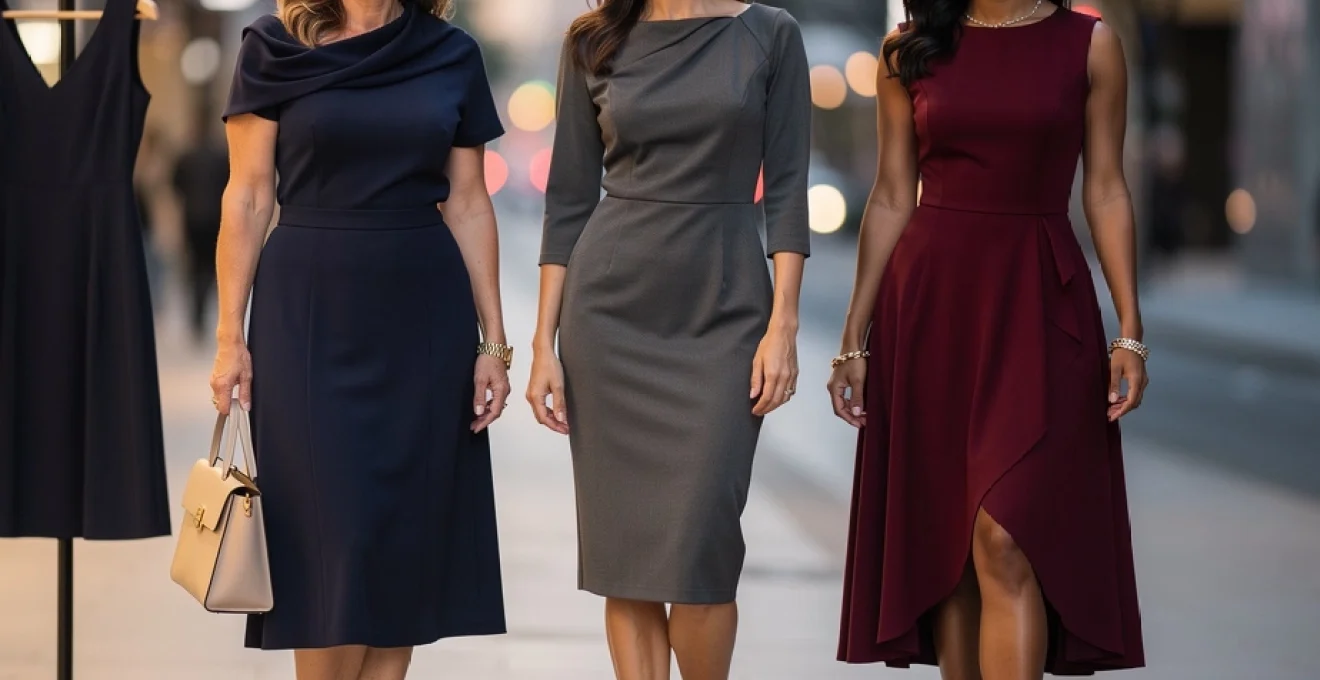
The modern woman’s wardrobe demands versatility above all else, and few garments deliver this flexibility quite like a well-designed transitional dress. In today’s fast-paced world, where professional commitments seamlessly blend into social obligations, the ability to transform a single outfit from boardroom appropriate to cocktail-ready has become essential. Contemporary fashion houses have responded to this need by developing innovative construction techniques, sophisticated fabric technologies, and strategic design elements that enable a dress to serve multiple purposes throughout the day. This evolution represents more than mere convenience; it reflects a fundamental shift in how we approach personal style and wardrobe investment in the 21st century.
Essential fabric technologies and construction techniques for Day-to-Night versatility
The foundation of any successful transitional dress lies in its fabric composition and construction methodology. Modern textile engineering has revolutionised the possibilities for creating garments that maintain their structure, comfort, and aesthetic appeal across varying wear conditions and styling demands.
Ponte roma Double-Knit properties and draping characteristics
Ponte Roma fabric represents one of the most sophisticated solutions for day-to-night dressing, combining the comfort of knitwear with the polished appearance of woven fabrics. This double-knit construction creates a stable, medium-weight textile that resists stretching whilst maintaining excellent recovery properties. The fabric’s inherent structure provides enough body to create clean lines and professional silhouettes during daytime wear, yet possesses sufficient drape to move gracefully during evening activities.
The composition typically features a blend of polyester, rayon, and elastane, creating a fabric that breathes well during extended wear whilst maintaining its shape integrity. This makes ponte Roma particularly valuable for professionals who require garments that look fresh from morning meetings through to after-work events. The fabric’s matte finish provides a sophisticated appearance that photographs beautifully under both natural and artificial lighting conditions.
Four-way stretch jersey compositions for extended wearability
Four-way stretch jersey fabrics have transformed the landscape of comfortable professional dressing. These advanced textile blends incorporate bi-directional stretch properties that allow movement in both horizontal and vertical directions, accommodating the body’s natural movements throughout extended wear periods. The most effective compositions combine natural fibres like cotton or modal with synthetic elastane or spandex, creating garments that feel custom-fitted whilst maintaining their original proportions.
This technology proves particularly valuable in fitted silhouettes that must transition from seated desk work to standing reception events. The fabric’s ability to stretch and recover prevents the formation of stress wrinkles and maintains a smooth, professional appearance regardless of activity level. High-quality four-way stretch jerseys also demonstrate excellent colour retention and dimensional stability after repeated washing cycles.
Wrinkle-resistant polyester blends and crease recovery performance
Modern polyester blend fabrics have evolved far beyond their historical associations with synthetic appearance and poor breathability. Contemporary wrinkle-resistant formulations incorporate advanced fiber processing techniques that create textiles with natural hand-feel and superior performance characteristics. These blends typically combine polyester with natural fibres like cotton, wool, or viscose, creating fabrics that resist creasing whilst maintaining breathability and comfort.
The crease recovery performance of these advanced blends proves invaluable for busy professionals who lack time for frequent garment maintenance. A high-quality wrinkle-resistant dress can be packed for travel, worn throughout a demanding day, and still appear fresh for evening obligations. This technology has become particularly sophisticated in luxury fashion segments, where the performance benefits are seamlessly integrated with premium aesthetics.
Modal-viscose hybrid fabrics for temperature regulation
Modal-viscose hybrid fabrics represent a breakthrough in temperature regulation technology for transitional garments. These cellulose-based fibres demonstrate exceptional moisture-wicking properties whilst maintaining the luxurious hand-feel associated with premium natural textiles. The hygroscopic nature of these fibres allows them to absorb and release moisture efficiently, keeping the wearer comfortable across varying environmental conditions.
The thermal regulation properties of modal-viscose blends prove particularly valuable in transitional dressing scenarios where you might move between climate-controlled office environments, outdoor settings, and temperature-variable evening venues. These fabrics maintain their draping characteristics across temperature fluctuations,
which means your dress will feel as comfortable at 8 a.m. as it does at 8 p.m. When combined with a small percentage of elastane, these hybrid fabrics resist bagging at the knees or elbows and maintain a smooth surface that reads as polished in both professional and evening contexts. For women building a streamlined wardrobe, investing in one or two dresses cut from modal-viscose blends can significantly reduce the need for seasonal duplicates, as the fabric adapts well to layering in cooler months and breathes efficiently in warmer climates.
Strategic design elements that enable seamless evening transformation
While fabric choice forms the foundation of a dress that transitions from day to night, it is the design architecture that ultimately determines how easily the garment can shift mood and function. Thoughtful pattern cutting, modular components, and subtle engineering details allow a single dress to perform like several different pieces, simply by adjusting a neckline, adding a panel, or revealing a new silhouette. In practice, this means you can leave the house in a look that feels understated and professional, then make a few strategic changes before an evening event without needing a full wardrobe change.
Convertible neckline mechanisms: wrap, cowl, and off-shoulder configurations
Convertible necklines are one of the most intelligent design solutions for day-to-night dresses. During the day, a higher, more structured neckline supports office appropriateness and a conservative aesthetic, yet with a few simple adjustments, the same dress can reveal a softer, more open neckline that suits cocktails, dinners, or formal events. Designers achieve this flexibility through cleverly placed panels, hidden buttons, and draped sections that can be repositioned without compromising the dress’s overall structure.
Wrap configurations remain a perennial favourite because they allow you to control coverage with precision. You might secure the wrap higher on the chest for client meetings, then loosen and reposition the overlap to create a subtle V-neck for the evening. Cowl necklines work similarly, using additional fabric that can be pulled higher for modest daytime wear, then allowed to drape lower at night for a more relaxed, fluid line. Off-shoulder mechanisms, often supported by elasticated channels or discreet internal straps, offer the most dramatic shift: worn on the shoulder during the day and gently slid off one or both shoulders for a sophisticated evening profile.
Detachable component systems: sleeves, belts, and overlay panels
Detachable components function like built-in accessories, allowing you to customise your dress without carrying a second outfit. Designers increasingly integrate snap-on sleeves, removable belts, and overlay skirts or peplums that can be added or removed depending on the occasion. This modularity is especially useful if you commute, travel for work, or move between venues where the dress code shifts from formal to relaxed within a few hours.
Consider a sleeveless sheath with detachable long sleeves secured via hidden zips at the armhole. Worn with sleeves, the dress reads corporate and structured; once removed, it instantly becomes more cocktail-appropriate. Belts play an equally powerful role, particularly when engineered with internal anchoring points so they sit perfectly at the intended waist position. Overlay panels—such as a lace skirt that buttons over a sleek under-dress or a chiffon peplum that clips at the waist—create additional volume and texture for evening, then detach easily for a cleaner daytime line. This system turns one well-constructed dress into multiple visual identities.
Reversible construction methods for dual aesthetic appeal
Reversible dresses represent the ultimate expression of versatility, offering two complete aesthetics within one garment. Achieving this effect requires advanced construction techniques: seams are often enclosed or double-bound, labels are heat-transferred or hidden, and closures are designed to function from both sides. When executed well, a reversible dress can offer a matte, understated surface for daytime and a more lustrous, patterned, or darker side for evening.
From a practical standpoint, reversible construction is particularly beneficial for travel wardrobes and capsule collections. You might wear the solid, neutral side with a blazer and flats for the office, then simply reverse the dress to reveal a subtle print or richer colour for dinner. Because the interior and exterior must both look refined, the fabric choice is crucial—medium-weight knits, double-sided jacquards, and bonded crepes tend to work best. While reversible dresses can represent a slightly higher upfront investment, they effectively halve your cost-per-wear by functioning as two separate pieces in one.
Hidden hardware integration: concealed zippers and magnetic closures
Hidden hardware is the quiet technology that makes many day-to-night transformations possible. Concealed zippers allow sections of a dress to open or close without visible interruption to the fabric’s surface, maintaining a clean line that reads as refined in any setting. Strategic placement—at side seams, along princess lines, or in back panels—means you can adjust slits, openings, or volume without drawing attention to the mechanism itself.
Magnetic closures and micro-snaps are increasingly used in contemporary collections to enable quick, intuitive changes. A high neckline might fold down and secure with internal magnets to create a softer evening V-shape; a modest front slit can be extended by unfastening hidden snaps for a more dramatic after-dark look. Because these systems are engineered into the garment rather than added as afterthoughts, they preserve structural integrity and ensure that each configuration—from fully closed for formal meetings to partially opened for social events—feels intentional and secure.
Professional silhouettes with built-in evening sophistication
Silhouette selection is another critical dimension in designing dresses that transition effortlessly from day to night. The most successful shapes strike a balance between structure and fluidity, offering enough definition to appear tailored at work while retaining movement and grace for evening wear. Here, construction techniques such as dart placement, panel seaming, and hem shaping work behind the scenes to contour the body in a way that feels both comfortable and elevated.
A-line midi constructions with strategic waist definition
The A-line midi dress remains one of the most universally flattering and versatile options for professional women. Its gently flared skirt provides ease of movement and all-day comfort, while the midi length satisfies most office dress codes and transitions smoothly into more formal settings. What distinguishes a truly transitional A-line is the way the waist is defined: not through aggressive cinching, but via carefully placed darts, contour seams, or a subtle integrated waistband that follows the body’s natural lines.
From a styling perspective, this silhouette can be worn with low block heels and a structured tote for day, then elevated with stilettos and statement jewellery at night. Because the skirt already carries a sense of ease and movement, you need only refine the accessories to signal a shift in occasion. In technical terms, an A-line midi cut from ponte, crepe, or four-way stretch jersey maintains its shape over long hours while avoiding the stiffness that can make some tailored dresses feel restrictive by evening.
Sheath dress architecture for boardroom-to-cocktail transitions
The sheath dress is the archetypal boardroom-to-cocktail silhouette, prized for its clean lines and architectural precision. Structurally, a well-designed sheath relies on princess seams, back darts, and carefully calibrated ease allowances rather than bulky linings or heavy boning. This approach creates a smooth, body-skimming profile that feels formal enough for high-stakes meetings but sophisticated enough for an evening event once paired with the right accessories.
To maximise versatility, contemporary sheaths often incorporate subtle design twists that only become prominent at night: a back vent that opens into a deeper slit when a hidden zip is released, a removable belt with metallic detailing, or an optional overlay that can be detached to reveal a sleeker base layer. Fabrics with a slight sheen—such as stretch crepe or refined double-knit—catch artificial light beautifully at dinner while retaining a matte, professional appearance under daylight or office lighting. The result is a single garment that can genuinely carry you from presentations to post-work networking without feeling out of place in either context.
Fit-and-flare proportions with structured bodice engineering
Fit-and-flare dresses offer a more feminine alternative to the sheath while still maintaining professional credibility when carefully constructed. The key lies in the bodice engineering: rather than relying on elasticated waistlines or loosely gathered seams, premium fit-and-flare styles use panel construction, internal stabilising tape, and sometimes light interfacing to ensure the bodice remains crisp and supportive throughout the day. This structure then gives way to a softly flared skirt that moves fluidly when you walk—an ideal combination for both the office and evening occasions.
For many women, this silhouette feels less restrictive than a straight sheath yet more polished than a casual skater dress. At work, you might layer a tailored blazer over the top, letting only the structured bodice and skirt hem show. By evening, removing the blazer, adding a waist-accentuating belt, and switching to refined heels can transform the look into something genuinely event-ready. Because the fit-and-flare design naturally emphasises the waist and skims the hips, it tends to flatter a wide range of body types, making it a smart choice if you prefer dresses that combine comfort with a defined shape.
Asymmetrical hemline techniques for visual interest escalation
Asymmetrical hemlines are a subtle yet powerful tool for giving a professional dress a more fashion-forward edge, particularly in the transition from day to night. During the day, a controlled asymmetry—such as a slightly dipped back hem or a side-slit wrap effect—adds visual interest without compromising polish. As evening approaches, the same asymmetrical lines catch the eye more dramatically, especially when movement, lighting, and higher heels come into play.
From a technical standpoint, achieving a balanced asymmetrical hem requires precise pattern drafting so that the garment hangs correctly and does not twist or ride up with wear. Designers often stabilise the hem with narrow facings or weighted tape to ensure that the line remains intentional rather than accidental. When paired with relatively minimal upper-body detailing, an asymmetric hem becomes the focal point, allowing the dress to feel daytime-appropriate under a blazer and immediately more dynamic once the blazer is removed and the shoes and jewellery are upgraded.
Colour theory and pattern selection for maximum versatility
Colour and pattern choices can dramatically influence how easily a dress adapts to different settings. While fabric and cut determine comfort and structure, it is the chromatic palette and motifs that often dictate whether a look reads as understated, bold, or season-specific. To build a wardrobe of dresses that transition effortlessly from day to night, it helps to think in terms of strategic colour theory rather than purely aesthetic preference.
Neutral tones—such as black, navy, charcoal, deep green, and rich chocolate—form the backbone of most successful transitional wardrobes. These shades behave almost like blank canvases, accepting both minimal daytime accessories and more expressive evening pieces without clashing. Dark neutrals, in particular, have a natural evening affinity: a navy midi that appears conservative with flats and a tote can instantly feel more formal with metallic heels and a clutch. Lighter neutrals like ivory, taupe, and dove grey, meanwhile, lend themselves to daytime freshness yet can still look refined at night when paired with sharper, more contrasting accessories.
For those who prefer colour, jewel tones offer an excellent compromise between presence and practicality. Emerald, sapphire, ruby, and amethyst hues tend to flatter a wide range of skin tones, hold their depth under artificial lighting, and integrate easily into professional dress codes when rendered in clean silhouettes. These colours are also resilient to trend cycles, making them smart long-term investments. Softer pastels and bright, saturated shades can also work for day-to-night dresses, but they require more nuanced styling: you may need to ground them with neutral outerwear and accessories during the day, then lean into bolder combinations for evening to avoid an overly casual impression.
Pattern selection deserves equal attention. Micro-prints—such as fine geometrics, pin dots, or subtle florals—read as texture from a distance, maintaining a professional demeanour while adding interest up close. Larger, high-contrast prints can be stunning but may feel less adaptable if your work environment is conservative. A useful rule of thumb is to evaluate whether the pattern can be easily toned down with a solid-colour blazer and simple shoes; if it still feels balanced, it is likely well-suited to day-to-night wear. Stripes, especially vertical or diagonally placed designs, can elongate the figure and move effortlessly from office to evening, provided the colour story remains relatively restrained.
Styling methodology: accessory transformation strategies
Even the most intelligently designed dress relies on styling to unlock its full day-to-night potential. Accessories act as visual cues that signal formality, personality, and intent; by adjusting them strategically, you can shift a look’s message in minutes. The goal is not to carry an entire second outfit, but to curate a compact set of high-impact pieces—shoes, bags, jewellery, and perhaps one outer layer—that can live in your desk drawer or car and instantly recalibrate your appearance.
Footwear is often the most transformative element. A pair of clean leather loafers or low block heels will keep a midi dress grounded and work-appropriate during the day, while a switch to pointed-toe pumps or strappy sandals immediately lengthens the leg line and adds evening sophistication. The same applies to bags: a structured tote or satchel communicates practicality and professionalism; a small crossbody or sleek clutch reads as social and event-focused. By planning shoe and bag changes in tandem, you create a clear visual narrative from daytime function to nighttime polish.
Jewellery and beauty choices offer more nuanced but equally effective adjustments. During the day, minimal pieces—stud earrings, a slim watch, a delicate chain—support a refined, distraction-free look. For evening, you might replace these with one or two statement items: sculptural earrings, a bold cuff, or a layered necklace that interacts with your dress’s neckline. Similarly, a quick change from neutral makeup to a defined eyeliner or richer lip colour can alter the overall mood without requiring a full reapplication. Think of these accessory transformations as a toolkit: you are not changing who you are, but emphasising different facets of your style depending on the setting.
Brand case studies: successful day-to-night dress collections from leading fashion houses
Many contemporary fashion houses have recognised the growing demand for dresses that transition effortlessly from day to night and have responded with dedicated collections built around versatility. Examining these case studies can help you understand how theory translates into real-world design and purchasing decisions. While each brand interprets the brief differently, successful collections tend to share common traits: performance fabrics, modular detailing, and silhouettes that sit comfortably at the intersection of professional and social dress codes.
At the luxury end of the spectrum, several heritage brands have introduced lines that pair traditional tailoring with modern fabrication. Their day-to-night dresses often feature refined crepes or double-knits with just enough stretch to support long wear, combined with discreet design features such as convertible necklines or removable belts. Marketing imagery typically shows the same garment styled in two or three distinct ways—under a blazer with minimal jewellery for day, then with elevated accessories and a bare neckline for evening—reinforcing the message of investment value and wardrobe efficiency.
Contemporary labels and digitally native brands have pushed the concept further by experimenting with modular components and reversible construction. Capsule collections may include dresses with detachable sleeves, snap-on overlays, or fully reversible colourways, catering to professionals who travel frequently or prefer minimalist wardrobes. Reviews and customer feedback often highlight the practicality of these features, particularly for those who commute or move between different environments without the opportunity to change. By studying how these brands communicate fabric composition, fit notes, and styling suggestions, you gain clearer insight into which design elements are most important for your own lifestyle.
Even in the mid-market, we see an increased emphasis on technical fabrics such as wrinkle-resistant blends, four-way stretch jerseys, and modal-viscose hybrids. Retailers frequently group these dresses under “desk-to-dinner” or “day-to-night” categories, making it easier to identify versatile options when shopping. As you browse, it is helpful to apply the principles discussed throughout this article: assess the fabric for comfort and recovery, examine the silhouette for both structure and movement, and evaluate colour and pattern through the lens of your existing wardrobe. When a dress meets these criteria and aligns with your personal style, it is far more likely to become a true wardrobe workhorse—one that looks as considered at the end of the day as it did at the beginning.