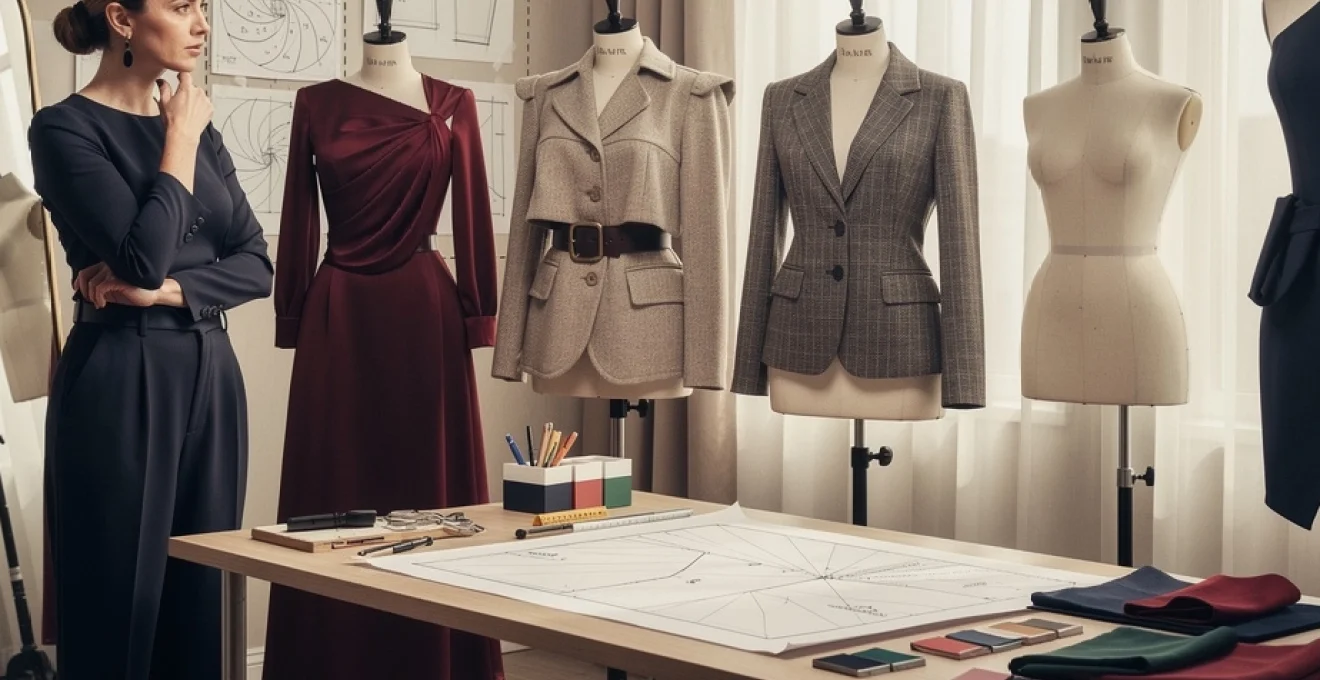
Fashion designers and styling experts have long understood that the secret to creating visually striking and harmonious outfits lies not in following rigid rules, but in mastering the art of proportional play. The manipulation of proportions serves as the foundation for balanced silhouettes, transforming how garments interact with the human form and ultimately determining whether an outfit flatters or detracts from the wearer’s natural beauty. This sophisticated understanding of proportional relationships enables fashion professionals to create clothing that enhances body geometry whilst expressing personal style through thoughtful design choices.
When you consider the most memorable fashion moments in history, they invariably demonstrate masterful proportional manipulation. From the dramatic volume contrasts of Christian Dior’s New Look to the streamlined precision of minimalist design, successful fashion relies on understanding how different elements relate to one another within the overall silhouette. This mathematical approach to styling extends far beyond simple aesthetic preferences, incorporating principles borrowed from architecture, art theory, and even natural phenomena to create visually compelling results.
Golden ratio applications in fashion design and silhouette construction
The golden ratio, mathematically expressed as 1:1.618, represents one of nature’s most prevalent proportional relationships and has profoundly influenced fashion design throughout history. This divine proportion appears naturally in everything from seashells to human facial features, making its application in fashion design particularly harmonious to the human eye. Fashion designers utilise this mathematical principle to create garments that feel inherently balanced and aesthetically pleasing, even when the wearer cannot consciously identify why a particular silhouette appears so perfectly proportioned.
In practical application, the golden ratio influences everything from the placement of design details to the overall proportions of garment sections. Consider how a well-designed jacket achieves its pleasing appearance: the relationship between the lapel width and collar size, the positioning of buttons relative to the hemline, and the balance between fitted and flowing sections all benefit from golden ratio calculations. This mathematical foundation provides designers with objective criteria for making subjective aesthetic decisions, resulting in clothing that transcends personal taste to achieve universal appeal.
Fibonacci sequence integration in garment proportioning
The Fibonacci sequence, where each number represents the sum of the two preceding numbers (0, 1, 1, 2, 3, 5, 8, 13…), offers fashion designers a sophisticated framework for creating proportionally balanced garments. This sequence naturally creates ratios that approximate the golden ratio, providing a practical tool for determining everything from pleat spacing to colour block proportions. Contemporary designers increasingly incorporate Fibonacci-based measurements when establishing the relationship between different garment elements, ensuring mathematical harmony within their creations.
Professional pattern makers often apply Fibonacci principles when determining the optimal proportions for multi-panelled designs, such as colour-blocked dresses or geometric print placements. The sequence helps establish pleasing relationships between contrasting elements, preventing designs from appearing random or unbalanced. This scientific approach to proportion creates garments that feel naturally harmonious, even when incorporating bold or avant-garde design elements.
Rule of thirds implementation for visual weight distribution
Borrowed from photographic composition principles, the rule of thirds provides fashion designers with a powerful tool for distributing visual weight across garments. This technique divides any design space into nine equal sections using two horizontal and two vertical lines, with the most visually appealing elements positioned at the intersection points. In fashion applications, this might translate to placing decorative elements, colour transitions, or silhouette changes at these mathematically determined focal points.
The rule of thirds proves particularly valuable when designing accessories or determining optimal proportions for layered looks. For instance, a scarf positioned to fall at the upper third intersection creates more visual interest than one draped symmetrically, whilst belt placement at the natural third division of the torso typically produces more flattering results than arbitrary positioning. This mathematical approach to styling ensures that even seemingly spontaneous fashion choices rest on solid compositional foundations.
Divine proportion calculations for Sleeve-to-Torso ratios
The relationship between sleeve proportions and torso dimensions significantly impacts overall silhouette balance, with divine proportion calculations providing precise guidelines for achieving optimal results. Professional pattern drafters regularly employ mathematical ratios to determine ideal sleeve lengths, circumferences, and attachment points relative to torso measurements. These calculations ensure that sleeves complement rather than compete with the wearer’s natural proport
ions. When sleeve length follows a divine proportion relative to the torso, the arm appears longer, the shoulder line cleaner, and the overall silhouette more refined. For instance, placing a three-quarter sleeve so that it ends around the narrowest part of the forearm, rather than at the elbow joint, echoes golden ratio spacing and creates a more graceful transition from shoulder to wrist. Similarly, balancing a voluminous bishop sleeve with a more structured bodice respects proportional harmony, preventing the sleeve from overwhelming the outfit.
Stylists often use these sleeve-to-torso ratios in everyday outfit planning, even without formal calculations. Cropped sleeves that finish around the lower third of the forearm can visually slim the arm, while full-length sleeves that extend slightly past the wrist bone elongate the hand and add elegance. By paying attention to where sleeves start and end in relation to the torso length, you can use proportion as a subtle but powerful tool to refine your silhouette and enhance balance in your clothing choices.
Mathematical frameworks used by coco chanel and yves saint laurent
Although Coco Chanel and Yves Saint Laurent are more frequently praised for their creativity than for their mathematics, both designers relied on proportional systems that mirror geometric and numerical frameworks. Chanel’s iconic suits, for example, were meticulously constructed with precise relationships between jacket length, sleeve length, and skirt hem. The jacket typically ended at a point that divided the body in flattering thirds, while pocket placement and trim lines followed consistent proportional spacing that echoed golden ratio principles, even if never stated as such.
Yves Saint Laurent approached silhouette construction with a similarly rigorous eye for harmony. His revolutionary tuxedo suits for women balanced sharp shoulder lines, nipped waists and clean trouser legs through carefully calculated ratios of width to length. The distance between lapel break and waist button, or between jacket hem and trouser crease, reflects a deep understanding of how the eye reads vertical and horizontal divisions. When you study archival pieces, it becomes clear that these designers did not rely on guesswork; instead, they embedded mathematical order into garments so the wearer could enjoy intuitive, effortless balance.
Vertical proportion manipulation techniques for figure enhancement
Vertical proportions determine how tall or short a silhouette appears and where the eye is drawn along the body. By deliberately manipulating vertical lines and break points, you can create the illusion of longer legs, a shorter torso, or a more balanced overall frame. In fashion styling, vertical proportion is less about actual height and more about perceived height, which is why two people of the same stature can look very different in photographs depending on how their outfits are proportioned.
Designers and stylists achieve these effects by shifting waistlines, playing with hemlines, and controlling where garments begin and end on the body. Strategic use of high-waisted silhouettes, empire lines, cropped jackets and asymmetrical hemlines enables almost anyone to refine their proportions visually. When you start thinking of your outfit as a series of vertical segments rather than isolated pieces, you unlock the power to sculpt your own balanced silhouette.
High-waisted silhouettes and leg lengthening methodologies
High-waisted silhouettes are one of the most effective tools for leg lengthening and creating balanced proportions. By raising the apparent starting point of the legs, high-waisted trousers, skirts and shorts compress the torso visually while expanding the vertical line of the lower body. This is especially useful if you feel your legs are proportionally shorter than your torso or if you want to create a more statuesque presence without heels.
To maximise the leg-lengthening effect, combine high-waisted bottoms with tucked-in or cropped tops, avoiding long tops that obscure the waistband and cancel out the illusion. Choosing a continuous colour from waist to toe, such as high-waisted trousers matched with similarly toned shoes, further extends the leg line. You can also use subtle vertical details—pressed creases, front seams or vertical stripes—to reinforce this effect. When styled with intention, a high-waisted silhouette not only elongates but also refines the overall balance of the body.
Empire line construction for torso proportion adjustment
The empire line, characterised by a raised waist seam sitting just below the bust, offers a powerful method for adjusting torso proportions. Originally popularised in Regency-era fashion and revisited repeatedly in contemporary design, the empire silhouette shortens the visual torso while allowing fabric to skim over the midsection and hips. This makes it an excellent strategy if you wish to shift focus upward toward the face and décolletage, or to create a softer, more elongated lower half.
For those with a longer torso or fuller midsection, an empire line dress or top creates a smooth vertical flow from bust to hem without clinging to the waist. The key is precision: if the raised seam sits too high, the bust can look compressed; too low, and the garment loses its proportion-adjusting effect. When executed correctly, the empire construction uses proportion to deliver comfort, elegance and visual balance in a single gesture, particularly in occasion wear and relaxed day dresses.
Cropped jacket styling and hip-to-shoulder ratio optimisation
Cropped jackets are invaluable when you want to optimise hip-to-shoulder ratios and re-balance your upper and lower body. By ending around the natural waist or slightly above the hip, a cropped jacket establishes a clear horizontal break that defines the waist and emphasises the shoulders. This is especially effective for those with a pear-shaped silhouette who wish to broaden the appearance of the upper body while maintaining a streamlined lower half.
When styling a cropped jacket, consider pairing it with high-waisted trousers or skirts to avoid creating a boxy midsection. The combination of a shortened jacket and an elevated waistband compresses the torso visually while highlighting curves at the right points. Structured shoulders, subtle padding or directional seaming at the top of the jacket can further enhance the shoulder line, bringing it into better proportion with the hips. Used thoughtfully, cropped outerwear becomes a precision instrument for sculpting balanced silhouettes rather than simply a trend-led piece.
Asymmetrical hemline design for visual height manipulation
Asymmetrical hemlines offer an advanced yet accessible technique for manipulating perceived height and directing the viewer’s gaze. By breaking free from a strict horizontal line at the hem, designers introduce diagonal or stepped edges that guide the eye along a longer path. This visual journey creates an impression of additional length, which can be especially beneficial for petite figures or anyone seeking a more elongated look without relying solely on heels.
High-low skirts, dresses with angled hems, and tops that dip at the front or back all use asymmetry to disrupt shortening horizontal lines. When the highest point of the hem reveals more leg at one side while the lowest point provides coverage and movement, the result is both dynamic and lengthening. Asymmetrical cuts also soften broad areas, such as wide hips or strong thighs, by avoiding a hard cut across the widest point. In effect, you are drawing a visual diagonal rather than a static bar, allowing proportion to work in your favour.
Horizontal proportion balancing through strategic volume placement
Horizontal proportions concern how width is distributed across the body and how garments add or subtract visual volume at different levels. Strategic volume placement can correct perceived imbalances, such as narrow shoulders relative to hips or a fuller bust above slender hips. Instead of thinking in terms of « hiding » areas, it is more productive to ask: where do you want to add structure, softness or emphasis to achieve a harmonious horizontal line?
Designers create this balance by alternating fitted and voluminous elements. For example, pairing a voluminous blouse with slim trousers keeps the overall silhouette anchored, while a full skirt looks most balanced with a more fitted, streamlined top. Textures, gathers, ruffles and shoulder details all add volume horizontally, whereas sleek fabrics and clean seams reduce it. When you learn to control where volume appears—at the shoulders, bust, waist, hips or hem—you can tailor the horizontal profile of your silhouette to feel balanced and intentional.
Colour theory and proportion perception in contemporary fashion
Colour theory plays a crucial role in how we perceive proportion, often as powerfully as cut or construction. Dark colours tend to recede and visually minimise, while light and bright shades advance and appear larger. This means that simply shifting the distribution of light and dark tones in an outfit can rebalance proportions without altering the underlying silhouette. For instance, wearing a darker shade on an area you wish to downplay and a lighter or more saturated colour where you want to draw attention creates an instant proportional adjustment.
Contemporary fashion makes extensive use of colour-blocking to sculpt the body through visual perception. Vertical blocks or panels of darker colour at the sides of dresses and trousers can narrow the torso or legs, whereas horizontal blocks at the shoulders widen the upper body to balance fuller hips. Low-contrast combinations—such as tonal outfits in similar hues—create a smoother, elongated line, while high-contrast pairings visually segment the body into distinct sections. By understanding how colour influences proportion, you can refine not only which garments you choose but also how you combine them to create balanced silhouettes.
Body geometry analysis and proportional styling solutions
Body geometry analysis looks beyond simple size categories to examine how different segments of the body relate to one another in shape and proportion. Rather than labelling certain forms as « good » or « bad, » this approach recognises that each body type presents its own set of lines, volumes and ratios that can be enhanced through intelligent styling. When you understand your geometry—whether you carry more volume at the midsection, hip, bust or evenly throughout—you gain a practical framework for using proportion to your advantage.
Proportional styling solutions draw on the same principles used in fashion design: redistributing visual weight, manipulating vertical and horizontal lines, and using colour and volume to balance the silhouette. Instead of applying generic rules, you can assess where you might want more structure, where you prefer softness, and how you would like the eye to move across your figure. The following strategies for common body shapes illustrate how precise proportional play can transform both fit and confidence.
Apple body shape proportion strategies using structured blazers
For an apple body shape, where volume is concentrated around the midsection with relatively slimmer limbs, structured blazers become a key styling tool. The goal is not to conceal the torso but to redistribute visual weight, creating clearer vertical lines and a more defined shoulder-to-hip relationship. A well-tailored blazer with subtle shoulder structure elongates the upper body and frames the torso, preventing the midsection from becoming the sole focal point.
Look for blazers that gently nip in at the waist without clinging, with lapels that create a vertical V-shape down the centre of the body. Single-breasted styles with a moderate button stance avoid unnecessary bulk, while hemlines that end around the upper hip or just below the fullest part of the midsection help create balanced proportions. When worn open over a darker, column-like base layer, the blazer’s edges form two vertical lines that slim and lengthen the torso, using proportion and geometry rather than compression to achieve balance.
Pear silhouette balancing with statement shoulder details
The pear silhouette, characterised by fuller hips and thighs with comparatively narrower shoulders, benefits greatly from proportion-enhancing details at the upper body. Statement shoulders—whether through subtle padding, gathered sleeves, epaulettes or sculptural detailing—widen the visual frame at the top, bringing it into alignment with the lower half. This horizontal rebalancing creates a more harmonious shoulder-to-hip ratio without hiding the natural curves that define the pear shape.
When styling a pear body shape, consider tops and jackets that feature shoulder emphasis combined with clean, simple lines over the hips. Avoid excessive volume or embellishment around the upper thigh, which can exaggerate width, and instead choose A-line or softly skimming skirts and trousers. By pairing a visually active top with a more minimal lower half, you draw the eye upward towards the face and shoulders. This proportional strategy celebrates the curves of the hips while ensuring the overall silhouette feels aligned and intentional.
Rectangle frame enhancement through cinched waist techniques
A rectangle frame, where shoulders, waist and hips share similar width, offers a naturally balanced but sometimes linear silhouette. Proportionally, the aim is often to introduce more curve and definition at the waist to create visual contrast. Cinched waist techniques—using belts, darted tailoring, wrap styles or strategically placed seams—can carve out the illusion of an hourglass even when the underlying measurements remain relatively straight.
Wrap dresses, belted blazers and tops with peplum or gentle gathers at the waist all exploit proportion by narrowing the midsection and subtly amplifying the bust and hips. The key is to avoid over-tightening, which can create awkward bunching, and instead focus on gradated shaping that respects the body’s natural geometry. Vertical seams that run from shoulder through waist to hip further reinforce this effect, guiding the eye along a continuous curved path rather than a straight column. Through these proportional interventions, the rectangle frame is enhanced rather than disguised.
Hourglass figure proportion maintenance in oversized trends
The hourglass figure, with its balanced bust and hips and clearly defined waist, can sometimes be challenged by oversized trends that risk obscuring its natural proportions. The objective here is not to avoid volume altogether, but to maintain the underlying waist definition that keeps the silhouette balanced. Without some form of proportional control at the midsection, oversized garments can transform an hourglass into a shapeless block, losing the harmony that makes this geometry so distinctive.
When embracing oversized pieces—such as relaxed blazers, wide-leg trousers or voluminous knits—hourglass figures benefit from strategic anchors. This may mean half-tucking a sweater to reveal the waistband, choosing outerwear with a belt, or pairing an oversized top with a more fitted bottom. Even subtle shaping, like side seams that curve in at the waist or elasticated hems that sit at the narrowest point of the torso, preserves proportional balance. By combining generous silhouettes with visible waist emphasis, an hourglass figure can enjoy contemporary volume without sacrificing its signature harmony.