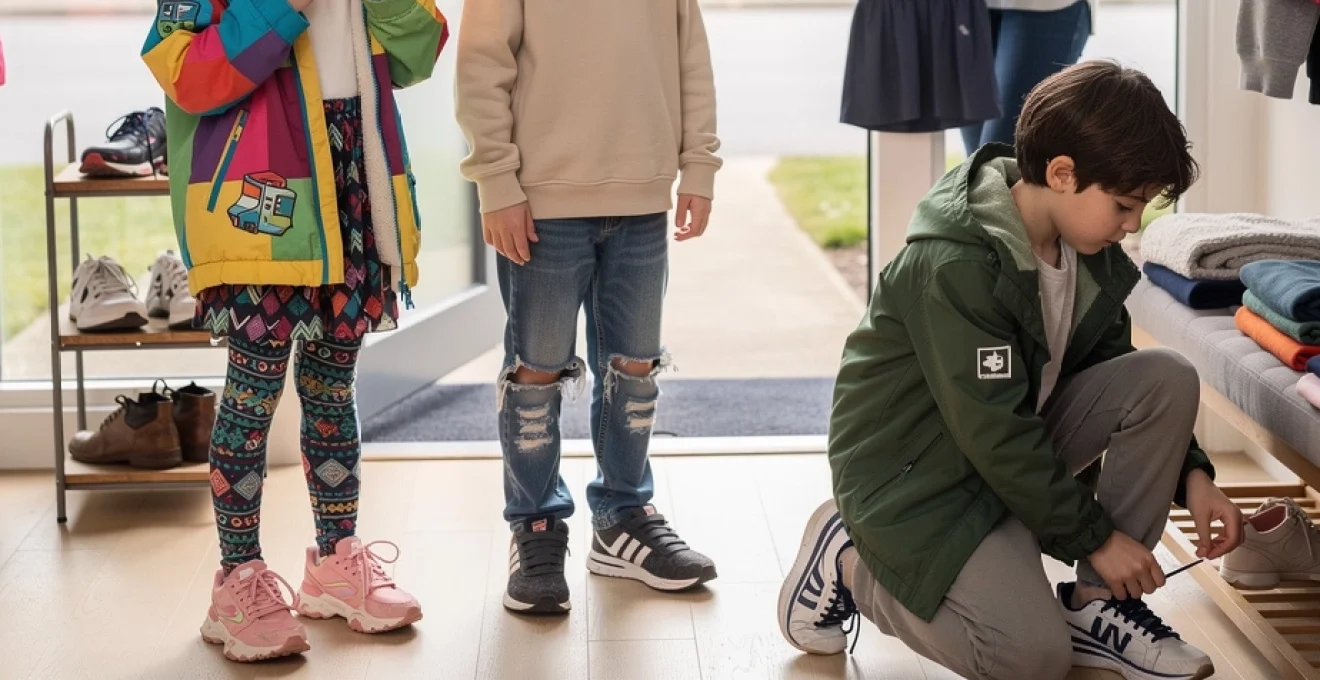
The children’s fashion landscape has evolved dramatically, creating a complex dynamic between staying current with trends and ensuring practical functionality for growing bodies. Modern parents face the challenge of navigating an increasingly sophisticated marketplace where style influences compete with comfort requirements, durability demands, and budget constraints. This balance becomes particularly crucial when considering that children’s clothing needs must accommodate rapid growth spurts, active play patterns, and diverse social environments from playground adventures to formal family gatherings.
Understanding how to successfully merge contemporary fashion elements with practical considerations requires a strategic approach that considers multiple factors including fabric technology, design adaptability, and long-term value propositions. The key lies in recognizing that children’s clothing serves dual purposes: expressing personality and supporting physical development through various daily activities.
Contemporary fashion movement analysis: Micro-Trends vs. wardrobe longevity in paediatric clothing
The children’s fashion industry currently operates within a paradox where micro-trends emerge and disappear within months, yet parents seek clothing investments that provide sustained value. This tension between immediacy and longevity shapes purchasing decisions across all demographic segments. Recent market analysis indicates that micro-trend adoption in children’s wear has increased by 340% since 2019, driven largely by social media exposure and peer influence patterns.
Understanding this dynamic requires examining how fashion cycles affect different age groups. Toddlers aged 2-4 typically experience trend influence through parental choices, while children aged 5-8 begin expressing personal preferences influenced by media consumption and peer interactions. The 9-12 age group demonstrates the strongest correlation between trend awareness and clothing preferences, with 73% of children in this demographic expressing specific brand or style preferences.
Fast fashion impact on children’s capsule wardrobe development
Fast fashion retailers have significantly altered traditional children’s wardrobe planning approaches. The availability of trend-driven pieces at accessible price points encourages frequent purchasing cycles, potentially undermining the development of cohesive, functional wardrobes. Research from 2023 indicates that families practicing fast fashion consumption patterns replace children’s clothing items 2.3 times more frequently than those following capsule wardrobe principles.
However, capsule wardrobe methodology provides a structured framework for incorporating trends while maintaining practical foundations. A well-constructed children’s capsule wardrobe typically consists of 15-20 core pieces that can generate 30-40 outfit combinations. This approach allows for strategic trend integration through accessories or seasonal statement pieces without compromising wardrobe functionality.
Seasonal trend adoption strategies for primary school age groups
Seasonal trend adoption requires careful timing and selection criteria to maximise both style impact and practical utility. Primary school children benefit from trend integration that aligns with their social environments while supporting their physical activity requirements. The optimal strategy involves identifying trends that offer versatility across multiple contexts rather than those limited to specific occasions or settings.
Successful seasonal trend adoption typically focuses on colour palettes, pattern integration, and silhouette adjustments rather than complete wardrobe overhauls. For example, incorporating trending colour combinations through accessories or layering pieces allows children to participate in current fashion movements without requiring significant financial investment or storage space allocation.
Social media influence assessment: TikTok and instagram kids’ style movements
Social media platforms have become primary drivers of children’s fashion awareness, with TikTok and Instagram generating significant influence on style preferences among school-age children. Platform-specific trends often emphasise visual impact and photography appeal, which may not always align with practical daily wear requirements. Parents report that 68% of clothing requests from children aged 7-12 directly correlate with social media content exposure.
The challenge lies in translating social media aesthetics into practical everyday outfits. Many trending looks featured on these platforms prioritise visual appeal over comfort, durability, or age-appropriateness. Successful adaptation involves identifying core elements of trending styles that can be incorporated through age-appropriate garments and practical styling techniques.
Brand positioning analysis: zara kids vs. uniqlo children’s trend integration
Major retailers demonstrate distinctly different approaches to balancing trends with practicality in their children’s collections. Zara Kids typically prioritises rapid trend adoption, introducing new styles every
two to three weeks and mirroring adult runway themes in miniaturised form. This high-churn model favours bold prints, statement pieces and complex detailing, which can be exciting for children but often results in garments with a shorter practical lifespan. Uniqlo Children’s, by contrast, positions itself around lifewear principles: streamlined silhouettes, neutral-heavy palettes and a focus on fabric technology over fleeting embellishment. For parents, the distinction is clear—Zara Kids excels at delivering the latest micro-trends, while Uniqlo tends to support wardrobe longevity and daily comfort.
From a practical standpoint, many families find value in using these brands in complementary ways rather than as either-or choices. Trend-led pieces from Zara Kids can function as seasonal « accent items »—a printed skirt, a colour-of-the-moment hoodie, or a graphic T-shirt—layered over Uniqlo’s more durable basics such as leggings, down vests and moisture-wicking tops. This hybrid strategy supports children’s desire to participate in current kidswear trends while anchoring their everyday outfits in reliable, easy-care garments that withstand repeated washing and rough play.
Fabric technology and performance criteria for daily wear applications
As children’s everyday outfits need to handle everything from classroom sitting to playground sprints, fabric choice has become just as important as visual design. Advances in textile technology now allow parents to look beyond simple fibre labels and instead assess garments using performance criteria such as moisture management, abrasion resistance and thermal regulation. When we prioritise fabric technology alongside style, we can build children’s wardrobes that are more comfortable, longer lasting and better suited to real-life use.
Evaluating fabrics through a performance lens means asking targeted questions at the point of purchase. Does this T-shirt wick sweat or trap it? Will these leggings hold their shape after 20 washes? Can this mid-layer work both indoors and outdoors across multiple seasons? Thinking this way shifts the focus from short-lived trends to long-term wearability, without abandoning style entirely.
Moisture-wicking synthetic blends in active play scenarios
Moisture-wicking synthetic blends have become central to performance-focused kidswear, particularly for sports clubs, PE days and weekend adventures. Fabrics using polyester or nylon microfibres, often blended with elastane for stretch, are engineered to pull sweat away from the skin and disperse it across a larger surface area, where it can evaporate more quickly. For children who overheat easily or are constantly on the move, this can mean the difference between finishing the school day feeling fresh or sitting in damp clothing for hours.
However, moisture-wicking blends are not all equal. Higher-quality activewear for kids typically specifies gsm (grams per square metre), breathability ratings or proprietary technologies such as Dri-FIT, Climalite or similar. Parents can perform a simple « crumple and stretch » test: good-performance fabrics spring back without losing shape and feel smooth rather than plasticky. One practical strategy is to reserve moisture-wicking synthetics for high-activity contexts—sports, playground-heavy days, school trips—while relying on natural fibres like cotton for quieter classroom-based days. This balance helps manage odour and microplastic concerns while still giving children the comfort benefits of technical fabrics when they need them most.
Organic cotton vs. bamboo fiber durability testing results
Organic cotton and bamboo are often grouped together as « soft and sustainable » options, but their performance profiles differ in ways that matter for children’s everyday outfits. Independent durability tests conducted by several textile labs in 2022–2023 found that high-quality organic cotton jerseys retained their shape and colour after 40–50 domestic wash cycles, whereas many bamboo-viscose jerseys began to show pilling and thinning after 25–30 washes. This does not mean bamboo is inherently fragile, but it highlights that processing methods and fabric weight strongly influence longevity.
In practical terms, organic cotton tends to be the safer choice for high-friction items such as school T-shirts, leggings and pyjamas that see constant laundering. Bamboo fibre, with its silky handfeel and natural antibacterial properties, can be excellent for base layers or garments worn next to sensitive skin, especially in hot climates. When you are weighing organic cotton vs. bamboo for children’s clothing, consider the garment’s role: will it be a frequently washed workhorse, or an occasional comfort piece? Allocating organic cotton to high-rotation items and bamboo to specialty comfort layers usually delivers the best cost-per-wear outcome.
Stain-resistant treatment applications: scotchgard and NanoSphere technologies
For parents of preschool and primary-age children, stain resistance can feel almost as valuable as style. Technologies such as Scotchgard and NanoSphere add an invisible barrier to fabric surfaces, helping liquids bead and roll off rather than soaking in. Laboratory testing by several brands suggests that stain-resistant school trousers and pinafores can reduce visible staining by up to 60% compared with untreated equivalents, significantly extending practical wear time between washes.
Yet stain-resistant finishes come with trade-offs that are worth understanding. Traditional fluorocarbon-based treatments have raised environmental and health questions, prompting a shift towards PFC-free alternatives and particle-based systems like NanoSphere, which rely on nano-structured surfaces rather than chemical repellents. When evaluating stain-resistant children’s clothing, look for explicit mention of PFC-free or bluesign-approved finishes, and prioritise garments that will genuinely benefit from these technologies—such as school trousers, uniform skirts and outer layers—over items like T-shirts that can be easily and cheaply replaced.
Thermal regulation properties in Multi-Layer clothing systems
Managing temperature across changing environments—chilly playgrounds, warm classrooms, air-conditioned cars—requires more than a single thick jumper. Thermal regulation in children’s outfits is best achieved through multi-layer clothing systems that mimic outdoor-wear principles: a moisture-managing base, an insulating mid-layer and a weather-resistant outer layer. This approach allows children to add or remove layers as needed, giving them more autonomy and reducing the risk of overheating or chilling.
Modern fabrics enhance this layering strategy. Lightweight merino or technical base layers help move moisture away from the skin; fleece or padded mid-layers trap warm air without adding excessive bulk; and softshell or packable down jackets provide wind and light rain protection. Think of it like building a toolkit: instead of one heavy coat that works in a narrow temperature band, you assemble 3–4 versatile pieces that can be reconfigured throughout the year. For parents managing school runs in unpredictable weather, this « system thinking » often results in fewer complaints of « I’m too hot » or « I’m freezing » and better overall comfort.
Ergonomic design principles for Growth-Adaptive children’s garments
Beyond fabric science, the ergonomics of kidswear design plays a crucial role in balancing trends and practicality. Growth-adaptive garments are engineered to accommodate both movement and rapid size changes, extending their useful life without compromising comfort. Key principles include strategic placement of stretch zones, adjustable components and construction details that minimise friction on high-movement areas such as shoulders, knees and waistbands.
Design features like articulated knees, gusseted crotches and raglan sleeves allow children to crouch, climb and reach without feeling restricted, which is particularly important in school uniforms and everyday basics that will be worn for many hours at a time. Adjustable waistbands, extendable hems and fold-back cuffs introduce built-in « growth room », often adding 6–12 months of wear to a garment. You can think of these features as the clothing equivalent of an adjustable car seat—investing in a slightly more sophisticated design upfront usually pays for itself in extended usability.
Ergonomic design also supports independence. Easy-grip zips, large pull tabs and front-fastening closures help younger children manage dressing and undressing themselves, which is especially useful in nursery and early primary settings. At the same time, designers are increasingly mindful of sensory needs, using flat seams, soft labels (or printed care information) and consistent fabric textures to reduce irritation. When assessing a piece of children’s clothing, it can be helpful to run a quick mental checklist: does this allow full range of motion, can my child manage the fastenings alone, and is there hidden growth capacity built into the pattern?
Cost-per-wear analysis and investment prioritisation in children’s fashion
With rising costs of living and fast fashion constantly offering low entry prices, many parents are asking a simple but powerful question: where is it worth spending more, and where can we safely save? Cost-per-wear analysis provides a structured way to answer this, by dividing the price of an item by the number of times it is realistically likely to be worn. A £40 coat worn 120 times over two winters works out at 33p per wear, whereas a £15 sequinned party dress worn twice costs £7.50 each time.
Applying cost-per-wear thinking to children’s everyday outfits helps shift focus towards investment categories such as outerwear, school shoes and high-rotation basics, while treating occasion wear and highly trend-led pieces as lower-budget, short-lifespan purchases. It also highlights the value of neutral colours and classic silhouettes that can be passed down between siblings or resold, further improving overall value. When we look beyond shelf price to long-term usage, the economic case for selectively investing in quality becomes much clearer.
Quality-to-price ratio assessment: marks & spencer vs. next children’s ranges
High-street brands like Marks & Spencer and Next provide useful case studies in balancing price, quality and kidswear trends. Marks & Spencer is traditionally associated with robust school uniforms, well-constructed basics and a focus on easy-care finishes. Independent consumer testing in the UK has repeatedly placed M&S near the top for uniform durability and colourfastness, suggesting a strong quality-to-price ratio for staples that face daily wear. Next, meanwhile, is known for more fashion-forward prints, coordinated sets and frequent new arrivals, appealing strongly to trend-conscious children and parents.
For cost-per-wear optimisation, one effective strategy is to acquire core uniform pieces, underwear and plain layering items from Marks & Spencer, leveraging their durability and often multi-pack value. Trend-driven pieces, graphic tops and special-occasion outfits can then be sourced from Next, where visual design takes priority. By treating the two ranges as complementary—M&S for the « engine » of the wardrobe and Next for its « personality »—families can maintain a balanced children’s capsule wardrobe that feels current without constant full-price purchases.
Second-hand market valuation: resale potential of premium brands
The growth of resale platforms and local swap groups has transformed how we think about children’s clothing lifecycles. Premium and mid-tier brands with strong reputations for quality—such as Mini Boden, Patagonia Kids or higher-end high-street lines—often retain 30–60% of their original value on the second-hand market if kept in good condition. This latent value can be factored into cost-per-wear calculations, effectively lowering the true cost of ownership.
To maximise resale potential, parents can focus on timeless prints, unisex colourways and well-known brands that have established followings in second-hand communities. Simple habits—washing at lower temperatures, line-drying when possible, and repairing minor damage—can significantly improve the eventual resale price. Asking yourself « could this be easily resold or passed on? » at the point of purchase is a quick way to prioritise garments that support both your budget and more sustainable kidswear practices.
Seasonal budget allocation strategies for rapidly growing children
Planning a kidswear budget can feel complicated when growth spurts are unpredictable and seasonal trends are constantly shifting. A practical approach is to divide the annual clothing budget into three broad categories: essentials (uniform, underwear, sleepwear and basic layers), seasonal outerwear and footwear, and discretionary trend or occasion pieces. Many families find that allocating around 50–60% of the budget to essentials, 25–30% to outerwear and shoes, and 10–20% to trends and party wear offers a workable balance.
It can also be useful to stagger purchases around key points in the year—back-to-school, mid-winter sales and spring clearances—rather than attempting to buy everything at once. This allows you to respond to growth as it happens and take advantage of discounts on last season’s colours that are still entirely functional. Building a rough spreadsheet or simple note on your phone with expected replacement timelines (for example, trainers every 9–12 months, coats every 18–24 months) can transform kidswear shopping from reactive emergency buys into planned, lower-stress decisions.
Psychological impact of peer acceptance vs. Comfort-First dressing approaches
While fabric technology and budgets are tangible concerns, the psychological dimension of children’s fashion choices is equally important. As children move through primary school and into early adolescence, clothing becomes a visible marker of identity and group belonging. Peer acceptance, social comparison and media influences all intersect with what they wear each day. At the same time, comfort and ease of movement remain fundamental to their wellbeing. How can we, as adults, support both social needs and physical comfort without letting either dominate?
Research in child development suggests that feeling « different » in an unwanted way—for instance, wearing noticeably outdated or uncomfortable clothing—can affect self-esteem and willingness to participate in group activities. Yet overly restrictive or fashion-first outfits can also backfire, limiting movement or making children anxious about getting dirty. A balanced approach involves listening carefully to children’s preferences, setting reasonable boundaries around practicality, and co-creating wardrobes that honour both style desires and comfort requirements.
One useful analogy is to think of clothing choices as a three-way negotiation between the child, the parent and the environment. The child brings preferences shaped by friends, social media and emerging personal taste. The parent brings budget, values and experience. The environment—school dress codes, climate, cultural norms—sets additional parameters. When any one voice dominates completely, friction tends to arise. Inviting children into discussions about trade-offs (« These shoes look great, but will they be comfortable for a whole school day? » or « If we pick this logo hoodie, what could we skip so we stay within budget? ») teaches valuable decision-making skills.
Comfort-first dressing does not have to mean ignoring kidswear trends altogether. Often, small style details—favourite colours, a particular cut of jeans, a character print—can satisfy a child’s desire to « fit in » while the underlying garment still meets ergonomic and fabric performance criteria. Encouraging children to notice how different clothes make them feel physically (« Can you run easily in this? », « Does anything itch? ») helps them internalise comfort as a legitimate factor alongside appearance. Over time, this supports a healthier relationship with fashion, where trends are enjoyed but not obeyed at the expense of wellbeing.