# How to Master Stacking Jewellery for a Luxury Look?
Jewellery stacking has evolved from a simple styling trick into a sophisticated art form that defines contemporary luxury aesthetics. The ability to layer multiple pieces harmoniously speaks volumes about personal style, creating visual narratives that are both complex and utterly captivating. What distinguishes a haphazard pile of accessories from a carefully curated luxury stack? The answer lies in understanding the technical principles that govern proportion, metal compatibility, and visual balance—knowledge that transforms ordinary jewellery collections into extraordinary personal statements.
The resurgence of jewellery layering in high-end fashion circles has redefined what it means to wear fine pieces with confidence and creativity. Unlike the rigid styling rules of previous decades, modern stacking embraces intentional eclecticism whilst maintaining an underlying structure that prevents visual chaos. This approach allows you to express individuality through thoughtful combinations that respect the integrity of each piece whilst creating something entirely new. The luxury market has responded enthusiastically, with discerning collectors now investing in complementary pieces specifically designed to work within stacked compositions rather than standalone statements.
Understanding metal compatibility and mixing precious metals
The foundation of any successful jewellery stack begins with understanding how different metals interact visually and physically. The outdated rule that prohibited mixing metals has been thoroughly debunked by contemporary jewellery designers and style authorities alike. However, this freedom comes with nuanced considerations that separate sophisticated stacks from chaotic assemblages. When combining precious metals, you’re essentially creating a palette that will frame gemstones, define proportions, and establish the overall temperature of your composition.
Metal mixing succeeds when there’s an intentional distribution across your stack rather than random placement. The human eye naturally seeks patterns and balance, so introducing metals in odd numbers—three different tones across seven pieces, for instance—creates visual intrigue without overwhelming the composition. Recent surveys indicate that 68% of luxury jewellery purchases now involve considerations of how pieces will layer with existing collections, demonstrating how fundamentally stacking has influenced buying behaviour. This shift has prompted jewellers to design with stackability as a primary feature rather than an afterthought.
Pairing yellow gold with rose gold and white gold
Yellow gold remains the quintessential foundation metal for luxury stacks, its warm luminosity providing a rich backdrop against which other tones can play. When introducing rose gold into a predominantly yellow gold stack, the two warm metals create a harmonious gradient that feels cohesive and intentional. The copper content in rose gold echoes the natural warmth of yellow gold whilst adding a romantic, vintage-inspired dimension that has become increasingly sought-after in luxury markets. Position rose gold pieces strategically throughout your stack rather than grouping them together—this distribution allows each metal to enhance the other through deliberate contrast rather than competition.
White gold introduces a cool counterpoint that can sharpen the overall composition when used judiciously. The key to successfully incorporating white gold lies in treating it as an accent rather than an equal partner to warmer tones. A single white gold piece amongst predominantly warm metals creates a sophisticated focal point, drawing the eye and adding contemporary edge to traditional combinations. Consider the rhodium plating on white gold, which provides that distinctive silvery finish but will wear over time, potentially revealing the slightly warmer natural colour beneath—a factor worth considering when planning long-term stack configurations.
Incorporating sterling silver with vermeil pieces
Sterling silver occupies a unique position in luxury stacking, offering cool-toned versatility at various price points. When combining sterling silver with gold vermeil—sterling silver with a substantial gold plating—you create depth through layering similar base metals with different surface treatments. This technique proves particularly effective for those building luxury-looking stacks on transitional budgets, as the underlying silver maintains consistent quality whilst the gold layer provides visual warmth. The thickness of gold plating on quality vermeil pieces (typically 2.5 microns or more) ensures durability within stacked arrangements where pieces inevitably contact one another.
The patina development on sterling silver adds character to stacked compositions, creating an evolving aesthetic that changes subtly over time. Rather than viewing tarnish as deterioration, consider it part of the living quality of your stack—a testament to the pieces you wear most frequently. High-quality vermeil maintains its gold
finish for longer when cared for properly, helping your mixed-metal stack retain a luxurious appearance even with daily wear. To avoid noticeable discrepancies between sterling silver and vermeil over time, keep both metals on a similar cleaning schedule and store them away from excessive humidity. When in doubt, position solid sterling silver pieces closer to the skin and vermeil on the outer edges of a stack, where friction is slightly lower. This subtle strategy preserves plating while still allowing you to enjoy the polished contrast between cool silver and warm vermeil in your stacked jewellery looks.
Balancing warm and cool metal tones in layered compositions
Balancing warm and cool metal tones is the key to creating stacked jewellery that feels intentional rather than improvised. Warm metals such as yellow gold and rose gold visually advance, catching the eye first, while cool metals like white gold, platinum, and sterling silver tend to recede slightly. In practice, this means that if you want a luxury stack with a golden glow, warm metals should represent at least 60–70% of the visible surface area, with cool metals playing a supporting role. Treat warm metals as your “canvas” and cool metals as “highlight pens” that sharpen edges and add definition.
One useful analogy is to think of your jewellery stack as interior design lighting: warm light creates atmosphere, while cool light adds clarity and structure. If your outfit already leans cool—think black, white, navy or grey—introducing more yellow or rose gold can soften the overall impression and add a touch of opulence. Conversely, if you are wearing earthy or camel tones, adding white gold or silver elements helps prevent the look from becoming visually heavy. For a truly luxurious finish, repeat each metal at least twice across different areas—neck, wrist, ears, and hands—so the composition feels cohesive from every angle.
Patina development on mixed metal stacks
Patina development is an often-overlooked aspect of stacking jewellery that can significantly influence the long-term aesthetic of your luxury combinations. Yellow and rose gold, particularly in higher carats, maintain their colour with minimal change, whereas sterling silver and some white gold alloys develop patina or tarnish over time. In mixed-metal stacks, these shifts in surface tone can either enhance the sense of depth and character or create visual discord if not managed thoughtfully. You can intentionally embrace patina by pairing slightly aged silver with brushed or matte-finish gold, creating an old-world luxury effect that feels collected rather than newly purchased.
From a technical standpoint, frequent contact between different metals can accelerate micro-scratches and wear, especially where high-polish surfaces meet textured finishes. To preserve the luxury look of your stacked jewellery, alternate high-polish pieces with more forgiving satin or hammered textures that disguise inevitable micro-abrasions. Periodic professional polishing of white gold and silver elements will reset the visual balance, ensuring cooler tones do not become dull next to richer gold. Ultimately, the most elegant mixed-metal stacks are those that age gracefully, with patina viewed less as a flaw and more as a subtle record of how often you have loved and worn your pieces.
Proportional layering techniques for necklaces and chains
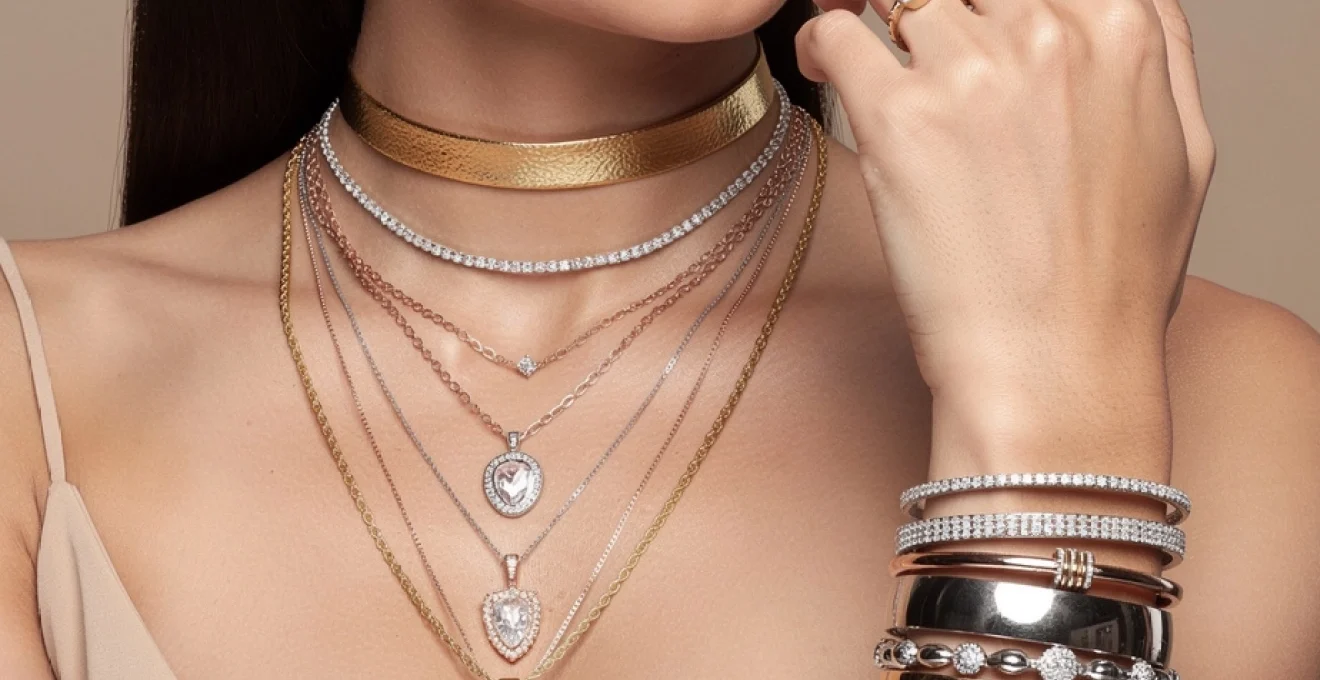
Necklace layering remains one of the most visible ways to master stacking jewellery for a luxury look. The neckline acts as a natural focal point, so any imbalance in proportion or spacing is immediately noticeable. A refined layered composition considers three technical aspects: chain length separation, variation in chain weight, and pendant placement. When these elements align, even a simple T-shirt can become the backdrop for a high-end, editorial-worthy jewellery moment. Conversely, neglecting them can result in tangling, crowding, and a cluttered appearance that undermines the sophistication you are aiming for.
Luxury necklace stacks typically feature between two and five layers, depending on your frame, neckline and the occasion. Fewer layers create a minimal, architectural feel, while more strands lend themselves to bohemian chic or maximalist elegance. You might ask: how do you know where to stop? A practical rule is to ensure that each necklace is clearly visible, with at least one finger’s width of negative space between pendants when you look in the mirror. This breathing room is what separates a deliberately curated layered necklace look from a simple accumulation of chains.
The 2-inch rule for chain length differentiation
The widely cited “2-inch rule” for chain length differentiation is a cornerstone of necklace stacking that looks and feels luxurious. In essence, each necklace in your layered stack should be approximately 2 inches longer than the one above it. This incremental spacing creates a cascading effect that allows every piece to sit comfortably without constant overlapping or tangling. For example, a classic sequence might include 14″, 16″, 18″ and 20″ chains, with each length creating its own level within the composition.
Of course, anatomy and personal preference influence how strictly you follow this guideline. If you have a shorter neck or prefer more subtle layering, you may opt for 1–1.5 inch increments, while taller frames can comfortably accommodate 2–3 inch gaps. Think of the 2-inch rule as the architectural blueprint: you can tweak it, but ignoring it altogether often results in necklaces clumping at a single point on the neckline. To refine the look further, combine the 2-inch rule with varied chain weights, placing the heaviest or most prominent chain at the mid-level for optimal visual balance.
Combining choker, princess, and matinée lengths
Working with classic necklace lengths—choker (around 14″), princess (16–18″), and matinée (20–24″)—gives structure to your layered necklace stacks. A choker acts as the anchor closest to the neck, framing the face and collarbones. The princess length, historically considered the most versatile, becomes the central layer that ties the composition together. Matinée-length pieces then elongate the torso, guiding the eye downward and adding a sense of drama and luxury to the look. When combined thoughtfully, these lengths mimic the natural flow of tailored clothing, from neckline to waistline.
To avoid a visually “top-heavy” stack, ensure that your chokers remain finer or more minimal when paired with elaborate princess or matinée necklaces. A slim gold choker, for instance, pairs beautifully with a more detailed pendant at princess length and a chunky chain at matinée length. This descending order of visual weight creates fluidity, much like a well-tailored dress that follows the lines of the body. If you wish to experiment with more avant-garde layering, consider adding a lariat or Y-shaped necklace into the matinée zone to create a vertical line that subtly elongates the silhouette.
Pendant placement strategy in multi-strand arrangements
Pendant placement can either elevate your stacked necklaces into a cohesive story or break the visual rhythm. In multi-strand arrangements, begin by deciding which layer will carry the primary focal pendant—this is usually at princess or matinée length. Once that hero piece is established, supporting pendants should be smaller in scale and placed on higher or lower chains so they do not compete directly for attention. Imagine your pendants as characters in a photograph: one should be in sharp focus, while others play complementary roles in the background.
A useful pendant placement strategy is to limit large pendants to one or two layers and keep the rest as clean chains or ultra-delicate charms. For example, a substantial medallion at 18″ pairs well with a tiny gemstone charm on a 16″ chain and a bare, fluid chain at 20″. This hierarchy prevents your neckline from feeling overcrowded while retaining depth and personality. If you are combining multiple symbolic or sentimental pendants, arrange them by visual weight rather than emotional importance, ensuring that the heaviest or darkest motif occupies the central or lowest layer for stability and harmony.
Incorporating statement pieces with delicate fine chains
Blending statement necklaces with delicate fine chains is one of the most effective ways to create a luxury necklace stack that feels editorial rather than excessive. The statement piece—whether a bold collar, a heavy link chain, or a gem-set pendant—should function as the architectural core of the composition. Surrounding it with lighter, finer chains adds a sense of air and movement, much like sheer layers soften the lines of a structured coat. Done well, this contrast underscores the importance of the statement piece instead of competing with it.
To avoid overwhelming your neckline, position the statement piece slightly off-centre within the stack rather than at the very top or very bottom. Placing a bold piece in the middle layer, framed by more delicate chains above and below, creates a natural gradient of weight and detail. If you wear a strong chain collar, for instance, add an ultra-fine choker above and a subtle pendant below for balance. Ask yourself: where do I want the eye to land first? Once that focal point is decided, every other chain should be chosen to guide the gaze toward or away from it in a deliberate way.
Bracelet stacking formulas and wrist composition
Bracelet stacking is where the art of luxury layering becomes tactile and kinetic. Your wrists are in constant motion—gesturing, writing, holding a glass—so any imbalance or discomfort in your bracelet stack will be immediately noticeable. A refined wrist composition takes into account the width of each piece, how they sit and move together, and the relationship between both wrists. While the trend toward maximal wrist stacks remains strong, the most elevated looks rely on clear formulas that balance negative space with visual richness.
When stacking bracelets for a luxury look, consider the wrist as a narrow stage with limited width. Overcrowding this space with pieces of similar size can create a rigid “cuff” effect that feels more utilitarian than elegant. Instead, think in terms of rhythm: alternating rigid bangles with fluid chains, or polished tennis bracelets with matte-finish cuffs. This interplay of movement and texture allows your stacked bracelets to catch the light from multiple angles, reinforcing the sense of considered opulence rather than casual clutter.
The odd-number stacking method for visual balance
The odd-number stacking method is a timeless visual principle borrowed from interior design and photography, readily applicable to luxury bracelet layering. In practice, this means wearing three, five, or seven bracelets together rather than an even number. Odd groupings naturally create a central focal point with supporting elements on either side, resulting in a more dynamic, less rigid composition. For example, three well-chosen bracelets—a bangle, a chain, and a tennis bracelet—often look more intentional than four similar pieces competing for the same space.
To refine this approach further, treat the centre bracelet as the “hero” of the composition. This might be a diamond tennis bracelet, an engraved bangle, or a distinctive chain link design. Flank it with simpler, thinner pieces that echo its metal tone or texture without replicating it exactly. The result is a stack that feels balanced from every viewpoint, whether you are typing at a desk or raising a glass at an evening event. If you wear a watch, consider it part of the odd-number grouping, building one to three complementary bracelets alongside it for a chic, layered wrist.
Mixing bangle widths with tennis bracelets
Combining bangles of varying widths with classic tennis bracelets is a hallmark of luxurious wrist stacking. Bangles provide structure and defined shapes, while tennis bracelets offer fluidity and continuous sparkle. A sophisticated formula is to pair one substantial bangle with a medium-width bangle and one or two slender tennis bracelets. The rigid curves of the bangles frame the delicate articulation of the tennis pieces, creating contrast in both volume and movement. This interplay echoes high jewellery styling seen on red carpets and couture runways.
From a proportional standpoint, it is wise to avoid stacking multiple wide bangles right next to one another, as this can visually shorten the forearm and feel heavy. Instead, position a strong bangle closest to the hand, followed by a tennis bracelet, then a slimmer bangle or chain. This order helps the stack taper gently up the arm, enhancing elegance. If you are working with coloured gemstones in your tennis bracelets, choose bangle finishes that either match the metal colour or provide a deliberate contrast—yellow gold bangles with white gold diamond tennis bracelets, for instance, create a striking yet cohesive luxury jewellery stack.
Integrating cuff bracelets with beaded and chain styles
Cuff bracelets introduce an architectural element to wrist stacking, acting almost like the structural beam in a building. Because cuffs occupy more surface area and often have a fixed shape, they should be treated as anchor pieces within your composition. To keep the look refined rather than overpowering, pair a cuff with softer, more flexible bracelets such as fine chains or high-quality beaded strands. This combination tempers the boldness of the cuff while allowing it to remain the star of the stack.
Placement plays a decisive role: wearing the cuff slightly higher on the forearm, with chain and beaded bracelets closer to the wrist bone, creates a natural gradient from bold to delicate. This arrangement also reduces friction and prevents smaller pieces from being trapped uncomfortably under the cuff. When working with gemstones or pearls in your beaded bracelets, echo one of the tones present in the cuff—metal colour, enamel detail, or stone hue—to visually tie the elements together. The result is a wrist stack that feels curated and luxurious, rather than improvised moments before you left the house.
Ring stacking architecture and finger proportions
Ring stacking brings the concept of jewellery architecture into sharp focus, as fingers provide a vertical canvas with defined boundaries. A luxury ring stack is not simply about how many rings you can wear at once, but how thoughtfully each band, setting, and stone contributes to an overall silhouette. The proportions of your fingers—their length, width, and taper—directly influence which stacking configurations will appear the most refined. Long, slender fingers can support more vertical stacking on a single finger, while shorter fingers often benefit from distributing rings across multiple digits.
A practical approach is to think in terms of “anchor, support, and accent” when composing a ring stack. The anchor might be a statement ring or engagement ring with a noticeable setting; supporting bands are usually simpler, echoing metal or stone details from the anchor; accent rings include midi rings or ultra-fine bands that add texture without significant height. As with bracelet stacking, odd numbers often create the most pleasing effect—three rings distributed across one hand, for instance, can look more deliberate than two. You might ask yourself: do I want one hero finger, or do I want harmony across the entire hand? Your answer will guide both placement and scale.
For a luxury look, pay close attention to vertical height and side profile. Too many high-set rings on adjacent fingers can cause discomfort and visual clutter, catching on fabrics or knocking together when you move. A refined solution is to vary the ring heights, keeping at least one low-profile band between two taller settings. This creates a rhythmic skyline across the fingers, reminiscent of an elegant cityscape rather than a crowded cluster of towers. Matching or complementary metals across your ring stack further unifies the design, while a repeated motif—such as milgrain detail, baguette cuts, or pavé bands—adds a quiet sense of continuity.
Earring curation and multiple piercing coordination
Curating earrings for multiple piercings is one of the most nuanced ways to master stacking jewellery for a luxury look. Your ears offer a vertical line punctuated by strategically placed piercings, making them ideal for graduated compositions. Rather than treating each earring as an isolated choice, think of the entire ear as a small gallery wall where each piece contributes to a cohesive visual story. The goal is to create flow from the lobe upward, with careful consideration of scale, shape, and sparkle.
With the rise of curated ears in fine jewellery boutiques, many clients now approach earring styling with the same intentionality once reserved for rings and necklaces. A well-balanced ear stack typically begins with a slightly larger or more ornate piece in the first lobe piercing, followed by progressively smaller or subtler designs as you move toward the helix. This descending scale helps maintain elegance, even when you incorporate multiple gemstones or mixed metals. If you wear statement earrings for a special occasion, adjust your upper piercings to ultra-minimal studs or remove them entirely, allowing the hero pair to command full attention.
Graduated sizing from lobe to upper cartilage
Graduated sizing is the technical principle that underpins most successful stacked earring arrangements. Starting with the largest or most visually dominant earring at the lobe and moving to smaller, more delicate pieces toward the upper cartilage creates a natural sense of upward lift. This approach subtly elongates the neck and frames the face, similar to how a well-tailored collar draws the eye upward. In practice, this might look like a small hoop or drop in the first lobe piercing, a petite stud in the second, and a tiny diamond or gold dot in the helix.
Pay attention not only to the size but also to the visual “weight” of each earring. A compact but heavily gem-set stud can be as visually impactful as a larger, plain hoop. When in doubt, line your chosen earrings up on a jewellery tray from largest to smallest and check whether the progression feels smooth and logical. Once you have this sequence, mirror it on the ear, adjusting where necessary based on your individual piercing placement. The result is an ear stack that looks considered and luxuriously cohesive from both profile and front-facing angles.
Mixing stud, hoop, and huggie earring styles
Mixing studs, hoops, and huggies within a single ear stack introduces movement and variety while maintaining refinement. Each style contributes a different structural quality: studs offer clean points of light, hoops create negative space and curves, and huggies provide a snug, modern frame around the earlobe. A classic luxury combination might feature a small gemstone hoop at the first lobe, a sleek gold huggie in the second, and a minimal stud higher on the ear. This interplay of shapes ensures that the stack looks interesting from every angle without feeling busy.
To keep the overall look polished, select one dominant design element—such as a specific gemstone, metal tone, or texture—and repeat it across your mixed earring styles. For example, pavé-set diamonds could appear on both a hoop and a huggie, while the accompanying studs remain in smooth high-polish gold. This repetition anchors the composition, much like a recurring motif in a piece of music. Consider comfort and practicality as well: huggies and small hoops are ideal for piercings that may come into contact with hair or headphones, while more sculptural studs work best in areas that experience less friction.
Symmetrical versus asymmetrical ear stacking approaches
Choosing between symmetrical and asymmetrical ear stacking is ultimately a question of personal style and the message you want your jewellery to send. Symmetrical stacks—where both ears mirror each other—convey classic balance and are particularly suited to formal or corporate environments. In this case, you might replicate the same graduated sequence of earrings on both sides, varying only in micro-details such as stone orientation. This approach allows the face to remain the central focus, framed by a harmonious halo of jewellery.
Asymmetrical stacking, on the other hand, offers a more fashion-forward, editorial feel. You might wear a statement drop on one side and a curated ladder of studs and huggies on the other, or vary the number of piercings displayed on each ear. The key to keeping asymmetry luxurious rather than chaotic is to maintain at least one unifying element—matching metals, identical studs used in different placements, or a recurring gemstone colour. Ask yourself: if I saw my reflection from a distance, would the overall impression still feel balanced? If the answer is yes, you have likely achieved that sweet spot where artistic asymmetry meets refined elegance.
Gemstone colour theory and strategic placement in stacked jewellery
Gemstones introduce a powerful dimension to stacked jewellery, adding not only colour but also light dispersion, symbolism, and emotional resonance. Applying basic colour theory to your gemstone choices can dramatically elevate the luxury feel of your stacks. Harmonious combinations—such as analogous hues of blue and green, or a monochrome palette of clear diamonds and white sapphires—tend to read as sophisticated and understated. In contrast, complementary colours like blue and orange or purple and yellow can create striking, high-impact statements when used sparingly as accents within a predominantly neutral metal framework.
Consider your jewellery stack as a miniature colour palette similar to that used in fine art. Metals provide the “background tones”, while gemstones act as saturated brushstrokes that draw the eye. Placing the most vivid stones at central focal points—such as the main pendant, the anchor ring, or the hero bracelet—ensures they command attention without overwhelming the composition. Smaller stones of the same or closely related hues can then appear in supporting roles, echoing the central colour in subtle ways. This repetition reinforces cohesion and gives your luxury jewellery stack a curated, almost bespoke appearance.
Strategic placement also means respecting the visual intensity of certain gemstones. Highly saturated stones like emeralds, rubies, and sapphires can quickly dominate if used in multiple large pieces within the same stack. To maintain balance, pair a bold coloured stone in one area (for example, a sapphire ring) with neutral diamonds or white topaz in adjacent pieces, allowing the colour to breathe. Alternatively, create a gradient: a deep central stone transitioning to lighter or pastel stones on either side, mimicking the effect of a carefully blended ombré fabric. This technique works beautifully in necklace layering and bracelet stacking alike.
Finally, do not underestimate the role of skin tone and wardrobe in gemstone selection. Warm undertones tend to glow next to green, champagne, and warm-toned diamonds, while cooler undertones are flattered by blues, violets, and icy white stones. Instead of matching your jewellery perfectly to your clothing, aim for a gentle dialogue between them—soft contrast often looks more expensive than direct duplication. In the end, mastering gemstone placement in stacked jewellery is much like composing a piece of music: you balance volume, rhythm, and recurring motifs to create a symphony that feels both luxurious and unmistakably your own.