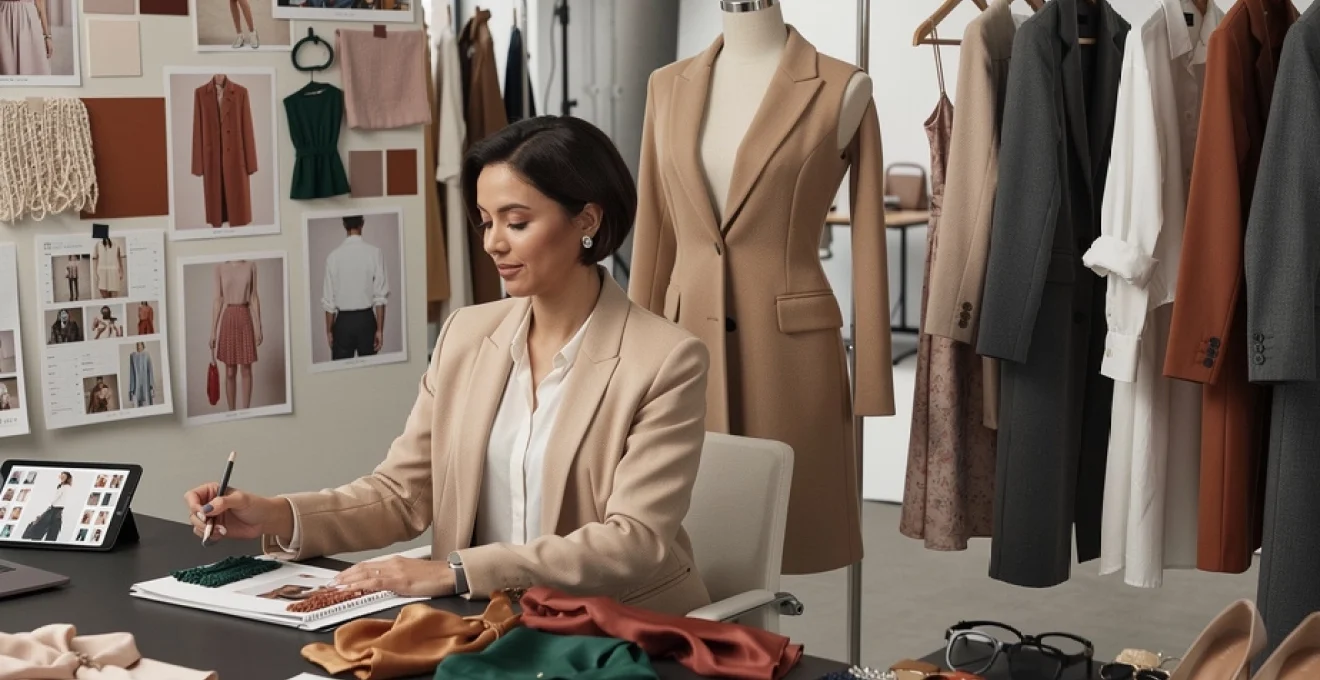
The journey from creative spark to finished outfit represents one of fashion’s most fascinating processes. Whether you’re a professional stylist curating looks for editorial shoots or an individual crafting your personal style, understanding the methodical approach behind successful styling can transform how you approach fashion. The modern styling process has evolved far beyond simple garment selection, incorporating sophisticated digital tools, psychological principles, and data-driven insights that elevate outfit creation to an art form.
Contemporary styling methodology combines traditional fashion expertise with cutting-edge technology, creating a comprehensive framework that addresses everything from initial inspiration gathering to final garment evaluation. This systematic approach ensures consistency, efficiency, and creativity in equal measure, allowing stylists to deliver compelling visual narratives that resonate with their intended audience.
Fashion mood board development and visual research techniques
The foundation of any successful styling project lies in comprehensive visual research and mood board development. This critical phase establishes the aesthetic direction and conceptual framework that will guide all subsequent styling decisions. Professional stylists dedicate substantial time to this process, recognising that thorough preparation directly correlates with superior final outcomes.
Effective mood board creation involves multiple layers of visual information, from colour palettes and texture samples to photographic references and artistic inspiration. The most successful mood boards tell a cohesive visual story whilst maintaining enough flexibility to accommodate creative evolution throughout the styling process. Digital platforms have revolutionised this practice, enabling real-time collaboration and seamless sharing across creative teams.
Pinterest algorithm optimisation for style discovery
Pinterest has emerged as an indispensable tool for fashion professionals, with its sophisticated algorithm providing unprecedented access to style inspiration. Understanding how to leverage Pinterest’s recommendation engine can dramatically enhance your research efficiency and uncover unexpected creative directions.
The platform’s algorithm responds to specific search behaviours and engagement patterns. By carefully crafting search terms that combine aesthetic descriptors with technical fashion terminology, stylists can access highly targeted inspiration boards. For instance, searching for « minimalist workwear capsule autumn textures » yields more refined results than generic terms like « office fashion ».
Successful Pinterest optimisation requires strategic board curation and consistent engagement with high-quality content that aligns with your aesthetic vision.
Adobe creative suite integration in concept visualisation
Professional styling increasingly relies on Adobe Creative Suite applications for concept development and client presentation. Photoshop enables precise colour matching and texture layering, whilst Illustrator facilitates technical flat drawings and proportion studies. InDesign serves as the primary tool for creating professional mood boards and client presentations.
The integration of these applications allows stylists to create detailed visual proposals that communicate complex styling concepts with remarkable clarity. Advanced users often employ custom colour palettes and style guides within their Adobe workflow, ensuring consistency across all project deliverables.
Colour psychology application in wardrobe planning
Understanding colour psychology forms a crucial component of sophisticated styling methodology. Different hues evoke specific emotional responses and cultural associations that can dramatically impact how an outfit is perceived. Research indicates that approximately 62-90% of snap judgements are influenced by colour alone, making this knowledge essential for effective styling.
Professional stylists leverage colour theory to create specific moods and communicate particular messages through their outfit selections. Warm colours typically convey energy and approachability, whilst cool tones suggest professionalism and reliability. Neutral palettes offer versatility and timelessness, making them particularly valuable for capsule wardrobe development.
Texture mapping and fabric combination strategies
Texture plays an equally important role in creating visually compelling outfits. The strategic combination of different fabric weights, weaves, and surface treatments adds depth and visual interest to any ensemble. Successful texture mapping requires understanding how different materials interact both visually and physically when layered together.
Contemporary styling often employs the « rule of three textures » – combining smooth, textured, and structured elements within a single outfit to create visual balance. For example, pairing a silk blouse (smooth) with a wool cardigan (textured) and leather accessories (structured) creates natural harmony whilst maintaining visual interest throughout the ensemble.
Seasonal trend forecasting through WGSN
Seasonal trend forecasting through WGSN data analysis
For professional stylists and brand teams, platforms like WGSN transform trend forecasting from guesswork into a data-driven discipline. Instead of relying solely on runway coverage or social media, WGSN aggregates global consumer insights, cultural shifts, and retail performance to predict which colours, silhouettes, and styling details will gain traction 12–24 months ahead. This long-range view allows you to build outfits and wardrobes that feel current not only today, but throughout upcoming seasons.
In practice, stylists use WGSN data to validate intuitive ideas and refine their fashion mood boards. For example, if your visual research points towards softer tailoring and muted greens, WGSN’s macro reports might confirm an emerging shift toward “quiet luxury” and biophilic colour stories. At a micro level, seasonal updates highlight key fabrications, print scales, and styling details (such as belt placement or hemlines), which you can translate directly into outfit formulas and wardrobe planning.
Even if you don’t have direct access to WGSN, you can apply the same logic by tracking recurring themes across runway reviews, trade shows, and retail new arrivals. The aim isn’t to copy every trend, but to filter trend insights through your own aesthetic and your client’s lifestyle. Used strategically, seasonal trend forecasting becomes one more tool to support intentional outfit creation rather than a mandate to constantly buy new clothes.
Wardrobe architecture and capsule collection framework
Once your creative direction is clear, the next step is translating inspiration into a functional wardrobe architecture. Think of this as building the “infrastructure” that supports daily outfit creation, much like an architect designing a home before any decor choices are made. A well-structured capsule collection framework reduces decision fatigue, increases outfit versatility, and ensures that each new piece you add has a clear purpose.
Professional stylists approach wardrobe planning like a systems designer. They map out lifestyle categories (work, off-duty, evening, travel), climate requirements, and personal style goals, then allocate a proportion of the wardrobe to each. Within this framework, you can decide which silhouettes, colours, and textures will become your core building blocks and which will act as accents. The result is a wardrobe that feels cohesive and expressive, yet highly practical.
Core piece selection using the 80/20 principle
The 80/20 principle is particularly powerful when applied to wardrobe architecture. Most people wear roughly 20% of their clothes 80% of the time, which means those core pieces have an outsized impact on your daily style experience. Identifying and curating this “power 20%” is the first step towards a capsule wardrobe that truly works for you.
Start by tracking what you reach for over a month or two: which trousers, shoes, and outerwear are in constant rotation? Analyse what these favourites have in common—fit, comfort level, colour, fabric, or styling versatility. These insights guide your investment in high-quality core items such as tailored trousers, well-cut jeans, neutral knitwear, and go-to footwear that anchor most outfits.
From there, you can intentionally duplicate success: if a particular silhouette of blazer works with most of your tops and dresses, consider owning it in two different neutral colours. Conversely, items that never make it into your outfits may indicate a mismatch between your purchases and your real-life needs. By aligning your wardrobe with the 80/20 rule, you streamline styling and free up mental energy for creative outfit experimentation.
Silhouette balancing through body geometry analysis
Silhouette is the backbone of any effective outfit, and mastering it starts with understanding your body geometry. Rather than forcing yourself into arbitrary “body type” categories, look at proportions: shoulder width to hip width, torso length to leg length, and where your eye naturally lands when you view yourself in the mirror. This geometric analysis gives you objective data to work with when you’re balancing volume and lines.
A simple rule of thumb is to contrast fitted and relaxed elements within an outfit. If you’re wearing wide-leg trousers, a more tailored top or structured jacket helps maintain visual balance. If you choose an oversized knit, pairing it with slim jeans or a pencil skirt keeps the silhouette intentional rather than overwhelming. Stylists also use vertical lines—such as open jackets, pressed trouser creases, or long necklaces—to elongate the body and guide the viewer’s gaze.
Think of silhouette like composing a photograph: you’re playing with negative space, focal points, and framing. When your wardrobe architecture includes a mix of silhouettes (cropped vs. longline jackets, straight vs. wide-leg trousers, body-skimming vs. voluminous dresses), you can “engineer” outfits that support your proportions instead of fighting them. Over time, you’ll recognise which combinations become signature silhouettes for your personal style.
Investment piece hierarchy in sustainable fashion
In a landscape increasingly shaped by sustainability concerns, the question is no longer just what to buy, but how to prioritise purchases. An investment piece hierarchy helps you allocate budget where it will have the most impact in both styling flexibility and longevity. This approach reduces impulse buying and supports a slower, more intentional relationship with fashion.
At the top of the hierarchy sit high-use, high-visibility items: outerwear, footwear, and daily carry accessories. These are worn frequently, withstand environmental stress, and often define the overall tone of your outfit. Mid-tier investments include tailoring, denim, and knitwear that form the backbone of your capsule collection. Lower tiers might include trend-led pieces or seasonal accents, where it may be more appropriate to opt for mid-priced options or pre-loved finds.
Evaluating an item for investment status involves multiple criteria: fabric quality, construction details, cost-per-wear, and alignment with your long-term style direction. Asking “Will this still feel like me in three to five years?” is a useful litmus test. By ranking categories in this way, you create a sustainable fashion strategy that supports both your values and your styling ambitions.
Versatility matrix for multi-occasion styling
One of the most effective tools used by stylists is a versatility matrix—a simple framework that measures how many contexts a single item can serve. Instead of viewing a garment as “workwear” or “weekend only”, you plot it across multiple scenarios: office, casual, evening, travel, and special events. The higher its adaptability, the higher its value within your wardrobe architecture.
To build your own matrix, choose a handful of key pieces and challenge yourself to style each in at least three different ways. For instance, a tailored blazer might pair with jeans and a tee for off-duty, tailored trousers and a silk blouse for presentations, and a slip dress for dinner. Pieces that perform well across categories should be prioritised when shopping and maintained carefully over time.
This structured thinking turns your wardrobe into a modular system, where elements can be recombined like building blocks. Much like a designer using a limited colour palette to produce endless variations, you’ll find that a tightly edited selection of versatile garments can yield a surprisingly large number of outfits for different occasions.
Professional styling methodologies and industry workflows
Behind every polished red-carpet look or magazine editorial is a clear styling methodology. While personal style is highly individual, professional stylists tend to rely on repeatable workflows that guide decision-making under tight deadlines and complex constraints. Understanding these processes can help you refine your own approach, whether you’re dressing clients, creating content, or simply elevating your daily outfits.
Industry workflows typically move through consistent phases: brief analysis, research and concepting, pull (selecting garments and accessories), fitting, and final styling on set or on the client. Within each phase, stylists apply distinct techniques—layering strategies, proportion play, or narrative-driven styling—to deliver a cohesive visual story. Let’s look at how some of these methodologies translate into practical outfit creation.
Rachel zoe’s layering technique implementation
Rachel Zoe is widely associated with the art of sophisticated layering, particularly in bohemian and “effortlessly glamorous” aesthetics. Her approach treats each outfit like a styled vignette, where garments, jewellery, and accessories build depth the way a decorator layers a room. The key is intentionality: every layer must contribute to proportion, texture, or narrative—not simply add bulk.
To implement this technique in your own styling process, start with a strong base layer such as a slip dress, tailored trousers with a fitted tank, or a column of monochrome. Next, introduce a mid-layer—perhaps a cropped jacket, waistcoat, or soft cardigan—that defines shape and adds texture. Finally, top with an outer layer like a long coat or statement jacket, and finish with accessories that echo or contrast key elements in the outfit.
Think in terms of “reveal and conceal”: where do you want movement, and where do you want structure? By staggering hemlines and mixing weights (chiffon against suede, denim against silk), you achieve visual richness without overwhelming the wearer. This systematised layering allows you to respond to changing temperatures and dress codes while maintaining a cohesive style narrative.
Editorial styling principles from vogue’s creative direction
Editorial styling, as seen in titles like Vogue, often appears aspirational and untouchable, yet it follows clear creative principles that can inform everyday outfit building. At its core, editorial styling prioritises storytelling over practicality, using clothing as a language to express mood, character, or cultural commentary. Silhouette may be exaggerated, colour choices heightened, and accessories used in unconventional ways.
One of the most useful editorial principles for personal styling is the concept of a “hero element”. In any given look, there is usually one focal piece—an sculptural coat, a bold print, or an unexpected proportion—that everything else supports. When you apply this to daily outfits, you avoid visual clutter by allowing one element to speak the loudest while keeping others more restrained.
Another editorial strategy is deliberate contrast: pairing ultra-feminine pieces with androgynous tailoring, or mixing opulent fabrics with utilitarian basics. Ask yourself, “What tension can I introduce here?” This might mean styling an evening skirt with a simple graphic tee or grounding a romantic dress with chunky boots. By borrowing these editorial techniques, you inject personality and narrative into even the most functional wardrobe.
Celebrity stylist approaches: law roach’s transformation methods
Law Roach, known for his work with clients like Zendaya, has popularised the idea of “image architecture”—using fashion to tell a long-term story about a client’s evolution. Rather than focusing on individual outfits in isolation, he considers the arc of appearances over seasons and years, creating a sense of progression and intentional reinvention. This holistic viewpoint is especially powerful if you’re looking to transform or rebrand your personal style.
At a practical level, Law’s method often combines deep archival references with contemporary pieces, resulting in looks that feel both familiar and fresh. When applied to your own wardrobe, this might involve revisiting vintage silhouettes or family heirlooms and styling them through a modern lens. The process starts with a clear vision: Who do you want to appear as in this next chapter of your life?
From there, you build a styling roadmap, planning key “moments” where your outfits communicate that evolution—a new role at work, a milestone birthday, or a creative pivot. Just as Law Roach crafts character arcs for his clients, you can use clothes as a visual narrative tool to mark shifts in identity and ambition.
Commercial styling standards for e-commerce photography
Commercial styling, particularly for e-commerce, operates under very different constraints from editorial or red-carpet work. The goal is clarity and conversion: the consumer must be able to see garment details, imagine how it fits into their life, and feel confident making a purchase. As a result, commercial stylists follow strict guidelines around fit, consistency, and product visibility.
Key principles include ensuring garments are steamed and properly tailored to the model, using pinning or temporary adjustments only when necessary to represent true fit. Outfits are typically built around the “buying hero” (the product being sold), with supporting pieces chosen to enhance its appeal without overshadowing it. For example, when styling a statement blouse for an online store, the trousers and accessories will be intentionally understated.
These standards offer valuable lessons for personal styling too. When you’re evaluating a new purchase in the fitting room or at home, mimic e-commerce conditions: good lighting, clean lines, and minimal distraction. Ask yourself if the garment looks compelling from all angles and whether you can clearly see how it integrates with existing pieces. This commercial mindset helps you become more objective and efficient in your outfit decisions.
Digital styling tools and virtual wardrobe management
As fashion becomes increasingly digitised, the styling process is no longer confined to physical closets and in-person fittings. Digital styling tools—from wardrobe apps to 3D outfit visualisers—allow you to experiment, plan, and refine looks in a virtual space. For busy professionals and content creators, these platforms act like a portable styling studio in your pocket.
Virtual wardrobe management typically begins with cataloguing your garments: photographing items, tagging them by colour, category, and season, and logging wear frequency. Once your digital closet is built, you can generate outfit combinations, schedule looks for upcoming events, and identify gaps or redundancies using built-in analytics. Some tools even integrate weather forecasts and calendar events, suggesting what to wear based on temperature and occasion.
Think of these platforms as the digital equivalent of a stylist’s rack: you can move items around, test unexpected pairings, and “save” successful outfits for future reference. This reduces morning decision fatigue and encourages more creative use of what you already own. Over time, virtual wardrobe data can reveal powerful patterns about your real-world style habits, supporting smarter purchasing and more intentional capsule collection planning.
Personalisation algorithms in contemporary fashion technology
Behind the scenes of many modern fashion experiences—from shopping apps to streaming-platform costume analyses—are personalisation algorithms designed to predict what you’ll want to wear next. These systems analyse your browsing history, purchase behaviour, saved images, and even engagement on social media to surface tailored recommendations. When used consciously, they can be powerful allies in your styling process.
For example, recommendation engines may suggest brands that cut trousers in proportions similar to pairs you already love, or highlight colour stories that align with your saved mood boards. This can streamline the research phase, allowing you to focus on evaluating fit, quality, and versatility rather than sifting through endless options. However, it’s also important to remain critical: algorithms tend to reinforce existing preferences, which can limit experimentation.
One way to balance convenience and creativity is to treat algorithmic suggestions as a starting point rather than a prescription. Ask yourself, “What does this recommendation assume about my style, and do I agree?” By occasionally searching outside your usual parameters—different price points, new categories, or alternative silhouettes—you introduce fresh data into the system and keep your personal style evolving, not stagnating.
Quality assessment and garment construction evaluation
The final step in moving from inspiration to outfit is ensuring that the garments you choose can withstand real life. Even the most beautifully styled look will fall short if the fabric pills after two wears or seams twist in the wash. Developing an eye for quality assessment and garment construction is therefore a core competency for any serious stylist or style-conscious individual.
Begin with fabric evaluation: check fibre content, hand-feel, opacity, and recovery (how well the material bounces back after being stretched). Natural fibres and high-quality blends tend to age more gracefully, but performance fabrics can be excellent for specific use cases. Next, inspect construction details: are seams straight and securely finished, are pattern pieces aligned, and do zips glide smoothly? Turn garments inside out; the inside should look almost as clean as the outside.
Fit is the final frontier of quality. A well-constructed garment should follow the body without strain or distortion, allowing comfortable movement while maintaining its intended shape. Think of it as the architecture that supports your styling ideas—if the “building” is unstable, no amount of creative accessorising will fix it. By combining aesthetic inspiration with technical scrutiny, you close the loop of the creative styling process: from mood board and algorithm to capsule wardrobe and, ultimately, outfits that look exceptional and perform over time.