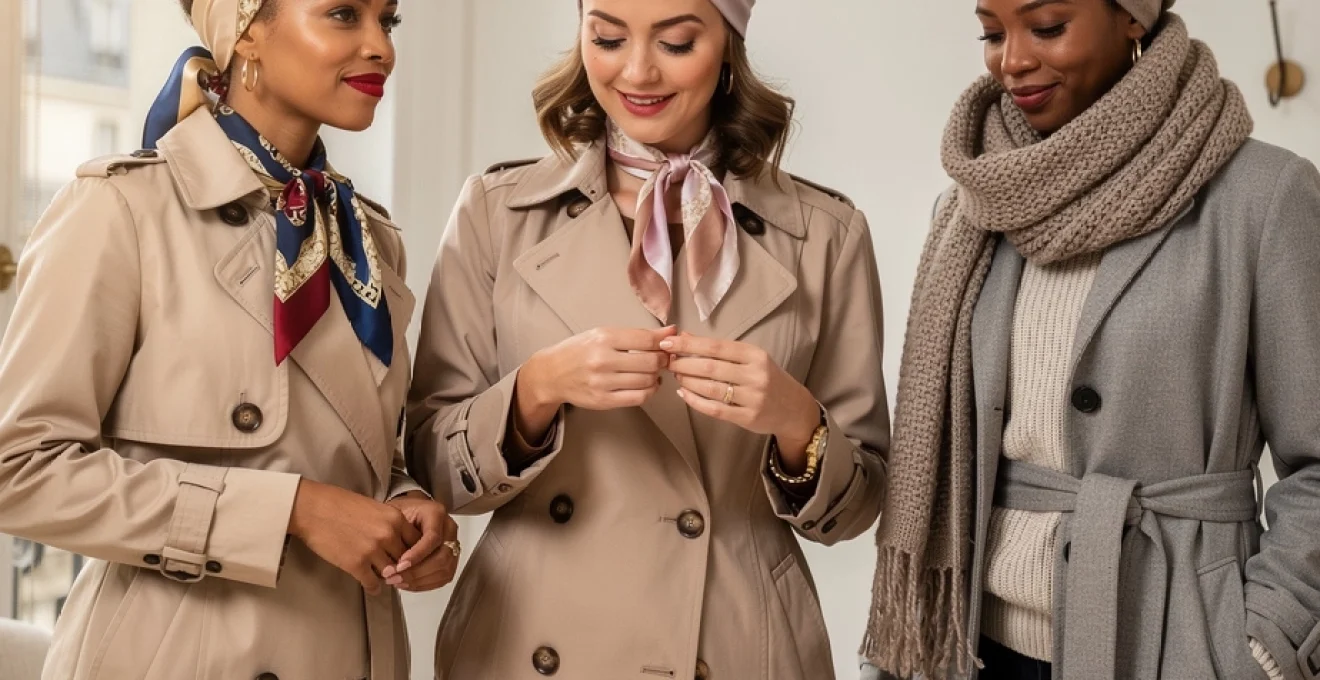
# Guide complet pour nouer votre écharpe avec style
The scarf stands as one of fashion’s most versatile accessories, transforming ordinary outfits into polished ensembles with minimal effort. Whether you’re battling winter winds or adding a sophisticated flourish to your spring wardrobe, mastering various tying techniques allows you to maximise the potential of this timeless piece. From silk squares to chunky wool wraps, each fabric type and scarf dimension offers unique styling possibilities that can elevate your personal aesthetic. Understanding how to manipulate fabric, create balanced proportions, and select appropriate techniques for different occasions empowers you to harness the full transformative power of this seemingly simple accessory.
The art of scarf styling transcends mere functionality. While providing warmth and protection remains important, the way you tie your scarf communicates attention to detail and sartorial confidence. A well-executed knot can define your silhouette, draw attention to your face, or serve as the statement element that pulls together disparate wardrobe pieces. With origins spanning from Parisian elegance to bohemian flair, scarf-tying techniques carry cultural significance and aesthetic heritage that continues to influence contemporary fashion trends.
Classic parisian knot techniques for square silk scarves
Square silk scarves represent the pinnacle of refined accessorising, with the carré de soie becoming synonymous with French elegance. These typically measure between 70cm to 90cm and feature printed designs that deserve thoughtful display. The beauty of silk lies in its ability to hold structure whilst draping gracefully, making it ideal for intricate knots that maintain their shape throughout the day. When working with square silk scarves, consider the weight of the fabric—lighter silks require gentler handling, whilst heavier twills can support more elaborate configurations.
The versatility of square silk extends beyond neck styling. You can incorporate these pieces into your hair, use them as bag accessories, or even transform them into belts. Each application demands specific folding and tying approaches that respect the fabric’s properties whilst achieving your desired aesthetic outcome. Before attempting any technique, ensure your scarf is pressed and free from wrinkles, as creases become particularly noticeable in silk and can detract from the polished appearance you’re seeking.
The traditional french loop method with hermès carré scarves
The French loop, known as the foulard plié, creates an effortlessly chic appearance that has remained fashionable for decades. Begin by folding your square scarf diagonally to form a triangle, then continue folding the pointed end towards the long edge until you achieve a band approximately 5-8cm wide. The width you select influences the final visual impact—narrower bands appear more delicate, whilst wider folds make bolder statements. Drape the folded scarf around your neck from behind, ensuring both ends hang evenly at the front.
Create a loose loop on one side by forming a small circle near the end of the fabric. Thread the opposite end through this loop, pulling gently to tighten. The secret to achieving that coveted Parisian nonchalance lies in intentional imperfection—adjust the knot slightly off-centre and allow the ends to fall at different lengths. This technique works beautifully with both printed and solid scarves, though intricate patterns showcase particularly well as the folding reveals different sections of the design. The French loop suits professional environments whilst remaining appropriate for casual weekend wear, demonstrating remarkable versatility across different contexts.
Executing the perfect cowboy knot for lightweight silk
The cowboy knot brings a touch of Western-inspired charm to silk scarf styling, creating a compact focal point at the base of your neck. Fold your square scarf into a triangle, then roll it loosely from the pointed end towards the long edge, maintaining consistent tension throughout. Position the rolled scarf around your neck with the bulk of fabric at the back and the two ends meeting at the front. Cross the right end over the left, then bring it up and through the loop you’ve created, pulling both ends to form a secure knot.
This technique particularly flatours open necklines such as V-necks or unbuttoned coll
lines and adds visual interest without overwhelming your outfit. Because the knot sits close to the throat, you can loosen it slightly for a softer, draped effect or tighten it for a sharper, more graphic look. If you wear glasses or bold earrings, this compact style frames your face rather than competing with your accessories, making it a practical everyday way to tie your scarf stylishly.
Mastering the ascot tie technique for formal occasions
The ascot tie technique brings a distinctly refined note to your scarf styling, echoing traditional menswear while remaining thoroughly modern. Start with your square silk scarf laid flat, then fold it diagonally into a triangle. Roll the long edge inward towards the point until you have a smooth band around 6-10cm wide, depending on how much volume you prefer at the neck. Place the centre of the band at the front of your neck, cross the ends behind, and bring them back to the front so they hang evenly.
Next, cross one end over the other at the centre of your chest and bring it up through the neck loop as if tying a cravat. Gently spread the upper layer to create a soft, cascading effect that covers the knot underneath, then tuck the ends inside your shirt or blazer. The result is a polished, almost tuxedo-like finish that pairs beautifully with tailored jackets, silk blouses, or evening dresses. When you want your scarf to function as both jewellery and neckwear, the ascot tie is one of the best ways to tie your scarf stylishly.
Creating the braided necklace style with thin scarves
The braided necklace style transforms a light silk square or narrow twill into a sculptural accessory that resembles a statement necklace more than a traditional scarf. To achieve it, fold your square scarf diagonally and then roll it tightly from the long edge to the point to create a slim rope. Place the midpoint at the nape of your neck so both ends fall forward, then tie a loose knot close to your collarbone. Now, twist each tail separately, then twist them around each other, maintaining consistent tension.
Once you reach the ends, secure them with a small double knot or tuck them discreetly under the braided section at the back of your neck. The resulting plaited effect adds texture and dimension, especially effective with printed silk scarves where colours interlace like threads in a tapestry. This method works particularly well when you want a neat neckline that still feels artistic—think minimalist knitwear, simple T-shirts, or sleek office separates. If you struggle to style jewellery with high necklines, this braided technique offers a soft, fabric-based alternative that remains comfortable all day.
Contemporary head wrapping methods and turban styles
Beyond the neck, scarves lend themselves beautifully to contemporary head wrapping methods and turban styles that celebrate both practicality and personal expression. Head wraps can protect your hair from the elements, hide a bad hair day, or simply add a bold focal point to a pared-back outfit. Lightweight silk, cotton, or modal squares are particularly well suited to these techniques, as they provide enough grip without becoming bulky. As you experiment, consider how the colours and prints of your scarf interact with your hair tone and skin undertones—this is one of the quickest ways to refresh your look without changing your clothes.
Modern head wrapping draws inspiration from diverse cultural traditions, from North and West African wraps to vintage European glamour. When approached with respect and awareness, these styles allow you to enjoy both comfort and creativity. You might ask yourself: do you want your scarf to read as a subtle accessory, or as the main character of your outfit? Selecting the right method—whether a simple 1950s headband or a dramatic crown wrap—helps you strike the perfect visual balance.
The retro 1950s headband fold technique
The retro 1950s headband technique channels Old Hollywood charm and pairs effortlessly with cat-eye sunglasses, red lipstick, or a polished ponytail. Begin by folding a square scarf into a triangle, then roll it from the long edge towards the point until you have a band 3-5cm wide. Place the centre of the band at the nape of your neck, bring the ends up over your ears, and tie a knot at the crown of your head. For a softer finish, tie the knot slightly to one side and create a small bow with the ends.
This headband style works particularly well for taming flyaways on windy days or adding structure to loose waves. Because it exposes the hairline and much of the crown, it feels lighter and more casual than a full turban while still reading as deliberate styling. If your scarf tends to slip on smooth or fine hair, you can secure it with discreet hairpins behind the ears. Think of this method as the hair equivalent of the French loop at the neck—simple, chic, and endlessly wearable.
Constructing a fulani-inspired crown wrap
The crown wrap, inspired by traditional West African head wrapping aesthetics, creates a sculptural halo effect that sits high on the head. To construct it with a medium to large rectangular or square scarf, first fold the fabric into a wide band, around 15-25cm depending on your hair volume. Place the centre of the band at the nape of your neck and bring the ends forward, crossing them firmly at the forehead. Then, pull the ends back again, twist them together, and coil the twist into a bun-like knot at the top or slightly off-centre of your head.
As you shape the crown, tuck in any loose fabric to build height and stability, much like sculpting clay until you achieve the desired silhouette. This style is particularly practical for protective hairstyles, locs, or braids, as it gathers hair away from the face while making it the visual anchor of your outfit. When exploring culturally rooted wrapping methods, it is important to understand and appreciate their origins rather than treating them as disposable trends. Done thoughtfully, a crown wrap can be both a powerful fashion statement and a celebration of textile traditions.
Achieving the classic audrey hepburn top knot style
The Audrey Hepburn-inspired top knot wrap evokes mid-century glamour, ideal for convertible drives, beach days, or simply adding drama to a minimalist look. Use a large square scarf in silk or cotton for adequate coverage. Fold it into a triangle and place the long edge across your forehead, with the point falling backwards over your hair. Bring the two ends under your hair at the nape of your neck, cross them tightly, then pull them back up to the top of your head.
Tie a firm double knot at the crown, leaving the ends either standing up playfully or draping softly to one side. The triangular point at the back can be tucked under the knot for a sleeker finish, or left visible for a slightly more bohemian feel. This method protects your hair from sun and wind while framing your features in a flattering way—much like a well-chosen hat, but with significantly more flexibility. If you wear eyeliner or bold brows, this style draws attention upward and creates a cinematic, photograph-ready effect.
Executing the modern twisted headband drape
The modern twisted headband drape combines the ease of a simple band with the visual interest of a turban, making it ideal for everyday wear. Take a long, narrow scarf or a diagonally folded silk square rolled into a band. Position the centre at the top of your head, bring the ends down in front of your ears, and cross them once or twice at the middle of your forehead to create a twist. Then guide the ends back around to the nape of your neck and tie a secure knot, tucking in any remaining fabric.
This technique is particularly forgiving if you are new to head wrapping, as the twist disguises slight imperfections in folding and tension. It behaves almost like a soft fabric tiara, adding height and interest without covering your entire head. For a more relaxed effect, you can let a few face-framing strands of hair escape at the temples. When you need to transition quickly from a casual daytime look to something more polished for evening, this twisted headband offers a swift yet impactful style upgrade.
Advanced neck draping configurations for winter scarves
When temperatures drop, winter scarves shift from decorative accessories to essential components of your cold-weather armour. Yet warmth does not need to come at the expense of style. Advanced neck draping configurations for wool, cashmere, and chunky knit scarves allow you to create volume, structure, and visual interest while still trapping heat effectively. The key lies in balancing bulk around your neck and shoulders with the proportions of your coat or jacket so that the finished look appears intentional rather than overwhelming.
As fabrics grow thicker, certain knots that work well with silk become impractical, but new possibilities emerge. Longer, oversized scarves invite double-wrapped styles and sculptural drapes that not only insulate but can subtly alter your silhouette, lengthening the torso or adding definition at the chest. Think of these techniques as architectural approaches to fabric: you are not just tying an accessory, you are building a shape around your upper body. With a little practice, these winter scarf styles will become some of the best ways to tie your scarf stylishly when the weather is at its harshest.
The double-wrapped parisian knot for oversized wool scarves
The double-wrapped Parisian knot offers extra insulation while retaining the clean lines of the classic French knot. Fold a long rectangular wool or cashmere scarf in half lengthways, then again widthways if you need to reduce volume. Drape it around your neck so that the folded loop sits on one side and the two loose ends on the other. Thread both ends through the loop as you would with a standard Parisian knot, but instead of tightening immediately, twist the loop once more to create a second opening.
Pass the ends back through this new opening, then gently cinch both layers towards your neck, adjusting until the fabric sits snugly but comfortably. The double twist locks the scarf in place and creates a compact, layered structure that is especially effective against wind. Because this configuration sits close to the throat and upper chest, it pairs well with open or V-shaped coat collars that frame the knot like a tailored backdrop. If you commute on foot or by bicycle, this is a practical yet polished way to ensure your scarf stays secure throughout the day.
Creating the waterfall drape with cashmere pashminas
The waterfall drape is designed to showcase the fluidity of a cashmere or modal pashmina, allowing the fabric to cascade down the front of your body. Start by placing the centre of the scarf at the back of your neck, leaving one end significantly longer than the other. Loop the longer end once around your neck, letting it fall back to the front. Now, gently pull the wrapped section forward and fluff it so that it overlaps and layers over the shorter end, creating a soft “waterfall” of fabric.
This style works particularly well with lightweight yet warm pashminas, as heavy knits may not fall as gracefully. It is a flattering option for elongating the torso because the vertical lines of the drape draw the eye downward. If you are wearing a simple sweater or a minimalist dress, the waterfall becomes the focal point, much like a dramatic necklace or statement lapel. When the weather is unpredictable, you can also pull one of the front layers over your shoulders for extra coverage without needing to retie the entire configuration.
Mastering the pretzel knot for chunky knit scarves
The pretzel knot, while slightly more complex, delivers both visual impact and functional warmth—perfect for chunky knit scarves. Fold your scarf in half and drape it around your neck so that the loop sits on one side and the ends on the other. Pull just one end through the loop, leaving the second end free. Then twist the loop once to create a secondary opening, and thread the other end through this new space in the opposite direction.
The interlocking paths of the two tails create a shape reminiscent of a soft pretzel, hence the name. This configuration not only looks intricate but also distributes bulk evenly around your neck and upper chest. It is particularly useful with very thick scarves that can feel cumbersome when simply wrapped multiple times. Once tightened to your liking, the pretzel knot holds its form surprisingly well, making it an excellent choice for long walks or outdoor events where you do not want to keep adjusting your scarf.
Styling the reverse drape tuck method
The reverse drape tuck delivers a sleek, almost collar-like effect that complements structured coats and blazers. Place your long scarf around your neck with both ends hanging evenly in front. Take one end and drape it back over your opposite shoulder, then do the same with the other end, crossing them at the back of your neck. Next, bring each end forward again by sliding them underneath the front section of fabric that now sits at your chest, effectively tucking them into the loop you have created.
The result is a smooth, continuous band of fabric around your neck with no obvious loose tails, ideal if you prefer a minimal aesthetic or dislike scarves flapping in the wind. Because everything is tucked in, this method layers cleanly under tailored outerwear without adding unnecessary bulk at the front. Think of it as the scarf equivalent of a hidden placket on a shirt: all the function, but with a streamlined, almost invisible finish. For monochrome winter outfits, the reverse drape tuck can add subtle texture without breaking up your colour palette.
Belt alternative styling techniques for waist accent scarves
Scarves make surprisingly effective belt alternatives, allowing you to cinch the waist, define your silhouette, and introduce pattern without committing to a traditional leather belt. To use a scarf as a belt, opt for a long rectangular shape or a diagonally folded large square, ideally in a fabric with a bit of grip such as silk twill, cotton, or modal. Thread the scarf through your belt loops as you would a regular belt, then tie a secure knot or bow slightly off-centre to avoid bulk at the front.
This technique shines over high-waisted trousers, midi skirts, and even lightweight coats, where a fabric belt can soften the lines of more structured garments. You can also create an obi-style wrap by looping the scarf twice around your waist and tying a flat knot at the back for a cleaner look. When styling dresses, consider placing the scarf slightly above your natural waist to create an empire effect that lengthens the legs visually. If you are looking for new ways to tie your scarf stylishly beyond the neck, using it as a waist accent offers impressive versatility.
Fabric-specific knotting approaches for different scarf materials
Not all scarves behave the same way when tied, and understanding how different fabrics respond to knots can dramatically improve your styling results. Silk, chiffon, wool, cashmere, polyester, and modal each possess unique properties in terms of weight, friction, and drape. Trying to force a delicate chiffon scarf into a bulky winter knot will only lead to frustration, just as wrestling a heavy wool wrap into a tiny bow will feel awkward. Instead, we can think of each fabric as a different musical instrument: the technique that produces a beautiful note on one will not necessarily suit another.
Adapting your knotting approaches to the specific material in your hands ensures both comfort and longevity. Gentle handling reduces wear on delicate fibres, while more assertive tying can help sculpt structure from thicker weaves. As you experiment with the best ways to tie your scarf stylishly, pay attention to how readily the fabric slides, how much volume it creates, and how easily it holds a knot. These observations will guide you towards techniques that complement, rather than fight, the material.
Handling delicate chiffon and georgette fabric structures
Chiffon and georgette are lightweight, semi-sheer fabrics that excel in airy, romantic scarf styles but require careful handling. Their low friction surfaces mean complex or heavily layered knots may slip out of place, so it is wise to favour simpler configurations like loose loops, soft bows, or single wraps. When folding these fabrics, avoid hard creases; instead, let them roll naturally between your fingers to preserve their floaty drape. Because they can snag easily, keep jewellery with sharp edges or rough zips away from contact points.
For neck styling, a basic Parisian loop or a draped knot tied gently at the front works best, allowing the ends to fall freely like a waterfall. On the head, chiffon shines as a softly tied band or a romantic turban with minimal twisting. Think of chiffon and georgette as the watercolours of your scarf collection: their beauty lies in transparency and movement, not in rigid structure. If you are unsure whether your knot is too tight, ask yourself if the fabric still looks light and fluid; if not, loosen it slightly until the scarf regains its signature softness.
Tying techniques for heavy wool and cashmere blends
Heavy wool and cashmere blends offer generous warmth and luxurious texture, making them ideal for sculptural, insulating knots. Because these fabrics have more friction and volume, they hold shape easily but can quickly become bulky if overhandled. Techniques such as the double-wrapped Parisian knot, pretzel knot, and reverse drape tuck make excellent use of their thickness, creating substantial yet controlled forms around the neck and shoulders. When folding, limit yourself to one or two lengthwise folds to avoid excessive bulk.
For particularly large blankets or oversized scarves, treating them like outerwear can be effective—draping them over the shoulders and securing with a belt at the waist, for instance, turns them into a makeshift poncho or cape. Wool and cashmere respond well to gentle steaming, which can refresh fibres and restore drape after a day of wear. If you find a configuration looks too heavy, try allowing one end to hang longer for a vertical line that visually streamlines the silhouette. The goal is to harness the fabric’s natural structure without letting it overpower the rest of your outfit.
Working with synthetic polyester and modal scarf textures
Polyester and modal scarves often serve as everyday workhorses in a wardrobe thanks to their durability, affordability, and print versatility. Polyester tends to be smooth and slightly slippery, while modal offers a softer, more cotton-like hand with good drape. With these materials, mid-complexity knots are very achievable: they are sturdy enough to hold structured shapes like braided necklaces or pretzel knots, yet light enough for softer styles such as waterfall drapes and loose wraps. If your polyester scarf tends to slide, choosing knots that incorporate multiple passes through a loop will help lock the fabric in place.
Because synthetics are generally low maintenance, they are excellent candidates for experimenting with new scarf-tying techniques without fear of damaging delicate fibres. You can also use them as hair wraps or bag accents, where exposure to friction and sunlight might be less kind to silk. Think of polyester and modal as your everyday test laboratory: once you perfect a style here, you can confidently translate it to more precious fabrics like silk or cashmere. This approach ensures your most prized scarves benefit from tried-and-tested methods rather than trial and error.
Asymmetrical draping methods for statement shoulder styling
Asymmetrical draping transforms a simple scarf into a statement-making element that draws the eye diagonally across the body. This is one of the most powerful ways to tie your scarf stylishly when you want it to function almost like couture tailoring or jewellery. To create a basic asymmetrical shoulder drape, place the scarf around your neck with one end much longer than the other. Throw the longer end over the opposite shoulder, allowing it to cascade down your back while the shorter end remains at the front.
You can refine this by tucking the shorter end into your coat lapel or securing the shoulder area with a discreet brooch to maintain the angle of the drape. The resulting diagonal line can visually narrow the torso, soften broad shoulders, or add movement to otherwise sharp, minimalist outfits. With large square scarves, try folding into a triangle and positioning the point over one shoulder like a cape, then anchoring the ends with a slim belt at the waist for a runway-inspired effect. As with any asymmetrical styling, the key is intentional imbalance: aim for harmony rather than perfect symmetry, and your scarf will feel like a thoughtfully composed part of your overall look rather than an afterthought.