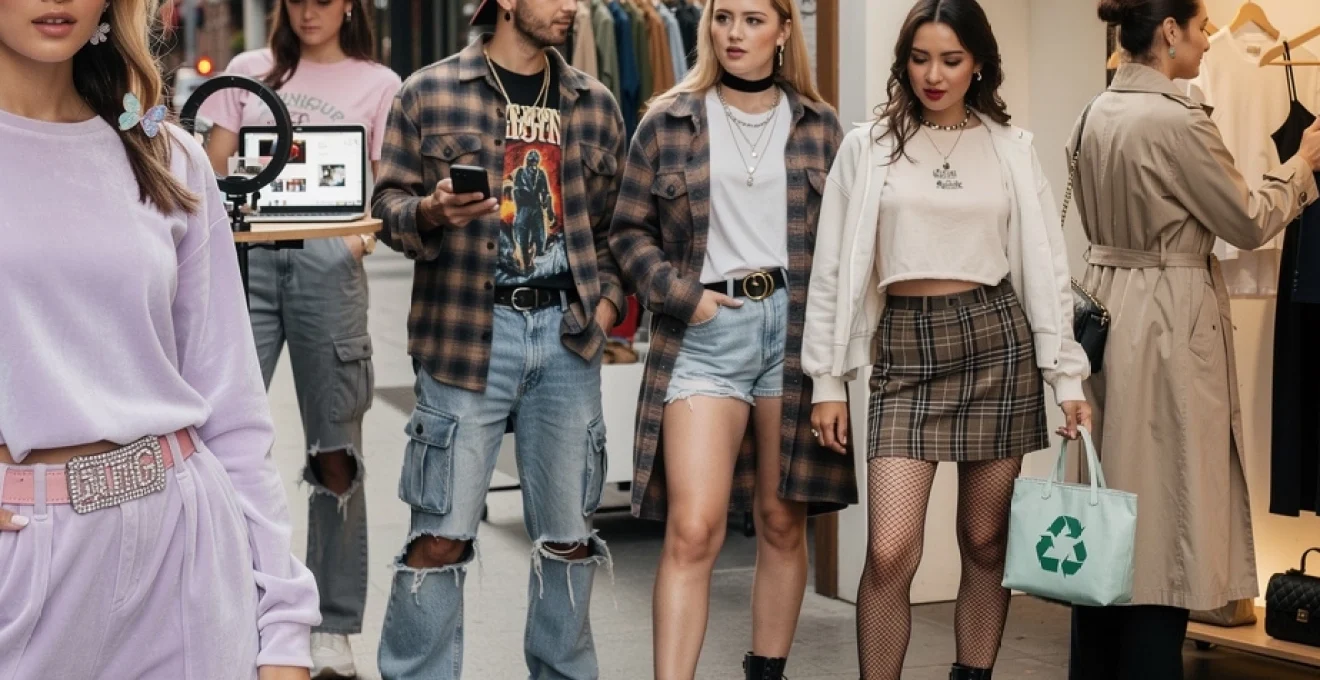
Fashion operates in predictable cycles, with past decades returning to influence contemporary style every twenty to thirty years. The current revival of 1990s and 2000s fashion represents more than nostalgic sentiment—it reflects fundamental shifts in consumer behaviour, cultural values, and digital influence. From minimalist aesthetics popularised by Calvin Klein and Helmut Lang to the maximalist logomania of early millennium brands, these decades have profoundly shaped today’s fashion landscape.
The resurgence encompasses everything from grunge-inspired layering techniques to Y2K futuristic elements, creating a complex tapestry of nostalgic fashion references. Social media platforms have accelerated this revival, with Gen Z consumers discovering and reinterpreting styles from before their birth. This phenomenon has transformed vintage shopping from niche activity to mainstream practice, whilst encouraging contemporary designers to mine these eras for inspiration in their latest collections.
Y2K aesthetic revival: Low-Rise jeans and cargo trousers domination
The Y2K aesthetic revival represents one of fashion’s most dramatic comebacks, transforming early 2000s styles from fashion faux pas to coveted trends. Low-rise jeans, once considered dated and unflattering, have reclaimed their position as the silhouette of choice for fashion-forward consumers. This revival extends beyond simple nostalgia, reflecting changing attitudes towards body confidence and self-expression.
Contemporary interpretations of millennium fashion demonstrate sophisticated evolution from their original forms. Modern low-rise styles feature improved fits and higher-quality denim, addressing previous concerns about comfort and wearability. Cargo trousers have similarly transformed, with designers like Jacquemus and Marine Serre incorporating technical fabrics and contemporary cuts whilst maintaining the utilitarian aesthetic that defined the original trend.
Juicy couture tracksuits and velour fashion resurgence
Juicy Couture tracksuits epitomise the early 2000s luxury casual movement, representing a time when comfort and glamour converged in unexpected ways. The brand’s revival demonstrates how specific fashion items can transcend their original context to become cultural symbols. Celebrity endorsements from figures like Paris Hilton and Kim Kardashian originally propelled these pieces to iconic status, creating associations with wealth and leisure that continue to resonate today.
Modern velour fashion has expanded beyond traditional tracksuit formats, with contemporary designers incorporating the luxurious fabric into dresses, accessories, and outerwear. This evolution reflects broader trends towards comfort-driven fashion, particularly following the pandemic’s influence on clothing preferences. The fabric’s tactile appeal and rich colour possibilities make it particularly suited to current maximalist tendencies in fashion.
Von dutch trucker caps and Logo-Heavy accessories
Von Dutch trucker caps represent the quintessential early 2000s accessory, embodying the era’s obsession with conspicuous branding and celebrity culture. The brand’s resurrection highlights fashion’s cyclical nature and the power of strategic brand positioning. Original Von Dutch pieces now command premium prices in vintage markets, whilst contemporary interpretations maintain the bold graphic aesthetic that made the brand famous.
Logo-heavy accessories have experienced renewed appreciation, challenging minimalist trends that dominated the 2010s. This shift reflects changing consumer attitudes towards brand expression, with younger demographics embracing overt branding as authentic self-expression rather than superficial consumption. The trend extends beyond caps to include belt buckles, handbags, and jewellery featuring prominent brand identifiers.
Baby tees and cropped silhouettes in contemporary collections
Baby tees and cropped silhouettes have become foundational elements in contemporary fashion, transcending their Y2K origins to influence mainstream design. These garments represent changing attitudes towards body exposure and feminine expression, with modern interpretations offering greater size inclusivity and diverse styling options. The trend reflects broader cultural shifts towards body positivity and individual expression.
Contemporary designers have refined the baby tee concept, incorporating premium fabrics and sophisticated construction techniques whilst maintaining the garment’s youthful appeal. Cropped silhouettes have expanded beyond basic tees to include blazers, cardigans, and even outerwear, demonstrating the versatility of proportional manipulation in fashion design. This evolution shows how seemingly
simple pieces evolve into directional staples when reimagined through contemporary proportions. Styling-wise, pairing cropped tops with higher-rise jeans or tailored trousers balances nostalgia with wearability, allowing you to nod to the 2000s while maintaining a polished modern wardrobe.
Butterfly clips and chunky highlights hair trend integration
Beauty trends from the late 90s and early 2000s have resurfaced alongside fashion, with butterfly clips and chunky highlights reappearing in contemporary hair styling. Rather than direct replicas of their Y2K predecessors, current interpretations tend to be more refined. Colourists now use balayage and face-framing techniques to echo the bold contrast highlights of the era without the harsh lines and brassiness that once dominated celebrity red carpets.
Butterfly clips, once associated with teen pop stars and school playgrounds, are now styled in deliberately curated ways for festivals, editorials, and street style looks. They function as both nostalgic accessories and practical tools for creating mini up-dos and half-up hairstyles. When combined with modern fashion aesthetics—such as minimalist tailoring or elevated loungewear—these playful hair accents offer a subtle way to incorporate Y2K energy without overwhelming your overall look.
Grunge and alternative fashion elements in modern street style
While Y2K glamour dominates many conversations about 2000s fashion, grunge and alternative style from the 90s have been equally influential in shaping modern streetwear. Originating from the Pacific Northwest music scene, 90s grunge championed anti-fashion, thrift shopping, and a nonchalant approach to dressing. Today, these principles align closely with sustainable fashion values and the rise of second-hand culture, making grunge aesthetics particularly relevant for conscious consumers.
Modern street style fuses grunge elements with contemporary silhouettes and fabrics, creating looks that feel intentional rather than careless. Oversized layers, distressed denim, and band tees are often balanced with sleek accessories or tailored outerwear. This blending of rough and refined reflects a broader cultural desire to express individuality while maintaining versatility in everyday wardrobes.
Flannel shirts and layered textures revival
Flannel shirts are at the heart of 90s grunge fashion and have firmly re-established themselves in modern wardrobes. Today’s versions often use higher-quality brushed cotton or wool blends, giving them a softer handle and more luxurious drape than many vintage originals. Worn open over baby tees, turtlenecks, or slip dresses, they provide an easy way to experiment with layered textures while referencing 90s alternative style.
Layering remains a key styling technique for anyone wanting to channel grunge in a contemporary way. Think of it as building a visual “playlist” of textures—ribbed knits, worn denim, flannel, and leather—rather than relying on a single statement piece. For example, pairing an oversized plaid shirt with tailored trousers and minimalist sneakers creates a look that feels relaxed yet put-together, proving that grunge influences can be adapted to modern office or city dressing.
Doc martens and combat boot styling techniques
Doc Martens and combat boots have transitioned from subcultural uniform to mainstream staple, symbolising resilience and rebellion in equal measure. Their enduring popularity lies in their versatility: these boots can ground hyper-feminine outfits, toughen up minimalist looks, or complement full-grunge ensembles. According to recent retail reports, global searches for “platform combat boots” and “chunky black boots” continue to rise year-on-year, highlighting their relevance across generations.
Styling combat boots today is about contrast and proportion. You might pair them with a satin slip skirt to offset softness with structure, or wear them under wide-leg cargo trousers for a 90s-meets-Y2K hybrid look. Rolling or tucking hems can change the silhouette dramatically, while coloured laces or patterned socks introduce subtle customisation. For those building a capsule wardrobe influenced by 90s and 2000s fashion, a classic pair of black boots offers a reliable anchor for both nostalgic and contemporary outfits.
Slip dresses over t-shirts layering method
The slip dress layered over a T-shirt is one of the most recognisable 90s styling techniques to return in recent years. Originally popularised by icons like Courtney Love and the cast of “My So-Called Life,” this combination balanced lingerie-inspired sensuality with casual modesty. In today’s fashion landscape, the look aligns with the ongoing interest in “underwear as outerwear” while remaining practical for everyday wear.
Contemporary slip dresses often feature bias cuts, mid-calf lengths, and sustainable fabrics such as recycled satin or organic silk blends. When worn over a fitted white tee, they immediately evoke 90s nostalgia; paired with a sheer mesh top or long-sleeve turtleneck instead, they lean towards a more futuristic or minimalist aesthetic. This layering method is particularly useful for extending the life of warm-weather pieces into cooler seasons, supporting a more sustainable, seasonless approach to dressing.
Chokers and dark makeup aesthetic integration
Chokers and dark makeup form the beauty counterpart to 90s grunge and alternative fashion, and both have seen a notable revival. Velvet bands, metal chains, and tattoo-style plastics have re-entered jewellery collections, often reinterpreted with contemporary closures and materials. Rather than being limited to overtly edgy outfits, chokers now appear alongside tailored blazers, slip dresses, and even minimalist knitwear, adding a subtle nod to rebellious subcultures.
Makeup trends echo this shift, with smudged eyeliner, berry lips, and cool-toned eyeshadows reappearing on runways and social media tutorials. The key difference today is precision and choice: you can opt for a polished, diffused smoky eye rather than the heavy, unblended looks that defined some 90s club scenes. By integrating one or two darker makeup elements—such as a kohl-lined waterline or a deep plum lipstick—you can reference grunge aesthetics without abandoning a contemporary, wearable finish.
Designer brand archival pieces and vintage luxury market
The resurgence of 90s and 2000s fashion has dramatically boosted interest in archival designer pieces and the vintage luxury market. Consumers are increasingly seeking original items from brands like Prada, Helmut Lang, Jil Sander, and early-2000s Gucci under Tom Ford, treating clothing as both cultural artefacts and investment assets. Data from major resale platforms shows double-digit growth in demand for vintage designer bags and ready-to-wear, particularly those featuring distinctive silhouettes or prints from these decades.
This appetite for archival fashion is driven by several factors: sustainability concerns, the desire for uniqueness in an era of mass production, and the prestige of owning historically significant designs. For many style-conscious shoppers, scoring a 1999 minimalist slip dress or a 2003 logo bag feels akin to collecting rare vinyl records—tangible pieces of fashion history that still function in everyday life. As a result, curated vintage boutiques, online resale platforms, and archival Instagram stores have become key players in shaping modern wardrobes.
However, navigating the vintage luxury market requires knowledge and care. Authenticity verification, condition assessment, and understanding price trends are crucial when investing in archival pieces. Many retailers now provide certificates of authenticity, detailed photographs, and restoration services to support buyers. For those interested in building a 90s or 2000s-inspired wardrobe sustainably, starting with one or two iconic vintage items—such as a tailored blazer, a shoulder bag, or a pair of sunglasses—can anchor an entire look while reducing reliance on newly produced garments.
Digital influence and social media fashion cycle acceleration
Digital platforms have fundamentally transformed how 90s and 2000s fashion trends are rediscovered and reinterpreted. Where earlier revivals unfolded slowly through magazines and runway coverage, today’s cycles move at the speed of the algorithm. A single viral post can resurrect a forgotten brand or micro-trend overnight, from specific styles of low-rise jeans to obscure slogan tees. This acceleration means that what once took years to trickle into mainstream consciousness can now happen in weeks.
At the same time, social media has democratised fashion history. Teenagers on TikTok analyse archival runway shows, Instagram creators share thrift hauls of 90s designer pieces, and Pinterest users build mood boards inspired by films like “The Matrix” or “10 Things I Hate About You.” This collective, crowd-sourced curation blurs the line between past and present, making the comeback of 90s and 2000s fashion feel less like a top-down trend and more like a collaborative cultural project.
Tiktok fashion challenges and viral styling content
TikTok plays a central role in reviving specific 90s and Y2K fashion items through challenges and styling videos. Hashtags like #Y2Kfashion, #90soutfits, and #thriftflip generate billions of views, turning nostalgic styling into quick, digestible content. Creators frequently set themselves tasks such as “dressing like it’s 2004 for a week” or “styling trends my mom wore in the 90s,” which not only provide entertainment but also educate younger audiences about fashion history.
These viral trends act like digital runways, showcasing how low-rise jeans, cargo trousers, mini skirts, or tiny handbags can be adapted to modern proportions and body types. Because content is user-generated, viewers see these pieces on a wide range of bodies and in everyday environments, which can boost confidence in trying bold or unfamiliar silhouettes. Yet the speed of TikTok’s fashion cycle also raises sustainability concerns: how do we enjoy the fun of experimentation without falling into rapid overconsumption?
Instagram influencer thrift flipping techniques
Instagram has become a hub for thrift flipping and second-hand fashion entrepreneurship, particularly around 90s and 2000s pieces. Influencers and small business owners showcase how they source, alter, and style vintage items—from transforming oversized men’s shirts into cropped tops to tailoring outdated denim cuts into current shapes. These short before-and-after reels demystify basic sewing and upcycling techniques, encouraging followers to see potential in garments they might otherwise discard.
For consumers interested in integrating nostalgic fashion sustainably, learning simple thrift flipping techniques can be transformative. Adjusting a hem, replacing buttons, or dyeing faded fabrics can breathe new life into older clothing, allowing you to recreate 90s or Y2K silhouettes without buying new fast-fashion copies. In many ways, this movement reinterprets the DIY spirit of 90s subcultures—punk, grunge, and rave—through the lens of today’s sustainability priorities and digital sharing culture.
Pinterest mood board creation for nostalgic aesthetics
Pinterest functions as a living archive of fashion imagery, making it an ideal tool for exploring and organising 90s and 2000s style inspiration. Users create mood boards dedicated to specific aesthetics—such as “Gen-X soft club,” “heroin chic revival,” “Y2K party outfits,” or “minimalist 90s workwear”—drawing from runway photos, magazine editorials, film stills, and street style. This visual cataloguing helps clarify which elements of these decades resonate most with your personal taste.
If you are building a modern wardrobe rooted in nostalgic influences, starting with a detailed Pinterest board can act like a digital fitting room. You can experiment with pairings—cargo trousers and corset tops, slip dresses and combat boots, logo caps and tailored blazers—before committing to purchases. Over time, patterns emerge: specific colour palettes, silhouettes, or brands that recur across your saved images. Treat these boards as a compass, guiding you towards intentional acquisitions rather than impulsive trend chasing.
Sustainable fashion movement and circular economy integration
The renewed interest in 90s and 2000s fashion has coincided with the rise of sustainable fashion and circular economy principles. In many ways, these decades were the last era before ultra-fast fashion took hold, which adds to their nostalgic appeal. Thrifting, swapping, and buying vintage—core behaviours in grunge and early streetwear scenes—now align with environmental priorities, making nostalgic dressing a surprisingly modern, eco-conscious choice.
As consumers become more aware of the fashion industry’s environmental impact, many are choosing to source original 90s and Y2K pieces rather than purchasing newly manufactured replicas. Renting designer items, supporting resale platforms, and investing in higher-quality garments designed to last all contribute to a wardrobe that honours the past without overburdening the planet. The idea of a “capsule wardrobe” built around timeless 90s minimalism or versatile early-2000s staples offers a practical framework for reducing waste.
Of course, sustainability is not automatically guaranteed by nostalgia. Buying excessive amounts of second-hand clothing can still contribute to textile waste and carbon emissions. The key is intentionality: choosing pieces that integrate seamlessly into your existing wardrobe, caring for them properly, and reselling or donating responsibly when they no longer fit your lifestyle. By treating 90s and 2000s fashion as a long-term investment rather than a fleeting costume, we can enjoy its aesthetic while supporting more responsible consumption patterns.
Contemporary brands reinterpreting millennium fashion DNA
Many contemporary brands are not simply copying 90s and 2000s trends; they are dissecting and reassembling the era’s design DNA through a modern lens. This involves borrowing key elements—low-rise cuts, cargo pockets, minimalist tailoring, playful prints—and combining them with updated fabrics, ethical production, and new silhouette experiments. The result is clothing that feels familiar yet fresh, like a remix of a song you once loved but now hear with clearer sound quality.
By studying how current labels reinterpret millennium style, we gain insight into which aspects of the era have real staying power. Clean lines, versatile separates, and well-cut denim from the 90s coexist with the fun, experimental spirit of Y2K fashion. For consumers, these brands offer a middle ground between pure vintage and ultra-modern design, making it easier to build wardrobes that honour nostalgia without feeling like costume.
GANNI and stussy Y2K-inspired collection analysis
GANNI and Stüssy exemplify how brands can mine Y2K influences while speaking to contemporary values. GANNI’s collections often feature playful prints, pastel colours, and quirky silhouettes that echo early-2000s street style—think ruffled mini skirts, bucket hats, and oversized graphic tees. Yet the brand pairs these nostalgic elements with responsible fabric choices and a focus on wearability, ensuring that statement pieces still integrate into everyday wardrobes.
Stüssy, rooted in 90s skate and surf culture, has leaned into its archival logo graphics and relaxed silhouettes as streetwear has entered the luxury conversation. Collaborations with high-end brands and limited-edition drops have positioned Stüssy at the intersection of past and present, where vintage-inspired hoodies and cargo shorts feel both authentic and current. For consumers seeking to bring 90s and Y2K energy into their closets, pieces from these labels function like modern heirlooms—grounded in history but designed for today’s lifestyles.
Jacquemus and sandy liang nostalgic design elements
Jacquemus and Sandy Liang reference 90s and 2000s fashion through subtle, often romantic details rather than overt replication. Jacquemus’s collections frequently feature low-slung skirts, asymmetric hemlines, and minimalist tailoring reminiscent of 90s Mediterranean minimalism. Micro bags, cut-out dresses, and sun-bleached colour palettes conjure images of early-2000s holiday campaigns while remaining firmly rooted in contemporary luxury.
Sandy Liang, meanwhile, draws heavily on childhood nostalgia and New York City street style, incorporating elements like fleece jackets, pleated skirts, and delicate bows. Her designs evoke memories of late-90s and early-2000s teen films, yet the cuts, fabrics, and construction are resolutely modern. Together, these brands demonstrate how designers can tap into personal and collective memories to create collections that resonate emotionally as well as aesthetically.
Reformation and realisation par slip dress reimagining
Reformation and Realisation Par have played pivotal roles in reviving the slip dress as a cornerstone of modern wardrobes. Drawing inspiration from 90s icons like Kate Moss and Carolyn Bessette-Kennedy, both brands offer bias-cut dresses that celebrate natural body lines rather than imposing rigid structure. The silhouettes are simple, but small design decisions—strap placement, neckline depth, fabric choice—make them feel relevant to current preferences for comfort and ease.
Crucially, these labels integrate sustainability and ethical production into their brand identities, updating the 90s slip dress for a generation attuned to environmental impacts. Reformation, for instance, publishes data on the water and carbon footprint of each garment, while Realisation Par focuses on limited drops and timeless prints designed to outlast microtrends. For consumers, investing in a well-cut slip dress from such brands offers a way to channel 90s minimalism while supporting more responsible fashion practices.
Marine serre and christopher kane futuristic retro fusion
Marine Serre and Christopher Kane embody a more experimental approach to 90s and 2000s revival, fusing nostalgic references with futuristic concepts. Marine Serre is known for her crescent moon motif, body-conscious silhouettes, and extensive use of regenerated fabrics, which together evoke both 90s clubwear and early-2000s techno aesthetics. Her collections often feel like costumes for a sci-fi film imagined at the turn of the millennium—precisely the era we are now romanticising.
Christopher Kane, meanwhile, has long explored the tension between sensuality and technology, referencing everything from neon colours to hardware details and unconventional materials. His work echoes the “electro-futurism” of late-90s and early-2000s editorials, where fashion imagined a hyper-technological future. By blending retro inspirations with forward-looking design, both designers remind us why Gen Z is so drawn to these decades: the 90s and 2000s were looking ahead, experimenting wildly with what clothing could be. Today, as we revisit their aesthetics with new tools and priorities, we have the opportunity to live out those fashion futures in more thoughtful, sustainable, and inclusive ways.