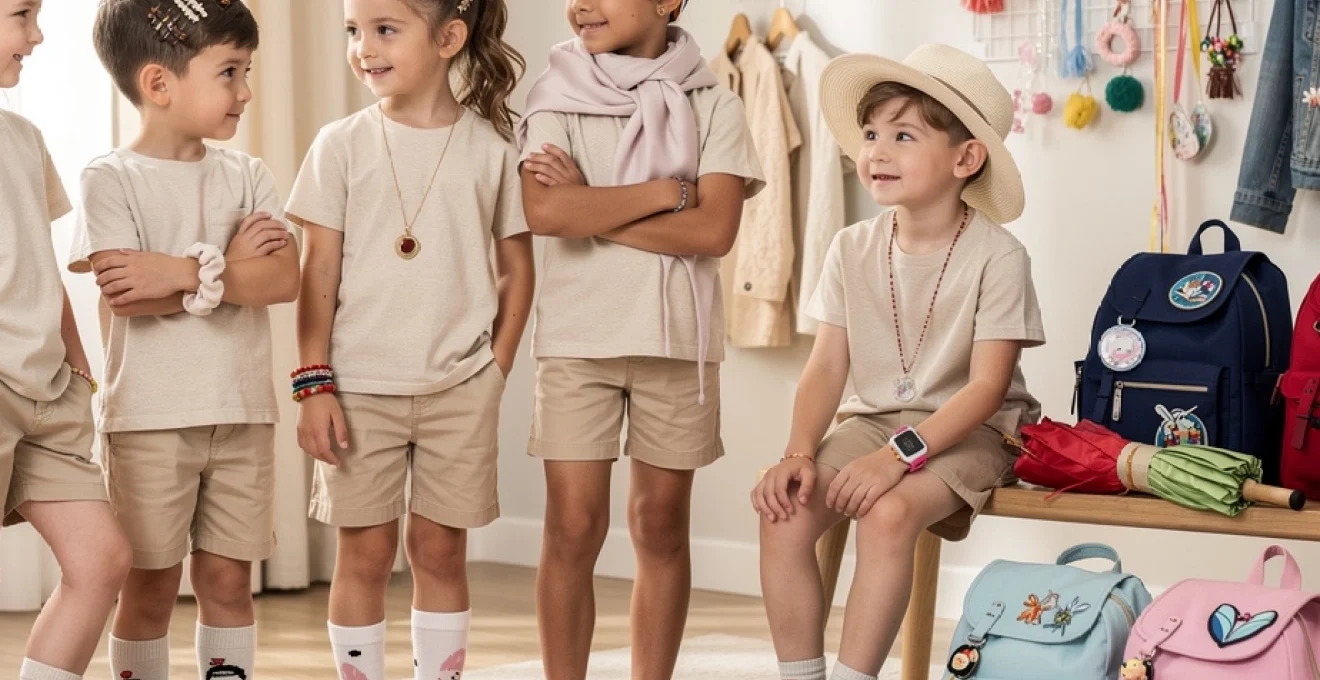
Children’s fashion has evolved far beyond basic clothing essentials, with accessories now playing a pivotal role in expressing individual personality and creativity. From statement hair pieces to personalised footwear elements, the right accessories can transform a simple outfit into a distinctive style statement that reflects a child’s unique character. Understanding how to select and coordinate accessories empowers parents to help their children develop confidence through self-expression whilst maintaining age-appropriate sophistication.
The art of accessorising children’s wardrobes requires balancing practical functionality with aesthetic appeal. Modern parents increasingly recognise that encouraging children to make thoughtful accessory choices fosters independence and creative thinking. Whether preparing for school, special occasions, or casual play, the strategic use of accessories allows children to communicate their interests, moods, and developing sense of style without overwhelming their youthful appearance.
Statement hair accessories: bows, headbands and hair clips for individual expression
Hair accessories serve as the crown jewel of children’s styling options, offering immediate visual impact whilst serving practical purposes. The resurgence of traditional hair ornaments combined with contemporary design elements creates endless possibilities for personalisation. Parents seeking to enhance their child’s natural features whilst accommodating active lifestyles find hair accessories particularly versatile.
The psychology behind hair accessory selection often reflects deeper personality traits. Bold, oversized pieces typically appeal to confident, outgoing children who enjoy being noticed, whilst subtle, delicate options suit quieter personalities who prefer understated elegance. Understanding these preferences helps parents guide their children toward accessories that genuinely resonate with their emerging identity.
Oversized velvet bows and satin ribbon techniques for special occasions
Luxurious velvet bows create dramatic focal points perfect for formal events, holiday celebrations, and photography sessions. The rich texture of velvet adds sophistication whilst maintaining childlike charm. Professional stylists recommend choosing bow sizes proportionate to the child’s head and hairstyle, with larger bows suited to sleek ponytails and smaller versions complementing loose, flowing hair.
Satin ribbon styling offers versatility through various tying techniques and colour combinations. Parents can create custom looks by weaving ribbons through braids, securing ponytails with elaborate bows, or using ribbon as headband alternatives. The key lies in selecting high-quality satin that maintains its shape and lustre through multiple wears and gentle washing cycles.
Patterned headbands: liberty print and Vintage-Inspired fabric selections
Liberty print headbands bring timeless elegance to children’s styling options, with their intricate floral patterns and premium fabric quality offering longevity and sophistication. These heritage designs complement both contemporary and vintage-inspired outfits whilst providing comfortable, secure fit for extended wear. The investment in quality Liberty prints often results in accessories that can be passed down between siblings or preserved as keepsakes.
Vintage-inspired patterns including gingham, polka dots, and small florals create nostalgic charm whilst remaining thoroughly modern in application. These classic motifs work exceptionally well with capsule wardrobes, providing versatile styling options that coordinate with multiple outfit combinations throughout different seasons.
Claw clips and barrettes: tortoiseshell and metallic finishes for everyday wear
Tortoiseshell claw clips offer sophisticated alternatives to traditional hair ties, providing secure hold whilst creating polished appearances suitable for school and casual outings. The timeless appeal of tortoiseshell patterns ensures longevity in style relevance, whilst the practical design accommodates various hair types and lengths. Quality claw clips distribute weight evenly, preventing hair damage and ensuring comfortable wear throughout active days.
Metallic barrettes in rose gold, silver, and brass tones add subtle glamour to everyday hairstyles. These accessories work particularly well for children who prefer minimalist aesthetics but still desire visual interest. The durability of metal components ensures these pieces withstand regular use whilst maintaining their lustrous finish.
Scrunchie styling: organic cotton and silk options for hair health
The scrunchie renaissance has brought renewed focus to hair-
friendly styling, with parents increasingly prioritising fabrics that protect delicate hair. Organic cotton scrunchies provide gentle tension without pulling, making them ideal for everyday school wear and sports activities. Silk options, particularly those made from mulberry silk, minimise friction and help reduce breakage, frizz, and tangling for children with textured or long hair.
When coordinating scrunchies with kids’ outfits, consider both colour and scale. Smaller scrunchies in neutral tones work well for minimalist looks, while oversized, patterned versions can intentionally act as a statement accessory. Maintaining a small rotation of high-quality scrunchies rather than numerous lower-quality elastics helps safeguard hair health whilst still offering plenty of styling variety.
Hair scarf integration: hermès-style wrapping methods for sophisticated looks
Hair scarves bring a touch of runway-inspired elegance to children’s outfits when styled thoughtfully. Lightweight cotton or silk-blend squares in child-friendly prints can be tied in Hermès-style wraps, creating chic headbands, turban knots, or ponytail accents without appearing too adult. The key is to select shorter, narrower scarves that sit comfortably on smaller heads and can be secured without excessive bulk.
Parents can experiment with simple wrapping methods such as the classic top-knot headband, the low-knot nape tie, or a half-up scarf bow. These techniques keep hair away from the face, which is particularly useful for school days, travel, and dining out. Choosing scarves that echo colours found elsewhere in the outfit helps achieve cohesive styling, while contrasting prints add playful personality for fashion-forward children.
Footwear character enhancement: shoe accessories and decorative elements
Shoes often act as the foundation of an outfit, but subtle footwear accessories can transform them into focal points that showcase a child’s personality. Customised shoelaces, charms, and removable decorations allow children to refresh their look without needing multiple pairs of shoes. This approach is not only cost-effective but also environmentally responsible, extending the lifespan of existing footwear.
From neon laces that highlight a sporty streak to themed charms that champion favourite characters, shoe accessories provide an accessible entry point into personal style. Because many of these additions are removable, parents can adapt the level of embellishment to different settings, dialling it down for school uniforms and elevating it for parties or weekend outings.
Shoelace customisation: neon colours and patterned cord alternatives
Replacing standard shoelaces with neon or patterned alternatives is one of the simplest ways to inject character into kids’ outfits. Bright laces in fluorescent pink, electric blue, or lime green instantly give classic trainers or canvas shoes a fresh, youthful twist. Patterned cord options, such as checkerboard, ombré, or galaxy prints, create visual interest without compromising practicality.
Parents should prioritise durable, washable materials and appropriate lace length to prevent tripping hazards. Flat laces tend to stay tied more securely for younger children, while older kids may enjoy experimenting with round hiking-style cords. Teaching fun lacing methods, such as ladder or checkerboard techniques, turns getting dressed into an engaging, confidence-building activity.
Shoe charms and jibbitz: crocs personalisation and canvas trainer applications
Shoe charms, including popular Jibbitz for Crocs, offer an instant way for children to “curate” their footwear around hobbies and interests. From animals and sports to emojis and initials, these small accessories allow for regular rotation as tastes evolve. Many children enjoy swapping charms with friends, turning personalisation into a shared social experience.
While Crocs are designed specifically for charm insertion, similar concepts can be adapted for canvas trainers by attaching charms to laces or eyelets using small clips or keyring-style fastenings. Parents should ensure that any added elements are securely fixed to avoid choking hazards for younger children. Rotating themed charms—for example, seasonal motifs at Christmas or Halloween—keeps kids excited about re-wearing existing shoes.
Ankle socks with character motifs: disney and cartoon-themed options
Ankle socks featuring Disney characters, superheroes, or favourite cartoon figures are subtle yet effective accessories for adding personality to kids’ outfits. These pieces work especially well in settings with stricter dress codes, such as schools with uniform policies, where socks may be one of the few allowable outlets for self-expression. Character socks peek out from trainers or boots, offering a playful surprise that children love.
For maximum wearability, parents should select high-cotton blends with reinforced heels and toes, ensuring comfort during long school days and active play. Coordinating sock designs with other accessories—such as a matching backpack motif or hair clip colour—creates a cohesive, considered look without appearing overly coordinated. Multi-pack sets with varied characters also give children the daily pleasure of choosing “who” they will wear.
Boot decoration techniques: patches, pins and removable embellishments
Boots provide an excellent canvas for creative decoration, particularly during autumn and winter when they are worn daily. Removable patches, enamel pins, and clip-on embellishments allow parents and children to experiment with different aesthetics without permanently altering the footwear. Denim-style iron-on patches can be temporarily attached to boot cuffs using adhesive Velcro strips, achieving the custom look without heat application.
Decorative boot clips with faux fur pom-poms, tassels, or metallic chains can be added for special occasions and removed for school or sports. As with all kids’ accessories, safety remains paramount: choose pins with secure backs and avoid dangling elements for very young children. By treating boots as a rotating style project, we can make practical footwear feel exciting and fashion-forward.
Bag selection and personalisation methods for youth fashion
Bags do more than carry essentials; they act as portable style statements and often become treasured possessions for children. From mini backpacks for nursery to crossbody bags for older kids, the right design balances function, comfort, and personality. Lightweight construction, padded straps, and appropriately scaled dimensions should be prioritised to protect growing shoulders and backs.
Personalisation turns a standard bag into something uniquely meaningful. Options include embroidered initials, iron-on patches, enamel pins, and removable keyrings or charms. For school-age children, clear labelling also helps prevent mix-ups, especially when popular designs are widely owned. Encouraging kids to help choose or decorate their bag gives them a sense of ownership and responsibility for their belongings.
Theme-based selection can also reinforce a child’s interests—such as space-themed prints for budding astronomers or musical notes for young performers—while neutral, minimalist designs suit kids who prefer understated style. Parents might keep one “everyday” bag and a more playful weekend option, using accessories such as interchangeable straps or clip-on pouches to switch between looks with ease.
Jewellery layering techniques: child-safe materials and age-appropriate styling
Jewellery for children should enhance charm and personality without overwhelming their natural features. Lightweight, hypoallergenic materials such as sterling silver, surgical steel, and food-grade silicone are ideal choices, particularly for sensitive skin. Age-appropriate design remains crucial: simpler, softer shapes suit younger children, while tweens may gravitate toward more intricate pieces and subtle layering.
Layering jewellery can be approached much like building an outfit: start with a simple base and add one or two focal points. For example, a single pendant necklace paired with a stack of friendship bracelets creates visual interest without clutter. Parents should also consider practicalities such as school rules (many institutions limit jewellery) and activity level; detachable or easily removable pieces help adapt looks throughout the day.
Friendship bracelet stacking: macramé and beaded combination methods
Friendship bracelets remain a timeless accessory, now updated with modern colour palettes and mixed materials. Macramé styles using cotton or waxed cord provide durability, while beaded designs introduce sparkle and personal symbolism through letter beads, birthstones, or favourite colours. Stacking several thin bracelets together allows children to build a “story” on their wrists that reflects friendships, milestones, or hobbies.
Combining macramé and beaded bracelets avoids visual monotony and creates a more sophisticated layered effect. Parents and children can enjoy DIY bracelet-making sessions, using kits or simple online tutorials to craft personalised stacks. Opting for adjustable sliding knots or elastic thread makes bracelets easy to put on and remove, reducing the risk of loss and accommodating growth spurts.
Pendant necklace selection: initial charms and birthstone integration
Pendant necklaces featuring initials and birthstones offer a subtle, meaningful way for children to wear personalised jewellery. Single-letter charms feel classic and understated, while pairing them with a small gemstone or coloured crystal introduces a delicate pop of colour. This combination works particularly well for special occasions like birthdays, first communions, or school award ceremonies.
To keep looks age-appropriate, parents should select shorter chain lengths that sit comfortably on the collarbone and choose pendants with smooth edges to prevent snagging or scratching. Lightweight metals with secure clasps are essential for active children. For those attending schools with jewellery restrictions, these necklaces can be reserved for weekends and family outings, giving kids something to look forward to wearing.
Ear accessory progression: clip-on to pierced earring transitions
Many children express interest in earrings long before parents feel ready for ear piercing. Clip-on and magnetic earrings provide an excellent transitional option, allowing kids to experiment with style without long-term commitment. These designs come in a wide range of playful motifs—from stars and hearts to miniature animals—making them ideal for parties, dress-up, and photo sessions.
When families decide to move from clip-ons to pierced ears, choosing a reputable piercing studio that uses sterile, single-use equipment and hypoallergenic starter studs is essential. Aftercare education, including daily cleaning and avoiding earring changes too early, helps prevent infections. Starting with simple, small studs before progressing to small hoops or drop earrings ensures comfort and safety while children adapt to their new accessory.
Watch styling: digital display options and interchangeable strap systems
Watches are both practical learning tools and stylish accessories for children. Digital display options, often with large, clear numbers and backlighting, help younger kids grasp the concept of time and build independence in managing routines. Older children may enjoy hybrid or analogue styles that feel more grown-up while still featuring durable, child-friendly materials.
Interchangeable strap systems extend a watch’s versatility, allowing one face to work with multiple outfits. Families can purchase sets including silicone, fabric, and faux-leather straps in different colours or prints, which can be swapped out in minutes. This approach encourages kids to think creatively about coordination—matching a strap to their school uniform one day and to a sports kit or party outfit the next.
Seasonal accessory coordination: weather-appropriate style adaptations
Seasonal accessories allow children to stay comfortable while still expressing their personality, whatever the weather. In colder months, knitted hats, scarves, and gloves in bold colours or playful patterns can brighten otherwise neutral outerwear. Choosing coordinated sets with subtle motifs—such as stars, stripes, or animal ears—keeps looks cohesive without becoming costume-like.
During warmer seasons, lightweight caps, bucket hats, and UV-protective sunglasses become essential. These pieces can be selected to echo recurring themes in a child’s wardrobe, such as tropical prints, pastel palettes, or sporty colour-blocking. Layering accessories according to changing temperatures—like adding a patterned raincoat or colourful umbrella in spring—teaches children how to adapt their outfits practically while still enjoying style.
Transitional periods between seasons offer opportunities to mix textures creatively. For example, a floral summer dress paired with opaque tights and a chunky cardigan becomes autumn-ready when complemented by a coordinating headband and ankle boots. By framing accessory choices around comfort first, parents can ensure that style enhancements never compromise warmth, sun protection, or mobility.
DIY customisation projects: upcycling and personalisation craft techniques
DIY customisation projects empower children to move from passive consumers of fashion to active creators of their own style. Simple upcycling techniques—such as adding fabric patches to denim jackets, painting canvas shoes with fabric-safe paints, or stitching on novelty buttons—allow kids to refresh older items instead of discarding them. This nurtures creativity while also reinforcing sustainable fashion values from an early age.
Personalisation crafts can be scaled according to age and skill level. Younger children might enjoy sticking fabric decals onto backpacks or threading large wooden beads for chunky necklaces, while older kids can experiment with embroidery, tie-dye, or heat-transfer vinyl to create more intricate designs. Setting up a small “accessory workshop” at home with basic supplies turns rainy afternoons into productive, confidence-building sessions.
Parents may wish to introduce structured projects, such as designing a custom keyring collection for school bags or creating a coordinated set of friendship bracelets for a birthday party. These activities not only result in unique accessories that add personality to kids’ outfits but also provide memorable bonding experiences. Over time, children begin to see their wardrobe as a canvas for self-expression, understanding that style is something they can shape and redefine as they grow.