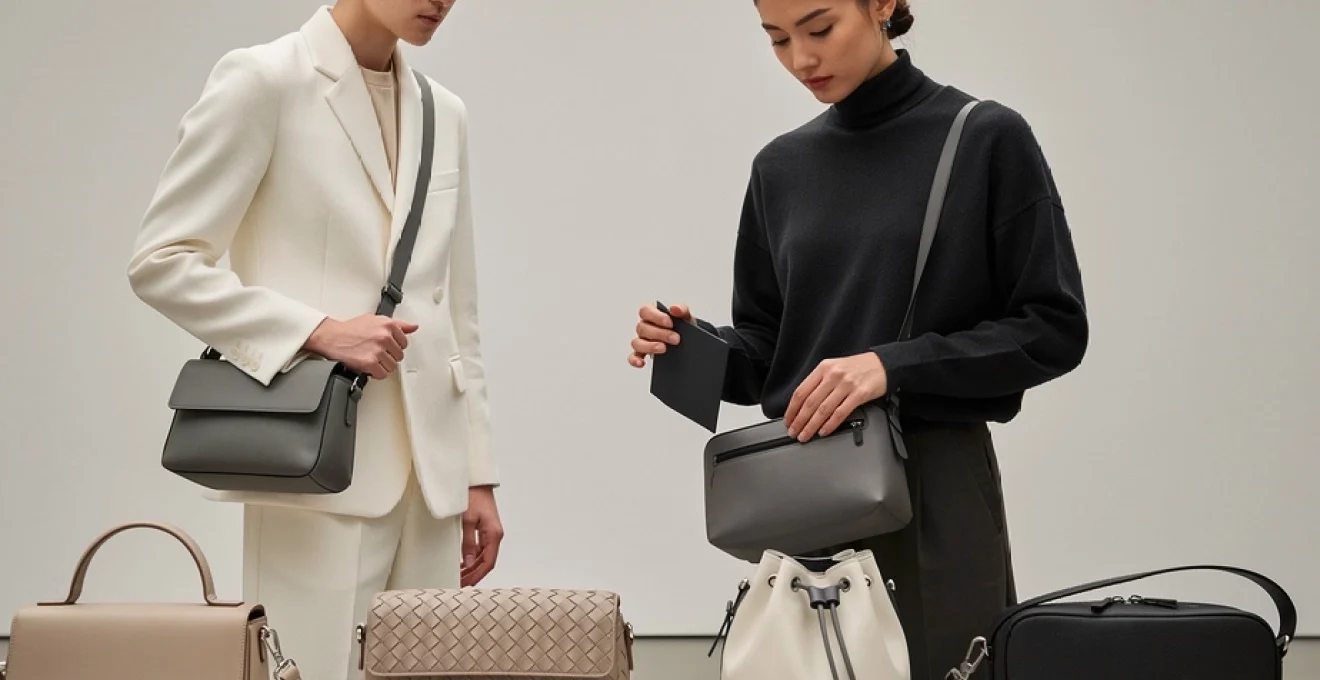
The fashion landscape has undergone a remarkable transformation over the past decade, with minimalism emerging as one of the most enduring and influential movements. This shift reflects a broader cultural change—a growing desire to simplify, to focus on what truly matters, and to reject the excess that dominated previous eras. At the heart of this revolution lies an unexpected hero: the compact bag. These diminutive accessories have become powerful symbols of intentional living, proving that true elegance doesn’t require grand gestures or ostentatious displays. Instead, they embody a philosophy where every element serves a purpose, where craftsmanship takes precedence over embellishment, and where less truly becomes more.
As our lives have evolved to become more streamlined and digitally focused, the physical objects we carry have naturally diminished. A smartphone replaces a wallet, a planner, a camera, and countless other items our parents’ generation deemed essential. This technological consolidation has created the perfect environment for compact bags to flourish. Yet their popularity extends beyond mere practicality—these accessories represent a conscious rejection of consumerism’s relentless demands, offering an alternative narrative where quality, versatility, and timelessness triumph over fleeting trends.
Defining compact bag architecture in contemporary minimalist design
Understanding what constitutes a truly minimalist compact bag requires examining the fundamental principles that govern their design. These aren’t simply smaller versions of traditional handbags; they represent an entirely different approach to accessory architecture. The essence of minimalist design lies in the deliberate removal of unnecessary elements whilst maintaining—or even enhancing—functionality. Every seam, every stitch, every millimetre of material must justify its existence.
Volumetric constraints and dimensional standards for minimalist carry solutions
The compact bag category typically encompasses accessories with internal volumes ranging from 0.5 to 3 litres, though the precise measurements vary considerably based on silhouette and intended use. The most popular formats include crossbody bags measuring approximately 18-22 cm in width, belt bags with capacities between 1-2 litres, and clutches that rarely exceed 25 cm in length. These dimensions aren’t arbitrary—they reflect extensive research into what modern consumers actually need to carry daily.
Industry data from 2023-2024 reveals that 68% of urban professionals now carry fewer than eight items when leaving their homes, down from an average of fifteen items just a decade ago. This dramatic reduction has prompted designers to reconsider traditional bag proportions entirely. The challenge becomes creating sufficient space for essentials—phone, keys, cards, perhaps a small cosmetic item—without permitting the accumulation of unnecessary objects. It’s a delicate balance between restriction and practicality, one that defines successful compact design.
Material selection: technical fabrics versus leather in compact construction
Material choices fundamentally shape both the aesthetic and functional characteristics of compact bags. Traditional leather remains the gold standard for luxury minimalist pieces, prized for its durability, tactile qualities, and ability to develop character through use. Full-grain and top-grain leathers dominate the premium segment, with vegetable-tanned options gaining favour among environmentally conscious consumers. These natural materials offer unparalleled longevity—a well-crafted leather compact bag can easily serve its owner for twenty years or more.
However, contemporary technical fabrics have carved out their own substantial niche within the compact bag market. Materials like ballistic nylon, Cordura, and innovative recycled polyesters provide exceptional strength-to-weight ratios whilst offering practical advantages including water resistance and easier maintenance. Some designers have pioneered hybrid constructions that combine leather accent points with technical fabric bodies, creating pieces that bridge traditional craftsmanship and modern functionality. The weight consideration becomes particularly crucial in compact formats—every gram matters when you’re creating an accessory designed for extended daily wear.
Streamlined closure systems: magnetic clasps, hidden zippers, and minimalist hardware
The hardware and closure mechanisms employed in minimalist compact bags represent some of the most thoughtful design elements. Traditional buckles, decorative locks, and prominent zippers often feel excessive against the clean lines these pieces demand. Instead, designers have embraced understated solutions: seamlessly integrated magnetic closures that provide security without
visible hardware. Hidden zippers tucked under clean flaps, low-profile sliders colour-matched to the body, and micro eyelets for detachable straps all contribute to a silhouette that appears almost seamless. The goal is intuitive, one-handed operation without visible complexity. When executed well, these closure systems feel almost invisible in daily use, yet they significantly enhance security and durability—discreet engineering that quietly supports a minimalist lifestyle.
Weight distribution engineering in small-format handbags
While compact bags contain less than traditional totes, weight distribution remains a critical ergonomic concern. A poorly balanced mini crossbody can dig into the shoulder or twist awkwardly against the body, undermining the promise of ease and comfort. Designers therefore pay close attention to strap anchoring points, ensuring they align with the bag’s centre of gravity and the natural curve of the torso. Many contemporary minimalist bags employ wider, slightly padded straps or adjustable webbing to diffuse pressure across a larger surface area.
Internal layout also plays a role in perceived weight. By positioning heavier items—phones, card holders, small power banks—closest to the body-facing panel, compact bags feel more stable in motion and less likely to swing. Some brands subtly curve the back panel or add a lightly structured base to keep contents from pooling at the bottom. The result is a small-format handbag that moves with you rather than against you, reinforcing the minimalist ideal of “frictionless” daily carry.
Iconic compact bag designs that shaped minimalist fashion movements
The rise of minimalist fashion has been punctuated by a series of compact bags that redefined how we think about scale, luxury, and everyday practicality. These pieces did more than ride a trend; they helped set the visual language for minimalist dressing in the 2010s and 2020s. By stripping away excess branding and decoration, they proved that a bag could be instantly recognisable through silhouette, proportion, and material alone. Each of the designs below has contributed in its own way to the ongoing conversation around compact, intentional carry.
The row’s margaux bag: architectural precision in compact luxury
The Row’s Margaux bag is often cited as a masterclass in quiet luxury, and its compact iterations distil that ethos to its purest form. Rather than relying on overt logos, the Margaux communicates status through its architecture: sculpted side gussets, precise handles, and a restrained palette of neutrals and deep, saturated tones. In smaller sizes, the bag still maintains its structural integrity, functioning almost like a portable building—each panel, seam, and curve engineered for balance and proportion.
This architectural approach has had a ripple effect across minimalist fashion. You see echoes of the Margaux’s discipline in the rise of “office-ready” compact handbags that pair seamlessly with tailored coats, wide-leg trousers, and monochrome knitwear. For consumers building a capsule wardrobe, the compact Margaux demonstrates how a single, impeccably constructed piece can anchor countless outfits. It is not merely an accessory; it is an organising principle around which a minimalist wardrobe can revolve.
Bottega veneta’s cassette: intrecciato craftsmanship in miniature form
Bottega Veneta’s Cassette bag, particularly in its small and mini formats, reimagines the house’s signature intrecciato weave for a new generation. Enlarged leather “cushions” create a bold grid that somehow remains minimalist despite its graphic presence. In compact sizes, this quilted structure functions almost like wearable sculpture, adding texture and depth to otherwise pared-back outfits. The absence of visible logos keeps the focus on craftsmanship and materiality—a key tenet of minimalist style.
The mini Cassette helped redefine how statement pieces function within a minimalist wardrobe. Instead of relying on colour or overt decoration, it demonstrates how a bag can become the focal point through surface and volume alone. Worn with simple tailoring or a slip dress, it injects visual interest without disrupting the overall restraint. For many, it became the gateway to understanding that “minimalist” does not have to mean “plain”; it can also mean precisely calibrated impact.
Mansur gavriel’s mini bucket bag: pioneering accessible minimalist aesthetics
When Mansur Gavriel introduced its bucket bag in the early 2010s, the fashion world took note. The mini version, in particular, crystallised a new kind of minimalist accessory: relatively affordable, structurally simple, and endlessly photogenic. Smooth vegetable-tanned leather, simple drawstring closure, and saturated yet soft colourways created an object that felt both approachable and aspirational. The bag’s clean cylinder form and absence of hardware aligned perfectly with the rising “normcore” and capsule wardrobe movements.
The mini bucket bag also proved that minimalist compact bags could thrive beyond the ultra-luxury segment. Its success on social media and in the wardrobes of style-conscious professionals encouraged a wave of brands to explore similar formulas—small footprints, clear lines, honest materials. For many consumers, it was the first step away from logo-heavy designs and towards a quieter, more enduring aesthetic. In that sense, it served as both product and philosophy lesson in minimalism.
Lemaire’s camera bag: functional reduction and unisex design principles
Lemaire’s camera bag is a textbook example of minimalist reduction applied to a unisex compact form. Inspired by utilitarian camera cases, it features a boxy profile, rounded corners, and a long adjustable strap that works across a wide range of body types. The design language is deliberately neutral—neither overtly feminine nor masculine—highlighting how compact bags can transcend traditional gender categories. In an era of increasingly fluid fashion, this has proven particularly resonant.
The bag’s internal structure echoes its minimalist exterior: a main compartment sized precisely for daily essentials, one or two slip pockets, and little else. This reduction is not about deprivation; it is about clarity. By limiting what you carry, the camera bag subtly guides you towards a more intentional approach to personal belongings. Its success among creatives, stylists, and urban commuters underscores a broader shift: minimalist fashion is less about appearance alone and more about how pieces perform in real life.
Functional capacity optimization in reduced-volume bag design
Designing compact bags for minimalist fashion is ultimately an exercise in spatial optimisation. When you only have one to three litres of internal volume to work with, every centimetre counts. The goal is to create the experience of “enough” space, even when the physical capacity is modest. This requires a meticulous understanding of contemporary everyday carry: smartphones in varying sizes, slim card holders, keys, earbuds, and perhaps one or two personal care items. Successful minimalist bags feel deceptively spacious because their internal architecture is so intelligently planned.
Modular interior organization systems for compact bags
One of the most effective strategies for maximising functionality in compact formats is the use of modular interior systems. Rather than sewing numerous permanent compartments—which can quickly clutter a small bag—designers are turning to removable pouches, card sleeves, and snap-in panels. Think of it as a tiny, customisable toolbox inside your handbag. You can configure it differently for workdays, travel, or evenings out, without needing a completely different bag.
This modularity aligns closely with capsule wardrobe principles. Just as you combine a limited number of garments into many outfits, you can recombine a few internal modules to suit multiple scenarios. From a user perspective, it also simplifies transitions between bags: you move one small insert containing essentials, rather than emptying everything item by item. For anyone embracing a minimalist lifestyle, this kind of system helps reduce decision fatigue and keeps everyday carry both tidy and intentional.
Rfid-blocking technology integration without compromising minimalist lines
As contactless payments and digital identity cards have become the norm, security concerns have followed. RFID-blocking technology—materials that prevent unauthorised scanning of cards—has quietly made its way into minimalist compact bags. The challenge for designers is to incorporate these protective layers without adding bulk, visual noise, or rigid patches that break the line of the bag. In practice, this often means bonding ultra-thin shielding fabrics between the lining and outer shell, or limiting RFID-blocking to a dedicated card sleeve.
For the wearer, the benefit is peace of mind without aesthetic compromise. You gain the functional protection of a tech-forward wallet while maintaining the clean interior and smooth exterior that define minimalist accessories. If you are curating a compact bag collection for everyday city life or frequent travel, prioritising models with discreet RFID protection is a smart, future-proof choice. It is a reminder that in contemporary minimalism, simplicity is supported by invisible layers of thoughtful complexity.
Strategic pocket placement and accessibility in limited space
In reduced-volume bags, pocket placement becomes almost as important as pocket quantity. Too many compartments and the interior feels cramped; too few and items jumble together. The sweet spot usually involves one main compartment complemented by one or two high-priority pockets—typically for a phone and cards. Designers often position these against the back panel for quick, secure access, sometimes slightly raised so they are easy to reach without digging.
Accessibility is also influenced by opening geometry. A compact bag with a narrow top zip may look sleek, but if you have to wrestle your hand through the opening, it undermines the minimalist promise of ease. Wider, D-shaped openings, gusseted sides, or envelope flaps that fold back completely allow you to see and reach everything at a glance. Think of it like a well-organised small apartment: strategic shelving and door placement make the space feel bigger than it is. In the same way, clever pocket design lets a compact bag punch far above its literal size.
Capsule wardrobe integration strategies for compact bag collections
For many people embracing minimalist fashion, compact bags are not isolated purchases; they are integral components of a broader capsule wardrobe. The question is no longer “How many bags can I own?” but “Which two or three compact bags will serve almost every scenario in my life?” Thinking in terms of systems rather than individual items helps ensure that each bag you add works hard, harmonising with your clothes, your colour palette, and your daily routines.
Colourway selection: neutral palettes and monochromatic design philosophy
Colour is one of the most powerful tools for ensuring that a compact bag integrates seamlessly into a minimalist wardrobe. Neutral palettes—black, tan, taupe, charcoal, deep navy—remain the most versatile options, acting almost like extensions of your outerwear or footwear. When you choose a bag in the same tonal family as your core clothing, you reduce visual clutter and make outfit-building significantly faster. A black crossbody with clean lines can slip just as easily into a work blazer look as it can into a weekend denim ensemble.
Some minimalists take this a step further with a monochromatic approach, selecting bags that virtually disappear into the outfit. Imagine an all-cream winter look with a compact ivory shoulder bag; the effect is quietly luxurious rather than attention-grabbing. If you crave variety, you can introduce a single accent colour—perhaps a muted forest green or burgundy mini bag—that still behaves like a neutral. The key is to resist impulse purchases in trend-driven colours and instead think about long-term cohesion: will this compact bag still work with 80–90% of your wardrobe two years from now?
Cross-functional styling: day-to-night versatility in compact formats
Minimalist living often means asking each item to do more than one job, and compact bags are no exception. The most useful designs transition effortlessly from day to night, from office to dinner, from sightseeing to a low-key event. How does this translate in practice? Look for bags with removable or adjustable straps that can be worn crossbody during the day and handheld or as a shoulder bag in the evening. A sleek camera bag that clips into a short chain strap after 6 p.m. instantly feels more polished without needing an entirely different accessory.
Material and finish matter here too. Matte leathers and refined technical fabrics tend to read as appropriate in both casual and formal contexts, especially when hardware is discreet. You might ask yourself: if I remove nothing from my bag and only change my shoes or jacket, will this compact piece still feel right at a restaurant or gallery opening? When the answer is yes, you’ve found a cross-functional design that truly supports a streamlined, minimalist lifestyle.
Seasonal adaptability through material transitions in minimalist bag design
Seasonal dressing can be a challenge for minimalists, particularly in climates with dramatic weather shifts. Compact bags offer a subtle but effective way to adapt without over-expanding your wardrobe. Many people find it useful to maintain one year-round “core” bag—usually in durable leather or high-performance nylon—and one or two seasonal alternates. For example, a light-coloured canvas or raffia mini tote might come out in summer, while a structured black leather crossbody takes precedence in autumn and winter.
Designers support this kind of seasonal rotation by offering consistent silhouettes across different materials. The same minimalist shape might be rendered in suede, smooth leather, or recycled technical fabric, allowing you to switch textures while maintaining visual coherence. Think of it as changing the fabric of your sofa cushions rather than buying new furniture. You preserve the overall aesthetic of your wardrobe while subtly responding to weather, mood, and context—a sustainable, low-clutter approach to seasonal style.
Sustainable manufacturing processes in minimalist compact bag production
Sustainability sits naturally alongside minimalism, and compact bags are well positioned to embody both values. Producing a smaller bag inherently uses fewer raw materials, but responsible brands go further, scrutinising every stage of the supply chain. Vegetable-tanned leathers that avoid heavy metals, recycled nylons made from post-consumer plastics, and traceable cotton canvases are increasingly common in minimalist collections. By prioritising high-quality materials that age well, designers also extend product lifecycles, reducing the need for frequent replacement.
Manufacturing processes themselves are also evolving. Some labels adopt “zero waste” cutting techniques, arranging pattern pieces like a puzzle to minimise offcuts. Others repurpose surplus leather from larger bags into compact wallets and mini styles, effectively turning potential waste into desirable products. Small-batch production and made-to-order models further reduce overstock and unsold inventory—major sources of environmental impact in fashion. For consumers, choosing a sustainably produced compact bag is not only an aesthetic decision; it is a vote for slower, more responsible fashion systems.
Market positioning and consumer psychology behind compact minimalist bags
The commercial success of compact minimalist bags is not accidental; it reflects deep shifts in consumer psychology. Many shoppers today are weary of overt status symbols yet still value craftsmanship and design. Compact bags occupy this middle ground: they can signal discernment and taste without shouting for attention. From a market perspective, they often serve as entry points into luxury brands—a more accessible price point than large totes, but still aspirational enough to feel special.
Psychologically, buying a compact bag can also symbolise a personal reset. Downsizing from an overstuffed tote to a small crossbody often coincides with broader lifestyle changes: decluttering a home, curating a capsule wardrobe, rethinking digital habits. The object becomes a daily reminder of those intentions. Brands leverage this by framing compact bags not just as products but as tools for a “simpler, more focused life.” When we choose these pieces, we are not only selecting an accessory; we are affirming a narrative about ourselves—one where we carry only what matters and let the rest fall away.