Travelling with precious jewellery requires meticulous planning, sophisticated security measures, and comprehensive risk assessment protocols. Modern travellers face evolving challenges when transporting valuable accessories across international borders, from sophisticated theft networks to complex customs regulations. Whether you’re carrying a family heirloom or contemporary designer pieces, understanding professional-grade protection strategies can mean the difference between enjoying your treasures abroad and facing devastating loss. The global luxury travel market has witnessed a 23% increase in jewellery-related theft incidents over the past five years, making security awareness more critical than ever for discerning travellers.
Pre-travel jewellery security assessment and documentation protocols
Establishing comprehensive documentation protocols before departure forms the cornerstone of effective jewellery security during travel. Professional travellers understand that preparation extends far beyond simply packing items carefully. The process begins with creating detailed inventories, obtaining professional certifications, and establishing robust insurance coverage that protects against international risks.
Professional appraisal certification for High-Value pieces
Professional appraisal certification provides essential legal and financial protection for travellers carrying significant jewellery collections. Certified gemologists offer detailed assessments that include precise measurements, clarity grading, and current market valuations essential for insurance claims and customs declarations. These documents become invaluable when dealing with international authorities or filing theft reports abroad.
Recent industry standards recommend obtaining appraisals from American Society of Appraisers certified professionals within 24 months of travel for pieces valued above £10,000. The appraisal process typically requires 3-5 business days and costs between £150-500 depending on piece complexity. Independent certification provides credible third-party validation that customs officials and insurance companies readily accept.
Digital photography documentation with gemological institute of america standards
Comprehensive photographic documentation following Gemological Institute of America protocols ensures precise identification and verification of your precious items. Professional photography captures essential details including serial numbers, hallmarks, distinctive characteristics, and wear patterns that distinguish authentic pieces from replicas. These images serve multiple purposes: insurance claims, theft reports, and customs documentation.
Optimal documentation requires capturing multiple angles using macro photography techniques under controlled lighting conditions. Include detailed shots of clasps, settings, engravings, and any unique identifying features. Store these images in multiple cloud-based platforms with timestamp verification to establish authenticity. Professional photographers specialising in jewellery documentation charge £75-200 per session and provide archival-quality images suitable for legal purposes.
Insurance coverage verification and travel rider policies
Standard homeowner’s insurance policies typically provide inadequate coverage for jewellery losses during international travel. Specialist travel riders offer enhanced protection covering theft, loss, and damage occurring anywhere worldwide. These policies often include coverage for mysterious disappearance, accidental damage, and even depreciation caused by loss of matching sets.
Premium travel jewellery insurance costs approximately 1-2% of total declared value annually, with coverage limits reaching £1 million per policy. Leading providers include Chubb, AXA, and Lloyd’s of London, each offering different coverage structures and claim procedures. Policy activation typically requires 72-hour advance notice before travel commencement, making early planning essential for comprehensive protection.
Serial number registration and Anti-Theft database enrollment
Anti-theft database registration significantly improves recovery prospects for stolen jewellery through international law enforcement networks. Services like Art Loss Register and Trace maintain comprehensive databases accessed by police agencies, auction houses, and legitimate dealers worldwide. Registration costs £25-75 per item and provides permanent database inclusion with automatic alerts when registered items surface in legitimate markets.
Modern tracking technologies include microscopic DNA marking systems that embed unique identifiers invisible to thieves but detectable by authorities. These systems cost £15-30 per item and provide irrefutable ownership proof. Some luxury manufacturers now include factory-installed tracking devices in high-value pieces, though battery life and signal range limitations restrict their practical effectiveness during extended travel.
Airport security screening procedures for fine jewellery and precious metals
Navigating airport security with valuable jewellery requires understanding Transportation Security Administration protocols and international screening variations. Professional travellers develop systematic approaches for efficiently managing security checkpoints while maintaining complete oversight of their precious items.
TSA PreCheck advantages for luxury accessory transport
Enrolling in trusted traveller programmes such as TSA PreCheck and Global Entry streamlines security procedures while reducing the amount of time your fine jewellery is exposed in public areas. With TSA PreCheck, you typically keep belts, shoes, and light jackets on, and you move through shorter queues, meaning fewer chances for distraction or opportunistic theft. For travellers carrying high-value pieces, the ability to pass through security swiftly and predictably is a significant risk-reduction measure.
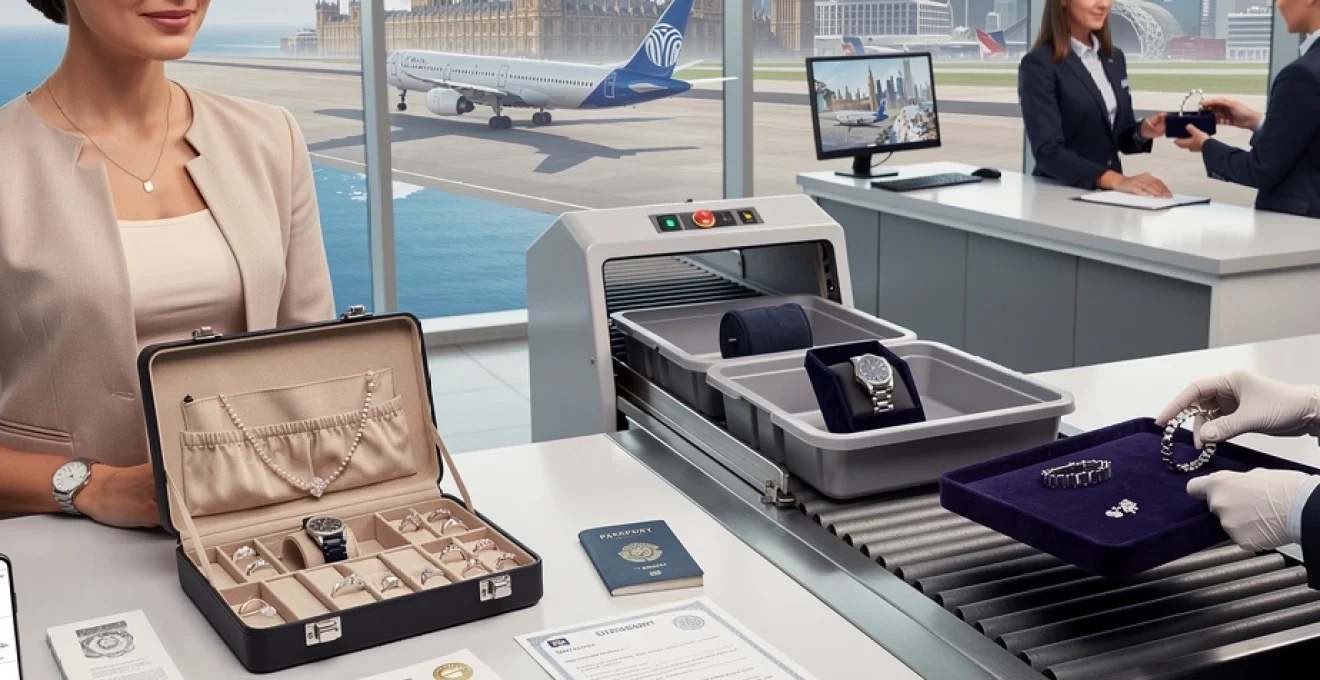
When travelling with jewellery through TSA PreCheck lanes, keep your pieces consolidated in a dedicated travel jewellery case inside your carry-on. If an officer needs to inspect items, request a private screening room so your Cartier earrings or diamond tennis bracelet are not displayed at an open checkpoint. You are entitled to remain in visual contact with your jewellery at all times during inspection, and you can politely insist on this if staff attempt to move your items out of sight.
X-ray machine detection of gemstone settings and metal alloys
Airport X-ray machines are designed to detect dense materials such as precious metals and gemstone settings, but they are not capable of assessing authenticity or value. From a security standpoint, this means that your platinum engagement ring and a costume-metal replica look similar on the screen, which can work in your favour when travelling with jewellery discreetly. However, substantial volumes of gold or multiple heavy chains may trigger additional screening, particularly at international airports with stricter controls.
To minimise complications, avoid sending loose jewellery pieces through the belt in open trays where they can be misplaced or quickly removed. Instead, place your travel jewellery organiser deep within your cabin bag so that it appears as a single, contained item during scanning. If security agents ask to view contents, calmly explain that you are carrying fine jewellery and request that inspection occurs on a clean, empty surface with your bag zipped closed again as soon as checks are complete.
Manual inspection protocols for cartier and tiffany statement pieces
Manual inspections become more likely when you are travelling with jewellery that includes large diamonds, complex gemstone clusters, or distinctive branded hardware such as Cartier or Tiffany signatures. Security officers may wish to verify that no prohibited items are concealed within hollow components or watch cases. While these checks can feel intrusive, understanding the process allows you to maintain control and protect your pieces from accidental damage.
Before an inspection begins, clearly state that your jewellery is high value and request that the officer wears fresh gloves to avoid residue or scratches on polished surfaces. Place each statement piece on the inspection tray yourself, and avoid letting staff pull at delicate chains or force open tight clasps. If you are asked to remove a luxury watch, position it dial-up on a soft cloth or inside its own pouch; this small step can prevent crystal scratches or bracelet stretch during handling.
International customs declaration requirements for rolex and patek philippe timepieces
High-end timepieces from brands such as Rolex and Patek Philippe attract particular attention at international borders due to their high resale value and counterfeiting prevalence. Many countries require travellers to declare luxury watches above certain value thresholds either upon entry, on re-entry to their home country, or both. Failure to declare can result in fines, seizure of the item, or lengthy investigations that disrupt your travel itinerary.
When travelling with jewellery-level watches, carry purchase receipts, appraisal certificates, and export documentation in digital format on your phone or tablet. Some jurisdictions allow you to register valuable items with customs before departure, creating a proof-of-ownership file that simplifies re-entry and avoids mistaken assumptions about overseas purchases. If in doubt, voluntarily declaring your timepiece and providing documentation is usually faster and safer than risking suspicion or confiscation during a random inspection.
Protective storage solutions during transit and hotel accommodation
Effective storage solutions are the backbone of safe jewellery travel, protecting pieces from both physical damage and opportunistic theft. During transit, your goal is to keep items consolidated, cushioned, and always within arm’s reach, ideally inside a structured case that resists crushing in overhead bins. Once you arrive at your hotel or villa, the focus shifts towards secure, discreet storage that blends into your environment without signalling the presence of high-value jewellery.
For flights and train journeys, select a rigid or semi-rigid travel jewellery case with dedicated slots for rings, padded bars for bracelets, and hooks for necklaces to prevent tangling. Place this case inside your personal item rather than your main carry-on so that it remains under the seat in front of you, not in overhead compartments that may be accessed by other passengers. At your accommodation, use the in-room safe for your most valuable pieces but complement it with creative concealment tactics, such as placing your closed jewellery case inside an unmarked packing cube or toiletry bag.
Destination-specific theft prevention strategies across global regions
Not all destinations present the same security profile when you are travelling with jewellery, and adjusting your approach to match local conditions is vital. A diamond line necklace that feels appropriate in a Monaco hotel lobby might be inappropriate in a crowded street market in Bangkok. Conducting a basic risk assessment for each location on your itinerary allows you to balance enjoyment of your pieces with realistic threat awareness.
As you plan your trip, review local crime statistics, traveller advisories, and region-specific guidance on pickpocketing and organised theft. You can then decide which jewellery to wear openly, which to keep discreetly under clothing, and which to leave in secure storage for specific excursions. Thinking of your jewellery wardrobe like a toolkit helps: you simply choose the right tool for the environment, rather than defaulting to maximum sparkle in every context.
Mediterranean coastal resort security considerations in monaco and santorini
Mediterranean coastal resorts such as Monaco and Santorini are synonymous with luxury travel, but their high-end profile also attracts professional thieves who specialise in targeting affluent visitors. In Monaco, you may feel surrounded by high jewellery and collectible watches, which can create a false sense of safety. However, hotel lobbies, marinas, and casino entrances are prime observation points where criminals study routines and identify targets wearing statement pieces.
When travelling with jewellery in these destinations, reserve your boldest pieces for controlled environments such as fine dining rooms or private events, and avoid wearing multiple conspicuous items simultaneously in public streets. In Santorini, steep pathways and crowded viewpoints create opportunities for distraction thefts while you are focused on scenery and photography. Opt for secure clasps on necklaces and bracelets, consider screw-back earrings, and keep valuable watches under shirt cuffs when navigating busy alleys or boarding small boats.
Urban metropolitan risk assessment for london, paris, and new york
Major cities like London, Paris, and New York offer world-class cultural experiences but also present varied risks for travellers wearing fine jewellery. Transport hubs, crowded tourist landmarks, and nightlife districts are consistent hotspots for pickpockets and grab-and-run theft. Thieves often operate in coordinated groups, with one person creating a distraction while another targets bags, wrists, or necklines.
Adopting a layered security strategy significantly reduces your exposure. Wear high-value items in a way that is not easily snatched: snug-fitting bracelets rather than loose bangles, necklaces short enough that they cannot be yanked from behind, and rings that fit firmly. When using taxis or ride-share services at night, avoid adjusting or displaying jewellery in the street; instead, secure items discreetly before stepping out of the vehicle. For theatre visits or fine dining in these cities, you can enjoy more glamorous pieces, provided you use reputable venues and return directly to your accommodation afterwards.
Developing nation precautionary measures in bangkok and mumbai markets
In developing urban centres such as Bangkok and Mumbai, bustling street markets and dense crowds create a very different security dynamic for travellers with jewellery. Here, the risk is less about high-end, targeted theft and more about opportunistic snatching in chaotic environments where police presence may be limited. Colourful markets and night bazaars can be captivating, but they are not ideal settings for prominent diamond jewellery or recognisable luxury-brand watches.
For these excursions, substitute your most valuable pieces with discreet, low-profile alternatives that still complement your outfit but do not advertise substantial wealth. Consider wearing a modest gold chain under clothing or switching to a durable travel watch instead of an intricate mechanical timepiece. Carry your main jewellery travel case locked in your hotel safe, and bring only one or two pieces out at a time, secured in a small, inconspicuous pouch close to your body if you anticipate changing looks between day and evening activities.
Remote destination protocols for safari lodges and island retreats
Remote locations such as African safari lodges and private island retreats offer natural seclusion that often reduces street-crime risk but introduces different challenges. Limited medical and repair facilities mean that damage to your engagement ring prongs or watch gaskets may go unresolved for the duration of your stay, increasing the risk of stone loss or water ingress. Additionally, open terraces, boardwalks, and boat transfers create physical hazards where jewellery can easily be dropped and irretrievably lost.
When travelling with jewellery to these destinations, prioritise durability and practicality over maximal sparkle. Closed-back bezel settings and sturdy bracelets tolerate outdoor activities far better than delicate claw-set stones or multi-strand chains. Remove rings and fine watches before activities involving water, sand, or wildlife interaction, and store them in a secure pouch in your daypack rather than leaving items loose in tents or on sun loungers. In truly off-grid environments, your safest option may be to bring a minimal capsule collection and leave heirloom-level pieces securely stored at home.
Emergency response procedures for lost or stolen jewellery abroad
Even with meticulous planning, incidents can occur, and having a clear emergency protocol dramatically improves your chances of recovery when jewellery goes missing abroad. Think of this as your contingency playbook: you hope never to use it, but if you do, every hour counts. Acting quickly, calmly, and in the correct sequence helps law enforcement, insurers, and hotel management support you more effectively.
The first step after confirming loss or theft is to secure your surroundings and ensure remaining items are safe: lock your travel jewellery case in the room safe, notify travelling companions, and change any visible routines that may have been observed by thieves. Next, report the incident to hotel security and local police, providing serial numbers, appraisal documents, and high-resolution photographs. Request official copies of all reports, as insurers and international recovery databases typically require formal documentation for activation.
Professional jewellery travel case selection and compartmentalisation techniques
Choosing the right travel jewellery case is as critical as selecting the pieces you bring. A well-designed case functions like a portable safe and display tray combined, protecting items from impact while allowing you to see everything at a glance. When evaluating options, consider four core criteria: structure, interior layout, security features, and portability. Skipping any of these elements can leave gaps in your overall protection strategy.
Look for cases with a rigid exterior shell, such as leather-wrapped wood or reinforced polycarbonate, lined with soft, non-abrasive fabrics like microfibre or suede to prevent scratches. Effective compartmentalisation keeps different jewellery categories separated so that metal components cannot rub together during transit. Rings should sit on padded rolls, earrings on dedicated cards or bars, and necklaces in individual channels with hooks that allow you to secure chains stretched flat, dramatically reducing tangling. For added security, some travellers prefer cases with lockable zips or integrated combination locks, particularly when staying in shared accommodations or during frequent hotel changes.