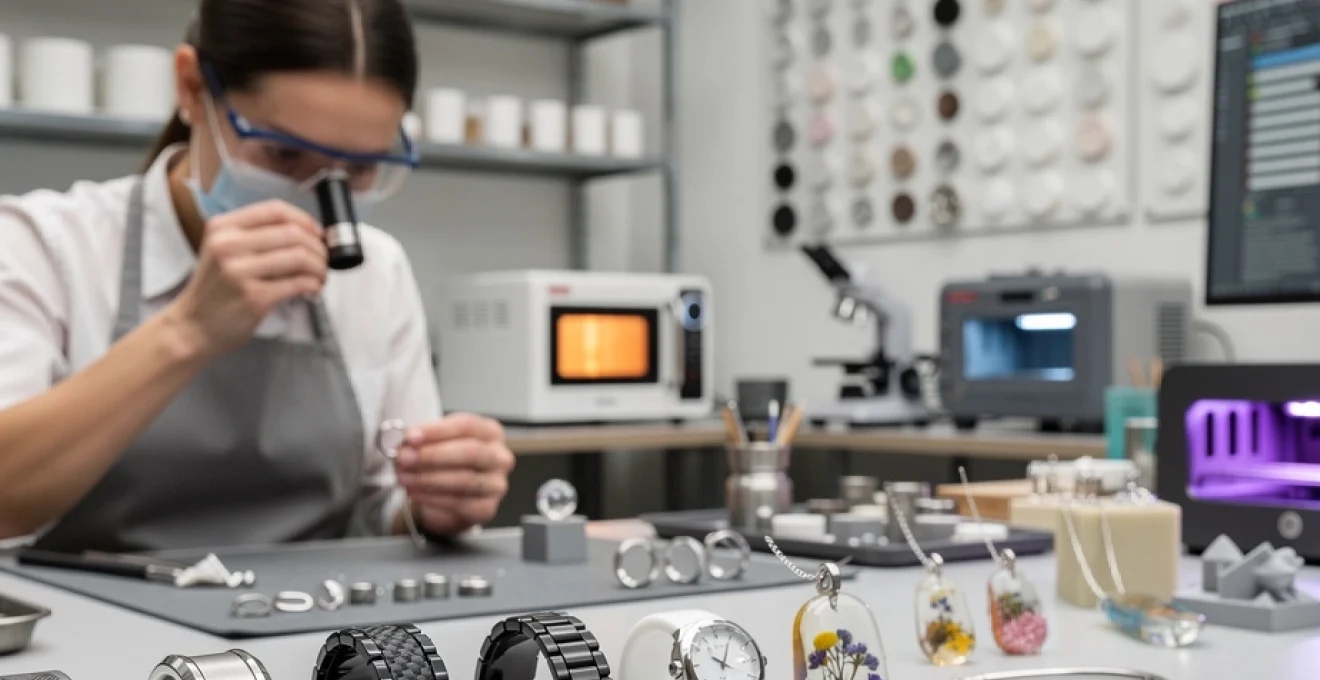
The jewellery industry stands at a fascinating crossroads, where centuries-old craftsmanship meets cutting-edge materials science. While gold, silver, and platinum have dominated the landscape for millennia, the past two decades have witnessed an unprecedented surge in alternative materials that challenge traditional notions of luxury, durability, and aesthetic appeal. From aerospace-grade titanium to laboratory-grown diamonds, these innovative substances are reshaping how designers conceptualise wearable art and how consumers approach personal adornment. This transformation isn’t merely about novelty—it represents a fundamental shift in values, driven by sustainability concerns, technological advancement, and a desire for personalisation that conventional materials simply cannot satisfy. As the boundaries between haute couture, industrial design, and fine jewellery continue to blur, understanding these new materials becomes essential for anyone engaged with contemporary adornment.
Titanium and its alloys: lightweight strength in contemporary jewellery manufacturing
Titanium has emerged as one of the most transformative materials in modern jewellery design, offering a unique combination of properties that were previously impossible to achieve in a single metal. With a strength-to-weight ratio that surpasses both steel and platinum, titanium delivers structural integrity without the heft that can make larger pieces uncomfortable during extended wear. This remarkable metal resists corrosion with exceptional tenacity, maintaining its appearance even in harsh environments that would tarnish silver or corrode lower-grade alloys. For individuals with metal sensitivities, titanium presents an entirely hypoallergenic option, as its biocompatibility means it rarely triggers allergic reactions—a quality that has made it indispensable in medical implants for decades.
The adoption of titanium in jewellery manufacturing has accelerated particularly in the wedding band sector, where durability and comfort rank as paramount concerns. Unlike traditional gold rings that can scratch, bend, or wear thin over years of daily use, titanium maintains its structural integrity with minimal maintenance. The metal’s natural grey hue offers a contemporary aesthetic that appeals to those seeking alternatives to conventional precious metals, whilst its ability to be anodised opens up a spectrum of colour possibilities without the need for gemstone embellishment.
Grade 5 Ti-6Al-4V applications in High-End wedding bands and body jewellery
Grade 5 titanium, technically designated as Ti-6Al-4V due to its composition of 6% aluminium and 4% vanadium, represents the gold standard for jewellery applications requiring superior strength. This aerospace-grade alloy delivers approximately 40% greater tensile strength than commercially pure titanium whilst maintaining excellent formability during manufacturing processes. High-end jewellery houses have increasingly specified Grade 5 for wedding bands that must withstand decades of continuous wear, particularly for individuals in physically demanding professions where softer metals would quickly deform.
In the body jewellery sector, Grade 5 titanium has become virtually synonymous with quality and safety. Its exceptional biocompatibility makes it the preferred choice for initial piercings, where the body’s healing response to foreign materials becomes a critical consideration. Professional piercers routinely recommend titanium for clients with known metal sensitivities or those seeking the fastest healing times. The material’s resistance to bodily fluids and its inability to leach potentially harmful ions into surrounding tissue make it superior to surgical steel alternatives, despite the higher initial cost.
Anodising techniques for chromatic surface colouration without gemstones
One of titanium’s most captivating properties emerges through anodising—an electrochemical process that creates interference patterns in the oxide layer on the metal’s surface. Unlike plating or coating, anodising actually thickens the naturally occurring titanium dioxide layer, creating colours through light refraction rather than pigmentation. This means the colours are integral to the surface rather than applied, resulting in exceptional durability that won’t chip, peel, or fade under normal wear conditions.
The voltage applied during anodising determines the resulting colour, with precise control allowing artisans to achieve hues ranging from subtle gold and bronze through vibrant purples, blues, and greens. Contemporary designers exploit this capability to create gradient effects, multi-tonal patterns, and even representational imagery on titanium surfaces. The process requires meticulous surface preparation and controlled electrical parameters, but the results offer
intricate optical effects without adding a single gemstone. For minimalists, anodised titanium offers colour and personality with virtually no added weight or maintenance. For more experimental studios, masking techniques, laser etching, and multi-step anodising cycles allow precise control over patterns, logos, and even micro-illustrations that would be difficult to reproduce cost-effectively in enamel or inlay work.
From a sustainability perspective, anodising is also attractive. The process consumes relatively little material, can be performed at room temperature, and does not rely on the mining or cutting of additional stones. When you consider the long-term colour stability and scratch resistance of the oxide layer, anodised titanium jewellery delivers a compelling balance of visual impact, durability, and low environmental footprint. This combination explains why anodised Grade 5 pieces feature so prominently in modern wedding bands, statement cuffs, and high-end body jewellery collections.
Biocompatibility standards and medical-grade titanium in piercings
When it comes to piercings, biocompatibility is non-negotiable. Medical-grade titanium alloys such as ASTM F136 and ISO 5832-3 compliant materials meet strict standards originally developed for orthopaedic implants and surgical hardware. These specifications restrict impurities like nickel and ensure that the alloy’s microstructure will not corrode or break down in contact with bodily fluids. For you as a wearer, that translates into a lower risk of irritation, faster healing, and a dramatically reduced chance of long‑term complications.
Professional piercers and reputable jewellery manufacturers increasingly advertise compliance with these medical standards, and this is more than a marketing line. It is a signal that the jewellery has passed well‑defined thresholds for toxicity, surface finish, and mechanical stability. If you are considering a new piercing, particularly in cartilage or sensitive areas, asking explicitly for ASTM F136 or “implant-grade titanium” can be one of the simplest ways to protect your health. In a marketplace where “hypoallergenic” is often used loosely, verifiable biocompatibility standards offer rare clarity.
There is also a design benefit to these medical-grade titanium alloys. Their high strength allows for thinner posts, secure threading systems, and low-profile ends that sit comfortably against the skin while still resisting deformation. This is especially important in areas exposed to movement or impact, such as navel and ear piercings, where softer metals might bend or catch. When you combine this mechanical reliability with the option for anodised colour, it becomes clear why titanium has become the default recommendation for modern body jewellery practitioners worldwide.
Combining titanium with carbon fibre composites for avant-garde pieces
At the more experimental edge of modern jewellery design, titanium is frequently paired with carbon fibre composites to create avant-garde pieces that look as if they belong in a concept car rather than a display case. Carbon fibre’s characteristic woven pattern, deep black lustre, and remarkable stiffness contrast beautifully with titanium’s cool metallic sheen. Together they deliver a “technical luxury” aesthetic that appeals to clients who favour performance-driven design over traditional ornamentation. You will often see this pairing in men’s rings, cufflinks, and pendant systems aimed at the luxury sports or automotive-inspired market.
From a manufacturing standpoint, bonding titanium to carbon fibre requires careful attention to interface design. Direct metal-to-composite joins can suffer from differential expansion and stress concentrations, so designers typically use intermediate bonding layers, mechanical interlocks, or precision-milled channels to capture the composite insert. When executed well, the result is a piece that is both lighter and stronger than an equivalent volume of solid metal. This allows for bold, architectural silhouettes that remain comfortable on the body—an important consideration for wide cuffs and statement necklaces.
There are, however, practical considerations. Carbon fibre is exceptionally strong in tension but can be vulnerable to sharp impacts or edge chipping, particularly in thin sections. For that reason, many high-end studios recess carbon fibre panels within protective titanium frames, much like a gemstone setting, to shield the composite edges. If you are considering a titanium–carbon fibre ring or bracelet, look for designs where the carbon fibre is not exposed at high-wear corners and ask about repair options should the composite ever become damaged. A well-engineered piece can last for many years, but, as with any advanced material, thoughtful design is key.
Ceramic materials: zirconia and silicon nitride in luxury timepiece-integrated jewellery
Advanced ceramics have moved from the laboratory into the jewellery world, particularly at the intersection of fine jewellery and luxury watchmaking. Materials such as zirconia (zirconium dioxide) and silicon nitride offer an unusual combination of extreme hardness, chemical inertness, and colour stability, making them ideal for components that must withstand daily wear while retaining a flawless surface. You will most often encounter these ceramics in bezels, links, and ring shanks that either accompany or echo high-end timepiece designs, creating integrated sets where jewellery and watch share a common material language.
Unlike traditional clay-based ceramics, technical ceramics are engineered at the microstructural level. Very fine powders are pressed into shape and then sintered at high temperatures to create dense, nearly pore-free structures with hardness approaching that of sapphire. The resulting components are highly scratch-resistant—far more so than gold or stainless steel—and retain their polish for years. For consumers frustrated by scuffed rings or worn bracelet edges, ceramic jewellery can feel almost miraculous in its ability to shrug off everyday abrasions.
Yttria-stabilised zirconia properties for scratch-resistant ring production
Yttria-stabilised zirconia (YSZ) is the workhorse ceramic in contemporary jewellery, prized for its toughness, colourability, and impressive scratch resistance. By adding a small percentage of yttrium oxide to zirconia, material scientists stabilise the crystal structure at room temperature, dramatically improving fracture toughness compared with traditional ceramics. In practical terms, this means YSZ rings can survive impacts that would easily chip or shatter more brittle materials, while still offering a surface hardness that resists scratching by most everyday objects.
For ring production, YSZ can be pigmented throughout its bulk, allowing manufacturers to create deep black, pure white, or even coloured ceramics that never fade because the colour is intrinsic to the material. Unlike plating, which can wear away, a YSZ ring is the same colour all the way through. This makes it particularly attractive for wedding bands and fashion rings where long-term appearance is a priority. Have you ever noticed how quickly a polished gold band can show fine scratches? A comparable YSZ band can remain visually pristine for years of daily wear, even for very active users.
There are, of course, trade-offs. YSZ cannot be resized in the same way as metal; once sintered, the ring’s dimensions are essentially fixed. This makes accurate initial sizing and thoughtful design crucial. Many brands respond by offering half sizes, lifetime exchange programmes, or hybrid metal-ceramic designs that allow some adjustability. As a buyer, you will want to confirm the brand’s policy on fit adjustments, especially for pieces intended as long-term commitments like wedding bands.
High-temperature sintering processes for ceramic jewellery components
The exceptional properties of technical ceramics arise from their production processes. High-temperature sintering, typically in the range of 1350–1600°C, fuses the fine zirconia or silicon nitride powders into a dense, cohesive structure. Before sintering, components are usually formed in an oversized “green” state using pressing, injection moulding, or CNC machining of partially bound compacts. During sintering, the piece shrinks predictably—often by 20–30%—as pores close and grains grow, demanding careful process control to achieve final dimensions within tight tolerances.
For jewellery manufacturers, mastering this shrinkage behaviour is akin to learning a new language. Tooling, moulds, and CAD models must all account for the sintering factor, and subtle variations in powder lot or furnace atmosphere can influence the end result. The reward is a component with outstanding mechanical and surface properties, but the path requires capital investment and technical expertise. This is one reason why many jewellery brands partner with specialised ceramic producers or watch industry suppliers rather than bringing ceramic processing fully in-house.
From an environmental standpoint, sintering is energy-intensive, but the resulting product’s longevity partially offsets this footprint. A ceramic bezel or ring that stays scratch-free for decades may, on balance, outperform softer metals that require refinishing or replacement. As lifecycle assessment tools become more common in jewellery design, we can expect more data-driven comparisons between ceramics and traditional materials, helping both designers and consumers make informed choices.
Black ceramic applications in brands like chanel J12 and rado
The most visible ambassadors for ceramic jewellery are arguably the black and white ceramic watches from brands like Chanel and Rado. The Chanel J12, launched in 2000, helped establish high-tech ceramic as a legitimate luxury material, pairing a deep, glossy black case and bracelet with Swiss watchmaking. Rado, meanwhile, has built much of its brand around scratch-resistant ceramic cases and bracelets, often in dramatic monochrome palettes. These pieces did more than introduce a new material; they changed the visual language of luxury, showing that high-end jewellery and timepieces could be sleek, modern, and almost futuristic.
The success of these watches has spilled over into ring and bracelet design. Many maisons now offer ceramic rings that echo the links or bezels of their signature timepieces, allowing clients to build coordinated sets. Black ceramic, in particular, offers a striking backdrop for diamonds and coloured gemstones, making pavé details appear almost to float on a pool of ink. For those who prefer understated luxury, a plain black ceramic band can serve as a subtle yet highly technical alternative to blackened metals or oxidised silver, without the maintenance these finishes often require.
One of the reasons black ceramic has proven so enduring is its resistance to discolouration. Unlike coated black metals, where a scratch can reveal a pale substrate, black ceramic is pigmented throughout. Even in high-wear zones like ring edges and bracelet corners, the colour remains consistent. For consumers who are hard on their jewellery—frequent travellers, professionals in physical roles, or simply people who wear the same piece every day—this makes ceramic an attractive, low‑maintenance choice.
Thermal expansion compatibility with precious metal inlays
Integrating ceramics with precious metals introduces an important technical challenge: thermal expansion compatibility. Different materials expand and contract at different rates when heated or cooled, and if those rates diverge too far, stresses can build up at the interface. In ring designs where gold or platinum is inlaid into a ceramic channel, mismatched thermal expansion can lead to cracks, delamination, or gaps over time—particularly if the piece is exposed to temperature swings such as hot tubs, saunas, or cold outdoor environments.
To address this, engineers and jewellers select alloys and geometries that minimise differential movement. YSZ has a thermal expansion coefficient not too far from some precious metal alloys, which makes harmonious pairings possible with the right design. Mechanical interlocks, compressive fits, and careful control of inlay geometry further protect against stresses. As a buyer, how can you translate this technical nuance into a simple check? One approach is to favour brands with proven track records in ceramic–metal hybrids and to ask whether the piece has been tested under accelerated ageing or thermal cycling conditions.
Properly designed ceramic–metal combinations can offer the best of both worlds: the scratch resistance and colour stability of advanced ceramics with the warmth and intrinsic value of precious metals. These hybrid pieces sit at the frontier of materials engineering in jewellery, turning what might once have been viewed as incompatible substances into harmonious, long-lasting designs.
Carbon-based innovations: laboratory-grown diamonds and graphene integration
Carbon, in its many forms, sits at the centre of some of the most exciting material innovations in modern jewellery design. At one end of the spectrum, laboratory-grown diamonds offer chemically and optically identical stones to those mined from the earth, but with different supply chains and often lower environmental footprints. At the other end, cutting-edge materials like graphene and carbon fibre composites introduce new possibilities for coatings, structures, and visual effects that were unthinkable even two decades ago. Together, these carbon-based materials are reshaping both the aesthetics and ethics of contemporary jewellery.
For consumers, the shift raises important questions. What does it mean for a diamond to be grown rather than mined? How should we evaluate sustainability claims around lab-grown stones or graphene-based coatings? And how can designers integrate these advanced materials in ways that feel timeless rather than purely technological? As we explore each of these questions, a common theme emerges: the future of jewellery is not just about what materials are used, but how transparently and thoughtfully they are deployed.
CVD and HPHT methods in cultured diamond production by companies like lightbox and pandora
Laboratory-grown diamonds are typically produced by one of two methods: High Pressure High Temperature (HPHT) and Chemical Vapour Deposition (CVD). HPHT replicates the conditions deep within the earth’s mantle, subjecting a carbon source and seed crystal to immense pressure and heat until diamond crystals grow. CVD, by contrast, uses a plasma of carbon-rich gas in a controlled chamber; carbon atoms precipitate onto a seed plate, building up diamond layer by layer. Both methods yield stones that are, at the atomic level, true diamond, with the same hardness, refractive index, and thermal conductivity as natural stones.
Brands like Lightbox (a De Beers venture) and Pandora have embraced CVD-grown diamonds for their controlled quality and scalability. Lightbox, for example, positions its stones as accessible luxury, with transparent pricing by carat and a focus on fashion-forward pieces rather than heirloom positioning. Pandora has integrated lab-grown diamonds into its collections as part of a stated goal to move away from mined stones, aligning with its broader sustainability narrative. For you as a buyer, the appeal lies not only in cost—lab-grown diamonds can be 20–40% less expensive than comparable mined stones—but also in the clearer provenance and often reduced water and land-use impacts.
However, the environmental story is not automatic. Both HPHT and CVD processes are energy-intensive, and the true footprint depends heavily on the energy mix and efficiency of the facility. A CVD diamond grown using renewable electricity will have a very different emissions profile from one produced with coal-generated power. This is where third-party certifications and transparent reporting become critical. When evaluating cultured diamond jewellery, it is wise to go beyond the “eco-friendly” headline and ask how the stones are powered and what independent audits back the sustainability claims.
Graphene-enhanced coatings for anti-tarnish properties in sterling silver
Graphene—the much-discussed two-dimensional form of carbon—has also begun to make quiet inroads into jewellery manufacturing, particularly as a performance-enhancing coating. A single layer of graphene is only one atom thick yet remarkably strong, conductive, and chemically stable. When incorporated into thin-film coatings on sterling silver, graphene can help form barrier layers that slow the diffusion of sulphur compounds responsible for tarnish. The goal is simple: keep silver pieces brighter for longer without resorting to thick, plastic-like lacquers that alter the metal’s tactile feel.
In practice, graphene-enhanced coatings are often paired with other nano-ceramic or polymer layers in multi-stack systems. Think of it as a microscopic lasagne, where each layer contributes a specific function—adhesion, hardness, chemical resistance—while keeping the overall film extremely thin. For you, the wearer, the ideal outcome is a piece of silver jewellery that retains the look and weight of uncoated metal, yet requires far less polishing over its lifetime. Early trials in this area are promising, with some manufacturers reporting significant reductions in tarnish over accelerated ageing tests.
As with any emerging technology, there are open questions. Long-term wear behaviour, repairability, and the environmental impact of coating processes all deserve scrutiny. If a coated piece is scratched or needs resizing, can the finish be reapplied seamlessly? How do these nano-coatings behave in recycling streams for precious metals? Responsible designers and manufacturers are already exploring these issues, recognising that technical performance must be balanced with lifecycle considerations.
Carbon fibre weaving techniques in statement necklaces and bracelets
Beyond coatings and gemstones, carbon fibre itself continues to gain traction as a structural material in jewellery, particularly in statement necklaces and bracelets. Carbon fibre composites are created by impregnating woven carbon filaments with resin and curing them into rigid forms. By varying the weave pattern and layup sequence, designers can tune stiffness, visual texture, and even directional strength—much like tailoring the grain of fabric in haute couture. The resulting components are exceptionally light yet strong, allowing for large, sculptural pieces that do not fatigue the wearer.
For jewellery, the aesthetic appeal of carbon fibre lies in its subtle play of light and shadow. The twill or plain weave patterns create a depth that shifts as the piece moves, reminiscent of silk moiré but rendered in futuristic black. Designers often contrast these dark, matte or semi-gloss surfaces with high-polish metals or bright gemstones to heighten the drama. Have you ever tried on a necklace that looks substantial but feels almost weightless? That experience is a hallmark of well-executed carbon fibre jewellery.
Weaving and forming techniques are critical. Flat laminates can be waterjet-cut or CNC-machined into precise shapes, but more advanced studios work with preforms—three-dimensional woven structures that conform to the body’s contours before curing. This approach minimises material waste and enables ergonomic designs that sit comfortably on the collarbone or wrist. However, carbon fibre’s rigidity means that once cured, pieces cannot be easily reshaped, so achieving the right fit demands careful prototyping. As a buyer, it is worth checking whether a brand offers different size options or adjustable segments to accommodate various body types.
Polymer resins and bioplastics: sustainable alternatives in fashion jewellery
Polymers and bioplastics have long had a place in costume jewellery, but recent advances are elevating these materials from simple stand-ins to thoughtful, sustainable choices. Modern resins can encapsulate organic inclusions, mimic glass or stone, or deliver vivid colours and translucency that metals alone cannot achieve. Bioplastics derived from renewable sources, such as corn starch or sugarcane, further align fashion jewellery with broader sustainability goals by reducing dependence on fossil-based feedstocks.
For designers, polymers offer extraordinary freedom. They can be cast, 3D-printed, machined, or thermoformed into shapes that would be challenging or uneconomical in metal. For you as a wearer, the benefits include light weight, affordability, and often surprising durability. The key question is no longer whether polymers belong in jewellery—they clearly do—but how to use them responsibly, with attention to longevity, recyclability, and skin compatibility.
Epoxy resin casting with botanical inclusions and metallic pigments
Epoxy resin casting has become a hallmark technique in contemporary artisan jewellery, particularly in pieces that encapsulate dried flowers, leaves, seeds, or other botanical elements. When mixed and cured correctly, clear epoxy creates a glass-like matrix that preserves delicate inclusions in suspended animation, turning small pieces of nature into wearable talismans. Metallic pigments, mica powders, and alcohol inks can be swirled into the resin to create marbled effects, galaxy-like depths, or shimmering colour gradients that rival traditional enamel in richness.
From a technical perspective, mastering epoxy involves far more than simply mixing two components. Precise ratios, controlled curing temperatures, and careful degassing are essential to avoid bubbles, yellowing, or soft finishes. UV-stable formulations and appropriate topcoats help ensure that your resin jewellery remains clear and vibrant over time, even with exposure to sunlight. For makers, working in clean, dust-free environments and allowing full cure times—often 24 hours or more—can make the difference between a professional-grade piece and one that disappoints in use.
It is also worth considering wear and care. While high-quality epoxies are reasonably scratch-resistant, they are not as hard as glass or ceramic. Storing resin jewellery separately from metal-heavy pieces and avoiding harsh chemicals will extend its life. If you are drawn to botanical resin jewellery for its natural aesthetics, you may find that the occasional tiny inclusion, like a trapped air bubble or slightly uneven petal, adds to its handmade charm, much as inclusions do in gemstones.
Polylactic acid (PLA) from corn starch in eco-conscious collections
Polylactic acid (PLA) is a biodegradable polyester derived primarily from fermented plant starch, typically corn or sugarcane. In the context of jewellery, PLA is most often used in 3D-printed pieces that celebrate geometric complexity and lightweight structures. Its appeal lies not only in its renewable origin but also in its compatibility with desktop 3D printers, which lowers the barrier to entry for independent designers and small studios. For eco-conscious collections, PLA offers a tangible way to reduce reliance on petroleum-based plastics.
However, PLA’s sustainability story is nuanced. While it can biodegrade under industrial composting conditions, it does not readily break down in typical household environments or landfills. That means PLA jewellery should still be designed for longevity rather than disposability. Think of PLA less as a throwaway plastic and more as a plant-based alternative that sits somewhere between traditional plastics and natural materials in its lifecycle profile. To maximise its benefit, many designers pair PLA components with modular hardware that can be disassembled, repaired, or recycled more easily.
In practical terms, PLA offers good stiffness and dimensional accuracy but can be brittle compared with some engineering plastics. This makes it ideal for earrings, pendants, and showpieces that are not subjected to heavy loads, but less suited to high-stress applications like ring shanks or clasps unless carefully engineered. Post-processing techniques—such as sanding, priming, and painting—can elevate the aesthetic from “3D-printed prototype” to refined finished piece, helping PLA jewellery compete visually with more traditional materials.
Uv-curable resins for rapid prototyping and 3d-printed jewellery
UV-curable resins power many of the most detailed 3D-printed jewellery prototypes and, increasingly, final components. In stereolithography (SLA) and digital light processing (DLP) printers, liquid photopolymer resins solidify layer by layer when exposed to patterned ultraviolet light. The resulting prints capture minute details—filigree, micro-textures, hollow lattice structures—that would be exceedingly difficult to carve or mill by hand. For fine jewellery houses, these resins are indispensable for creating master patterns for casting; for fashion-forward brands, they increasingly serve as the final material.
The advantages are clear: rapid turnaround, high resolution, and the ability to iterate designs quickly based on client feedback. Imagine being able to try on a full-scale prototype of a complex ring design within 24 hours of approving a CAD render. That is the promise of UV-resin-based workflows. Yet, there are also material considerations. Many standard photopolymers can be brittle and sensitive to UV exposure over time, leading to potential yellowing or cracking if used as final-wear pieces without protective coatings or thoughtful engineering.
To address this, materials suppliers have developed “engineering resins” with improved toughness, flexibility, and heat resistance. Some are specifically marketed for jewellery applications, balancing crisp detail with better long-term durability. If you are considering purchasing 3D-printed resin jewellery, it can be helpful to ask the maker what type of resin they use and how they finish and protect the pieces. Proper post-curing, washing, and sealing are crucial steps in ensuring that the spectacular forms enabled by UV printing also stand up to daily life.
Silicone rubber moulding for flexible wearable art pieces
Silicone rubber has long played a behind-the-scenes role in jewellery as a mould-making material, but it is increasingly stepping into the spotlight as a primary medium for flexible wearable art. Medical- and food-grade silicones are soft, skin-safe, and available in a wide range of colours and durometers (hardness levels). Designers exploit these properties to create bracelets, chokers, and even body-hugging sculptural pieces that bend and flex with the wearer, blurring the boundary between jewellery and fashion accessory.
One of silicone’s greatest strengths is its ability to capture fine detail. When used as a casting medium around embedded elements—such as metal studs, LED modules, or textile fragments—it can securely hold complex assemblies while remaining comfortable against the skin. The result is jewellery that feels almost like a second skin, ideal for performance art, runway shows, or everyday wear for those who prioritise comfort. Have you ever wished a rigid cuff could move with you rather than against you? Silicone-based designs aim to answer that wish.
From a sustainability standpoint, silicone is more durable and thermally stable than many conventional plastics, but it is not widely recycled in typical municipal systems. As a result, responsible use focuses on longevity: creating pieces that will be worn and loved for many years, not single-season novelties. For wearers with sensitive skin, high-quality platinum-cured silicones are generally well tolerated, but it is still wise to monitor for any irritation and to clean pieces regularly with mild soap and water to prevent buildup at the skin interface.
Refractory metals: tantalum, niobium, and tungsten carbide in men’s jewellery
Refractory metals—elements with exceptionally high melting points and robust mechanical properties—have carved out a distinctive niche in contemporary men’s jewellery. Tantalum, niobium, and tungsten carbide stand out for their dark, modern aesthetics and impressive durability. They appeal particularly to clients who want something that feels more industrial and understated than traditional yellow gold, yet still conveys a sense of permanence and gravitas.
Tantalum, with its deep bluish-grey tone and natural corrosion resistance, offers a luxurious heft and a surprising softness under the tool compared to its reputation as a refractory metal. This makes it more amenable to resizing and detailed machining than many alternatives. Niobium, like titanium, can be anodised to produce a broad colour palette, making it popular in body jewellery and more expressive men’s bands. Tungsten carbide, by contrast, is exceptionally hard and scratch-resistant—often marketed as “forever polished”—but that hardness comes with trade-offs in brittleness and non-resizability.
For wedding bands and everyday rings, these metals offer a compelling proposition: surfaces that stay sharp and crisp, even in the face of manual work and active lifestyles. However, they also challenge traditional workshop practices. Standard jeweller’s saws, burs, and files struggle with tungsten carbide; instead, manufacturing relies on powder metallurgy, diamond grinding, and precision lapping. Repairs are often impractical, meaning that if a tungsten carbide ring is severely damaged or no longer fits, replacement rather than modification is the norm. Tantalum and niobium are somewhat more forgiving, but still demand specialised tooling and expertise.
From a safety perspective, there is sometimes concern about whether very hard rings can be removed in emergencies. Modern ring-cutting tools and hospital protocols have largely addressed this issue, using diamond-tipped cutters or cracking tools to fracture tungsten carbide bands when necessary. If this is a concern for you due to your profession or hobbies, discussing material options with both your jeweller and, if relevant, workplace safety officers can provide peace of mind. Ultimately, refractory metal jewellery exemplifies the broader theme of this article: materials once reserved for aerospace, electronics, or heavy industry now serve as canvases for personal expression.
Smart materials and shape-memory alloys: nitinol applications in kinetic jewellery design
Smart materials—substances that change properties in response to external stimuli—represent one of the most intriguing frontiers in modern jewellery design. Among them, shape-memory alloys like Nitinol (a nickel–titanium alloy) stand out for their ability to “remember” and return to a predetermined shape when heated or mechanically activated. Originally developed for aerospace and medical devices, Nitinol now enables kinetic jewellery pieces that move, transform, or adapt to the wearer in ways traditional metals cannot achieve.
The core principle behind Nitinol is its reversible phase transformation between martensite and austenite structures. At lower temperatures or under stress, the alloy can be deformed significantly; when heated above its transformation temperature, it snaps back to its original form. Designers harness this behaviour to create rings that open slightly when chilled and tighten at body temperature, bracelets that coil or uncoil with warmth, or pendants that subtly change shape under the heat of the skin or ambient conditions. Imagine a brooch whose petals unfurl slightly as you step into a warm room—that is the poetic potential of shape-memory jewellery.
In kinetic pieces, Nitinol often serves as an internal actuator hidden within more familiar materials. Fine wires or strips of Nitinol can be embedded into titanium, silver, or polymer structures, providing movement without the bulk of traditional hinges or springs. This opens up new possibilities for interactive jewellery that responds to touch, temperature, or even small electrical currents supplied by micro-batteries or energy-harvesting modules. For tech-forward brands, integrating Nitinol with sensors and microcontrollers hints at a future where jewellery becomes both expressive and responsive, blurring further the line between adornment and wearable device.
There are, however, practical and ethical questions to navigate. Nickel content means that not all Nitinol formulations are suitable for prolonged skin contact, particularly for individuals with nickel sensitivities. Careful encapsulation, coatings, or the use of barrier layers are essential when employing Nitinol in areas prone to sweating or friction. Additionally, designing for longevity is critical: repeated cycling between shapes can eventually fatigue the alloy if not properly engineered, and end-of-life recycling pathways for smart-material jewellery are still in their infancy.
Despite these challenges, the creative payoff is significant. Smart materials like Nitinol encourage us to rethink what jewellery can do, not just how it looks. As designers, manufacturers, and consumers become more comfortable with dynamic, adaptive pieces, we can expect to see kinetic jewellery move from avant-garde galleries into mainstream collections—quietly, playfully, and in sync with the rhythms of modern life.