Parents across the UK face a familiar challenge that seems to intensify with each passing season: keeping up with their children’s rapid growth whilst maintaining a reasonable clothing budget. The average family spends approximately £400-600 annually on children’s clothing, yet many garments are outgrown within three to six months. This financial pressure has led to a surge in demand for innovative approaches to children’s fashion that balance affordability with quality and style.
The modern approach to children’s wardrobes requires strategic thinking beyond simply purchasing the cheapest available options. Smart shopping strategies, combined with careful planning and creative solutions, can reduce clothing costs by up to 60% whilst ensuring children remain well-dressed and comfortable. Understanding growth patterns, fabric technologies, and retail cycles becomes essential for budget-conscious families seeking sustainable solutions.
Strategic wardrobe planning for rapid growth phases
Size progression mapping and growth chart analysis
Understanding your child’s growth trajectory forms the foundation of effective wardrobe planning. Children typically experience growth spurts at predictable intervals: ages 2-3, 5-6, and during early adolescence. By maintaining detailed records of your child’s measurements every three months, you can anticipate size changes and plan purchases accordingly. This methodical approach prevents the common scenario of discovering that an entire wardrobe no longer fits seemingly overnight.
Professional growth charts, available from the NHS, provide valuable benchmarks for predicting future sizing needs. However, each child follows their unique growth pattern, making personal tracking essential. Recording height, weight, and key measurements such as chest circumference and inseam length helps identify when your child consistently falls between sizes, indicating the optimal time to transition to the next size up.
Capsule wardrobe architecture for toddlers and School-Age children
Creating a capsule wardrobe for children requires balancing versatility with practicality. A well-designed capsule typically comprises 15-20 pieces that mix and match seamlessly, creating numerous outfit combinations from minimal items. For toddlers, focus on comfortable, easy-to-change pieces including bodysuits, leggings, cardigans, and simple dresses or shorts. School-age children benefit from a foundation of neutral basics that accommodate both casual play and smart occasions.
The key to successful capsule planning lies in selecting a cohesive colour palette. Limiting choices to three primary colours and two accent colours ensures every piece coordinates with others, maximising outfit possibilities. Natural fibres and quality basics form the capsule’s backbone, whilst trendy pieces serve as affordable accent items that can be replaced seasonally without significant expense.
Seasonal transition planning with Multi-Size purchasing
Effective seasonal planning involves purchasing items in multiple sizes during end-of-season sales. When winter clothing reaches clearance prices in February and March, savvy parents stock up on next year’s requirements in larger sizes. This strategy requires accurate growth prediction but can yield savings of 50-70% compared to full-price purchases.
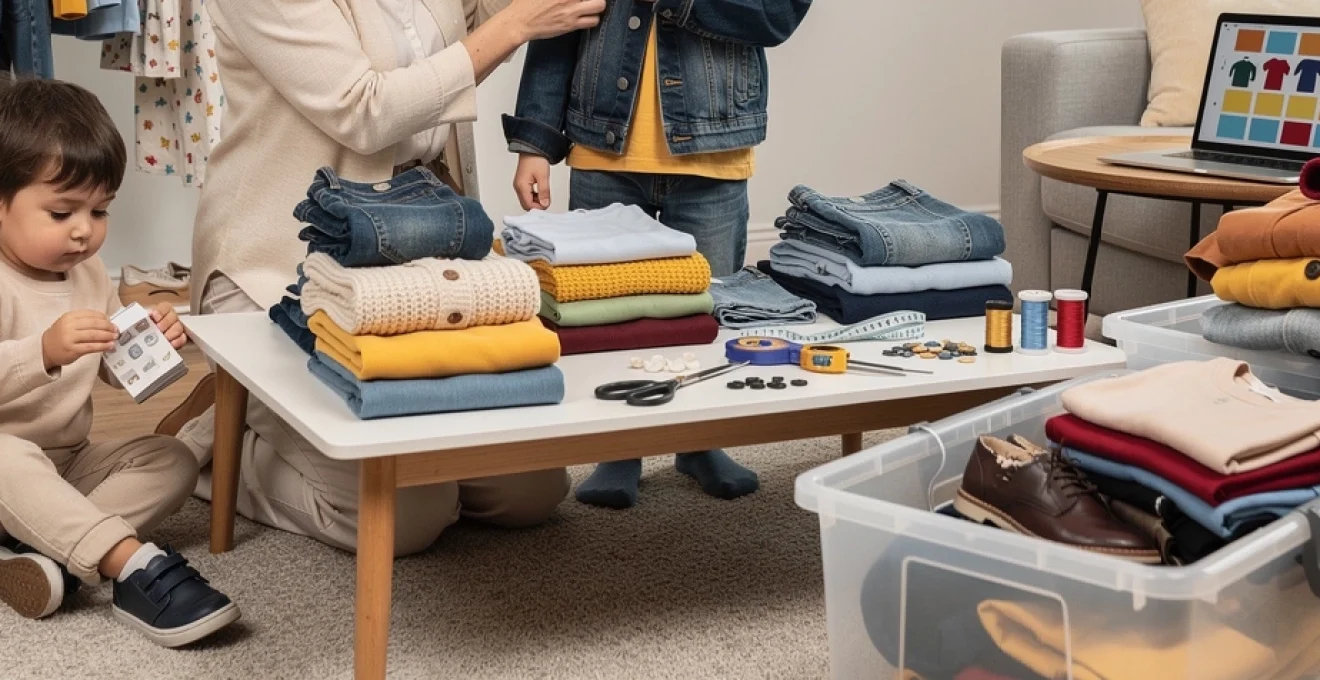
Consider purchasing versatile items like cardigans, jumpers, and jeans one size larger during sales periods. Adjustable features such as turn-up cuffs, drawstring waists, and expandable straps extend wearing periods and accommodate growth spurts. Storage organisation becomes crucial for this approach, requiring clearly labelled containers sorted by size and season to prevent forgotten purchases.
Investment prioritisation: core pieces vs. trend items
Strategic investment allocation maximises wardrobe value by identifying which items warrant higher spending and which can be purchased economically. Core pieces including coats, shoes, and school uniforms deserve investment due to their frequent use and visibility. These items endure heavy wear and require durability to maintain appearance throughout their wearing period.
Conversely, trend items, character clothing, and rapidly outgrown pieces like sleepwear represent opportunities for budget shopping. Fast fashion retailers and discount stores provide adequate quality for these temporary items. The investment ratio should approximately follow the 70/30 rule: 70% of the budget allocated to quality core pieces, 30% for trendy or temporary items.
Cost-effective shopping strategies and retail channel optimisation
Outlet store navigation: next clearance, M&S outlet, and TK maxx timing
Brick-and-mortar outlet stores remain one of the most effective ways to secure budget-friendly fashion for fast-growing children, provided you understand their stock cycles. Retailers such as Next Clearance, M&S Outlet, and TK Maxx typically receive new deliveries mid-week, with Wednesday and Thursday mornings offering the best selection before weekend traffic. Visiting at these times increases your chances of finding complete sizes and matching sets at significantly reduced prices.
Timing your visits around retail seasons further maximises savings. After major events such as back-to-school, Christmas, and the summer holidays, outlets receive large quantities of unsold stock from mainline stores. Parents who can plan one or two strategic shopping trips per season often secure high-quality items for 40–70% less than full RRP. To avoid impulse purchases, arrive with a clear list of required sizes and categories, focusing on wardrobe gaps rather than eye-catching bargains.
Online flash sale maximisation: zara kids, H&M, and ASOS strategies
For parents juggling work, school runs, and weekend activities, online flash sales provide a flexible way to source stylish, budget-friendly clothes for children. Brands such as Zara Kids, H&M, and ASOS frequently run short-term promotions, app-only discounts, and mid-season sales that can reduce prices by 20–60%. The key is to prepare in advance by creating wishlists in each account, so when a flash sale begins, you can purchase quickly before popular sizes sell out.
Newsletter subscriptions and app notifications offer a valuable early-warning system. Many retailers reward new subscribers with a one-off discount code, which can be reserved for higher-value items such as winter coats or school shoes. When a promotion launches, compare items across retailers in separate tabs to ensure you are genuinely securing the best deal. Combining discounts with free-delivery thresholds or click-and-collect options helps keep the total cost per item low, particularly when buying multiple sizes for future growth.
Second-hand market exploitation: vinted, depop, and local car boot sales
The pre-loved market has transformed how UK families manage children’s wardrobes, offering both sustainability and substantial savings. Platforms such as Vinted and Depop host thousands of listings for children’s clothing, many worn only a handful of times. By filtering searches by size, condition, and brand, you can build a high-quality wardrobe at a fraction of the original cost. Favour sellers with multiple listings in your child’s size to negotiate bundle deals and lower postage per item.
Local car boot sales, community nearly-new events, and school fundraising markets provide further opportunities to pick up bargains. Because prices are often negotiable, arriving early ensures access to the best items, while arriving towards the end can secure deeper discounts as sellers prefer not to take stock home. As with any second-hand purchase, inspect seams, zips, and knees for wear, and factor in a thorough wash before adding pieces to your child’s everyday rotation.
Subscription box economics: kidizen and boden mini analysis
Subscription and curated-box services promise convenience, but are they genuinely cost-effective for fast-growing children? Platforms like Kidizen (peer-to-peer resale with curated options) and premium brands such as Boden Mini’s bundles can work well if you understand their pricing models. Typically, you pay a fixed fee for a selection of items tailored to your child’s age, style, and size, often with the option to return what you do not need. The per-item price may be higher than bulk discount retailers, but you save time and benefit from carefully chosen pieces.
To assess value, calculate the effective cost per wear and compare against your usual spending patterns. If your child is in a rapid growth phase or particularly hard on clothes, you may prefer to reserve subscription services for occasional quality pieces rather than full wardrobes. Many families adopt a hybrid model: a subscription box once or twice a year to refresh core pieces, supplemented by second-hand finds and sale shopping to keep the overall budget balanced.
Fabric technology and durability assessment for high-wear items
Cotton-polyester blend performance in school uniforms
School uniforms are among the highest-wear items in any child’s wardrobe, often washed multiple times per week. Cotton-polyester blends have become the standard for polo shirts, trousers, and jumpers because they balance comfort with durability. A higher polyester content generally improves colourfastness and resistance to bobbling, while cotton maintains breathability and softness against sensitive skin. For most children, a 60/40 or 65/35 cotton-polyester blend offers an ideal compromise between comfort and longevity.
From a budget perspective, these blends usually deliver a lower cost per wear than 100% cotton alternatives, which can shrink and fade faster under frequent washing. When evaluating school uniform labels, look for descriptions such as easy-care, non-iron, and colour stay, all of which indicate fabric technologies designed for busy families. You may pay a small premium upfront, but reduced replacement frequency often offsets this within a single school year.
Elastane integration for extended fit longevity
Elastane (also known as Lycra or spandex) is a key ingredient in budget-friendly fashion for fast-growing children because it provides stretch without compromising shape. When integrated into jeans, leggings, and fitted tops, a small percentage of elastane (usually 2–5%) allows garments to adapt to height and weight changes over several months. This means your child can continue wearing the same pair of trousers as they grow taller, particularly when combined with adjustable waists and roll-up hems.
Think of elastane as a built-in “growth allowance” that helps garments flex with your child rather than against them. However, excessive elastane can reduce durability, especially in knees and seat areas exposed to constant movement. Look for a moderate stretch content in high-wear items, and consider reserving heavier-stretch fabrics for pieces like leggings and sportswear, where flexibility and comfort are more important than long-term structural rigidity.
Reinforcement techniques: knee patches and elbow guards
Knees and elbows are the first casualties in most children’s wardrobes. Reinforcement techniques, whether factory-applied or DIY, can significantly extend garment life. Many brands now incorporate double-layer knees in joggers and school trousers, or use heavier-weave fabric at stress points on jackets and hoodies. These subtle upgrades add months of wear, making them excellent choices when you are trying to keep clothing costs under control.
For items you already own, iron-on patches and sew-on knee guards provide a simple, cost-effective fix when holes appear. Rather than discarding an otherwise sound pair of trousers, a patch can transform them into designated “play clothes” for the park or garden. Over time, this approach builds a two-tier wardrobe system: smarter pieces reserved for school and outings, and reinforced pieces for messy activities, both delivering strong value for money.
Stain-resistant coating technologies in children’s casualwear
Spills and stains are inevitable, but modern fabric treatments can limit the damage. Many children’s casualwear ranges now feature stain-resistant or water-repellent coatings, often marketed as easy-clean or stay-clean. These technologies create a microscopic barrier on the surface of the fabric, causing liquids and dirt to bead rather than soak in. For everyday items such as school shirts, pinafores, and chinos, this can halve the number of garments lost to permanent staining.
While these coatings can gradually diminish with repeated washing, they still extend the functional life of garments, especially when combined with prompt stain treatment at home. When considering whether a stain-resistant item justifies a slightly higher price tag, compare how often you currently discard clothes due to stubborn marks. For children prone to spills or creative mess, stain-resistant technology often pays for itself within one term.
Alteration techniques and DIY modification strategies
Learning a few basic alteration skills can dramatically reduce how often you need to replace your child’s clothes. Simple modifications such as taking up or letting down hems, tightening waistbands, and replacing elastic can all be achieved with minimal equipment. For example, trouser legs can be initially hemmed slightly shorter with an invisible stitch, then unpicked and re-pressed as your child grows, gaining an extra season of wear from the same pair.
Elasticated waistbands are particularly forgiving for fast-growing children. If a waistband becomes too tight, inserting a small panel of elastic at the back can provide additional comfort. Conversely, if trousers or skirts start slipping, you can sew a few discreet tucks or add internal buttonhole elastic to adjust the fit. These alterations may take 10–15 minutes each but often save you from purchasing a new garment, especially for higher-priced items like formalwear or coats.
DIY modification also offers opportunities to refresh older pieces and keep fashion-conscious children engaged with their wardrobes. Adding iron-on patches, decorative badges, or contrast cuffs can transform a plain jumper or faded jeans into something unique. This not only extends garment life but also encourages children to value creativity over constant consumption. Why buy a new hoodie when you can update an existing one with a bold zip or colourful elbow patches?
Multi-child wardrobe systems and hand-me-down optimisation
For families with more than one child, a strategic hand-me-down system is one of the most powerful tools for maintaining a budget-friendly wardrobe. The aim is to build a shared clothing “pipeline” where quality items flow from older to younger siblings with minimal friction. To achieve this, prioritise gender-neutral basics wherever possible – think navy joggers, grey school jumpers, and striped tops that look equally appropriate on any child.
Organisation is crucial. Storing outgrown clothes in clearly labelled containers by size (and sometimes by season) ensures you can quickly locate what you need when the next child reaches that age. Many parents find it helpful to maintain a simple inventory list on paper or in a notes app, recording what is already in storage and which categories are lacking. This prevents overbuying and focuses your budget only on genuine gaps, such as winter coats or school shoes that rarely survive multiple children.
It is also important to be realistic about wear and tear. Not every item will be suitable as a hand-me-down, particularly if it has heavy pilling, stains, or broken fastenings that cannot be easily repaired. By reserving higher-quality brands and more durable fabrics for categories you know will be passed down, you create a tiered system where the best pieces enjoy two or three lives, while cheaper or delicate items serve a single child well before being responsibly recycled or donated.
Seasonal inventory management and storage solutions
Efficient seasonal management ensures that clothes are ready when your child needs them and that you are not buying duplicates due to disorganisation. At the start and end of each season, conduct a quick wardrobe audit: remove items that are too small, too worn, or weather-inappropriate, and assess what remains. This process need not be lengthy – 20–30 minutes per child is usually sufficient – but it provides clarity on which categories (for example, waterproofs or smart outfits) require attention.
Storage conditions have a direct impact on how well clothing survives between seasons or between children. Clean items thoroughly before storing to prevent stains setting and to discourage moths, then fold and place them in airtight plastic boxes or sturdy fabric storage bags. Labelling each container with size range and season (such as Age 3–4: Autumn/Winter) means you can retrieve the right box at a glance when the weather changes or a growth spurt hits.
Finally, consider creating a small “next size up” section within your child’s wardrobe or a dedicated box under the bed. This is where you keep sale purchases bought in advance, hand-me-downs waiting to be grown into, and any outlet or second-hand bargains you have collected. By rotating items from this holding area into active use as soon as they fit, you ensure that nothing languishes forgotten at the back of a cupboard – and every pound you spend on your fast-growing child’s wardrobe delivers maximum value.