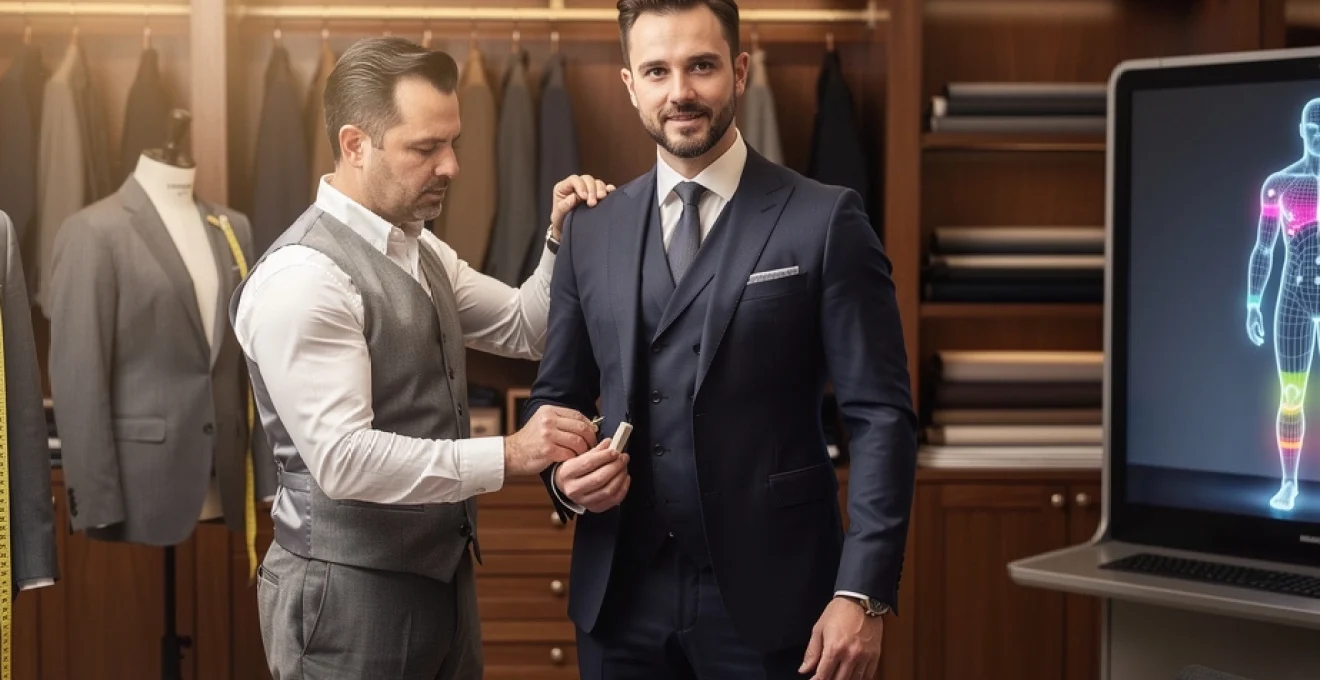
In the realm of menswear, the difference between looking well-dressed and appearing truly distinguished lies not in the price tag or brand name, but in how precisely a garment conforms to your body. Perfect fit serves as the foundation upon which all great style is built, transforming even modest pieces into statement garments whilst simultaneously making expensive clothing appear cheap when executed poorly. The art of achieving an impeccable silhouette combines centuries-old tailoring traditions with modern fitting techniques, creating garments that enhance your natural proportions and project confidence in every movement.
Understanding the nuances of proper fit extends far beyond simply ensuring sleeves aren’t too long or trousers aren’t too tight. It encompasses a comprehensive appreciation of how fabric interacts with the human form, how construction techniques influence drape, and how subtle adjustments can dramatically alter the visual impact of an ensemble. Whether you’re investing in bespoke tailoring or refining ready-to-wear pieces, mastering the principles of fit will elevate your appearance more effectively than any trending style or seasonal update.
Tailoring fundamentals: body measurements and garment construction
The foundation of exceptional fit begins with understanding the complex relationship between human anatomy and garment construction. Precise measurement techniques form the cornerstone of professional tailoring, yet many men underestimate the sophistication required to translate body dimensions into perfectly fitted clothing. Traditional measuring methods have evolved significantly, incorporating not just static measurements but dynamic assessments of how the body moves and changes throughout daily activities.
Essential body measurement points for precise fitting
Professional tailors recognise that the human body presents numerous measurement points, each critical to achieving optimal fit. The chest measurement, taken at the fullest part of the chest with arms relaxed, provides the foundation for jacket sizing. However, equally important is the natural waist measurement, taken at the narrowest point of the torso, which determines the degree of suppression achievable in a jacket’s silhouette. The shoulder measurement, extending from the prominent bone at the base of the neck to the shoulder point, establishes the jacket’s most critical dimension – one that cannot be significantly altered post-construction.
Neck measurements encompass both the collar size and the crucial back neck-to-waist length, which influences the jacket’s overall balance and posture. Arm measurements include not only the sleeve length from shoulder to wrist but also the bicep and forearm circumferences, ensuring comfort during movement whilst maintaining a clean line. Hip measurements affect both trouser fit and jacket length proportions, whilst thigh and seat measurements determine trouser comfort and drape through the leg.
Drop measurements and proportional analysis techniques
The drop measurement – the difference between chest and waist measurements – provides crucial insight into body type and determines the appropriate level of jacket suppression. A typical drop of 6-8 inches suits most men, whilst athletic builds may present drops of 10-12 inches, requiring specialised pattern adjustments to avoid unsightly pulling or bunching. Understanding these proportional relationships enables tailors to create garments that enhance natural physique whilst maintaining comfort and mobility.
Contemporary tailoring also considers shoulder slope, back posture, and arm positioning when creating patterns. Forward shoulder posture, common in modern professionals, requires adjustments to shoulder blade measurements and back balance. These considerations ensure that jackets hang naturally without pulling across the back or creating unsightly wrinkles at the shoulder blades.
Suppression methods in contemporary tailoring
Modern suppression techniques extend beyond traditional side seam adjustments to incorporate strategic seaming and darting throughout the garment. Centre back seams allow for significant waist suppression whilst maintaining clean side lines, particularly effective for men with pronounced drops. Side body pieces, common in high-end construction, enable more precise shaping through the torso whilst distributing suppression across multiple seams.
Advanced tailors employ varying degrees of suppression throughout the jacket’s length, creating subtle shape changes that enhance the wearer’s silhouette. The technique involves graduated suppression, beginning minimally below the armhole and increasing towards the natural waist before gradually reducing towards the jacket’s hem. This creates a natural, flowing line that avoids the artificial appearance of excessive suppression concentrated in a single area.
<h
Dart placement and seam allowance calculations
Whilst suppression distributes shaping along the length of the jacket, dart placement refines how that shaping interacts with specific body contours. Front darts, running from the chest toward the hem, help remove excess fabric over the waist and hips, creating a clean, sculpted line without pulling across the buttoning point. Side body darts, more common in higher-end and made-to-measure garments, allow tailors to fine‑tune fit over the ribcage and lower back, especially useful for men with prominent shoulder blades or a pronounced lower back curve.
Back darts are particularly effective for clients with a fuller seat or hollow back, allowing subtle contouring that prevents fabric from collapsing or pooling at the waistline. The position, length, and depth of these darts are determined by both body measurements and posture analysis rather than arbitrary aesthetic preference. When executed correctly, darts become almost invisible in wear, yet they play a decisive role in achieving a sharp, uninterrupted silhouette that follows the torso’s natural architecture.
Equally crucial is the calculation of seam allowances, which provide both structural integrity and future alteration capacity. In quality tailoring, seam allowances at critical points such as centre back, side seams, and trouser waistband are intentionally generous, often 1.5–3 cm, to allow for weight fluctuation and posture changes over time. This extra cloth is not a sign of imprecision; it is a deliberate investment in longevity and flexibility, ensuring the garment can be rebalanced rather than replaced as your body evolves.
Professional tailors also consider how seam allowances interact with fabric weight and construction method. Heavy flannels and tweeds, for instance, may require slightly wider allowances to prevent seam strain and to accommodate thicker pressing rolls, whereas lightweight tropical wools demand more conservative allowances to avoid bulk. By treating darts and seam allowances as a technical system rather than isolated details, expert makers create menswear that looks sharp on day one and can continue to fit beautifully for a decade or more.
Savile row standards: traditional british tailoring excellence
When we speak about the importance of fit in achieving a sharp appearance, nowhere are the principles more rigorously applied than on Savile Row. This small London street has set global benchmarks for precision cutting, structural elegance, and understated luxury for nearly two centuries. Each house maintains a distinctive silhouette and fitting philosophy, yet all share one conviction: fit is not negotiable. Studying these approaches gives you a clearer understanding of how different tailoring traditions can complement your own physique and style.
Whilst modern ready-to-wear often relies on generic size blocks, Savile Row tailors draft individual paper patterns that reflect your unique measurements, posture, and movement habits. The result is a spectrum of house styles—from sharply structured to softly draped—each engineered to achieve balance, proportion, and long‑term comfort. Whether you ever commission a bespoke suit or simply use these standards as a reference when buying off‑the‑rack, understanding Savile Row’s fit philosophy will sharpen your eye and raise your expectations.
Henry poole & co. house style and fitting philosophy
Henry Poole & Co., often credited as the founding house of Savile Row, is known for a classic, dignified silhouette that emphasises balance and restraint. Their cut typically features a moderately structured shoulder, clean chest, and gently suppressed waist, creating an impression of quiet authority rather than aggressive sharpness. The jacket length and button stance are carefully calibrated to divide the body into harmonious thirds, a proportion that flatters most men regardless of height or build.
From a fitting perspective, Henry Poole places particular importance on coat balance—the relationship between front and back lengths measured over the shoulder. This ensures the jacket neither kicks out at the back nor collapses at the front, even when you move, sit, or stand for extended periods. The chest canvas is shaped by hand to follow the ribcage rather than sit flat, allowing the fabric to drape smoothly without tension lines across the buttoning point.
The overall result is a suit that feels almost conservative at first glance but reveals its sophistication in motion. For men seeking a sharp appearance suitable for business, formal events, and long wear, this style offers an ideal benchmark: structured enough to project presence, yet restrained enough to remain relevant for many years. Even when purchasing ready‑to‑wear, looking for similar features—balanced length, moderate shoulder structure, and controlled waist suppression—can help you approximate the Henry Poole aesthetic.
Huntsman’s structured shoulder construction methods
At the opposite end of the Savile Row spectrum, Huntsman is admired for a more dramatic, equestrian‑inspired silhouette. Their signature look features a strong, roped shoulder, clean chest, and a long, lean jacket line that elongates the torso. This style is particularly effective for men wanting a powerful, razor‑sharp appearance, especially in formal or business‑driven contexts where authority and clarity of line matter.
The key to Huntsman’s impact lies in its shoulder construction. Layers of canvas, felt, and padding are sculpted by hand to build a clean, lifted shoulder line that visually broadens the upper body without appearing bulky. The armhole is cut relatively high, allowing the sleeve to move with the body whilst the coat remains visually stable. This combination creates that unmistakable “standing to attention” posture, even when you are simply walking or standing at ease.
Because of this engineered structure, Huntsman’s fitting process pays close attention to shoulder angle, neck point position, and sleeve pitch. Any mismatch between these elements can cause drag lines or restriction, which would undermine the intended sleekness. For men exploring structured ready‑to‑wear or made‑to‑measure, taking note of how the shoulder line sits—neither collapsing nor over‑extending—can help you identify garments that echo Huntsman’s refined precision.
Anderson & sheppard’s soft tailoring approach
Anderson & Sheppard represents a very different philosophy of fit: one that emphasises ease, drape, and natural movement. Often associated with the “London drape” cut, their tailoring features softer shoulders, a fuller chest, and subtle drape over the blade area, which allows the cloth to fall in gentle vertical lines rather than being stretched tightly across the torso. The result is a silhouette that looks relaxed yet impeccably composed, ideal for men who value comfort without sacrificing elegance.
This softer approach requires just as much technical precision as a structured cut. Anderson & Sheppard drafts patterns with extra cloth placed strategically over the chest and shoulder blades, then shapes that cloth through ironing and light canvasing rather than heavy padding. The higher armhole and fuller sleeve head give the wearer exceptional mobility, making the jacket feel more like a second skin than a rigid shell.
For modern professionals who move frequently between meetings, travel, and social engagements, this style of fit can be transformative. It demonstrates that a sharp appearance does not require tightness; instead, it relies on controlled fullness that flatters the body in motion. When trying on softly tailored pieces, look for garments that skim rather than grip, with vertical lines that remain clean even when you raise your arms or sit down.
Gieves & hawkes military-inspired precision cutting
Gieves & Hawkes integrates a long history of military tailoring into a distinctly modern, sharp aesthetic. Their suits typically feature a firm, slightly extended shoulder, a clean chest, and a pronounced waist, echoing the disciplined lines of dress uniforms. This military‑inspired fit is designed to straighten the wearer’s posture, creating a commanding presence that feels intentional rather than severe.
The cutting process emphasises symmetry and discipline in every seam. Lapels are drafted to sit close to the chest without gaping, the button stance is chosen to define the natural waist, and the skirt of the jacket is kept clean and controlled to avoid flaring. These details may sound minor, but together they produce that crisp, “inspection‑ready” look associated with ceremonial dress—translated into everyday suiting.
For men who appreciate a sharp, slightly formal look that still works in contemporary offices and events, Gieves & Hawkes offers a practical template. When evaluating similar ready‑to‑wear garments, examine how the lapels lie, whether the waist feels neatly drawn in yet comfortable, and whether the skirt of the jacket hangs straight without twisting. These cues will help you identify pieces that borrow from this precise, military‑influenced approach to fit.
Contemporary menswear brands and fit innovation
Whilst Savile Row sets the gold standard for bespoke fit, contemporary menswear brands have been quietly revolutionising how sharp clothing is designed, graded, and delivered. Advances in pattern‑cutting software, consumer data, and 3D modelling allow modern labels to refine their size blocks and offer more targeted fits across body types. Instead of a single “regular” cut, you now see slim, athletic, and relaxed variations—each engineered around specific body proportions rather than just scaled measurements.
Many direct‑to‑consumer brands have built their reputation on fit consistency, using customer feedback and return data to continually adjust key measurements like rise, thigh width, and shoulder span. This data‑driven approach means you can often find off‑the‑rack garments that come surprisingly close to made‑to‑measure precision, particularly in core items such as chinos, denim, and knitwear. Some labels even combine online fit quizzes with algorithm‑driven recommendations, helping you identify the best cut for your frame before you purchase.
At the higher end, luxury brands have begun integrating 3D body scans and virtual avatars during product development, testing how garments sit on a wide range of physiques before they ever reach the shop floor. This reduces the guesswork in fit grading and helps minimise common fit issues like collar gaps, seat strain, or twisted sleeves. For the modern man, this means more choice, fewer compromises, and a better chance of finding pieces that contribute to a consistently sharp wardrobe without the need for full bespoke.
Fabric drape and structure impact on silhouette
Even the most carefully drafted pattern can only achieve its full potential if the chosen fabric supports the intended silhouette. Fabric drape—how cloth falls and moves—plays a pivotal role in how sharp or relaxed a garment appears. A heavy worsted wool with firm body will hold crisp lines and sharp creases, ideal for business suits and formal tailoring. In contrast, a lightweight linen or soft flannel will follow the body’s contours more fluidly, creating a softer, more casual impression.
Think of fabric like the paper in architectural drawing: you can sketch the same design on tissue paper or card stock, but the end result will behave very differently in three dimensions. Structured fabrics such as cavalry twill, high‑twist wool, or dense cotton drills are excellent for creating clean trousers and jackets that resist wrinkling and maintain strong visual lines throughout the day. These are the workhorses of a sharp wardrobe, particularly if you spend long hours seated or moving between meetings.
Softer, more fluid fabrics—cashmere blends, brushed flannels, lightweight linens—excel at comfort and visual richness but require more sophisticated pattern work to prevent sagging or collapsing. Tailors may add internal structure through canvases and interlinings, or they may intentionally cut with extra drape in the chest and back to allow the fabric to move gracefully. When you try on a garment, notice not just how it fits but how it hangs: does the cloth form clean vertical lines, or does it cling and crease unpredictably?
For men building a versatile wardrobe with a consistently sharp appearance, the key is to match fabric drape to the garment’s purpose. Structured worsteds and high‑twist wools are ideal for formal suits and office wear; mid‑weight cottons and wool‑blend jerseys suit smart‑casual pieces like chinos and blazers; softer fabrics can be reserved for less formal settings where comfort and texture take precedence. Understanding this relationship between cloth and cut helps you choose garments that not only fit in theory but perform beautifully in real life.
Professional alterations techniques for optimal fit
Even with the best intentions, off‑the‑rack garments rarely fit perfectly straight from the hanger. Professional alterations bridge the gap between standardised production and your individual proportions, often transforming a good purchase into a great one. The goal is not to reinvent the garment but to refine key points—shoulders, waist, sleeves, and trousers—so the overall silhouette appears intentional, balanced, and clean.
Understanding what can and cannot be altered cost‑effectively empowers you to shop more strategically. Shoulder width and jacket length are difficult and expensive to correct, so these should be close from the outset. In contrast, taking in the waist, adjusting sleeve length, or tapering trousers are straightforward modifications that most competent tailors can handle with precision. By combining smart buying decisions with focused alterations, you can achieve a near‑bespoke level of sharpness from ready‑to‑wear pieces.
Shoulder line adjustments and armhole modifications
The shoulder line is the visual anchor of any tailored garment, so even minor adjustments here have a disproportionate effect on your overall sharpness. Ideally, the jacket shoulder should end where your natural shoulder bone does, with the sleeve head falling straight down rather than collapsing or extending beyond. If the shoulder is slightly too wide, a skilled alterations tailor can sometimes reduce it by trimming and reattaching the sleeve, though this is a complex and costly procedure best reserved for high‑quality pieces.
Armhole modifications are less visible but equally critical to comfort and mobility. A higher armhole, counter‑intuitively, usually allows for better range of motion, as the coat moves with your arm rather than pulling across the chest. However, raising an armhole after construction is technically demanding, as it requires reshaping both the armhole and sleeve head. When considering a jacket, it is wise to choose one with an armhole height that already suits your build, using alterations only for subtle refinements rather than major surgery.
In some cases, minor shoulder pitch adjustments—rotating the sleeve to match forward or backward shoulder posture—can eliminate drag lines and improve how the sleeve hangs. This is particularly relevant for men who spend many hours at desks and have developed a forward‑rolled posture. Whilst not every alterations shop offers this level of work, knowing that such corrections exist allows you to seek out specialists when you want a truly sharp, anatomically correct fit.
Trouser break length and leg tapering methods
Trousers play a larger role in a sharp appearance than many men realise. The trouser break—how much fabric rests on the shoe—significantly affects how long and clean your legs appear. A classic full break creates a pronounced fold above the shoe, sometimes suited to very traditional or conservative dress. A half break offers a modern balance, with a slight touch of fabric on the front of the shoe and a clean line at the back. A no‑break or slight crop gives a contemporary, fashion‑forward look, particularly flattering on slimmer builds.
Adjusting the hem is one of the simplest and most affordable alterations. A tailor can shorten the trousers to your desired break, occasionally adding or removing a cuff depending on your preference and the garment’s style. The key is consistency: all your dress trousers should ideally share a similar break, so your overall wardrobe appears intentional rather than haphazard.
Leg tapering is another powerful tool for refining fit. Many ready‑to‑wear trousers are cut generously through the thigh and calf to accommodate a broad customer base. A tailor can narrow the leg from the knee down (and sometimes slightly through the thigh) to create a more streamlined line without compromising comfort. The aim is not to create skin‑tight trousers, but to follow the natural shape of your leg so excess fabric doesn’t bunch or flap when you walk. When done well, leg tapering instantly sharpens your silhouette and pairs effortlessly with both formal shoes and clean sneakers.
Waist suppression in suit jackets and blazers
Waist suppression—the gentle narrowing of the jacket at the midsection—is one of the most effective alterations for improving your overall shape. A straight, boxy jacket can make even a fit man appear wider and less defined, whereas a subtly suppressed waist creates an athletic V‑shape, broadening the shoulders visually and slimming the torso. The goal is to follow your natural waist, not to force an exaggerated hourglass line that strains the buttons or pulls the vents.
Most jackets have sufficient seam allowance at the side seams or centre back to allow them to be taken in by 2–4 cm in total. During a fitting, your tailor will pin along these seams while you stand naturally and move your arms, ensuring that the new shape is both flattering and functional. It is important to test sitting and reaching forward; if the jacket feels restrictive or the vents pull apart excessively, the suppression may be too aggressive.
For men with a more substantial midsection, waist suppression can still be helpful, but it must be applied with care. Sometimes the more flattering choice is to create a gently shaped column rather than a sharply nipped waist, maintaining clean vertical lines that visually elongate the body. In all cases, you want the jacket to close comfortably without strain—remember that sharpness comes from controlled structure, not from tightness.
Sleeve length precision and button stance positioning
Sleeve length is one of the quickest visual indicators of whether a garment truly fits. In classic menswear, the jacket sleeve should end at the wrist bone, allowing around 0.5–1.0 cm of shirt cuff to show. Too long and the arms appear shortened and sloppy; too short and the jacket looks as though it has been outgrown. Fortunately, sleeve length adjustments are usually straightforward, especially when shortening from the cuff rather than the shoulder.
Complications arise when functioning buttonholes—often called “surgeon’s cuffs”—are present. Shortening sleeves significantly from the cuff can distort the spacing and position of these buttonholes, requiring more advanced work from the shoulder end instead. When buying jackets with working cuffs, it is wise to ensure the sleeves are already close to your ideal length, leaving only minor refinements for the tailor.
Button stance—the height of the primary fastening button—also shapes how your torso is perceived. A higher button stance can shorten the torso visually and emphasise the chest, while a lower stance lengthens the body and can appear more relaxed. On ready‑to‑wear, changing button stance is rarely practical, as it affects the roll of the lapel and the internal canvasing. However, understanding its importance helps you choose jackets that naturally align with your proportions: if you have a long torso, a slightly higher button stance may balance your frame; if you are shorter, a moderate or lower stance can help create the illusion of height.
Digital fit technology and 3D body scanning
The future of achieving a sharp appearance is increasingly shaped by digital fit technology. 3D body scanning, once confined to research labs and high‑end tailoring houses, is now accessible through specialised studios and even smartphone‑based apps. These systems capture hundreds of data points—from chest and waist circumference to shoulder slope and posture alignment—in a matter of seconds, generating a detailed digital avatar that can be used to design or adjust garments with remarkable precision.
For brands, this technology reduces guesswork in pattern development and size grading. Designers can test how a suit, shirt, or coat behaves on a range of realistic body shapes before any physical samples are produced, adjusting key dimensions to improve comfort and appearance. Industry reports suggest that accurate digital fitting can cut sample iterations by more than half and significantly reduce return rates, which are often driven by dissatisfaction with fit rather than style.
For you as a wearer, 3D scanning and virtual try‑on tools promise a more personalised, confident shopping experience. Instead of relying solely on size labels, you can receive recommendations tailored to your specific build and fit preferences—slim, regular, or relaxed—directly from your scan data. Some innovators even combine these scans with machine‑learning algorithms, learning from your feedback over time to refine future suggestions. It is akin to having a digital fitter who remembers every detail about how you like your clothes to sit.
Of course, technology is not a complete replacement for skilled human tailoring, particularly when it comes to nuances like fabric behaviour, pressing, and hand shaping. Yet, when digital tools and traditional craftsmanship work together, the results can be exceptional: patterns drafted from scans, refined by eye, and then adjusted through physical fittings. As these technologies continue to mature, the ideal of consistently sharp, individually tuned fit will become accessible to more men than ever before—whether through bespoke, made‑to‑measure, or highly optimised ready‑to‑wear.