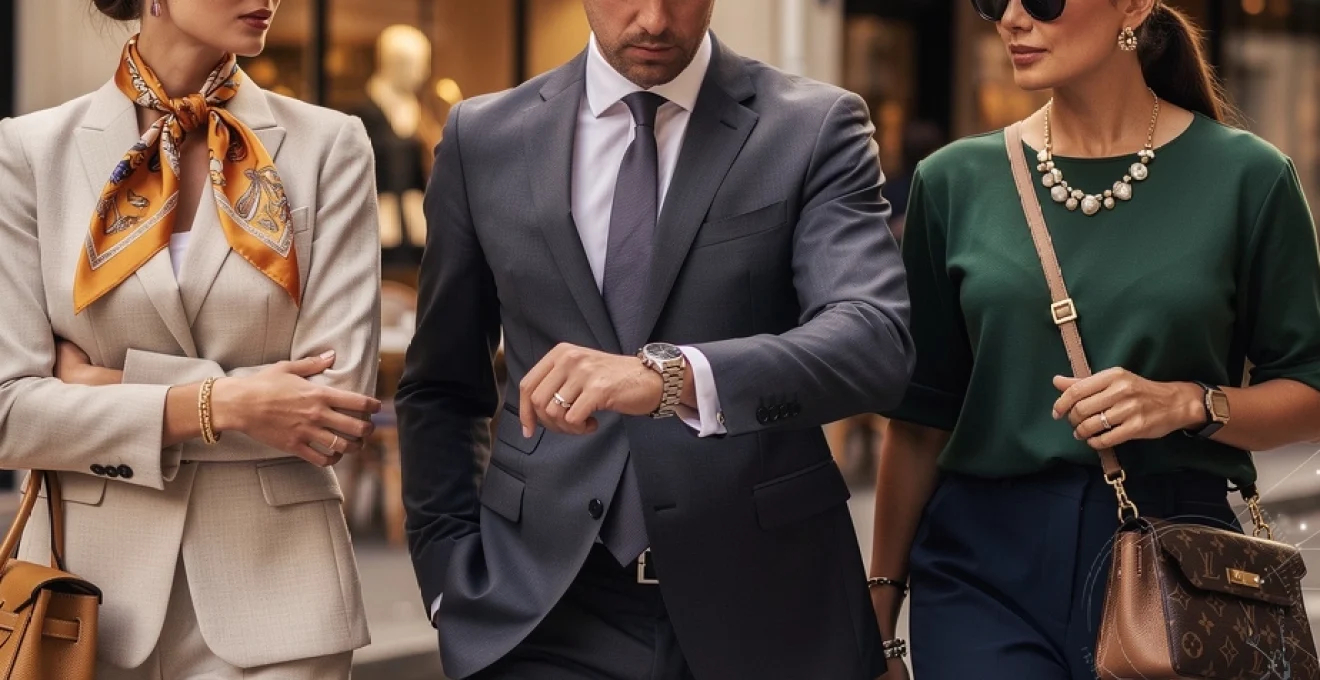
Luxury accessories have transformed from mere status symbols into powerful tools of personal expression and psychological empowerment. The influence of a Hermès Birkin bag, a Cartier timepiece, or Louboutin shoes extends far beyond their material worth, shaping not only how others perceive us but fundamentally altering how we perceive ourselves. When you incorporate luxury accessories into your daily wardrobe, you’re engaging in a complex psychological and social exchange that affects confidence levels, professional interactions, and personal identity formation. This phenomenon has evolved significantly in recent decades, with luxury brands increasingly focusing on accessible accessories that allow broader demographic participation in luxury culture.
The relationship between luxury accessories and everyday styling operates on multiple interconnected levels, from the neurochemical responses triggered by wearing prestigious items to the sophisticated craftsmanship techniques that create lasting aesthetic impact. Understanding these mechanisms reveals why a carefully selected luxury accessory can transform a simple outfit into a statement of sophistication and cultural awareness. The investment in luxury accessories represents more than mere consumption; it constitutes a strategic approach to personal branding and cultural capital accumulation that influences professional opportunities, social positioning, and long-term wardrobe value.
Psychological foundations of luxury accessory impact on personal style expression
Veblen’s conspicuous consumption theory in contemporary accessory selection
Thorstein Veblen’s seminal work on conspicuous consumption continues to provide crucial insights into modern luxury accessory selection patterns. When you choose to wear a recognisable luxury watch or carry a designer handbag, you’re participating in what Veblen identified as the deliberate display of economic capability through consumption choices. This behaviour extends beyond simple showing off; it represents a sophisticated form of social communication that establishes group membership and individual positioning within complex social hierarchies.
Contemporary research demonstrates that luxury accessory consumption triggers measurable neurological responses, including increased dopamine production and enhanced self-perception scores. These physiological changes directly influence posture, vocal patterns, and social interaction confidence levels. The phenomenon explains why wearing luxury accessories often results in improved professional performance and more positive social reception, creating a self-reinforcing cycle of enhanced confidence and social validation.
Symbolic interactionism and brand identity communication through hermès scarves
Hermès scarves exemplify how luxury accessories function as sophisticated communication tools within symbolic interactionist frameworks. Each scarf design carries specific cultural references, artistic collaborations, and historical significance that communicate the wearer’s cultural literacy and aesthetic sophistication. When you incorporate an Hermès scarf into your daily styling, you’re engaging in complex visual storytelling that conveys messages about travel experiences, artistic appreciation, and cultural capital accumulation.
The versatility of luxury scarves demonstrates how single accessories can adapt to multiple styling contexts whilst maintaining their symbolic power. Research indicates that individuals who regularly incorporate luxury scarves into their wardrobes report increased confidence in professional settings and enhanced sense of personal style coherence. This effect stems from the accessory’s ability to elevate simple garments whilst providing a consistent element of refinement across different outfit combinations.
Cognitive dissonance reduction in High-End purchase justification behaviours
The psychological process of justifying luxury accessory purchases reveals fascinating insights into human decision-making and value attribution. When faced with the significant financial investment required for luxury accessories, consumers engage in cognitive dissonance reduction strategies that emphasise quality, longevity, and cost-per-wear calculations. These mental processes often result in more thoughtful consumption patterns and increased attachment to purchased items.
Studies demonstrate that individuals who successfully justify luxury accessory purchases through quality and craftsmanship arguments exhibit greater satisfaction and more frequent usage patterns compared to those motivated purely by status considerations. This psychological framework explains why luxury accessories often become central elements of personal style identity, as the mental investment in justification creates deeper emotional connections to the items.
Social identity theory applications in luxury handbag ownership patterns
Luxury handbags serve as particularly potent symbols within social identity theory frameworks, offering insights into group membership aspirations and individual positioning strategies. The choice between different luxury handbag brands communicates specific values and group affiliations: Chanel suggests classic sophistication, Balenciaga implies contemporary edge, whilst Bottega Veneta conveys understated luxury appreciation.
Research into handbag ownership
Research into handbag ownership consistently shows that consumers use brand, size, and model choice to align themselves with desired reference groups. Owning a Lady Dior, a Gucci Jackie, or a Telfar Shopping Bag sends different signals about political awareness, aesthetic leanings, and socio-economic aspirations. Over time, these ownership patterns reinforce in-group belonging, as you tend to recognise and gravitate toward others whose luxury accessories mirror your own identity narrative.
Maslow’s hierarchy implementation through cartier and tiffany & co. status signalling
Maslow’s hierarchy of needs provides a powerful lens for understanding why luxury accessories like Cartier bracelets or Tiffany & Co. necklaces exert such influence on everyday styling. At the basic level, accessories fulfil functional needs—timekeeping, securing garments, protecting eyes from sunlight. Yet as you move up the hierarchy, these same items begin addressing psychological and self-actualisation needs: esteem, belonging, and self-expression.
Cartier’s Love bracelet or Tiffany’s Return to Tiffany collection operate as tangible markers of esteem and recognition, often connected to life milestones such as graduations, promotions, or relationship commitments. Wearing these pieces daily reinforces both internal and external perceptions of achievement, helping satisfy Maslow’s esteem needs through visible status signalling. At the highest level, when selected for personal meaning rather than pure status, such accessories contribute to self-actualisation by aligning your outward appearance with your internal values and aspirations, turning everyday outfits into curated reflections of personal growth.
Material science and craftsmanship techniques elevating daily wardrobe aesthetics
Italian leather processing methods in bottega veneta intrecciato weaving impact
The tactile pleasure and visual depth of Italian leather play a crucial role in how luxury accessories transform simple outfits. Bottega Veneta’s iconic intrecciato weaving technique, developed in the late 1960s, illustrates how material science and artisanal skill converge to elevate everyday styling. By using thinner, high-quality hides and weaving them into a tight lattice, artisans increase both flexibility and tensile strength, producing bags and belts that drape softly yet resist deformation.
From a styling perspective, the intrecciato surface behaves almost like fabric, catching light in subtle gradients rather than harsh reflections. This soft visual texture pairs seamlessly with minimalist wardrobes, adding depth to monochrome looks or neutral capsule collections. Because the weave distributes stress across multiple leather strips, these accessories age gracefully, acquiring a patina that enhances rather than diminishes their aesthetic impact. For daily wear, this means your favourite Bottega Veneta bag or wallet not only withstands frequent use but gradually becomes more visually interesting, anchoring even the most understated outfits.
Swiss horological complications in patek philippe daily wear integration
Swiss watchmaking showcases how technical precision can become a central stylistic element in luxury accessory design. Patek Philippe, renowned for its horological complications—perpetual calendars, moon phases, world time functions—transforms engineering achievements into wearable jewellery that quietly enhances everyday looks. While many owners rarely use every function, the mere presence of these complications signals a deep appreciation for craftsmanship and mechanical intelligence.
Integrating a Patek Philippe into daily styling shifts the focal point of an outfit from clothing to wrist. A simple navy blazer and white shirt ensemble, for instance, reads very differently when paired with a Calatrava versus a Nautilus. The former communicates classic understatement; the latter suggests contemporary success and global mobility. Interestingly, studies on workplace perception indicate that a refined mechanical watch correlates with higher ratings of reliability and competence, meaning that your choice of horological accessory subtly influences how colleagues and clients interpret your professionalism.
Precious metal alloy compositions in bulgari serpenti collection durability
Behind the visual drama of Bulgari’s Serpenti jewellery and watches lies advanced knowledge of precious metal alloys. Pure gold (24k) is too soft for daily wear, so luxury houses develop proprietary blends—typically 18k gold mixed with copper, silver, palladium, or other metals—to balance colour, hardness, and resistance to abrasion. Bulgari’s warm rose gold and luminous yellow tones result from finely calibrated alloy recipes that maintain richness of hue while withstanding everyday impact.
For accessories like Serpenti bracelets and watches that coil around the wrist and flex with movement, alloy elasticity and memory are critical. The metal must bend repeatedly without cracking yet retain its original shape, a requirement addressed through specific heat treatments and carefully controlled rolling processes. For you as the wearer, this translates into jewellery that can be integrated into daily styling without constant concern for damage. The structural integrity of these alloys allows Serpenti pieces to function as signature accessories—worn with everything from knitwear to evening dresses—without losing their sculptural definition or surface brilliance over time.
Silk fibre treatment processes in chanel camellia motif preservation
Silk accessories demonstrate how micro-level fibre treatments can have macro-level effects on style longevity. Chanel’s camellia-adorned silk pieces, from brooches to scarves, rely on carefully processed mulberry silk whose fibres have been degummed, dyed, and finished to balance softness with structural stability. Enzymatic and mechanical treatments remove sericin (the natural gum) while preserving fibroin, the protein that gives silk its characteristic sheen and tensile strength.
To maintain the crisp geometry of camellia petals or the clean drape of a silk scarf in daily wear, Chanel employs specific finishing techniques such as light calendaring, heat setting, and sometimes invisible backing. These processes help the accessory resist deformation from humidity, friction, and repeated folding. As a result, when you knot a Chanel scarf around your neck or loop it through a handbag handle, it retains its graphic clarity and lustre, consistently elevating casual outfits. The science behind fibre treatment ensures that these delicate-looking accessories can sustain frequent use whilst preserving the brand’s iconic visual codes.
Cultural capital accumulation through strategic accessory investment portfolios
Bourdieu’s distinction theory in louis vuitton monogram recognition systems
Pierre Bourdieu’s theory of distinction explains how taste operates as a form of social currency, and luxury accessories are among its most visible manifestations. The Louis Vuitton monogram functions as a recognition system that instantly communicates familiarity with specific cultural codes. Yet, as monogrammed pieces become more widespread, distinction shifts from mere logo visibility to nuanced knowledge of limited editions, archival reissues, and subtle design changes.
For instance, understanding the historical difference between the classic Speedy, the Alma, and contemporary collaborations (such as those with artists like Yayoi Kusama) allows you to curate an accessory collection that signals not just purchasing power but informed discernment. In everyday styling, carrying a rare or vintage LV piece operates like speaking a sophisticated dialect within the broader language of luxury fashion. It tells those « in the know » that your relationship with luxury accessories is rooted in cultural literacy rather than superficial trend following.
Cross-cultural luxury perception studies of rolex submariner global appeal
The Rolex Submariner offers a compelling case study in cross-cultural luxury perception. Originally designed as a professional dive watch, it has evolved into a near-universal symbol of success, recognised from New York to Nairobi. Consumer behaviour studies show that, across diverse markets, the Submariner is associated with reliability, achievement, and understated authority, making it one of the most effective luxury accessories for bridging cultural style norms.
When integrated into everyday styling, the Submariner’s versatility allows it to pair with business suits, smart-casual chinos, or even technical outerwear without visual dissonance. This adaptability reinforces its global appeal: the watch does not overpower an outfit but quietly upgrades it, functioning as a shared visual shorthand for competence and stability. For professionals who travel or operate in international environments, such a cross-culturally legible accessory can ease first impressions and foster instant credibility.
Generational wealth transfer patterns in van cleef & arpels alhambra collections
Van Cleef & Arpels’ Alhambra collection illustrates how luxury accessories become vehicles for generational wealth transfer and intergenerational identity. The clover motif, introduced in 1968, has remained remarkably consistent, allowing mothers, daughters, and grandmothers to share a visual language of luck, elegance, and continuity. In many families, Alhambra necklaces, bracelets, or earrings are gifted at life milestones and later passed down, accumulating emotional and financial value.
This continuity shapes everyday styling across generations. A young professional might layer an inherited mother-of-pearl Alhambra pendant with contemporary pieces, blending heritage with modernity. The accessory becomes a portable archive of family history and social ascent, contributing to Bourdieu’s concept of embodied cultural capital. Because Alhambra designs remain recognisable yet discreet, they integrate effortlessly into daily wardrobes, allowing wearers to signal both lineage and taste without ostentation.
Educational institution networking through goyard trunk heritage symbolism
Goyard’s history as a trunk-maker for aristocrats and world travellers imbues its modern totes and briefcases with dense symbolic capital. Among alumni networks of elite educational institutions, a Goyard Saint Louis or Saigon bag often functions as a subtle badge of shared values: discretion, heritage appreciation, and global mobility. Unlike heavily logoed pieces, Goyard’s hand-painted chevron pattern requires a certain level of familiarity to recognise, reinforcing in-group boundaries.
In practical terms, carrying a Goyard work bag to conferences, alumni events, or co-working spaces sends a layered message: you value craftsmanship, understand niche luxury, and likely move within specific social and professional circles. Over time, such accessories become tools of networking, sparking conversations with others who share similar reference points. In everyday styling, a Goyard piece elevates even casual academic or creative uniforms—think dark denim, knitwear, and simple shirts—by adding a historical and cultural dimension that pure clothing cannot convey alone.
Digital fashion technology integration in luxury accessory authentication systems
The rapid expansion of the resale and grey markets has pushed luxury houses to integrate advanced digital technologies into accessory authentication. Today, brands experiment with NFC chips, blockchain-based certificates, and micro-tagging systems embedded in handbags, watches, and even shoe soles. These invisible layers of data function like digital passports, recording origin, ownership history, and service interventions, which can be verified via dedicated apps or brand platforms.
For everyday styling, this technological shift has two key implications. First, it increases your confidence when purchasing pre-owned luxury accessories, encouraging more sustainable consumption and enabling you to rotate pieces without sacrificing authenticity assurance. Second, it subtly enhances the experiential aspect of ownership: scanning your Hermès bag or Hublot watch to access its digital archive creates a sense of ongoing interaction with the brand. As augmented reality try-on tools and virtual showrooms evolve, we can expect luxury accessories to exist simultaneously in physical and digital wardrobes, allowing you to test styling combinations virtually before committing in real life.
Seasonal adaptability mechanisms in high-end accessory styling methodologies
One of the reasons luxury accessories exert such strong influence on everyday styling lies in their seasonal adaptability. A well-chosen accessory acts like a hinge between wardrobes, helping you transition seamlessly from winter to spring or office to holiday. Consider a Burberry cashmere scarf: in colder months it functions as a practical layer over wool coats, while in milder weather it can be draped over shoulders with a trench or even styled as a shawl for evening events.
High-end styling methodologies often rely on what we might call « modular luxury »—pieces that work across multiple climates and contexts. Neutral leather handbags, classic watches, and fine jewellery rarely look out of place, regardless of season. You can amplify their relevance by adjusting surrounding elements: pairing a Rolex with linen shirts and loafers in summer, then with turtlenecks and tailored coats in winter. This strategic rotation maximises cost-per-wear and keeps your style coherent year-round, even as specific garments enter and exit your closet.
Investment performance analytics of luxury accessories in resale market valuations
The investment dimension of luxury accessories has become increasingly prominent, with specialised indices now tracking the performance of categories such as watches, handbags, and fine jewellery. Over the last decade, certain Hermès Birkin and Kelly models, for example, have reportedly outperformed traditional asset classes, appreciating at annual rates exceeding 10–14% in some periods. Similarly, iconic Rolex and Patek Philippe references have seen sustained demand on the secondary market, often trading above retail for sought-after configurations.
For everyday styling, understanding these dynamics encourages more analytical decision-making. Instead of impulsively buying trend-driven pieces, you can build an accessory portfolio that balances emotional appeal with potential resale strength. Factors such as brand heritage, model scarcity, condition, and completeness of original packaging all influence long-term value. By tracking auction results and reputable resale platforms, you gain insight into which accessories function as wearable assets rather than depreciating purchases.
Of course, not every luxury accessory should be approached as an investment; sentiment and self-expression remain central. Yet when you align your personal taste with models that historically hold or increase their value, your daily outfits benefit twice. You enjoy the confidence and aesthetic uplift of wearing exquisite accessories, while also maintaining optionality: the ability to resell or trade up in the future as your lifestyle and style preferences evolve. In this sense, strategic luxury accessory ownership transforms your wardrobe into a dynamic, semi-liquid portfolio that supports both your financial and sartorial objectives.