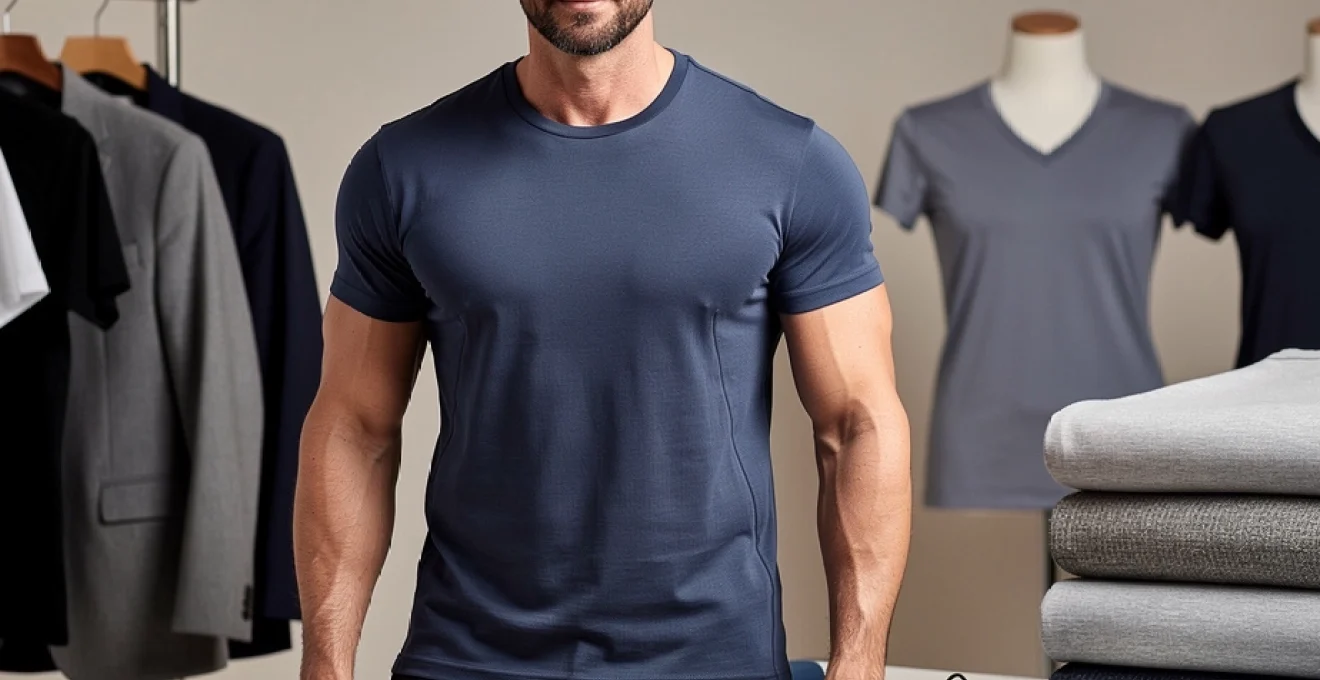
The fitted T-shirt has transcended its humble origins as an undergarment to become one of the most indispensable pieces in contemporary menswear. Unlike its baggy predecessors that dominated the 1990s and early 2000s, today’s fitted T-shirt represents a perfect marriage of comfort, style, and versatility. This evolution reflects changing attitudes towards masculine fashion, where sharp tailoring meets everyday practicality. The modern fitted T-shirt delivers a clean silhouette that flatters the male physique whilst maintaining the casual ease that makes it suitable for everything from weekend errands to smart-casual office environments. Its enduring popularity stems from its ability to serve as both a standalone piece and a foundational layer within sophisticated layering systems.
Anatomical design features that define the fitted T-Shirt silhouette
The distinction between a standard T-shirt and a fitted variant lies in precise engineering that follows the natural contours of the male torso. Modern fitted T-shirts employ sophisticated pattern-making techniques that create a streamlined appearance without sacrificing comfort or movement. These garments typically feature a closer cut through the body, strategically placed seams, and carefully calculated proportions that enhance the wearer’s physique. The result is a garment that appears tailored whilst retaining the inherent comfort associated with casual wear.
Tailored side seam construction for enhanced body contouring
Traditional T-shirts often feature straight side seams that create a boxy silhouette, but fitted variants incorporate curved or angled seams that follow the natural V-shape of the male torso. This construction technique involves creating a subtle taper from the chest to the waist, which helps define the wearer’s shape without creating an overly tight fit. Premium fitted T-shirts employ side seam placement that sits slightly forward on the torso, creating a three-dimensional shape that accommodates movement whilst maintaining visual appeal.
Strategic shoulder seam placement and armhole engineering
The shoulder seam placement in a fitted T-shirt requires meticulous attention to ensure both comfort and aesthetic appeal. The ideal shoulder seam should sit precisely at the end of the shoulder bone, creating a clean line that enhances the wearer’s natural shoulder width. Advanced armhole engineering involves creating a higher armhole that reduces fabric bulk under the arms whilst maintaining sufficient ease for movement. This technical approach prevents the common issue of excess fabric pooling around the armpit area, which can detract from the garment’s sleek appearance.
Graduated hem tapering techniques for modern fit profiles
Contemporary fitted T-shirts often incorporate subtle hem tapering that creates a gentle curve rather than a straight line across the bottom edge. This technique, known as graduated hemming, helps the garment maintain its shape when worn and prevents the bunching that can occur with traditional straight hems. The hem length itself becomes crucial in fitted designs, typically sitting at the optimal point between the waist and hip to create the most flattering proportions for various body types.
Neckline architecture: crew neck versus V-Neck proportional dynamics
The neckline construction in fitted T-shirts requires careful consideration of both aesthetics and functionality. Crew neck designs typically feature a higher, closer-fitting collar that frames the neck without appearing restrictive. The rib construction around the neckline must maintain its shape over time whilst providing enough stretch for comfortable wear. V-neck variants demand precise angle calculations to create a flattering neckline that doesn’t appear too deep or shallow for the intended fit profile. The collar itself becomes a design element that contributes to the overall sophistication of the garment.
Premium fabric technologies driving fitted T-Shirt performance
The success of a fitted T-shirt depends heavily on fabric selection and construction methods that provide the right balance of structure, comfort, and durability. Modern textile technologies have revolutionised how these garments perform, offering enhanced properties that were previously impossible to achieve. Premium fitted T-shirts now incorporate advanced fabric blends and construction techniques that ensure the garment maintains its shape and appearance even after extensive wear and washing.
Pima cotton weaving techniques for durability and drape
Pima
Pima cotton is renowned for its extra-long staple fibres, which can be spun into finer, stronger yarns than conventional cotton. In a fitted T-shirt, this translates into a fabric that drapes cleanly over the torso, following the body’s lines without clinging or losing its shape. High-quality jersey knits made from Pima cotton resist pilling, maintain surface smoothness, and offer a subtle sheen that instantly elevates a simple outfit. For men seeking a fitted T-shirt that can handle frequent wear, Pima’s superior tensile strength means fewer distortions at the neckline, hem, and side seams over time.
From a comfort perspective, Pima cotton delivers an exceptionally soft hand-feel that improves with washing, rather than degrading. This makes it ideal for men with sensitive skin or those who wear fitted T-shirts as their primary base layer throughout the week. Because Pima fibres are longer and more uniform, they create fewer loose ends within the fabric, reducing irritation and friction against the skin. When you combine this with a well-engineered fitted pattern, you get a T-shirt that feels almost second-skin while still looking sharp and structured.
Bamboo-modal blends: moisture-wicking properties and stretch recovery
Beyond premium cotton, bamboo-modal blends have emerged as a high-performance option for fitted T-shirts that need to transition from office to gym to travel. Bamboo-derived viscose and modal fibres excel at wicking moisture away from the skin, helping regulate body temperature during long days or in warmer climates. This makes a fitted T-shirt in a bamboo-modal blend particularly effective as a base layer under blazers, overshirts, or lightweight jackets, where overheating can quickly become an issue. The silky texture of these blends also contributes to a refined appearance that pairs well with tailored pieces.
Another key advantage of bamboo-modal blends is their natural stretch and recovery, especially when combined with a small percentage of elastane. Unlike cheaper synthetic-heavy fabrics that can feel plasticky or trap heat, these blends offer a breathable, eco-conscious alternative that still hugs the body in a flattering way. You’ll notice that the T-shirt returns to its original shape after wear, resisting the bagging at the elbows, chest, or waist that often plagues lower-quality garments. For men who value both performance and sustainability, a bamboo-modal fitted T-shirt offers a balanced solution that supports an active, modern lifestyle.
Ring-spun cotton construction methods for enhanced softness
Ring-spun cotton refers to a specific spinning process where cotton fibres are continually twisted and thinned, producing a finer, stronger, and softer yarn. In fitted T-shirts, this translates to a fabric that feels noticeably smoother against the skin while retaining enough structure to complement the body’s natural lines. Because the yarns are more compact and uniform, ring-spun cotton fabrics display fewer irregularities, giving the fitted silhouette a clean, premium appearance. This is particularly important when the T-shirt is worn as a standalone piece, where every detail of drape and texture becomes more visible.
From a durability standpoint, ring-spun cotton tends to outlast open-end cotton in everyday wear tests, especially at high-friction points like the underarms and side seams. You can think of ring-spun yarns as tightly braided ropes compared to loosely twisted cords—the former resist fraying and breaking more effectively over time. For men building a capsule wardrobe around a few high-quality fitted basics, investing in ring-spun cotton ensures that the T-shirts retain their softness and shape after dozens of wash cycles. This construction method supports the long-term value of the garment, reducing the need for constant replacement.
Four-way stretch elastane integration for movement optimisation
While natural fibres provide breathability and comfort, the integration of elastane (also known as spandex or Lycra) is what gives many modern fitted T-shirts their characteristic flexibility. Four-way stretch fabrics move both horizontally and vertically, allowing the garment to expand and recover in all directions as you sit, reach, and twist throughout the day. In a fitted silhouette, this is crucial: without elastane, a close-cut T-shirt might feel restrictive across the chest or shoulders, especially for men with athletic builds. With the right percentage of stretch fibre—typically between 3–8%—the T-shirt hugs the body without creating pressure points.
Four-way stretch also enhances the T-shirt’s ability to maintain a sharp outline around the neckline, sleeves, and hem, even after extended wear. Instead of sagging or warping, the fabric gently snaps back into place, preserving that clean, tailored look that defines a well-made fitted basic. For anyone who commutes, travels, or works in a dynamic environment, this movement optimisation makes the fitted T-shirt a reliable companion that adapts to your day. It’s the difference between constantly adjusting your clothes and forgetting you’re wearing them—while still looking polished.
Style integration across professional and casual dress codes
One of the main reasons the fitted T-shirt has become a staple in men’s wardrobes is its ability to bridge the gap between casual and professional settings. As workplace dress codes continue to relax—especially in tech, creative industries, and hybrid offices—the line between “weekend wear” and “workwear” is increasingly blurred. A high-quality fitted T-shirt in a neutral shade can anchor both a smart casual outfit with chinos and loafers, and a laid-back look with jeans and trainers. The key lies in choosing fabrics and fits that look intentional rather than sloppy.
In more formal or traditional environments, the fitted T-shirt works best as a base layer that quietly elevates the rest of your outfit. Worn under an unstructured blazer, a fine-gauge cardigan, or even a casual suit, it softens the overall aesthetic while keeping you comfortable through long meetings or travel days. Opting for a crew neck with a refined, minimal rib instantly looks more polished than a loose, stretched collar. By understanding how to deploy different fitted T-shirts—solid colours, subtle textures, and varied weights—you can navigate multiple dress codes with minimal effort and maximum impact.
Manufacturing excellence: quality markers in fitted T-Shirt production
When you pick up a fitted T-shirt, what clues tell you it will hold up after months of regular wear? Beyond feel and fit, manufacturing details reveal a great deal about long-term performance. High-quality production standards ensure that the T-shirt retains its silhouette, resists seam failure, and maintains colour depth over time. For men interested in building a wardrobe around fewer, better pieces, recognising these quality markers helps justify investing in premium fitted basics rather than fast-fashion alternatives.
Double-needle stitching standards for seam integrity
Double-needle stitching is a hallmark of robust garment construction, particularly along high-stress seams such as the shoulders, sleeves, and hem. Instead of a single line of thread, two parallel rows secure the fabric, distributing tension more evenly and reducing the likelihood of seam splitting. In a fitted T-shirt, where the fabric is under constant mild tension as it contours the body, this added reinforcement becomes especially important. A well-made fitted T-shirt should show neat, even double-needle work without loose threads or skipped stitches.
This level of stitching not only improves durability but also contributes to the garment’s aesthetic. Straight, balanced stitch lines give hems and sleeves a crisp edge that complements the streamlined silhouette of a fitted cut. If you compare two T-shirts side by side—one with single-needle, one with double—you’ll often notice that the latter looks more substantial and finished. For men who wear fitted T-shirts as part of a smart casual uniform, this subtle difference in seam integrity can be the factor that keeps the garment in rotation for years rather than months.
Pre-shrunk treatment processes and dimensional stability
Few things undermine the appeal of a fitted T-shirt faster than unexpected shrinkage after the first wash. To mitigate this, quality manufacturers subject fabrics or finished garments to pre-shrunk treatment processes, often involving controlled washing and tumbling before the T-shirt reaches the customer. This step stabilises the fibres and helps ensure that the dimensions—body length, chest width, sleeve length—remain true to size over time. For a fitted silhouette, maintaining this dimensional stability is critical, as even minor shrinkage can turn a flattering cut into a restrictive one.
When you see “pre-shrunk” or “pre-washed” on a label, it signals that the brand has accounted for natural fibre behaviour during laundering. That doesn’t mean there will be zero change, but it dramatically reduces the risk of dramatic size shifts. As a practical tip, you can combine this feature with sensible care—cool washes, minimal tumble drying—to maximise the lifespan of your favourite fitted T-shirts. Think of it as calibrating a finely tuned instrument; once the pattern and fabric are stabilised, the silhouette you fell in love with on day one is far more likely to endure.
Reinforced stress point engineering at shoulder and hem junctions
Certain areas of a fitted T-shirt endure more strain than others, particularly where seams intersect or where the garment is frequently grabbed and pulled. Shoulder junctions, necklines, and side-seam-to-hem intersections are common failure points in cheaper T-shirts. High-quality manufacturers address this through reinforced stress point engineering, adding bar tacks, extra stitching, or small internal binding strips to fortify vulnerable areas. These reinforcements are often invisible from the outside but significantly prolong the garment’s usable life.
For men who frequently layer fitted T-shirts under outerwear, these stress points become even more crucial. Repeatedly pulling sleeves through jacket arms, adjusting hems, or lifting carry-on luggage can create micro-tears that eventually split seams. By reinforcing these zones, brands ensure that the T-shirt remains structurally sound even under daily wear patterns. When assessing a fitted T-shirt, gently inspect these junctions—if they feel flimsy or show gaps in stitching, it may be a sign that the garment is built for short-term use rather than long-term wardrobe integration.
Colourfast dyeing methods for long-term appearance retention
Even the best cut and construction can be undermined if a fitted T-shirt fades or discolours after a handful of washes. Colourfast dyeing methods, such as reactive dyeing for cotton or yarn-dyeing techniques, help lock pigments into fibres so that hues remain rich and consistent over time. This is especially important for wardrobe essentials like black, navy, and white fitted T-shirts, which often form the backbone of daily outfits. A deep black that turns charcoal too quickly can make an otherwise sharp outfit look tired.
Advanced dyeing processes also minimise colour bleeding, which protects both the T-shirt and other garments washed alongside it. Some premium brands test their T-shirts through multiple wash cycles to ensure that shades stay within a narrow tolerance of their original tone. For you, this means a more predictable cost-per-wear: the colour you buy is the colour you keep, rather than a temporary state that rapidly degrades. When building a streamlined, repeatable style, this level of consistency is invaluable.
Versatile layering capabilities within contemporary menswear systems
The true power of the fitted T-shirt emerges when you view it not as a standalone item, but as a modular component within a broader wardrobe system. Because of its streamlined profile and refined fabrics, it layers seamlessly under everything from denim jackets and overshirts to tailored blazers and casual suits. Unlike bulkier or boxier T-shirts, a fitted cut reduces unwanted bunching at the waist and arms, allowing outer layers to sit correctly. This clean stacking of garments creates a visually coherent look that feels intentional rather than improvised.
Consider how a single fitted white T-shirt can function: worn alone with dark denim for a minimal aesthetic, under a flannel shirt for weekend layering, or beneath an unstructured navy blazer for smart casual occasions. Each combination feels distinct, yet the base element remains the same, simplifying your daily decision-making. This is where the fitted T-shirt truly earns its “staple” status in men’s wardrobes—it acts like a well-designed connector piece in a modular system, enabling numerous outfit permutations without demanding constant new purchases. When you invest in high-quality fitted basics, you effectively expand your styling options exponentially.
Economic value proposition: cost-per-wear analysis of quality fitted basics
From an economic standpoint, the fitted T-shirt illustrates how investing more upfront can reduce overall wardrobe costs over time. Instead of buying multiple low-quality tees that lose their shape, fade quickly, or shrink unpredictably, many men now opt for a smaller rotation of premium fitted basics. Cost-per-wear analysis offers a simple way to compare these approaches: divide the price of the T-shirt by the number of times you realistically expect to wear it. A £15 T-shirt that looks tired after 10 wears effectively costs £1.50 per wear, whereas a £45 fitted tee that still looks sharp after 60 wears costs just £0.75 per wear.
This shift from quantity to quality aligns with broader trends in sustainable and minimalist fashion, where the focus is on building a lean wardrobe of high-performing essentials. A well-constructed fitted T-shirt supports this philosophy by delivering reliable styling versatility, consistent comfort, and slower visual degradation. You save time by making fewer shopping trips, reduce clutter in your drawers, and project a more polished image day to day. When you consider the fitted T-shirt’s role across casual, professional, and layered looks, its economic value becomes clear: it’s a small, recurring investment that underpins a wide range of outfits, year after year.