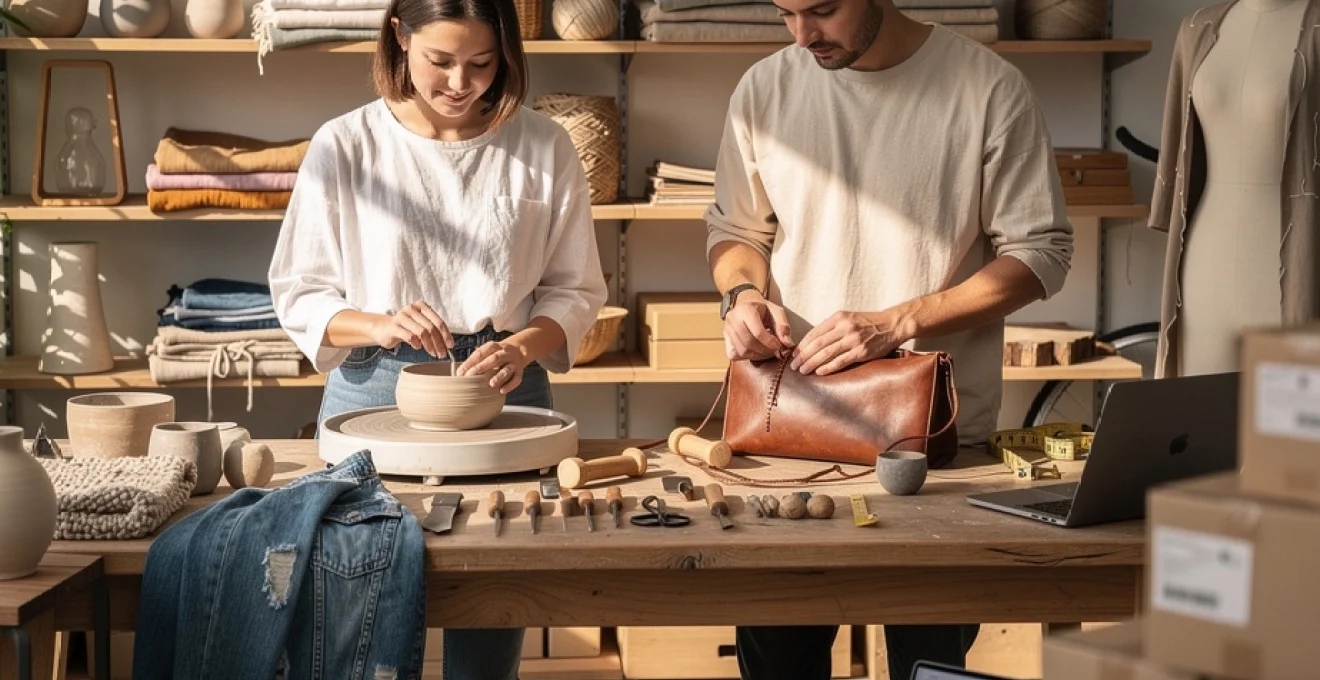
The contemporary marketplace is witnessing a remarkable transformation. Across Europe, North America, and beyond, consumers are deliberately choosing imperfect pottery over factory-manufactured ceramics, hand-knitted garments over mass-produced fashion, and bespoke furniture over flat-pack alternatives. This isn’t mere nostalgia—it represents a fundamental shift in how people assign value, define luxury, and express identity through material objects. The handmade renaissance speaks to deeper cultural anxieties about technology, sustainability, and authenticity in an increasingly homogenised global economy. Understanding why artisanal production has captured the imagination of millions reveals essential truths about modern consumer psychology and the evolving definition of quality in the twenty-first century.
Consumer fatigue with Mass-Produced goods and fast fashion economics
The relentless pace of fast fashion and mass production has created what economists term « consumption exhaustion »—a psychological state where acquiring new possessions no longer delivers satisfaction. Since the 1990s, clothing production has doubled whilst garment prices have fallen by approximately 36% when adjusted for inflation. This abundance paradox has left consumers surrounded by possessions yet feeling increasingly disconnected from them. Research conducted by the Ellen MacArthur Foundation indicates that the average garment is worn just seven times before disposal, creating mountains of textile waste that epitomise our throw-away culture.
This industrial model prioritises volume over value, speed over substance. Factory production lines churning out identical objects have stripped away the human element that once defined craftsmanship. When you purchase a mass-produced item, you’re acquiring functionality without story, utility without soul. The psychological disconnect becomes particularly acute when these items fail quickly—planned obsolescence means many products are designed to break, forcing repeated purchases that benefit manufacturers whilst frustrating consumers. The average household now contains approximately £4,000 worth of unused items, testament to purchases that never truly satisfied.
Younger consumers, particularly those aged 25-40, are rejecting this model with increasing vehemence. Having grown up saturated with cheap goods, they’re now prioritising quality, longevity, and meaning. The statistics are compelling: 73% of millennials report willingness to pay premium prices for sustainable products, whilst 62% actively seek out handmade alternatives to mass-produced goods. This demographic shift isn’t simply about purchasing power—it reflects fundamentally different values around ownership, identity, and environmental responsibility. Fast fashion’s promise of endless novelty has been exposed as hollow, driving consumers toward artisanal alternatives that offer genuine distinctiveness.
The economic implications extend beyond individual purchasing decisions. The European handicraft market, valued at approximately €280 billion in 2024, is projected to exceed €400 billion by 2033, representing an 8% compound annual growth rate. This remarkable expansion signals that artisanal production isn’t a niche curiosity but a substantial economic force. Traditional craft sectors—from knife forging in Sheffield to ceramic production in Portugal—are experiencing unprecedented demand, creating employment in regions previously hollowed out by deindustrialisation. The handmade revival represents economic regeneration alongside cultural renewal.
The craft revival: from william morris to contemporary maker culture
To understand today’s artisanal renaissance, one must revisit the Arts and Crafts Movement of the late nineteenth century. Confronted with industrialisation’s dehumanising effects, William Morris and his contemporaries championed handwork as morally superior to machine production. They believed objects should be « made with joy » and that decorative beauty possessed intrinsic social value. Whilst their movement ultimately failed to stem industrial capitalism’s tide, their philosophical framework resurfaces whenever societies feel technology has advanced too far, too fast. Today’s maker culture echoes Morris’s conviction that creating with one’s hands offers dignity and meaning in an automated world.
Arts and crafts movement principles resurging in modern consumption
The Arts and Crafts philosophy centred on several core principles that resonate powerfully in contemporary markets: honest materials, visible construction techniques, integration of form and function, and respect for traditional skills. These concepts have been rediscovered by designers and consumers alike who recognise their relevance to current challenges. When you examine a hand-thrown ceramic vessel, you can see the potter’s fingerprints in the clay—physical evidence of human touch that factory moulds cannot replicate. This transparency appeals to consumers weary of products
that feel anonymous and over-engineered. Similarly, handwoven textiles that reveal slight irregularities in the weave signal honesty rather than defect. These qualities reflect a broader desire to see how something is made, to understand its construction, and to feel that form, function, and aesthetics are in dialogue rather than at odds. In this sense, many of today’s handmade and artisanal pieces are less about nostalgia and more about re-aligning consumption with values such as integrity, transparency, and respect for skill.
We also see a renewed respect for the labour conditions that the original Arts and Crafts thinkers fought for. Morris criticised factories not only for ugliness but for alienating workers from the products of their labour. The current enthusiasm for artisanal goods mirrors this critique: buyers care who made their clothes, their ceramics, and their furniture, and under what circumstances. Certifications, maker profiles, and studio stories give consumers reassurance that they are supporting livelihoods rather than exploiting them. In an era of globalised supply chains, this emphasis on ethical production has become a powerful differentiator.
Etsy, instagram, and TikTok as digital marketplaces for artisan commerce
If the nineteenth-century craft revival was fuelled by pamphlets, guilds, and salons, today’s movement is powered by platforms like Etsy, Instagram, and TikTok. These digital marketplaces have democratised access to customers for independent makers who would once have been limited to local fairs or small boutiques. A ceramicist in Lisbon can now sell mugs to buyers in Berlin, New York, or Tokyo with a few clicks, turning what might once have been a side practice into a viable business. For many artisans, social media doubles as both shopfront and storytelling tool.
Algorithms and short-form video have also changed how we discover and evaluate handmade pieces. Time-lapse videos of wheel-thrown pottery, visible mending tutorials, and behind-the-scenes studio tours satisfy a deep curiosity about process that mass brands rarely reveal. Neuromarketing studies suggest that seeing the making process activates brain regions associated with empathy and trust, making viewers more likely to value and purchase the final object. In effect, platforms like TikTok and Instagram Reels are re-teaching large audiences to appreciate craft techniques that had faded from everyday awareness.
At the same time, Etsy and similar marketplaces have introduced new challenges: increased competition, pricing pressures, and questions about what qualifies as « handmade ». As some sellers outsource production or import semi-finished goods, discerning consumers have learned to look more carefully at product descriptions, studio photos, and maker backstories. Successful artisans respond by doubling down on transparency—sharing their tools, raw materials, and failed experiments as well as polished work. For brands and individual makers alike, authenticity is no longer a marketing slogan but an ongoing performance that must be continually demonstrated online.
Wabi-sabi aesthetics and the embrace of imperfection in handmade objects
One of the most striking shifts in contemporary design culture is the embrace of imperfection, often described through the Japanese aesthetic philosophy of wabi-sabi. Rather than striving for flawless symmetry and glossy surfaces, many consumers now actively seek out cracks repaired with gold, uneven glazes, and visible joins. In handmade and artisanal pieces, these irregularities are not treated as defects but as signatures of human involvement. They remind us, subtly but persistently, that nothing lasting is ever truly perfect—and that this is precisely where beauty lives.
Psychologically, this move away from perfection echoes broader fatigue with polished digital lives and airbrushed social media feeds. Owning a hand-thrown mug whose rim is slightly thicker on one side can feel like a quiet act of resistance against the tyranny of uniformity. It says: this object was touched, considered, and cared for by a real person, not optimised by a machine. For interior designers, incorporating wabi-sabi-inspired artisanal goods into a space introduces warmth and relatability, softening the hard edges of modern architecture and mass-produced furniture.
We can think of wabi-sabi as an antidote to product disposability. When you accept that an item will wear, fade, and perhaps chip, you’re more likely to integrate those changes into its story rather than treating them as reasons for replacement. This mindset aligns with the slow living and sustainable consumption movements, where patina is interpreted as character rather than damage. In practice, it means that handmade objects often remain in use longer because their evolving surfaces continue to feel emotionally and aesthetically rewarding.
Studio pottery movement influencing contemporary ceramic demand
The current surge of interest in artisanal ceramics builds on a twentieth-century lineage: the studio pottery movement. Pioneers such as Bernard Leach and Lucie Rie rejected industrial ceramic factories in favour of small studios, limited runs, and individual authorship. Their work helped shift ceramics from strictly utilitarian wares to collectible art objects, paving the way for today’s wave of independent potters. Museums and galleries now host major exhibitions of studio ceramics, and auction houses report steadily rising prices for both historic and contemporary pieces.
This heritage has filtered into mainstream consumer tastes. Hand-thrown tableware, once associated with niche craft markets, now appears in high-end restaurants, boutique hotels, and aspirational homeware catalogues. The visual language of studio pottery—muted glazes, tactile surfaces, irregular silhouettes—has become synonymous with understated luxury. When consumers choose a hand-made bowl over a factory-pressed one, they are often unconsciously aligning themselves with this tradition, signalling an appreciation for the potter’s hand and the time embedded in the clay.
From a market perspective, ceramics illustrate how handmade and artisanal goods can bridge art, design, and everyday utility. A single studio can produce both exhibition pieces and practical dinner sets, blurring the line between collectible object and daily tool. For buyers, this hybridity is attractive: they can justify higher prices for artisanal ceramics because they are not merely decorative but central to daily rituals like eating and drinking. As more people work and entertain from home, these rituals have taken on renewed importance, making the sensory pleasure of using handmade ceramics particularly compelling.
Sustainability credentials and circular economy integration
The rise of handmade and artisanal pieces also reflects deeper engagement with sustainability and circular economy principles. In contrast to linear « take-make-dispose » models, many craft-based businesses inherently operate in smaller loops: sourcing locally, minimising waste, repairing or repurposing leftovers, and producing in response to real demand rather than speculative forecasts. Consumers who want to reduce their environmental impact often find that buying fewer, better-made items from artisans aligns more closely with their values than purchasing many cheaper goods from global chains.
Policy shifts across Europe and North America are reinforcing this trend. Extended Producer Responsibility regulations, textile waste targets, and carbon reporting requirements are pushing brands to re-evaluate supply chains and material choices. Artisans who already work with natural fibres, reclaimed timber, or low-impact dyes find themselves ahead of the curve. When combined with transparent storytelling and third-party certifications, these sustainability credentials turn handmade products into tangible expressions of climate-conscious living rather than abstract ideals.
Carbon footprint reduction through local artisan production chains
One of the most immediate advantages of artisanal production is the potential reduction in carbon footprint through shorter, more localised supply chains. A handwoven blanket produced from regionally sourced wool and sold within the same country avoids the complex logistics of global freight, warehousing, and multi-stage distribution that accompany mass-produced goods. Studies from organisations such as the World Crafts Council Europe suggest that small-scale craft enterprises often generate significantly lower emissions per item, particularly when they use manual or low-energy tools instead of heavy machinery.
Of course, not every handmade object is automatically low-carbon—international shipping for online orders can still add up—but the overall model favours proximity. Many consumers now consciously prioritise artisans within their own region, both to support local economies and to reduce transport emissions. Retailers and marketplaces are responding by introducing location filters, carbon labels, and « made within 100 miles » badges that help buyers make informed decisions. For brands looking to build a more sustainable product portfolio, partnering with local craftspeople can be a practical route to decarbonisation as well as differentiation.
There is also a behavioural dimension. When you meet the maker at a market stall or studio open day, you’re more likely to consider the true cost of production, ask about materials, and care for the item you buy. This deeper engagement can lead to longer product lifespans and fewer impulse purchases, which, in turn, reduces the carbon impact associated with overconsumption. In this way, handmade and artisanal pieces contribute not only through their production methods but also by reshaping how we think about ownership and responsibility.
Zero-waste practices in contemporary textile and leatherwork craftsmanship
Many contemporary textile and leather artisans are actively experimenting with zero-waste design methodologies. Instead of cutting garment patterns that leave 15–30% of fabric on the floor—a common figure in industrial fashion—they develop pattern layouts that use every centimetre of cloth. Techniques such as zero-waste pattern cutting, modular design, and knit-to-shape production dramatically reduce offcuts. In leatherwork, makers repurpose smaller pieces into wallets, keyrings, or patchwork panels, ensuring that premium hides are used to their fullest extent rather than discarded.
These production choices are not only environmentally beneficial; they also add narrative depth to the finished pieces. A bag made from studio offcuts, for instance, can be marketed as a one-of-a-kind item that literally would not exist without the brand’s commitment to resourcefulness. Consumers drawn to sustainable handmade fashion are often willing to pay more when they understand that their purchase helped prevent waste. For independent designers, this alignment between aesthetic experimentation and ethical practice can be a powerful source of innovation.
Zero-waste craft practices also challenge our expectations about what a « finished » product should look like. Patchwork garments, visible mending, and asymmetrical patterning all signal that efficiency and beauty can coexist. They encourage us to see leftover materials not as junk but as creative prompts. Much like a chef crafting a delicious meal from pantry scraps, artisans who embrace zero-waste design demonstrate that constraints can drive originality, making their work stand out in a saturated marketplace.
Upcycling methodologies in furniture making and home décor
Upcycling—transforming discarded materials into objects of higher value—is central to the handmade renaissance in furniture and home décor. Independent makers scour demolition yards, auction houses, and even kerbside rubbish collections for solid wood pieces, metal frames, and vintage textiles that can be given new life. A mid-century chair with broken upholstery might gain a new seat made from handwoven fabric; an old door can become a dining table, complete with its original imperfections and nail holes as part of the design language.
From an environmental perspective, upcycling extends the useful life of existing materials and reduces demand for virgin resources. From a psychological standpoint, it imbues objects with layered histories: your dining table might carry traces of a former warehouse, school, or farmhouse. This narrative richness is something mass-produced furniture, even when styled as « vintage », struggles to replicate. It satisfies a growing desire among homeowners and interior designers for spaces that feel rooted, storied, and distinct rather than assembled from flat-pack catalogues.
For consumers interested in incorporating more sustainable handmade décor, starting with upcycled pieces is often a practical entry point. They can work with local artisans to adapt heirloom furniture, commission custom shelving from reclaimed wood, or source lighting made from repurposed glass. These collaborations not only divert materials from landfill but also deepen the relationship between maker, client, and object. Over time, such choices can transform a home into a sort of living archive of conscious decisions rather than a temporary backdrop for trends.
Transparency in supply chains: traceability from raw material to finished product
Transparency has become a key differentiator for handmade and artisanal brands. Where mass-market companies often struggle to map complex, multi-tiered supply chains, small craft businesses can typically describe their processes in detail—from the farm where they source wool to the tannery that prepares their leather. This level of traceability is increasingly important as consumers ask tough questions about labour conditions, animal welfare, and environmental impact. When you buy a handwoven rug and know the exact village where the wool was spun and dyed, the purchase carries a different ethical and emotional weight.
Technologies such as QR codes, blockchain-based provenance tools, and digital product passports are making it easier for artisans to document and share this information. Scanning a label might reveal photos of the workshop, interviews with makers, or certifications for organic fibres and non-toxic dyes. Unlike complex global brands, small producers can integrate these tools without needing massive IT infrastructures, turning transparency into a competitive advantage. For sustainability-minded consumers, such clarity reduces the risk of greenwashing and supports more intentional spending.
Of course, full traceability is still a work in progress, and even the most diligent artisans may rely on some intermediaries. But the cultural expectation has shifted: opacity now raises suspicion, while openness generates trust. As regulatory frameworks evolve—particularly in the EU—companies that already practice radical transparency will be better positioned to meet new disclosure requirements. In this context, the handmade and artisanal sector is not merely catching up with sustainability standards; in many cases, it is helping to define them.
Neuromarketing and the psychology of handcrafted authenticity
Beyond ethics and aesthetics, there is a powerful psychological dimension to why handmade and artisanal pieces are trending again. Neuromarketing research—combining neuroscience, psychology, and consumer behaviour—suggests that our brains respond differently to objects we perceive as handcrafted. Experiments using functional MRI have shown that when people believe a product is handmade, areas associated with empathy, reward, and valuation light up more strongly than when they think the same item is machine-made. In other words, the mere perception of human labour and intention increases subjective value.
This effect relates to what psychologists call the « effort heuristic »: we tend to assume that things requiring more effort are inherently better. When you hold a hand-carved spoon or a hand-stitched jacket, you intuitively imagine the time, focus, and skill invested in its creation. That imagined effort triggers feelings of respect and even gratitude, which in turn can make you more willing to care for and keep the item. It’s similar to how a home-cooked meal often feels more satisfying than takeout, even when the ingredients are similar—the human effort is part of the flavour.
Authenticity plays a crucial role here. If consumers suspect that a « handmade » label is simply a marketing tactic, the neurological benefits evaporate. Genuine markers of craft—irregular stitching, visible tool marks, maker signatures—act as cues that our brains use to distinguish real from staged authenticity. Brands that attempt to mimic these signals through artificial distressing or factory-produced « vintage » effects may achieve a superficial aesthetic but rarely the same emotional resonance. For designers and retailers, the lesson is clear: investing in true craftsmanship and honest storytelling yields deeper, more durable customer relationships than imitative shortcuts.
There is also a social identity component. Choosing handcrafted goods allows people to communicate values such as creativity, independence, and environmental concern without saying a word. A handmade tote bag or set of artisanal coffee cups functions as a kind of quiet branding, signalling belonging to a tribe that prioritises meaning over convenience. Neuromarketing studies indicate that when products help reinforce desired self-images, consumers experience a stronger « fit » and are more likely to become repeat buyers. In this sense, the appeal of handmade items is not just about the objects themselves but about who we become when we use them.
Premiumisation strategy: positioning artisanal goods in luxury markets
As consumer appreciation for craftsmanship has grown, many handmade and artisanal brands have successfully moved into the premium and luxury segments. This process of premiumisation involves reframing craft not as a budget-friendly alternative to mass production, but as a higher-value proposition based on scarcity, skill, and story. In traditional luxury markets, status was often signalled by logos and price tags; today, discerning buyers increasingly look for subtle indicators such as hand-finished seams, regional techniques, or limited production runs.
Large luxury houses have taken note, acquiring or partnering with heritage ateliers to highlight their artisanal credentials. At the same time, independent makers are carving out their own space at the top end of the market, selling directly to affluent consumers who value uniqueness over brand recognition. For these customers, an anonymous but exquisitely made handwoven coat can feel more luxurious than a mass-marketed designer item. The emphasis shifts from « who made it » in terms of brand fame to « how it was made » in terms of process excellence.
Heritage branding and storytelling in craft narratives
Heritage has become one of the most effective tools for premiumising artisanal goods. Brands that can trace their roots to a specific region, technique, or family lineage are able to position their products as carriers of cultural memory rather than mere commodities. A workshop that has produced knives in the same town for four generations, or a weaving cooperative preserving an endangered pattern, offers something that cannot be replicated by newer, purely trend-driven labels. The story itself adds perceived value, reinforcing the sense that the object is part of a larger continuity.
Effective heritage branding requires more than a romantic backstory on a hang tag. It involves rigorous documentation, careful stewardship of techniques, and respect for the communities involved. Consumers today are adept at spotting superficial narratives that use culture as decoration rather than acknowledging it as a living, evolving practice. Successful craft brands therefore invest in archival research, oral histories, and collaborations with local historians or cultural institutions. They may host exhibitions, publish books, or run workshops that invite the public into their world, deepening both understanding and loyalty.
For artisans and small businesses, thoughtful storytelling can be a powerful differentiator in crowded marketplaces. Sharing the origin of a dye plant, the symbolism of a motif, or the evolution of a tool transforms a product page into an education in miniature. When buyers feel that they are not just acquiring an object but also learning something meaningful, they tend to form stronger attachments and view the purchase as an investment in intangible as well as tangible value.
Limited edition production models and scarcity marketing tactics
Scarcity has always been a cornerstone of luxury, and handmade goods lend themselves naturally to limited edition models. A single artisan or small team can only produce a finite number of pieces each month, which creates inherent limits on supply. Instead of trying to mimic industrial scale, many craft brands lean into this constraint, releasing small batches, numbered series, or seasonal collections that sell out quickly. This approach not only respects the realities of hand production but also heightens anticipation and perceived exclusivity.
From a marketing perspective, transparent scarcity—rooted in genuine capacity limitations rather than artificial manipulation—can build trust. When a ceramicist explains that they only fire their kiln once a month and therefore produce a fixed number of vases, buyers understand the rhythm and may even plan their purchases around it. Waiting lists, pre-order windows, and subscriber-only drops are common tactics that allow artisans to match demand more closely to supply, reducing overproduction and waste while maintaining a sense of desirability.
There is, however, a balance to strike. Overuse of scarcity language can lead to fatigue or frustration if customers feel constantly shut out. The most respected artisanal brands pair limited editions with clear communication, fair allocation (for example, lotteries rather than fastest-finger-first sales), and occasional open editions for core products. This mix allows them to cultivate a premium aura without alienating aspiring customers who may not yet be ready—or able—to compete for the rarest pieces.
Collaborative drops: artisans partnering with mainstream retailers like anthropologie
Collaborations between independent artisans and mainstream retailers have become an important bridge between niche craft culture and broader consumer markets. Stores such as Anthropologie, West Elm, and various department chains regularly commission limited collections from ceramicists, illustrators, textile designers, and furniture makers. These « collaborative drops » introduce handmade aesthetics to audiences who might never visit a craft fair or specialist gallery, while giving makers access to professional photography, merchandising, and distribution.
For artisans, such partnerships can be both opportunity and test. On one hand, they provide significant exposure and financial stability, often allowing a studio to invest in better equipment, assistants, or training. On the other, they raise questions about production capacity, pricing, and creative control. The most successful collaborations are those where the artisan’s voice remains clear and the manufacturing process stays aligned with their values—even if some aspects are scaled or adapted for retail.
From a consumer perspective, collaborative collections can act as an accessible entry point into the world of handcrafted goods. Buying a limited-edition mug from a well-known retailer may be the first step toward later seeking out the maker’s independent work. In this way, collaborations serve as gateways, expanding the market for artisanal products and normalising the idea that everyday items—from lampshades to tea towels—can and perhaps should bear the mark of an individual creator.
Price anchoring through material provenance and labour-hour transparency
One of the persistent challenges for artisans entering luxury markets is explaining why their handmade products cost more than mass-produced alternatives. Price anchoring—providing reference points that help consumers interpret value—has emerged as a practical strategy. By breaking down material costs, labour hours, and overheads, many makers demystify their pricing and invite buyers to see the full economic picture. A coat described simply as « wool, €600 » feels abstractly expensive; a coat detailed as « locally spun merino from a family farm, plant-dyed over three days, hand-tailored over 25 hours » tells a different story.
This level of transparency not only justifies higher prices but also educates consumers about the realities of ethical production. It becomes clear that a €30 fast-fashion jumper is not cheap by magic; its low cost is subsidised by someone else’s underpaid labour or by environmental externalities. In contrast, a clearly costed handmade item invites you to decide whether you want to participate in a different, more accountable economic model. For many buyers who care about fair wages and sustainable practices, this clarity enhances rather than diminishes the appeal of artisanal goods.
Some brands take this further by publishing standard labour rates, profit margins, or comparisons between their process and industry norms. While not every customer will scrutinise the details, knowing they are available enhances trust. Over time, such transparency can shift market expectations, making it less acceptable for any brand—handmade or industrial—to hide behind opaque pricing structures. In this environment, artisans who have always worked in the open gain recognition for what they were already doing.
Digital fabrication meeting traditional techniques: hybrid craftsmanship
As much as the handmade trend is about human touch, it is not anti-technology. In many studios, digital tools and traditional techniques now coexist in what we might call hybrid craftsmanship. Laser cutters, CNC routers, and 3D printers are used to create precise components, jigs, or prototypes that artisans then refine by hand. A woodworker might design a complex joint in CAD software, have it cut by machine for accuracy, and then finish, assemble, and oil the piece manually. The result is an object that benefits from both the efficiency of digital fabrication and the warmth of artisanal finishing.
This blending of old and new is reshaping what « handmade » can mean. Rather than a binary choice between handcrafted and industrial, we are moving toward a spectrum where digital and analogue processes support each other. For example, a jeweller can 3D-print wax models to test forms before hand-casting and polishing the final piece; a textile artist can use digital looms to experiment with complex patterns, then complete the fabric with hand-stitched embellishments. These approaches allow artisans to push creative boundaries while remaining rooted in material knowledge and manual skill.
Hybrid craftsmanship also opens doors for customisation at scale. Parametric design tools enable makers to offer personalised dimensions, engravings, or configurations without reinventing their process each time. Customers can tweak a table’s length or a lamp’s shade shape online, while the artisan maintains control over materials, joinery, and finishing. This level of bespoke service was historically reserved for ultra-luxury clients; today, it is increasingly available to mid-market buyers looking for something tailored yet attainable.
Looking ahead, we can expect to see even more integration between digital technologies and artisanal practices. Augmented reality may help customers visualise handmade pieces in their homes before commissioning them; AI-assisted design tools could suggest variations that makers then interpret through their own sensibilities. The enduring constant will be the human capacity to judge, adapt, and imbue materials with meaning—qualities that algorithms, however sophisticated, cannot fully replicate. In a world saturated with the virtual, the combination of digital precision and human imperfection may prove to be the most compelling expression of craft yet.