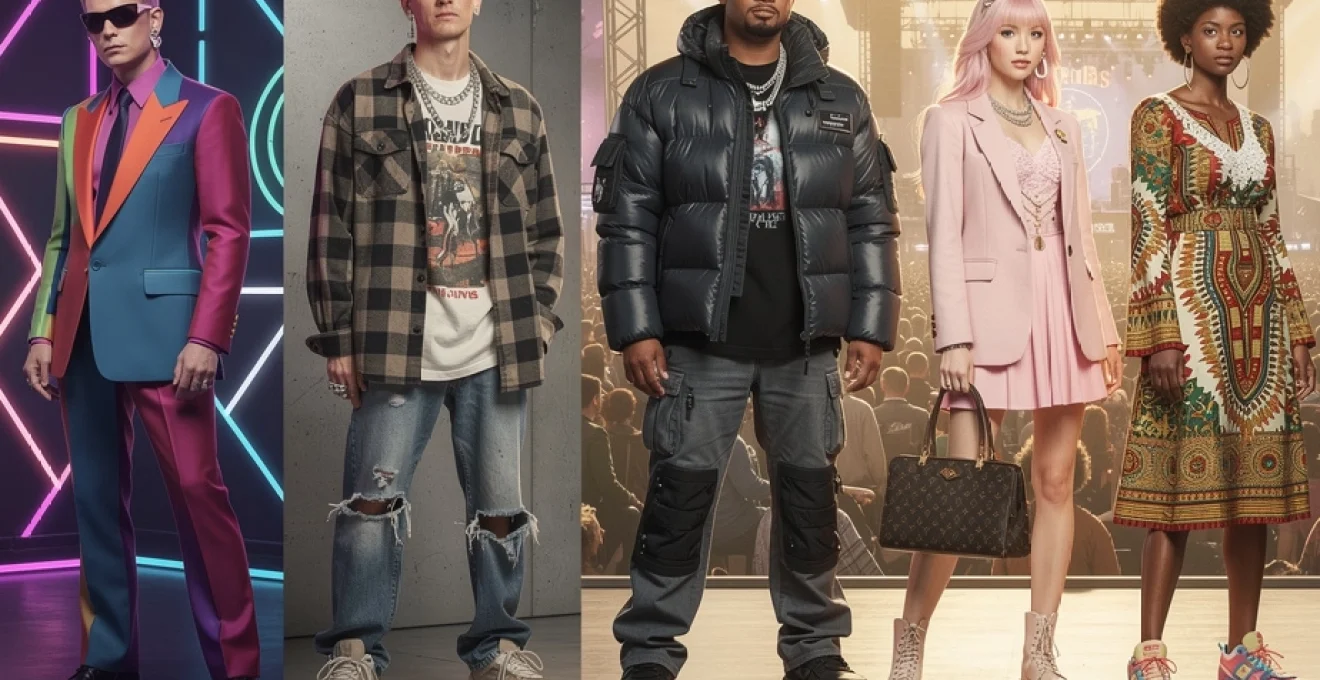
The symbiotic relationship between music and fashion has fundamentally reshaped how we understand contemporary aesthetic expression. From underground punk venues to global streaming platforms, musical movements continue to dictate sartorial choices across diverse demographics. This cultural phenomenon transcends mere surface-level trends, embedding itself deeply within the fabric of modern identity formation. Music scenes don’t simply inspire clothing choices; they create entire visual languages that communicate values, rebellion, aspiration, and belonging. The acceleration of digital culture has intensified this relationship, transforming localised subcultures into global movements overnight. Fashion houses now monitor underground music scenes with the same intensity they once reserved for Parisian runways, recognising that tomorrow’s luxury collections may emerge from tonight’s warehouse rave.
Historical evolution of Music-Fashion synergy: from punk rock aesthetics to Hip-Hop streetwear
The transformation of music-driven fashion aesthetics throughout recent decades reveals a fascinating trajectory of cultural rebellion, commercialisation, and eventual mainstream absorption. Each musical movement has contributed distinct visual elements that continue influencing contemporary design philosophies. Understanding this historical progression illuminates how today’s fashion landscape emerged from decades of subcultural innovation and cross-pollination between musical genres and aesthetic expression.
1970s punk movement’s DIY fashion philosophy and safety pin symbolism
The punk movement fundamentally challenged traditional fashion hierarchies through its radical do-it-yourself approach to clothing construction and modification. Emerging from London’s working-class neighbourhoods and New York’s underground scene, punk fashion rejected expensive garments in favour of deconstructed, personalised pieces that reflected individual rebellion against societal norms. Safety pins became powerful symbols of both practical necessity and aesthetic statement, transforming functional hardware into decorative elements that communicated anti-establishment sentiment.
This aesthetic philosophy extended beyond mere clothing choices to encompass entire lifestyle approaches. Punk fashion emphasised accessibility and creativity over commercial consumption, encouraging followers to modify existing garments rather than purchase new ones. Torn denim, leather jackets adorned with hand-painted slogans, and repurposed household items became standard elements of punk wardrobes. The movement’s influence persists today through luxury brands incorporating distressed textures and unconventional materials into high-fashion collections.
1980s new wave scene’s geometric silhouettes and synthesised visual identity
New Wave music’s electronic soundscapes found visual expression through sharp geometric patterns and futuristic silhouettes that mirrored the genre’s technological innovation. Artists like Kraftwerk and Depeche Mode pioneered aesthetic approaches that combined minimalist design principles with bold colour contrasts. The movement’s fashion philosophy embraced synthetic materials and angular cuts that reflected the synthesised nature of the music itself.
This period witnessed the emergence of power dressing concepts that would later dominate corporate fashion throughout the decade. Oversized shoulder pads, metallic fabrics, and structured blazers became synonymous with New Wave aesthetics. The influence of this era remains evident in contemporary fashion’s continued fascination with architectural silhouettes and technological materials.
1990s grunge subculture’s Anti-Fashion statement and flannel deconstruction
Grunge fashion emerged as a direct response to the excess and artificiality of 1980s aesthetics, promoting authenticity through deliberate neglect of traditional fashion standards. Seattle’s music scene gave birth to a clothing philosophy that prioritised comfort and practicality over appearance, yet paradoxically created one of the decade’s most influential fashion movements. Flannel shirts, originally workwear garments, became symbols of artistic integrity and rejection of mainstream commercialism.
The grunge movement’s impact extended far beyond its musical origins, influencing luxury fashion houses to incorporate distressed elements and casual silhouettes into their collections. Marc Jacobs’ controversial 1993 grunge collection for Perry Ellis demonstrated how underground aesthetics could translate into high-fashion contexts, albeit with mixed commercial results initially.
2000s Hip-Hop culture’s luxury brand appropriation and logomania phenomenon
Hip-hop culture revolutionised fashion’s relationship with luxury brands through strategic appropriation and recontextualisation of high-end designer pieces. Artists like Jay-Z and Kanye West transformed expensive European fashion houses into
symbols of cultural capital, wearing logos not as subtle status markers but as bold declarations of success. Tracksuits, monogrammed accessories, and oversized silhouettes migrated from music videos into everyday wardrobes, turning the streets into informal runways. The logomania phenomenon of the early 2000s signalled a shift toward hyper-visible branding, where garments functioned as both clothing and advertisement.
This era also normalised the fusion of sportswear and luxury, with artists pairing sneakers and jerseys with high-end tailoring and jewellery. What began as subcultural styling quickly became central to global fashion, as brands like Louis Vuitton, Gucci, and Burberry strategically engaged with rap and R&B artists to access younger, more diverse audiences. Today’s high/low fashion combinations and the dominance of streetwear in runways can be traced directly to this hip-hop-led redefinition of what aspirational style looks like.
2010s indie folk revival’s vintage romanticism and artisanal craftsmanship
In contrast to hip-hop’s glossy logomania, the 2010s indie folk revival embraced a softer, more introspective fashion language rooted in vintage romanticism. Artists associated with indie folk and alternative scenes favoured textured knits, heritage fabrics, and muted, earthy colour palettes. This aesthetic aligned with a growing cultural appetite for slower living, analogue experiences, and a return to perceived authenticity in both music and wardrobe choices.
Fashion inspired by this movement often celebrated artisanal craftsmanship: hand-stitched details, visible mending, and small-batch production echoed the DIY ethos of earlier subcultures but with a more pastoral, nostalgic sensibility. Brands leaned into workwear-inspired silhouettes, raw denim, and rugged boots, framing them as timeless investments rather than seasonal trends. The indie folk aesthetic also supported the rise of sustainable and ethical fashion narratives, as consumers looked for clothing that told a story, much like the storytelling lyrics that defined the genre.
Contemporary music genre aesthetics shaping high street fashion collections
As we move deeper into the 2020s, contemporary music scenes increasingly shape high street fashion collections in real time. Fast-fashion brands monitor viral tracks, music video aesthetics, and tour wardrobes to anticipate what silhouettes and colour stories will resonate with younger audiences. Rather than waiting for luxury trickle-down, retailers now treat emerging genres as primary reference points for design direction, merchandising, and in-store styling.
The result is a fashion ecosystem where drill, K-pop, Afrobeats, and EDM aesthetics coexist on the same racks, giving shoppers access to multiple identity scripts in a single visit. For designers and marketers, understanding how each music scene codes status, belonging, and rebellion is crucial to building collections that feel relevant rather than derivative. This section explores how specific contemporary genres are reshaping everyday style, from technical outerwear to pastel tailoring.
Drill music’s technical wear integration and urban camouflage patterns
Drill music, emerging from Chicago and later crystallising in London and other global cities, has cultivated a fashion aesthetic grounded in practicality, anonymity, and urban resilience. Technical wear—waterproof shells, insulated puffers, and cargo-heavy utility trousers—plays a central role in drill-inspired style. These garments are not only visually aligned with the genre’s gritty sound but also respond to real environmental and social conditions in dense urban spaces.
Urban camouflage patterns, dark tonal layering, and balaclava-adjacent accessories contribute to a visual language of guardedness and protection. On the high street, this has translated into widespread adoption of tech fabrics, taped seams, and multifunctional pockets in menswear and increasingly in womenswear. Retailers from sports chains to mass-market fashion giants now release seasonal capsules that mimic drill’s blend of performance wear and street uniform, while softening the more contentious elements (such as full face coverings) for broader consumer appeal.
K-pop industry’s Gender-Fluid styling and pastel colour palettes
The global success of K-pop has introduced a highly stylised, meticulously curated fashion vocabulary that normalises gender-fluid dressing and playful experimentation. Idols frequently blur traditional masculine and feminine codes, pairing sharp tailoring with pearl necklaces, crop tops, or lace details. This visibility has helped make gender-fluid styling feel aspirational rather than marginal, particularly for younger consumers who encounter these looks through performance stages, variety shows, and social media.
Pastel colour palettes, glossy fabrics, and coordinated group outfits have migrated directly into high street collections, from coordinated co-ords to soft-hued knitwear and oversized blazers. Retailers replicate the « comeback lookbook » structure of K-pop promotions, dropping themed capsules that echo album aesthetics—school-uniform tailoring one season, cyberpunk streetwear the next. For shoppers, dressing in a K-pop-inspired wardrobe becomes a way to inhabit the same cinematic universe as their favourite groups, while brands gain access to a highly engaged, trend-sensitive fan base.
Afrobeats scene’s bold print maximalism and traditional textile fusion
Afrobeats, with its optimistic rhythms and global reach, has propelled African fashion aesthetics into mainstream visibility. Artists and fans alike embrace bold print maximalism, celebrating Ankara, Kente, and other traditional textiles in contemporary silhouettes. This fusion of heritage fabric and modern tailoring speaks to a broader cultural movement that centres African creativity and challenges Western dominance in trendsetting.
On the high street, we now see capsule collections that reference Afrobeats style through vibrant colour-blocking, exaggerated sleeves, and mixed prints. While authenticity and respectful sourcing remain ongoing concerns, some brands collaborate directly with African designers or artisans to ensure that traditional motifs are not reduced to surface-level decoration. For consumers, adopting Afrobeats-inspired fashion can function as both a style choice and a statement of cultural pride or solidarity, particularly within diasporic communities.
Electronic dance music’s neon spectrum and functional rave garments
Electronic dance music (EDM) and its many subgenres have long shaped festival style, but their influence now extends into everyday streetwear. The neon spectrum—highlighter greens, electric pinks, and ultraviolet blues—appears not only in rave-ready bodysuits but also in windbreakers, sneakers, and accessories designed for urban life. These high-visibility colours tap into a desire for self-expression and visibility in both physical and digital spaces.
Functional rave garments, such as hydration-pack-compatible vests, reflective trousers, and convertible cargo shorts, inform a broader trend toward clothing designed for movement and nightlife. High street brands adopt elements like reflective piping, mesh panels, and detachable components, while toning down overtly club-specific details for mass wearability. The result is a hybrid wardrobe that allows you to transition from daytime errands to late-night sets without a complete outfit change, echoing the 24/7 nature of contemporary music consumption.
Festival culture’s impact on mainstream fashion merchandising strategies
Festival culture has evolved into a powerful engine for fashion merchandising, with major events functioning as live lookbooks and content factories. Retailers build dedicated « festival edit » sections online and in-store, timing them to the global circuit from Coachella and Glastonbury to Afro Nation and Tomorrowland. These edits typically feature crop tops, cowboy boots, crochet pieces, and statement accessories designed to photograph well on social feeds, acknowledging that visual documentation is now as central to the experience as the performances themselves.
From a strategic standpoint, festivals provide brands with rich data on which music-driven aesthetics are resonating. Capsule drops are planned around headline acts and anticipated performance moments, while collaborations with artists and influencers extend the lifecycle of festival collections beyond the event itself. For consumers, the line between « festival outfit » and everyday wardrobe is increasingly blurred, as pieces designed for desert fields and muddy campsites get restyled for city streets, offices, and nightlife.
Social media amplification of Music-Fashion Cross-Pollination through platform analytics
Social media has transformed the way music scenes influence fashion, turning every outfit post, tour photo, or behind-the-scenes clip into actionable data. Platforms like TikTok, Instagram, and YouTube not only host content but also provide analytics that brands and labels use to track which looks, colours, and silhouettes gain traction. A music video fit that spawns thousands of recreation videos can prompt fast-fashion replicas to appear within weeks, making the feedback loop between stage and store tighter than ever.
For fashion marketers, platform analytics reveal which demographics engage with specific aesthetics, enabling micro-targeted ad campaigns and personalised recommendations. We can think of this process as a kind of « algorithmic stylist »: by tracking saves, shares, and click-throughs, platforms learn which music-fashion combinations you are most likely to emulate. At the same time, this raises questions about originality and over-saturation—when everyone sees the same viral look, how do you maintain a sense of individual style?
Luxury fashion houses’ collaboration models with music industry tastemakers
At the luxury level, collaborations with musicians have shifted from one-off endorsements to long-term creative partnerships that reshape brand identities. Music industry tastemakers serve as both muses and co-authors, influencing everything from casting and soundtracks to campaign narratives and product design. These alliances acknowledge that cultural relevance today often originates from music scenes rather than strictly from fashion insiders.
Collaboration models vary widely: some houses appoint artists as official ambassadors, while others invite them into design studios as guest creators or capsule collaborators. In each case, the goal is similar—to tap into the emotional resonance and devoted fan communities that music scenes generate. The following examples illustrate how specific creative directors have woven music cultures into the DNA of their respective brands.
Louis vuitton’s virgil abloh era and Hip-Hop cultural integration
Virgil Abloh’s tenure at Louis Vuitton Menswear marked a watershed moment in the integration of hip-hop culture into luxury fashion. Coming from a DJ and streetwear background, Abloh approached design with the sensibility of a producer sampling different cultural references. His collections referenced album artwork, tour merchandise, and skate culture, while runway soundtracks often featured contemporary rap and R&B artists.
Abloh’s collaborations with musicians—both formal and informal—reinforced the idea that the music scene as fashion incubator could sit at the core of a heritage house. Hip-hop codes like oversized outerwear, graphic prints, and sneaker-centric styling became fully legitimised within the luxury landscape. For younger consumers who grew up seeing rappers as primary style icons, this alignment between Louis Vuitton and hip-hop felt less like appropriation and more like long-overdue recognition.
Gucci’s alessandro michele vision and rock stardom romanticism
Under Alessandro Michele, Gucci embraced an eclectic, maximalist aesthetic imbued with rock stardom romanticism. The brand collaborated with and dressed musicians across rock, glam, and indie scenes, from Harry Styles to Florence Welch, crafting a visual universe of velvet suiting, embroidered blazers, and gender-fluid blouses. These looks referenced 1970s tour wardrobes, vintage album covers, and backstage photography, reimagined through a contemporary lens.
Michele’s vision turned Gucci into a kind of costume department for modern rock mythology, where everyday consumers could purchase pieces that felt stage-ready. Campaigns often featured musical performances or band-like casting, further blurring the line between fashion editorial and concert poster. In doing so, Gucci positioned itself as a brand for those who see their personal style as a performance, even offstage.
Balenciaga’s demna gvasalia approach to streetwear couture fusion
Demna Gvasalia’s Balenciaga has become synonymous with the fusion of streetwear and couture, drawing heavily on the visual language of contemporary music scenes. Oversized hoodies, logo-heavy outerwear, and distressed sneakers echo the wardrobes of rap, trap, and techno communities, but are rendered with couture-level construction and pricing. Soundtracks for Balenciaga shows often feature industrial or electronic tracks, reinforcing the brand’s association with club culture and underground nightlife.
Demna’s approach treats the street as the new salon, and music fans as key arbiters of taste. Collaborations with artists and the use of concert-style merch drops extend the brand’s presence beyond traditional luxury channels. This strategy not only resonates with younger audiences but also challenges older conceptions of what « elegant » fashion should look like, positioning streetwear as a legitimate, enduring pillar of high design.
Saint laurent’s anthony vaccarello and parisian rock chic modernisation
Anthony Vaccarello’s Saint Laurent continues the house’s longstanding relationship with rock culture, modernising Parisian rock chic for a new generation. Slim tailoring, leather trousers, and sharp-shouldered jackets remain central, but are now styled alongside sheer tops, sequinned minis, and gender-fluid accessories that reflect contemporary shifts in music scene aesthetics. Campaigns frequently feature musicians or are shot at concert venues and recording studios, reinforcing the brand’s alignment with live performance energy.
By casting emerging bands and established rock icons alike, Saint Laurent positions itself as both historian and innovator of rock style. The brand’s runway soundtracks and after-show performances act as extensions of this narrative, turning each collection debut into a mini music festival. For consumers, buying Saint Laurent is not only about acquiring a garment but about accessing a carefully curated fantasy of nocturnal, amplified Parisian life.
Emerging technologies facilitating Music-Fashion aesthetic convergence
Emerging technologies are accelerating the convergence of music and fashion aesthetics, creating new channels for co-creation and immersion. Virtual concerts and digital fashion drops now happen in gaming environments and metaverse platforms, where avatars wear outfits that exist only as code. Musicians debut tracks alongside augmented reality filters and virtual try-on features, allowing fans to « wear » an aesthetic on their screens before purchasing a physical equivalent.
Artificial intelligence and data analytics help brands identify which music-inspired looks are likely to resonate, analysing streaming trends, playlist moods, and social chatter. We can imagine this as a kind of cultural weather forecast, where designers check « what the scene is listening to » before sketching their next collection. At the same time, innovations in smart textiles—such as colour-changing fibres responsive to sound or light—hint at a future where clothing literally reacts to music in real time, turning the body into a live visualiser.
For both industries, these technologies present opportunities and challenges. They offer richer storytelling tools and new revenue streams, but also demand thoughtful navigation of issues like digital ownership, sustainability, and creative authenticity. What remains constant is the core impulse: to use both sound and style to express who we are, where we come from, and which scenes we choose to call home.