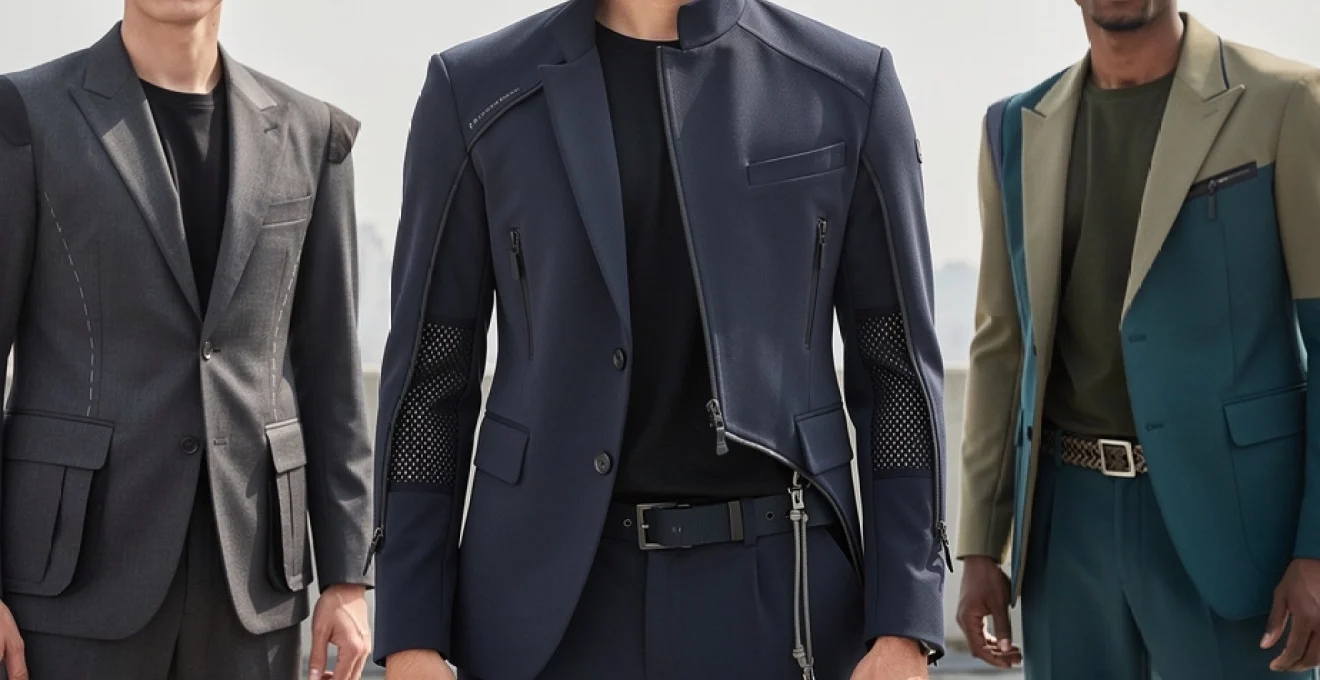
# Fashion-forward details that redefine modern menswear
Modern menswear has reached an inflection point where traditional craftsmanship meets radical innovation. The contemporary landscape is no longer defined by rigid dress codes or conservative silhouettes but by an exciting fusion of technical expertise and experimental design. Today’s fashion-forward gentleman isn’t simply buying clothes—he’s investing in garments that challenge conventions through unexpected construction methods, advanced materials, and architectural details that would have been unthinkable just a decade ago. This evolution represents more than aesthetic preference; it reflects a fundamental shift in how masculinity, functionality, and artistry intersect within the fashion industry.
The transformation happening across menswear collections globally demonstrates that innovation doesn’t require abandoning heritage techniques. Instead, the most compelling developments emerge when designers deconstruct traditional garment construction and rebuild it with contemporary sensibilities. From the elimination of internal shoulder padding to the integration of aerospace-grade fastening systems in formalwear, each detail serves a purpose beyond mere decoration. These innovations address practical needs—versatility, durability, climate adaptability—while simultaneously creating visual signatures that distinguish truly progressive menswear from conventional offerings.
Deconstructed tailoring techniques reshaping contemporary suits
The rigid, highly structured suit that dominated boardrooms for decades is giving way to more fluid interpretations that prioritize comfort without sacrificing sophistication. Deconstructed tailoring strips away the traditional internal architecture of jackets and trousers, revealing construction methods that celebrate the natural movement of fabric rather than forcing it into predetermined shapes. This approach transforms how garments interact with the body, creating silhouettes that feel simultaneously relaxed and refined—a balance that resonates with contemporary lifestyles that blur the boundaries between formal and casual environments.
Unstructured shoulders and soft canvas construction methods
The elimination of padded shoulder structures represents one of the most significant departures from traditional tailoring. Instead of built-up layers of canvas and wadding that create sharp, angular shoulder lines, contemporary designers are embracing natural shoulder slopes that follow the wearer’s actual physique. This spalla camicia construction, refined by Neapolitan tailors over generations, uses minimal internal structure—sometimes just a lightweight canvas layer or even eliminating canvas entirely. The result is a jacket that drapes elegantly while allowing unrestricted arm movement, creating a visual language of effortless sophistication rather than corporate rigidity.
Soft canvas construction extends beyond the shoulders to encompass the entire chest and front panels. Rather than using multiple layers of heavy canvas fused or sewn throughout the jacket front, progressive tailoring employs thinner, more pliable materials that maintain shape without stiffness. This technique reduces garment weight by approximately 30-40% compared to fully structured alternatives, making suits dramatically more comfortable for extended wear. The flexibility also means jackets crease and recover more naturally, developing character through wear rather than appearing permanently rumpled—a quality that aligns perfectly with modern preferences for garments that age gracefully.
Raw edge seam finishes in jacket lapels and hemlines
Exposing raw fabric edges—traditionally hidden through meticulous finishing techniques—has become a distinctive aesthetic signature in avant-garde menswear. Raw edge lapels, where the fabric edge remains visible rather than being turned under and stitched, create textural interest while highlighting the quality of the material itself. This technique demands exceptional fabric selection, as inferior materials will fray unattractively, making the raw edge both an aesthetic choice and a quality indicator. The visual effect adds an element of calculated imperfection that humanizes otherwise polished garments.
Similarly, raw hemlines on jacket sleeves and trouser legs challenge conventional finishing standards. Some designers employ controlled fraying, where edges are strategically cut and treated to fray to a predetermined extent, creating organic texture that contrasts with clean-finished areas. Others use laser cutting to create raw edges that won’t continue unraveling, combining the aesthetic of unfinished construction with practical durability. These approaches reflect a broader movement toward celebrating the handmade and imperfect—qualities that distinguish bespoke craftsmanship from mass production in an era when visual authenticity commands premium positioning.
Oversized silhouettes inspired by raf simons and demna gvasalia
These oversized proportions, popularised on runways by Raf Simons and Demna Gvasalia, reinterpret classic menswear codes through volume rather than ornamentation. Extended shoulder lines, elongated sleeves, and generous body widths create a deliberate sense of exaggeration that feels more sculptural than sloppy. The key is controlled imbalance: a dramatically wide blazer paired with tapered trousers, or a longline coat grounded by substantial footwear, keeps the silhouette intentional. For everyday wear, you can dial down the drama by opting for relaxed fits with slightly dropped shoulders, achieving the same fashion-forward attitude without overwhelming your frame.
Beyond aesthetics, oversized tailoring responds to modern comfort expectations in menswear. Looser fits improve airflow, layering potential, and range of motion, making suits viable for hybrid work lifestyles and extended city commutes. Many labels now offer “relaxed tailored” blocks as standard, combining wider leg openings with higher rises and extended jacket lengths. When trying these silhouettes, focus on proportion rather than size—choose your regular size in a relaxed cut instead of simply sizing up, ensuring that necklines, armholes, and waistbands still sit where they should.
Exposed dart manipulation and visible basting stitches
Traditional tailoring conceals its inner workings, but contemporary menswear increasingly puts construction on display. Exposed darts—those triangular folds of fabric used to shape the torso—are now being repositioned, lengthened, and even topstitched on the exterior of jackets and shirts. This intentional visibility turns a functional pattern-making element into a graphic design feature, tracing contour lines across the body and creating subtle shadow play. Designers use contrast thread or raised seams to emphasise these lines, effectively “drawing” anatomy-inspired geometries onto otherwise minimal garments.
Visible basting stitches extend this narrative of transparency. Once removed after final pressing, these large, loose stitches are now sometimes left in place along lapels, pocket flaps, and vents as a deliberate nod to the atelier. Think of it as the sartorial equivalent of leaving exposed brick in an interior—evidence of craftsmanship becomes part of the aesthetic. For the wearer, these details communicate an appreciation of process and pattern cutting, signalling that your suit or coat is more than a generic off-the-rack piece.
Advanced textile innovation and performance fabrications
As climate volatility and urban mobility reshape how we dress, advanced textiles have moved from niche outerwear into the heart of modern menswear. Performance fabrics once reserved for mountaineering or cycling now appear in blazers, tailored trousers, and even dress shirts, redefining what a “formal” fabric can do. The most forward-thinking brands treat fabric development as a core design discipline, blending technical fibres with traditional yarns to deliver weather resistance, breathability, and stretch without sacrificing refinement. The result is a new generation of garments that feel as comfortable as sportswear while looking boardroom-ready.
Gore-tex infinium and schoeller dryskin integration in formalwear
Among the most transformative innovations is the integration of Gore-Tex Infinium and Schoeller Dryskin into tailoring. Unlike classic Gore-Tex shells, Infinium is optimised for comfort and breathability while still offering windproof and water-resistant properties—perfect for sleek, unbulky overcoats and commuter blazers. Schoeller Dryskin, a double-weave fabric with a durable face and moisture-wicking inner layer, has become a favourite for high-performance tailored trousers. It resists abrasion, sheds light rain, and stretches in multiple directions, making it ideal for cyclists and frequent travellers who demand movement without creasing.
When these advanced membranes and weaves are bonded to wool or cotton suiting cloth, you get hybrid garments that defy old categories. Imagine a navy blazer that looks completely traditional yet shrugs off sudden showers and regulates body temperature on a packed commute. As more cities experience unpredictable weather patterns, we can expect to see these “stealth performance” textiles become standard in premium menswear, especially in capsule wardrobes designed for business trips and one-bag travel.
Bonded wool-nylon hybrid constructions for four-season versatility
Bonded wool-nylon hybrids sit at the crossroads of luxury and longevity. By laminating or interweaving fine merino with robust nylon filaments, mills create fabrics that retain wool’s drape, thermal regulation, and natural crease recovery while gaining increased tear strength and water resistance. These constructions are particularly effective for four-season coats, blazers, and technical suiting that need to transition from winter layering to spring showers without feeling out of place. The handle is smoother and more compact than pure wool, giving garments a modern, slightly technical surface.
From a practical standpoint, bonded hybrids also improve shape retention and reduce pilling, extending garment life—a key consideration as consumers become more selective and sustainability conscious. For you as a wearer, this means fewer dry-cleaning cycles, better performance under a backpack strap, and a suit that still looks sharp after multiple long-haul flights. If you’re investing in one “do-everything” navy or charcoal suit, seeking out a wool-nylon blend can be a smart, future-facing choice.
Recycled econyl and tencel lyocell in sustainable suiting
As sustainability moves from marketing tagline to measurable expectation, innovative fibres like Econyl and Tencel Lyocell are reshaping the conversation around eco-conscious tailoring. Econyl is a regenerated nylon made from discarded fishing nets, fabric scraps, and industrial plastic waste, chemically recycled into a high-quality yarn. When blended with wool or cotton, it adds durability and quick-drying performance without the environmental burden of virgin synthetics. Several luxury labels now use Econyl linings, pocketing, and outer shells for lightweight jackets and smart casual trousers, proving that recycled content can look and feel premium.
Tencel Lyocell, derived from sustainably managed wood pulp, brings a different kind of innovation to modern menswear. Its fibres are smooth, breathable, and naturally resistant to odour, making them ideal for dress shirts, summer suits, and travel-ready separates. The closed-loop production process recycles over 99% of the solvent used, drastically reducing water and chemical waste. For the style-conscious professional, a Tencel-blend suit offers fluid drape, crease resistance, and a subtle sheen—perfect for warm climates or long conference days where comfort is non-negotiable.
Laser-cut perforations and engineered mesh panelling
Laser-cut perforations and engineered mesh panels bring the language of performance footwear and sports jerseys into the tailored wardrobe. Rather than relying solely on vents or open weaves, designers now use precision laser technology to create micro-perforations in specific zones—underarms, inner thighs, or back yokes—where heat builds up most. These patterns can be nearly invisible from a distance, maintaining a clean front-facing appearance while significantly improving breathability during wear. It’s the sartorial equivalent of discreet air-conditioning built into your blazer or trench coat.
Engineered mesh panelling takes this concept further by integrating knit or woven mesh sections directly into garment patterns. You’ll see this in half-lined blazers with mesh shoulder panels, shirts with ventilated back pleats, or trousers featuring mesh behind the knees for enhanced mobility. For men who move between city streets, office environments, and social settings in a single day, these hidden performance zones quietly elevate comfort. The key is subtlety: done well, you’ll feel the difference long before anyone notices the technical intervention.
Architectural collar constructions and neckline innovations
In modern menswear, the collar has evolved from a static framing device into an architectural focal point. As designers question what a “smart” neckline should look like, we see an influx of hybrids that blend Eastern tailoring, sportswear influences, and sculptural thinking. These experimental collar constructions do more than catch the eye—they alter how jackets sit on the body, how shirts layer beneath knits, and how you signal formality without defaulting to a classic spread collar and tie. For men building a contemporary wardrobe, investing in a few standout necklines can instantly update familiar silhouettes.
Nehru collar adaptations in contemporary blazer design
The Nehru collar—or band collar—has transitioned from cultural reference to global design language in menswear. Contemporary blazers now feature pared-back stand collars that eliminate lapels altogether, creating a clean vertical line from neck to hem. This streamlined shape feels inherently modern and works particularly well in lightweight wool, cotton twill, or technical blends. When styled with a minimal crewneck or mandarin-collar shirt, the look occupies a sweet spot between tailoring and smart casual, ideal for creative offices or evening events where a full suit and tie feel overdressed.
For those hesitant to abandon lapels entirely, some designers offer hybrid styles with very short, angled lapels that flow into a raised collar band. This maintains a hint of traditional suiting DNA while emphasising the upright neckline. The effect is subtly elongating, especially on shorter frames, and draws attention upwards towards the face—an underrated advantage in client meetings or presentations where presence matters.
Detachable shawl collars with magnetic closure systems
Detachable shawl collars bring modular thinking to the neckline, allowing a single blazer or coat to shift personas throughout the week. Typically crafted in contrasting fabrics—velvet, ribbed knit, or quilted nylon—these collars attach via discreet magnetic systems or concealed buttons. Snap them on for evening events to add softness and formality around the neck, then remove them for a clean, minimal daytime look. It’s a clever way to extend the life and versatility of a capsule wardrobe without owning multiple near-identical jackets.
Magnetic closure systems have improved dramatically in recent seasons, with low-profile components that lock securely yet release without strain on the fabric. For you, that means easy on-off transformations, even over a turtleneck or scarf. Designers are also experimenting with asymmetrical shawl shapes that wrap across the chest and fasten at the shoulder, blurring the boundary between lapel, scarf, and outerwear panel. Think of it as wearable architecture: the same core garment, reconfigured through interchangeable structural elements.
Asymmetric lapel geometries and origami-inspired folds
Asymmetric lapels and origami-inspired folds bring a sculptural dimension to modern menswear, particularly in formal jackets and statement coats. Instead of mirrored lapels meeting at the centre front, you’ll see one side extending further, folding over itself, or cutting away at unusual angles. These deviations create directional lines across the torso, subtly reshaping how the body is perceived—broadening the chest, sharpening the waist, or lengthening the neck, depending on the design. The result is visually dynamic, especially in solid, dark fabrics where shadows accentuate the three-dimensional structures.
Origami-inspired folds often appear along collars, plackets, and pocket flaps, using fabric manipulation rather than surface prints to create interest. For example, a blazer might feature a folded pleat running from shoulder to hem, doubling as both decorative element and hidden pocket opening. These techniques reward closer inspection and signal a deeper level of pattern-making sophistication. If you’re ready to move beyond classic tailoring but don’t want loud colours or graphics, asymmetric lapels and folding details offer a refined yet distinctive avenue.
Utilitarian hardware and functional fastening systems
Hardware has become one of the most expressive tools in redefining modern menswear. Where classic tailoring relied almost exclusively on horn buttons and metal zips, contemporary designers are borrowing fastening systems from climbing gear, military equipment, and technical backpacks. These components don’t just look modern—they change how garments function, how quickly you can adapt to different environments, and how securely items stay in place. The trend aligns with the broader shift toward functional luxury, where every visible detail earns its place through performance as well as aesthetics.
YKK AquaGuard zippers replacing traditional button plackets
YKK AquaGuard zippers, with their sleek, rubberised tape and water-repellent construction, are migrating from rain shells into tailored outerwear and even suit jackets. Replacing traditional button plackets with a coated zip instantly modernises a piece, signalling technical intention while simplifying closure. On car coats and macs, AquaGuard zips create a clean, uninterrupted front that blocks wind and drizzle more effectively than overlapping buttons. Some designers hide the zip behind a fly front for a minimalist look; others highlight it as a graphic, contrasting line.
For urban commuters, the benefits are obvious: faster on-and-off, fewer snags in crowded trains, and better protection during unexpected showers. If you’re considering a new trench or overcoat, paying attention to zipper spec can be just as important as fabric choice. A high-quality AquaGuard system will glide smoothly, resist corrosion, and maintain its seal over years of heavy use.
Fidlock magnetic buckles on tailored waistbands
Fidlock magnetic buckles—originally developed for helmets and technical bags—have quietly entered the tailored space, especially in trousers and adjustable side tabs. These buckles use guided magnetic closure combined with mechanical locking, snapping into place with satisfying precision. On a waistband, this translates into quick, micro-adjustable fastening without the need for traditional belt loops or internal drawstrings. The look remains clean and minimal from the outside, yet the functionality rivals that of high-end sports equipment.
Imagine stepping through airport security without having to unthread a belt or re-button a complex side tab system. With Fidlock-equipped trousers, you can fine-tune fit after a meal, a long drive, or a layered winter outfit, maintaining comfort without visual fuss. For men embracing a belt-free, streamlined aesthetic, this technology delivers both convenience and a subtle conversation piece for those who appreciate engineering.
D-ring adjusters and paracord drawcords in trouser design
D-ring adjusters and paracord drawcords inject utilitarian flair into modern trouser design, blending workwear practicality with fashion-conscious detail. Instead of a conventional belt, some trousers now feature integrated side adjusters with metal D-rings and climbing-grade cords, allowing you to cinch the waist while adding a tactile, technical accent. The cords can be left long and tied, trimmed for minimalism, or even swapped out for different colours to customise the look—much like changing laces on a pair of sneakers.
Functionally, these systems reduce bulk at the waist and eliminate the need for an external belt, which is especially useful when layering cropped jackets or tucking in knitwear. For casual tailoring, cargo trousers, and hybrid jogger-suits, D-rings and paracords strike a balance between polish and practicality. If you’re transitioning from streetwear to smarter silhouettes, this is an easy detail to look for that keeps your wardrobe feeling authentic to your style history.
Woojin cobra buckles integrated into formalwear belting
Woojin and Cobra-style buckles—known for their quick-release mechanisms and extreme load-bearing capacity—are now being repurposed as centrepieces of modern formalwear belts. Their industrial profiles contrast sharply with smooth leather straps and finely tailored trousers, creating a high-low tension that feels distinctly contemporary. The appeal lies in both the tactile satisfaction of the click-lock closure and the visual nod to tactical gear, reframed through a luxury lens.
For evening outfits or fashion-forward office dressing, a sleek black Cobra-buckle belt can replace classic prong styles, especially when paired with minimalist derbies or chunky loafers. The key is restraint: keep the rest of the outfit relatively clean and neutral so the buckle reads as a considered design choice rather than costume. Over time, expect to see similar hardware migrate onto shoulder straps for crossbody bags, trench coat belts, and even shoe straps, further blurring the line between apparel and equipment.
Modular design systems and convertible garment engineering
Modularity has become a defining principle in future-ready menswear, answering a simple question: how can one garment perform multiple roles in a single day or across seasons? By building in detachable components, reversible panels, and configurable layers, designers allow you to adapt to changing temperatures, dress codes, and travel scenarios without carrying a complete wardrobe. It’s a systems-thinking approach borrowed from product design and architecture, applied directly to your clothes rail.
Zip-off sleeve configurations for blazer-to-gilet transformations
Zip-off sleeves are no longer confined to hiking jackets; they’re appearing in sharply cut blazers and technical overcoats as well. Concealed zipper tracks run along armholes or shoulder seams, allowing sleeves to be removed cleanly and transformed into gilets or waistcoats. In practice, this means you can wear a full-sleeve blazer to a meeting, then detach the arms for a more relaxed, layered look at an evening event—without changing the rest of your outfit.
For best results, look for designs where the zipper tape is either colour-matched or hidden under a narrow binding, ensuring that the armhole still looks intentional when worn sleeveless. Many brands also engineer slightly wider shoulders in gilet mode to maintain balance over shirts and knitwear. As work and leisure continue to blend, this kind of convertible tailoring offers genuine value, especially if you travel frequently or live in climates with large temperature swings between morning and evening.
Removable liner systems using snap-button matrices
Removable liner systems have long been a staple of military and heritage outerwear, but modern iterations are far more refined and user-friendly. Instead of a simple quilted vest buttoned at a few anchor points, contemporary coats and parkas use dense snap-button matrices or discreet zipper rails to secure full-body liners. These liners may be insulated with recycled down, PrimaLoft, or lightweight fleece, transforming a rain shell into a winter-ready coat in seconds.
From a sustainability perspective, this reduces the need for multiple redundant jackets; from a practical standpoint, it lets you fine-tune warmth for indoor and outdoor settings. Some labels even offer interchangeable liners—think different colours, quilting patterns, or insulation weights—that you can purchase separately over time. It’s not unlike upgrading components of a high-performance laptop: the core shell remains, while internal “modules” evolve with your needs.
Interchangeable pocket modules with hook-and-loop attachments
Interchangeable pocket modules push modularity into a more experimental, streetwear-influenced territory. Using hook-and-loop (Velcro) or concealed snap systems, designers create detachable pockets that can be repositioned across jackets, vests, and trousers. One day, you might attach a large cargo pocket to your thigh for a photo shoot or fieldwork; the next, you strip the garment back to its minimalist base for a gallery opening. This plug-and-play approach lets you customise both storage capacity and visual complexity.
Crucially, the best examples treat pockets as designed objects in their own right, with sculpted shapes, waterproof zips, and labelled compartments for phones, passports, or headphones. As everyday carry (EDC) culture grows and men pay more attention to how they organise essentials, these modular systems provide a satisfying, tactile way to adapt clothing to different workflows. Just as you might rearrange icons on your phone home screen, you can rearrange your physical storage across your outfit.
Colour blocking and panelled construction methodologies
Colour and panel construction have become powerful tools in redefining modern menswear, especially as notions of masculinity expand beyond rigid minimalism. Rather than relying solely on prints or loud logos, designers use blocks of colour and strategically placed panels to sculpt the body, create movement, and express personality. When executed with restraint, these techniques can be remarkably wearable—even in conservative environments—while still delivering a clear fashion-forward message.
Chromatic segmentation techniques in multi-tonal suiting
Chromatic segmentation in tailoring involves dividing a suit into zones of complementary or contrasting colour—panels, lapels, sleeves, or pocket flaps—rather than sticking to a single shade. Think of a charcoal blazer with ink-blue sleeves, or a beige suit where the lapels and side panels shift into a slightly darker sand tone. These subtle shifts add depth and visual interest without veering into novelty, especially when the palette stays within a tight tonal range.
For bolder expressions, some designers mirror sportswear colour blocking: sharp divisions at the waist, shoulders, or hem echo racing stripes and varsity jackets. The effect can visually broaden the chest, narrow the waist, or lengthen the legs, much like strategic lighting in photography. If you’re curious about multi-tonal suiting but cautious about longevity, start with low-contrast combinations—navy with midnight panels, stone with warm taupe—which read as elevated rather than loud.
Contrast gusset insertions and articulated knee panels
Contrast gussets and articulated knee panels marry ergonomic pattern cutting with graphic detail. Gussets—extra pieces of fabric inserted at stress points like underarms or crotch seams—allow for greater mobility and reduce strain on the stitching. When these gussets are rendered in a contrasting colour or fabric, they become a visible feature rather than an invisible fix. The result is a garment that both moves better and looks more dynamic, particularly when you’re in motion.
Articulated knee panels, borrowed from motorcycle and climbing trousers, introduce curved seaming and sometimes additional fabric at the knees, pre-shaping the leg for bending and crouching. In tailored joggers or smart-casual chinos, these panels can be cut from subtly different textures—matte versus sateen, twill versus ripstop—to create depth. For men who cycle, commute, or work in creative fields, this kind of construction delivers tangible comfort benefits while aligning with the ongoing fusion of sportswear and suiting.
Tonal gradation dyeing processes across garment sections
Tonal gradation dyeing, often referred to as ombré or dip-dyeing, has matured from a festival trend into a sophisticated tool for modern menswear. Instead of abrupt colour changes, garments transition gradually from one shade to another—dark at the hem fading to light at the shoulders, or vice versa. When applied to tailoring, knitwear, or outerwear in restrained palettes—think navy to slate, olive to khaki—the effect is atmospheric rather than theatrical, evoking sunset skies or aged patinas.
Technically, these effects are achieved through carefully controlled dye baths, spray applications, or even hand-dyeing techniques, sometimes repeated across different garment panels to maintain consistency. In a world of flat, factory-standard colours, this nuanced variation reads as artisanal and unique. If you’re looking to add visual softness and “romantic realism” to your wardrobe without embracing overtly floral or traditionally feminine motifs, tonal gradation across structured pieces offers a compelling, future-leaning path.