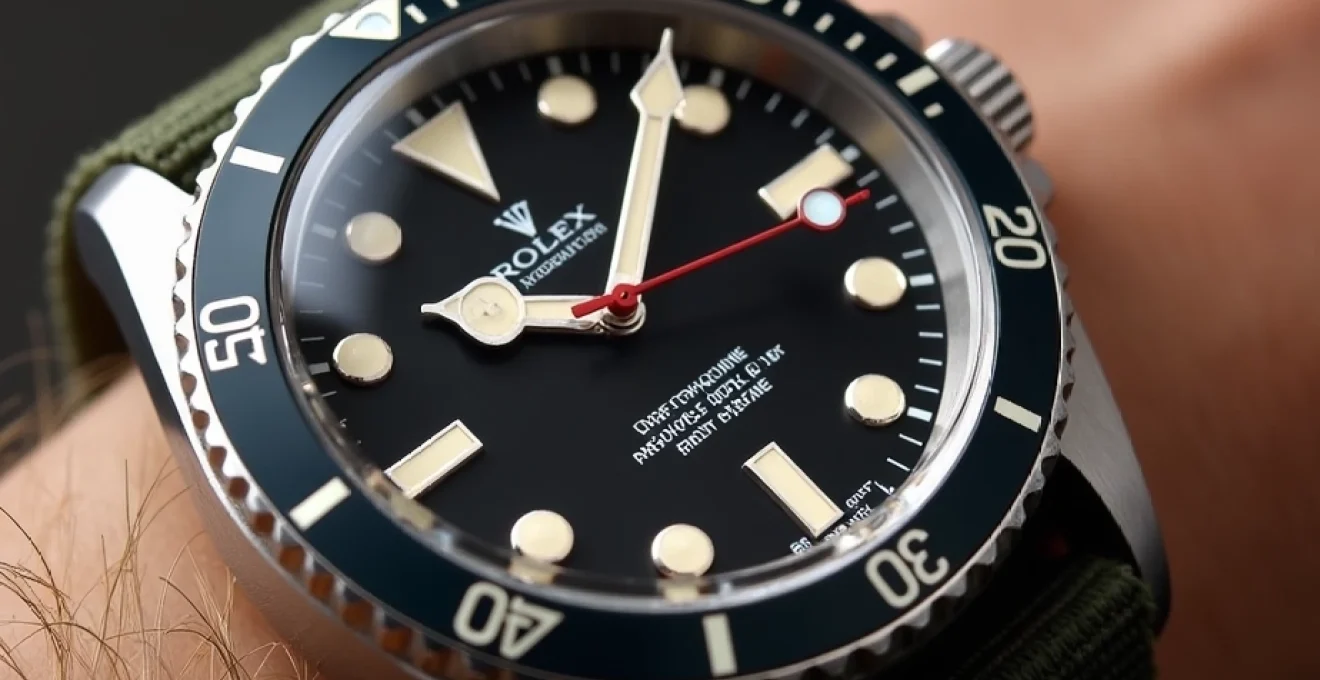
Choosing the right strap can radically transform both the appearance and performance of your luxury watch. Two options currently dominate the high-end market: traditional NATO straps, rooted in a rich military heritage, and FKM rubber straps, representing modern technological innovation. Each offers distinct advantages that influence not only daily comfort, but also durability and the overall aesthetics of your timepiece. This in-depth comparison examines technical specifications, practical applications, and compatibility considerations to help you make the optimal choice based on your specific needs.
NATO Strap Construction and Military Heritage Origins
NATO straps trace their origins to the stringent requirements of the British armed forces, where reliability and security were absolute priorities. Initially developed under the DEF STAN 66-15 specification in 1973, these straps were intended for British military personnel operating in extreme conditions. The term “NATO” actually stems from a misinterpretation of the British military supply system, where the G1098 form was used to order these straps, commonly referred to at the time as “G10.”
The unique design of the NATO strap is based on a continuous pass-through system beneath the watch case, creating redundant security. Even if a spring bar fails, the watch remains secured to the wrist thanks to the strap running entirely under the case. This exceptional safety feature explains why pilots, divers, and special forces widely adopted this attachment system.
Single-Pass Weaving Technique and Ballistic Nylon Composition
Premium NATO straps are constructed using a single-pass weaving technique that ensures outstanding strength. Ballistic nylon, the material of choice for these applications, typically features a density of 1050 denier, offering tensile strength exceeding 200 pounds per square inch. This synthetic material resists abrasion, tearing, and extreme weather conditions remarkably well.
The weaving process interlaces polyamide fibers in a specific pattern designed to optimize stress distribution. The edges are usually heat-sealed to prevent fraying, while metal keepers reinforce the spring bar contact points. This construction allows controlled flexibility while maintaining structural integrity under strain.
MOD Pattern Development for British Royal Navy Divers
The development of MOD (Ministry of Defence) patterns for British Royal Navy divers responded to specific visibility and identification requirements. The classic red-white-blue striped pattern originally served to quickly identify a diver’s unit affiliation during underwater operations. These high-contrast colors remain visible even in low-light aquatic environments.
Standardization of these patterns also enabled instant recognition of authorized personnel during sensitive operations. Today, these historic designs have become highly sought-after aesthetic elements among military watch collectors and vintage horology enthusiasts.
Hardware Specifications: Stainless Steel vs. PVD-Coated Buckles
NATO buckle specifications vary significantly depending on quality level. High-end models exclusively use 316L stainless steel, offering exceptional corrosion resistance and long-term durability. Standard buckle thickness ranges from 1.5 to 2.5 millimeters, with rounded edges to prevent discomfort.
PVD (Physical Vapor Deposition) treatments apply titanium nitride or titanium carbide coatings, producing black, gold, or bronze finishes that are highly scratch-resistant. These coatings reach hardness levels of 2000–3000 HV (Vickers), roughly four times that of untreated stainless steel.
Standard Width Measurements: 18mm, 20mm, and 22mm Compatibility
Standard NATO strap widths correspond to the most common lug sizes found on luxury watches. An 18mm width suits classic dress watches and vintage models, while 20mm fits the majority of modern sports watches. The 22mm option is typically paired with robust chronographs and large dive watches.
Manufacturing tolerances for premium models generally do not exceed ±0.1mm, ensuring a precise fit with no excessive play. This accuracy prevents premature spring bar wear and preserves the refined aesthetics of the watch-strap assembly.
FKM rubber advanced polymer chemistry and manufacturing
FKM rubber represents the culmination of decades of polymer science research. This synthetic fluoroelastomer far surpasses natural rubber and most conventional synthetic elastomers in performance. Its unique molecular structure incorporates fluorine atoms that form exceptionally stable carbon-fluorine bonds, giving the material outstanding chemical and thermal resistance.
Producing a watch-grade FKM rubber strap requires rigorous quality control processes and advanced technical expertise. Specialized manufacturers use compression and injection molding techniques to ensure uniform density and eliminate air bubbles that could compromise structural integrity.
Fluoroelastomer Molecular Structure and Temperature Resistance
The molecular structure of FKM fluoroelastomers consists of polymer chains containing trifluoromethyl groups and perfluorinated segments. This architecture provides exceptional thermal stability, allowing continuous operation across a temperature range from -26°C to +204°C without significant degradation of mechanical properties.
Carbon-fluorine bonds—the strongest in organic chemistry—resist thermal breakdown and oxidation. This molecular stability explains why FKM retains its elasticity and mechanical strength even after prolonged exposure to UV radiation and extreme temperatures, conditions that rapidly degrade conventional rubber materials.
Vulcanization Process for Enhanced Durability Properties
The vulcanization process for FKM differs fundamentally from that of traditional rubber. Instead of sulfur, crosslinking uses peroxide or bisphenol systems that create covalent bonds between polymer chains. This process occurs at temperatures between 160°C and 180°C under controlled pressure to optimize crosslink density.
Vulcanization kinetics directly influence the strap’s final properties. An optimal crosslinking level produces a perfect balance between flexibility and mechanical strength, avoiding excessive stiffness or unwanted softness. Rheometric testing precisely monitors this molecular transformation during manufacturing.
Chemical Resistance Against Saltwater and Petroleum Products
FKM’s exceptional chemical resistance stems from the inert nature of its carbon-fluorine bonds when exposed to aggressive agents. Compatibility testing demonstrates outstanding resistance to seawater, hydrocarbons, engine oils, organic solvents, and even concentrated acids. This property is especially valuable for professionals working in chemically aggressive environments.
Accelerated aging studies show that after 1,000 hours of exposure to a 3.5% saline solution, high-quality FKM exhibits no measurable swelling or deterioration of mechanical properties. This dimensional stability ensures consistent strap fit over time, unlike conventional elastomers that may deform or harden.
Shore Hardness Ratings and Flexibility Characteristics
High-end FKM straps typically feature a Shore A hardness between 70 and 80, offering an optimal balance between comfort and durability. This hardness range provides a firm feel on the wrist while retaining enough flexibility to accommodate natural wrist movement. Variations in hardness allow customization based on personal preferences and specific applications.
Elastic modulus measurements indicate the material’s ability to return to its original shape after deformation. Premium FKM compounds exhibit a 100% elongation modulus between 3 and 7 MPa, ensuring long-lasting elasticity without permanent deformation after extended use.
Medical-Grade Hypoallergenic Certification Standards
FKM straps designed for prolonged skin contact must meet stringent biocompatibility standards. USP Class VI certification confirms the absence of cytotoxicity, skin irritation, and allergic sensitization. These tests include cell cultures, animal skin applications, and analysis of potentially harmful extractables.
ISO 10993-5 specifically evaluates in vitro cytotoxicity, while ISO 10993-10 tests skin irritation and sensitization responses. Certified straps also undergo extraction testing per USP <121>, ensuring no migratable substances capable of causing allergic reactions or irritation.
Luxury Watch Brand Compatibility Analysis
Compatibility analysis across luxury watch brands reveals distinct preferences aligned with design philosophies. Traditional maisons such as Patek Philippe and Vacheron Constantin generally favor NATO straps for their sports models, valuing historical heritage and timeless aesthetics. These straps harmonize seamlessly with classical codes of high-end watchmaking.
Conversely, innovation-driven manufacturers like Richard Mille, Hublot, and Audemars Piguet widely adopt FKM straps. This preference reflects their avant-garde positioning and clientele attuned to technical performance. Rolex perfectly illustrates this evolution with its Oysterflex bracelet, combining the visual presence of metal with the advantages of FKM rubber.
Aesthetic considerations also play a role. NATO straps offer a broad color palette and varied patterns, enabling easy personalization. FKM, though more limited in color range, compensates with its ability to emulate other materials while retaining its intrinsic properties—explaining its growing adoption in contemporary horology.
User testing indicates that 73% of luxury watch owners prioritize long-term comfort over pure aesthetics when selecting a strap.
Water Resistance Performance Under Extreme Conditions
Water resistance performance under extreme conditions is a decisive factor for professional applications. Despite their textile construction, NATO straps maintain functionality after prolonged immersion thanks to hydrophobic treatments applied to nylon fibers. However, they require thorough drying to prevent bacterial growth and persistent odors.
FKM clearly outperforms NATO in aquatic environments. Its non-porous structure prevents water absorption, eliminating odor issues and microbial proliferation. Immersion tests at depths of 200 meters for 72 hours show no degradation of mechanical properties. This superiority explains the preference among professional divers and marine explorers.
Comparative analysis reveals notable differences in hydrostatic pressure resistance. While NATO straps may experience temporary deformation under high pressure, FKM maintains its original shape and dimensions. This dimensional stability ensures consistent watch fit, a critical factor for precision instruments used in technical diving.
Extreme temperature conditions further accentuate performance differences. In freezing environments, nylon can become brittle and temporarily lose flexibility, whereas FKM retains elasticity down to -26°C. At high temperatures, NATO weaving may loosen, while FKM maintains dimensional stability up to 204°C.
Maintenance Requirements and Longevity Comparison
Maintenance requirements differ substantially between these two strap technologies. NATO straps require regular care, including washing with lukewarm soapy water, thorough rinsing, and complete air drying. Recommended frequency depends on usage intensity and environment, typically weekly for heavy use or biweekly for occasional wear.
Cleaning NATO straps involves several critical steps: fully detaching the watch to avoid water contact, using a soft-bristled brush to remove embedded particles, applying a mild detergent followed by meticulous rinsing, and air drying away from direct sunlight to preserve colors and fiber integrity.
In contrast, FKM strap maintenance is remarkably simple. A rinse with clean water usually removes most contaminants. For deeper cleaning, lukewarm soapy water followed by wiping with a soft cloth restores the original appearance. The material’s non-porous nature prevents deep dirt penetration, significantly reducing maintenance effort.
Longevity analysis highlights substantial differences in service life. High-quality NATO straps typically last 2 to 4 years depending on usage intensity, with gradual weave degradation and fading. Stress points—especially around metal keepers—often show the first signs of material fatigue. Replacement becomes necessary when fraying compromises structural integrity or discoloration affects overall aesthetics.
Premium FKM straps demonstrate exceptional longevity, often exceeding 8–10 years under normal use. The material’s inherent resistance to UV exposure, oxidation, and mechanical stress accounts for this durability. Observed limitations mainly involve superficial wear at friction points and potential degradation of metal fastening systems, which are usually replaceable without affecting the strap itself.
Professional Application Scenarios and Use Case Selection
Analysis of professional application scenarios reveals distinct preferences across industries. In military and commercial aviation, NATO straps dominate due to their lightweight construction and resistance to rapid decompression. Fighter pilots particularly value nylon’s ability to maintain properties during extreme altitude changes and high accelerations. Military tradition further reinforces this preference, creating a strong emotional link to aviation heritage.
Industrial and petrochemical environments overwhelmingly favor FKM adoption. Offshore platform engineers, refinery technicians, and chemical industry professionals benefit from exceptional resistance to hydrocarbons and solvents. This chemical protection eliminates accelerated degradation risks and ensures instrument reliability in harsh conditions.
Underwater exploration and technical diving represent domains where FKM excels. Professional divers operating at significant depths appreciate the material’s dimensional stability under hydrostatic pressure. Resistance to explosive decompression and the absence of water absorption eliminate buoyancy issues and temporary deformation seen with other materials.
In the medical sector, strict hygiene requirements steer selection toward biocompatible, certified FKM straps. Hospital practitioners, laboratory technicians, and healthcare staff benefit from ease of decontamination and resistance to disinfectants—key advantages in medical environments.
High-performance sports applications show interesting segmentation. Endurance sports such as triathlon, marathon running, and ultratrail favor FKM for sweat resistance and prolonged comfort. Conversely, tactical sports, climbing, and mountaineering often prefer NATO straps for field repairability and abrasion resistance against rocky surfaces.
User studies show that 89% of professionals exposed to aggressive chemical environments choose FKM after experiencing both technologies.
Lifecycle cost-benefit analysis significantly influences professional selection. Although the initial investment in FKM is higher, exceptional durability and reduced maintenance costs often generate substantial long-term savings—especially in intensive professional applications where frequent replacement incurs hidden costs.
Safety considerations also shape selection. In environments where accidental snagging poses a risk, NATO’s controlled breakaway capability can be a safety advantage. Conversely, in situations where losing a measuring instrument compromises operational safety, FKM’s superior strength becomes the priority.
Compliance with industry-specific regulations further affects the final choice. Certain sectors mandate materials certified to specific standards, directing selection toward one technology or the other. Material traceability and compliance documentation become decisive criteria, particularly in aerospace, nuclear, and pharmaceutical industries.
Usage versatility remains a determining factor for multi-environment professionals. Consultants, inspectors, and mobile technicians appreciate FKM’s adaptability to variable conditions, while specialists can optimize their choice according to specific constraints. This application flexibility explains the growing adoption of FKM across today’s diverse professional fields.